
Reviewed by Thomas Okafor, Peptide Chemist · Last reviewed October 18, 2026
Topical GHK-Cu, listed as copper tripeptide-1 on ingredient labels, is a cosmetic ingredient with decades of skin research and a short list of small human studies to its name. Injectable GHK-Cu is a different story: it’s sold as a freeze-dried research reagent, and no human trial using that route has been published. Same molecule, two very different evidence bases. In September 2026, NPR summed up the change in a headline: the copper peptide trend “has gone from creams to injections ahead of the science.” This guide lays out what that science covers for each route, labeled by study type. Our Medical Disclaimer applies here: research-grade GHK-Cu is a lab-only reagent that no regulator has approved for people.
GHK-Cu Injectable vs Topical at a Glance
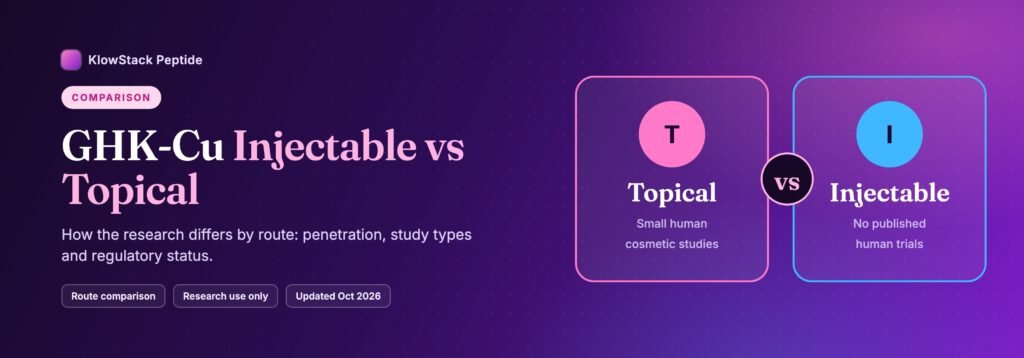
Topical GHK-Cu comes in cosmetic serums and creams, acts mainly in the outer skin layers and has small human cosmetic studies. Injectable GHK-Cu is sold as a lyophilized research vial, would reach the bloodstream, and has no published human trials. Their regulatory categories differ too.
| Topical (serum or cream) | Injectable (research vial) | |
|---|---|---|
| Form sold | Cosmetic serum, cream or lotion | Freeze-dried powder in a sealed vial |
| Where it acts | Outer skin layers, with some reaching the dermis | Throughout the body via the bloodstream |
| Human evidence | Small cosmetic studies, 8 to 12 weeks | None published |
| Main study types | 👤 Human cosmetic; 🧪 lab; 🐭 animal | 🧪 Lab; 🐭 animal by other delivery routes |
| Registered human trials | A phase 2 topical gel study, recruiting | None found on ClinicalTrials.gov |
| Regulatory category | Cosmetic ingredient | Unapproved research reagent |
The table has no amount column on purpose. Topical studies used cosmetic formulations of varying strength, and no injectable amount has been studied in people.
What Topical GHK-Cu Is: Serums and Creams
Topical GHK-Cu is the copper-bound tripeptide glycine-histidine-lysine, added to skincare under the ingredient name copper tripeptide-1. GHK-Cu serum and GHK-Cu cream are the two most common formats, and both are regulated as cosmetics when sold for appearance. Its cosmetic career began after chemist Loren Pickart isolated GHK from human plasma in the early 1970s. Topical copper peptide products have been sold for decades, and NPR noted that GHK-Cu, while not an approved drug, “does have considerable scientific research behind it.” Dr. David Goldberg, a clinical professor of dermatology at Mount Sinai’s Icahn School of Medicine, told NPR that for topical copper peptides, “the science behind this is very solid.” The blue tint many serums carry comes straight from the copper. Our GHK-Cu guide covers the molecule’s history.
How Far Does GHK-Cu Get Into Skin?
🧪 Further than many people assume, at least for its copper. In in vitro experiments by Hostynek, Dreher and Maibach, a 0.68% water-based GHK-Cu solution was applied to donated human skin in diffusion cells for 48 hours. Copper crossed the full-thickness skin sample at about 136 micrograms per square centimeter, with roughly 82 to 97 more retained inside the tissue. One detail changes how to read that result: the team measured copper alone, and intact peptide wasn’t tracked. Whether GHK stayed attached on the way through is unknown. A companion paper by the same team, published months earlier, reported nearly identical penetration figures and described the work as delivering copper for anti-inflammatory research, so the question they asked was about the metal more than the peptide. GHK-Cu is also a charged, water-loving molecule, two traits that usually slow passage through the skin’s oily outer barrier.
Serum vs Cream
The difference is the vehicle. Serums are usually water-based and light, while creams are emulsions of water and oils that stay longer on the surface. Vehicle, pH and other ingredients all influence how much peptide reaches deeper layers, and published studies rarely compare formats head to head.
What Injectable GHK-Cu Is
Injectable GHK-Cu is research-grade peptide powder sealed in a vial for laboratory use. It isn’t an approved drug in the US, and it hasn’t been tested in people by any systemic route. Systemic exposure raises research questions that skin studies can’t answer. A peptide that reaches the bloodstream meets enzymes, kidneys, the liver and the immune system, none of which a skin cream encounters in any meaningful way. That’s why topical findings can’t stand in for systemic ones. Copper handling becomes a whole-body question, and immune reactions to peptide impurities become possible. A 2026 evidence review in Pharmaceutics adds a chemistry wrinkle: formulation papers seldom say how much copper stays attached to GHK and how much drifts loose, and loose copper acts differently in living tissue. A KlowStack guide to oral vs injectable peptides, coming soon, explains the broader route question. Why hasn’t anyone run the human trials? NPR’s reporting points to economics. GHK is a natural, decades-old molecule that’s hard to patent, and Warren Ladiges, a University of Washington professor who has studied the peptide for years, told NPR that bringing it through drug development would require huge investment, meaning “it’s probably never going to get FDA approval.” Dermatologist David Goldberg suggested injection might offer added benefits, partly because the molecule doesn’t easily penetrate deeper into skin from a cream, while adding that he wants to see human studies done first.
What the Research Shows by Route
The research divides sharply by route. Topical GHK-Cu has small human cosmetic studies plus lab and animal work. Lab and animal studies explored other delivery methods in models of wound repair and inflammation. No published human trial has tested injectable GHK-Cu.
Topical: Small Human Cosmetic Studies
👤 The human trials are gathered in a 2018 review by GHK’s discoverer, Loren Pickart, and Anna Margolina:
- Facial cream. Seventy-one women used a GHK-Cu facial cream for 12 weeks, and their skin grew denser and thicker, with fewer fine lines.
- Eye area. Forty-one women tried a GHK-Cu eye cream for 12 weeks, and it outscored both a placebo and a vitamin K formula.
- Thigh-skin collagen. Collagen rose in 70% of the GHK-Cu group, while vitamin C reached 50% and retinoic acid 40%.
Each was small and brief, and several had ties to companies developing the ingredient. The 2026 Pharmaceutics review judged the clinical record thin and pointed to a 13-person post-laser study without an objective benefit, while still seeing real promise in the underlying biology.
Lab and Animal Studies
🧪 In cultured human fibroblasts, GHK-Cu raised collagen, elastin and glycosaminoglycan production. Gene-expression database work by Pickart’s group linked GHK to changes in thousands of genes, a computational signal that hasn’t been confirmed in tissue. 🐭 In rodents, GHK-Cu has been studied in wound models and in a 2016 mouse lung-injury study, where it reduced inflammatory markers. Animal delivery methods are chosen for the experiment, and they say nothing about human use.
Injectable Route: What Is Missing
We searched ClinicalTrials.gov on October 18, 2026 and found three registered GHK-Cu studies: a recruiting phase 2 trial of a topical GHK-Cu gel for acute skin wounds (NCT07437586), a not-yet-recruiting study of a patch’s effect on circulating GHK levels (NCT07706361) and a completed facial skincare study. None tests injected GHK-Cu. PubMed holds no published human injectable trial either.
Evidence Depth by Route
| Study type | Topical | Injectable or systemic |
|---|---|---|
| 🧪 In vitro (cells, skin samples) | Published | Published (cell work applies to both) |
| 🐭 Animal | Published | Limited, using research delivery methods |
| 👤 Human cosmetic | Limited: small trials | Not applicable |
| 👤 Human clinical | One phase 2 gel trial recruiting | None found |
[image] Reading down each column shows where claims can and can’t lean. A statement about injectable GHK-Cu that cites “clinical studies” is almost always borrowing from the topical column. When reading any peptide study, the methods section tells you the route, model and sample size, which together decide how far a finding can travel. One registered study could start filling the right-hand column. NCT07706361, listed as not yet recruiting, plans to measure circulating GHK and GHK-Cu levels in people using a skin patch. If it runs, it would produce some of the first human data on how much GHK reaches the bloodstream from outside the body, a basic measurement the injectable debate has never had.
Reported Side Effects by Route
Topical copper peptide side effects described in user reports include redness, stinging and irritation, though published cosmetic studies didn’t record adverse events systematically. For injectable GHK-Cu, no human trial safety data exist. The FDA and clinicians interviewed by NPR point to copper load and immune reactions as open questions. Topical. 💬 User reports describe irritation, redness and dryness, and people with copper sensitivity are a natural concern. 👤 The cosmetic trials focused on skin measures, so their published summaries say little about reactions. Injectable. 🏛️ The FDA’s compounding risk page calls the human record for injectable GHK-Cu thin and warns that clumped peptide molecules and impurities could provoke an immune response. In the NPR report, experts named copper overload and a dangerous immune reaction as potential injection risks, and dermatologist Marisa Garshick pointed to products from unregulated suppliers that come with no assurance of quality. For perspective on the copper itself, about 15.8% of GHK-Cu’s mass is copper. A dedicated GHK-Cu side effects guide, organized by study type, is in the works.
Regulatory Status: Cosmetic Ingredient vs Research Reagent
As of October 18, 2026, topical GHK-Cu is sold as a cosmetic ingredient, regulated by intended use. Injectable GHK-Cu isn’t FDA-approved, isn’t on the 503A Bulks List for compounding and is scheduled to come before FDA’s compounding advisory committee by the end of February 2027. Topical. Per the FDA’s cosmetic vs drug guidance, what a product is meant to do determines whether it counts as a cosmetic, a drug or both. Appearance claims keep a serum in the cosmetic category. Injectable. In its April 22, 2026 update, the FDA’s compounding risk page moved injectable GHK-Cu out of Category 2 and into the list of withdrawn nominations. Leaving Category 2 didn’t open the door to compounding: pharmacies can’t compound it for injection unless it joins the bulks list of permitted ingredients, a point NPR also made. 2026 policy. A temporary policy covering compounded access to certain peptides reached the White House budget office on October 15, 2026, per the Associated Press. Its text and its list of peptides aren’t public yet.
FAQs
What is the difference between injectable and topical GHK-Cu?
The molecule is the same, but the route changes everything else. Topical GHK-Cu is a cosmetic ingredient applied to skin, with small human studies. Injectable GHK-Cu is a research reagent that would reach the bloodstream, and it has no published human trials.
What do topical GHK-Cu studies measure?
Skin density and thickness, fine lines, wrinkle depth and collagen, usually over 8 to 12 weeks in a few dozen participants. Lab studies add collagen and elastin production by skin cells, and penetration studies measure how much copper crosses skin samples.
Is GHK-Cu serum the same compound as research-grade GHK-Cu?
Chemically, yes: both contain the glycine-histidine-lysine copper complex. Serums dilute it in a cosmetic base with other ingredients, while research-grade GHK-Cu is concentrated powder intended for laboratory work, with purity confirmed on a certificate of analysis.
Has injectable GHK-Cu been studied in humans?
No. Our October 18, 2026 searches of PubMed and ClinicalTrials.gov turned up no human trial of injectable GHK-Cu, published or registered. Registered human studies involve a topical gel and a patch.
Is injectable GHK-Cu FDA-approved?
No. The FDA hasn’t approved it, and as of October 2026 it isn’t a permitted bulk ingredient for compounding. An advisory review is expected by the end of February 2027.
Why is GHK-Cu blue?
The copper does it. Copper(II) soaks up light from the red-orange end of the spectrum and leaves blue to bounce back, so GHK-Cu powder and many copper peptide serums look blue or blue-violet. The color confirms copper is present, though it can’t confirm purity.
Conclusion
Topical and injectable GHK-Cu share a molecule and little else. The topical route has small human cosmetic studies and lab work behind it, while the injectable route has animal data from research delivery methods and no published human trials. Our GHK-Cu hub and GHK-Cu skin research page go deeper, and our GHK-Cu benefits page and KLOW stack guide show where the peptide fits in blends.
Disclaimer: Research-grade GHK-Cu is sold for laboratory research use only and isn’t approved for human or veterinary use or consumption. This page summarizes published research and isn’t medical advice. Read our Medical Disclaimer and Editorial Policy. Last reviewed October 18, 2026.
Sources
- [Review: in vitro, animal, human cosmetic] Pickart L, Margolina A. 2018. Regenerative and protective actions of the GHK-Cu peptide in the light of the new gene data. International Journal of Molecular Sciences. doi:10.3390/ijms19071987
- [Review] Pickart L, Vasquez-Soltero JM, Margolina A. 2015. GHK peptide as a natural modulator of multiple cellular pathways in skin regeneration. BioMed Research International. PMC4508379
- [In vitro skin penetration] Hostynek JJ, Dreher F, Maibach HI. 2011. Human skin penetration of a copper tripeptide in vitro as a function of skin layer. Inflammation Research. doi:10.1007/s00011-010-0238-9
- [Review] Mateescu DM, et al. 2026. GHK-Cu as a bioactive metallopeptide and drug-delivery cargo. Pharmaceutics. doi:10.3390/pharmaceutics18091077
- [Animal + in vitro] Park JR, et al. 2016. The tri-peptide GHK-Cu complex ameliorates lipopolysaccharide-induced acute lung injury in mice. Oncotarget. doi:10.18632/oncotarget.11168
- [Trial registry] Topical GHK-Cu Gel for Acute Skin Wound Healing (NCT07437586), ClinicalTrials.gov
- [Regulatory] Certain Bulk Drug Substances for Use in Compounding that May Present Significant Safety Risks, FDA, current as of April 22, 2026
- [Regulatory] Is It a Cosmetic, a Drug, or Both? (Or Is It Soap?), FDA
- [News] Stone W. The copper peptide trend has gone from creams to injections, ahead of the science, NPR (via KPBS), September 7, 2026
- [News] Trump administration advances plan for peptide drugs favored by RFK Jr., Associated Press, October 15, 2026