
Reviewed by Thomas Okafor, Peptide Chemist · Last reviewed October 19, 2026
BPC-157 Gut Research at a Glance
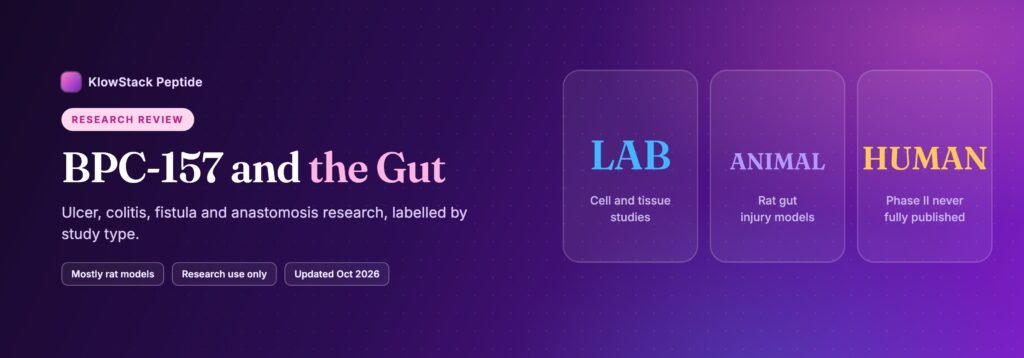
The gut is where BPC-157’s story starts, and it’s still where the research is densest. That makes “bpc-157 gut” a good test case for a question that runs through all peptide research: how far can rat findings travel? This guide labels each result 🧪 lab, 🐭 animal or 👤 human, so the answer is visible line by line. Like every compound we cover, BPC-157 is a research-use-only reagent with no approval for people, per our Medical Disclaimer.
Where BPC-157 Comes From and Why Gut Research Came First
BPC-157 is a 15-amino-acid fragment of a larger protein called BPC, which Croatian researchers isolated from human gastric juice in the early 1990s. Because it came from the stomach and stayed stable in gastric juice in lab tests, its first research focused on protecting the stomach lining. In a 1993 paper, the Zagreb team led by pharmacologist Predrag Sikiric described BPC, a gastric juice protein of about 40,000 daltons, and the 15-amino-acid fragment they believed carried its activity. They placed it within a “stomach-stress-organoprotection” idea: the stomach, under stress, might produce protective signals for other organs. That’s why researchers often call it a “stable gastric pentadecapeptide.” 🧪 Romanian reviewers writing in Pharmaceutics in 2026 confirm it shows “unusual stability in gastric juice,” a trait most peptides lack. For the full backstory, start with our What Is BPC-157? guide.
Proposed Mechanisms in Gut Models
Gut researchers propose four overlapping mechanisms for BPC-157: protecting stomach-lining cells, supporting blood vessels through nitric oxide signaling, stabilizing the gut barrier, and influencing gut-brain signaling. Each comes from rodent or cell work, and most of it from one research group.
Cytoprotection and the Gastric Lining (Animal)
🐭 “Cytoprotection” describes the stomach’s ability to defend its own lining against harsh substances. A 2020 review in Gut and Liver by Sikiric, Hahm and colleagues argues BPC-157 is “continuously present in the gastric mucosa and gastric juice” and protects the lining against alcohol and anti-inflammatory drugs in rodent models.
Blood Vessels and the NO System (Lab and Animal)
🧪 and 🐭 BPC-157 interacts with the nitric oxide (NO) system, which controls blood flow, in many of Sikiric’s rat studies. 🧪 Separately, Hsieh and colleagues showed in 2017 that it activates VEGFR2, a receptor for new blood vessel growth. The Gut and Liver review describes rats forming bypass vessels around blocked ones.
Gut-Barrier Proteins (Lab and Animal)
🐭 A 2020 review by Park, Lee, Sikiric and Hahm in Current Pharmaceutical Design discussed BPC-157 in models of increased intestinal permeability after anti-inflammatory drug exposure, describing it “for the first time” as a possible counter to drug-induced barrier damage.
Gut-Brain Axis Research (Rodent)
🐭 A 2023 review in Pharmaceuticals by Sikiric’s group proposed that BPC-157 may influence both brain-to-gut and gut-to-brain signaling, based on rodent studies. It’s a hypothesis-driven summary from the originating lab.
BPC-157 in Ulcer Research
In ulcer research, BPC-157 has been tested in rat models of stomach and duodenal lesions caused by alcohol, anti-inflammatory drugs such as indomethacin, and cysteamine. Rats given BPC-157 showed fewer or smaller lesions in these studies. No human ulcer study has been published. The rat ulcer models work by giving animals a substance known to damage the gut lining, then measuring the damage under a microscope or by eye:
- 🐭 Alcohol lesions. Concentrated ethanol damages the stomach lining within minutes, and the 2020 Gut and Liver review summarizes BPC-157’s protective effect across these studies.
- 🐭 Anti-inflammatory drug lesions. Indomethacin and diclofenac cause stomach and intestinal injury. A 1999 study by Sikiric and colleagues used indomethacin to build a new rat model of “adaptive cytoprotection.”
- 🐭 Cysteamine duodenal ulcers. A classic model dating to Hans Selye and Sandor Szabo, revisited in a 2023 review linking BPC-157 to dopamine signaling in the stomach.
These rat models are standard in ulcer pharmacology, and many approved stomach drugs were tested in them first. They show what happens to an acute injury over hours or days in a rodent. They can’t show what BPC-157 would do in a person with a chronic ulcer, which involves factors like the bacterium H. pylori that these models leave out.
BPC-157 in Colitis and IBD Research
Rat models of colitis, internal fistulas and surgical bowel joins make up BPC-157’s IBD research, with reports of reduced damage. An enema formulation called PL 14736 reached phase II trials in ulcerative colitis in the 2000s, but full results never appeared in peer-reviewed journals. 🐭 Colitis. One of the earliest colitis studies came from outside Zagreb. Researchers at Warner-Lambert’s research division in Michigan published a 1995 study in which BPC-157, given into the abdominal cavity, reduced chemically induced colon damage in rats in a dose-dependent way. Delivered directly into the colon at one tested amount, it didn’t significantly reduce the damage. The Zagreb group later reported effects in cysteamine colitis and colon-to-colon joins in a 2013 study by Klicek and colleagues. 🐭 Fistulas and anastomoses. A fistula is an abnormal tunnel between organs, a serious complication in Crohn’s disease. Rat studies tested BPC-157 in colon-to-bladder fistulas, and a 2024 review collected its studies in anastomoses, the surgical joins between bowel segments. 👤 The ulcerative colitis trial history. In a 2012 review, Sikiric’s group wrote that PL 14736 had been “so far only tested in clinical phase II” for inflammatory bowel disease. Those trial results were never published in full in a peer-reviewed journal. The 2026 Pharmaceutics review states that BPC-157 has “no completed Phase II clinical trial” in the record, and that all clinical data come from fewer than 30 people across three uncontrolled pilot studies, none of them in the gut. A related tripeptide, KPV, has its own colitis research in mice. It’s covered on our KPV gut and IBD research page.
What About IBS? (Research Status)
No human study of BPC-157 in irritable bowel syndrome has been published, and a PubMed search on October 19, 2026 found no animal studies using IBS models either. Claims linking BPC-157 to IBS extrapolate from ulcer and colitis research, which involve different processes. IBS and inflammatory bowel disease sound alike but differ fundamentally. IBD, which includes ulcerative colitis and Crohn’s disease, involves visible inflammation and tissue damage that can be scored under a microscope, which is what rat colitis models mimic. IBS involves symptoms like pain and changes in bowel habits without that visible damage, and its research models focus on gut sensitivity, motility and the gut-brain connection. BPC-157’s research falls almost entirely on the IBD-like side. The gut-brain review offers a theoretical bridge, and no study has tested BPC-157 in a visceral-sensitivity or motility model of IBS. Pages that list IBS among BPC-157’s research areas are extrapolating beyond what’s been measured.
What About “Leaky Gut”? (Research Status)
“Leaky gut” is a popular term for increased intestinal permeability, a measurable property in research where the gut lining lets more molecules pass. BPC-157 has been discussed in animal and review literature on drug-induced permeability. No human study has measured BPC-157’s effect on gut permeability. Intestinal permeability is a real research concept. Scientists measure it with sugar-absorption tests, tight-junction proteins (the seals between gut cells) or electrical resistance across cell layers. Increased permeability appears in several conditions, though whether it causes symptoms or follows from them is still debated, and “leaky gut syndrome” isn’t a recognized medical diagnosis. 🐭 The main BPC-157 source here is the 2020 Park review, which focused on permeability after anti-inflammatory drug exposure in models. That’s one specific type of injury, studied mostly in rodents, and it doesn’t translate into evidence about people who describe themselves as having leaky gut.
Evidence Table: Model, Study Type, Main Finding, Limits
| Area | Model | Study type | Reported finding | Limits | Citation |
|---|---|---|---|---|---|
| Stomach lesions | Alcohol, NSAIDs | 🐭 Rat | Fewer lesions | Acute injury only | Sikiric et al., 2020 review |
| Ulcer models | Indomethacin | 🐭 Rat | Adaptive cytoprotection model | Originating lab | Sikiric et al., 1999 |
| Colitis | TNBS colitis | 🐭 Rat | Less colon damage by one route | Single dose by colon route | Veljaca et al., 1995 |
| Colitis and anastomosis | Cysteamine colitis, colon joins | 🐭 Rat | Improved tissue scores | Originating lab | Klicek et al., 2013 |
| Fistula | Colovesical fistula | 🐭 Rat | Fistula closure reported | Originating lab | Grgic et al., 2016 |
| Gut barrier | NSAID permeability models | 🐭 Review of rodent work | Barrier stabilization proposed | Review only | Park et al., 2020 |
| Gut-brain | Rodent models | 🐭 Review | Two-way signaling proposed | Hypothesis | Sikiric et al., 2023 |
| Ulcerative colitis | PL 14736 enema | 👤 Phase II, unpublished | Results not in peer review | No published data | Sikiric et al., 2012 |
[image]
Limits of the Evidence
- One group dominates. Most gut studies come from Sikiric’s lab in Zagreb, with the 1995 Warner-Lambert study a notable exception.
- Rats, short timelines. Acute chemical injuries over hours or days are quite different from chronic human gut disease.
- No published human efficacy data for any gut condition.
- A blood-level puzzle. The 2026 Pharmaceutics review notes a plasma half-life under 30 minutes in animals, alongside effects that last hours to days, which researchers haven’t explained.
- Expert view. Those reviewers called BPC-157 “a compelling but pharmaceutically underdeveloped profile,” pointing to missing formulation and dosing science as the main barrier.
Safety data are summarized on our BPC-157 side effects page, and other research areas on our BPC-157 benefits page.
Regulatory Status (Dated)
BPC-157 has no FDA approval as of October 19, 2026. In its compounding safety-risk list, revised April 22, 2026, the FDA moved BPC-157 to the withdrawn-nominations table and noted it doesn’t have enough information to judge whether the peptide would harm people. An advisory panel backed adding it to the compounding bulks list in July 2026, per AJMC. The Associated Press reported that a temporary compounding policy, said to cover BPC-157, went to the White House in mid-October 2026. In sport, BPC-157 is one of the few peptides named outright on the WADA Prohibited List, in section S0. Our peptide legality guide explains the categories.
FAQ
What gut models has BPC-157 been studied in?
Rat models of stomach and duodenal lesions from alcohol, anti-inflammatory drugs and cysteamine, chemically induced colitis, fistulas between organs, surgical bowel joins and drug-induced gut permeability. Nearly all are rodent studies.
Has BPC-157 been tested in humans for gut conditions?
An enema formulation, PL 14736, reportedly reached phase II trials in ulcerative colitis in the 2000s, but the results were never fully published. No published human study of BPC-157 for any gut condition exists as of October 19, 2026.
Is there research on BPC-157 and IBS or leaky gut?
No human studies exist for either. For IBS, we found no animal studies using IBS models. For leaky gut, rodent and review literature discusses BPC-157 in drug-induced permeability models only.
Why was BPC-157 first studied in the stomach?
It’s a piece of a protein found in human gastric juice, and it stays stable in gastric juice in lab tests. Its discoverers proposed that the stomach produces protective signals, so stomach-lining protection was the natural starting point.
How does BPC-157 gut research compare with KPV gut research?
BPC-157’s gut work centers on rat injury models like ulcers, fistulas and colitis, mostly from one lab. KPV’s centers on mouse colitis and cell studies of inflammatory signaling. Neither has published human gut data. A KPV vs BPC-157 comparison is coming, and our anti-inflammatory signaling hub already covers both.
Bottom Line + Disclaimer
BPC-157’s gut research is extensive in rats and thin everywhere else. Ulcer and colitis models dominate, IBS and leaky gut have no direct evidence, and the one human trial program never published its results.
Sources
- [Review: animal] Sikirić P, et al. 1993. A new gastric juice peptide, BPC: an overview of the stomach-stress-organoprotection hypothesis and beneficial effects of BPC. Journal of Physiology Paris. PubMed
- [Review] Mateescu DM, et al. 2026. BPC-157 as an investigational peptide therapeutic: biopharmaceutical challenges, formulation strategies, and translational development barriers. Pharmaceutics. doi:10.3390/pharmaceutics18050625
- [Review: animal] Sikiric P, Hahm KB, et al. 2020. Stable gastric pentadecapeptide BPC 157, Robert’s stomach cytoprotection/adaptive cytoprotection/organoprotection, and Selye’s stress coping response. Gut and Liver. doi:10.5009/gnl18490
- [In vitro + animal] Hsieh MJ, et al. 2017. Therapeutic potential of pro-angiogenic BPC157 is associated with VEGFR2 activation and up-regulation. Journal of Molecular Medicine. doi:10.1007/s00109-016-1488-y
- [Review] Park JM, Lee HJ, Sikiric P, Hahm KB. 2020. BPC 157 rescued NSAID-cytotoxicity via stabilizing intestinal permeability and enhancing cytoprotection. Current Pharmaceutical Design. doi:10.2174/1381612826666200523180301
- [Review: animal] Sikiric P, et al. 2023. Stable gastric pentadecapeptide BPC 157 may recover brain-gut axis and gut-brain axis function. Pharmaceuticals. doi:10.3390/ph16050676
- [Animal] Sikirić P, et al. 1999. New model of cytoprotection/adaptive cytoprotection in rats: endogenous small irritants, antiulcer agents and indomethacin. European Journal of Pharmacology. PubMed
- [Review: animal] Sikiric P, et al. 2023. From Selye’s and Szabo’s cysteamine-duodenal ulcer in rats to dopamine in the stomach. Pharmaceuticals. doi:10.3390/ph16121699
- [Animal] Veljaca M, et al. 1995. BPC-15 reduces trinitrobenzene sulfonic acid-induced colonic damage in rats. Journal of Pharmacology and Experimental Therapeutics. PubMed
- [Animal] Klicek R, et al. 2013. Stable gastric pentadecapeptide BPC 157 heals cysteamine-colitis and colon-colon-anastomosis. Journal of Physiology and Pharmacology. PubMed
- [Animal] Grgic T, et al. 2016. Stable gastric pentadecapeptide BPC 157 heals rat colovesical fistula. European Journal of Pharmacology. doi:10.1016/j.ejphar.2016.02.038
- [Review: animal] Bajramagic S, et al. 2024. Stable gastric pentadecapeptide BPC 157 and intestinal anastomoses therapy in rats: a review. Pharmaceuticals. doi:10.3390/ph17081081
- [Review] Sikiric P, et al. 2012. Focus on ulcerative colitis: stable gastric pentadecapeptide BPC 157. Current Medicinal Chemistry. doi:10.2174/092986712803414015
- [Regulatory] Certain Bulk Drug Substances for Use in Compounding that May Present Significant Safety Risks, FDA, current as of April 22, 2026
- [News] FDA Panel Backs 6 Peptides for Compounding, AJMC
- [News] Trump administration advances plan for peptide drugs favored by RFK Jr., Associated Press, October 15, 2026
- [Regulatory] The Prohibited List, World Anti-Doping Agency