
Regulatory Watch · Reviewed by Thomas Okafor, PhD · Published November 4, 2026
A federal policy published on a Friday rarely stays quiet past the weekend, and this one didn’t. Within days of HHS releasing its enforcement discretion policy for six peptides, drug-safety advocates, a former FDA official, state regulators and local clinicians had all weighed in. The hhs peptide policy itself hasn’t changed since our October 31 report. What’s new is the shape of the debate around it, and a short window for anyone who wants their view on the record.
What critics are saying
The strongest objections came from groups that have opposed peptide compounding all year.
- Partnership for Safe Medicines. Executive director Shabbir Safdar told NBC News the policy would expose Americans to “untested, dangerous substances” [1]. In a November 2 update, the group repeated his comment that the decision “leaves Americans in a gray area as to whether peptides are safe or not” [2]. Days before the policy appeared, the same group filed a citizen petition asking FDA “to stop the compounding of certain peptides,” arguing it is illegal and carries safety risks [3].
- Center for Science in the Public Interest. Dr. Peter Lurie, a former FDA official who now leads the group, said the agency was “turning a blind eye” to widen access to unproven drugs [1].
- FDA’s own reviewers. NBC noted that FDA scientists had concluded there wasn’t enough data to show the peptides are safe and effective, before the advisory committee narrowly voted to recommend them in July [1].
What supporters and HHS say
HHS presents the policy as a move toward safety. A department spokesperson told NBC that “HHS is working to put prevention and patient safety at the center of health care” [1]. Health Secretary Robert F. Kennedy Jr. and other supporters argue that licensed compounding, with identity and purity checks and mandatory adverse event reporting, gives people an alternative to the gray market for products labeled “research use only” [1].
That argument rests on the policy’s conditions, which we listed in full last week: bulk material from FDA-registered facilities with a valid certificate of analysis, single-ingredient products, and reporting of serious side effects to MedWatch.
Why states may decide how much changes
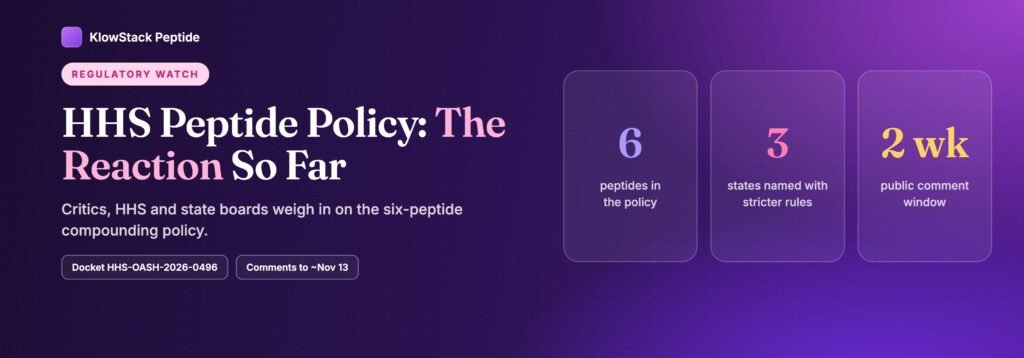
Federal enforcement discretion doesn’t override state law. Compounding pharmacies are licensed and inspected by state pharmacy boards, and Politico reported that access may change little in states with stricter rules, naming Alabama, Mississippi and Ohio, as summarized by the Partnership for Safe Medicines [2]. A pharmacy in one state may be able to compound BPC-157 under the policy while a pharmacy across the border can’t. How federal and state rules interact is laid out in our explainer, are peptides legal.
What clinicians are telling patients
Away from Washington, local health workers describe rising interest and confusion. Jennifer Truman, an advanced practice registered nurse at Norton Healthcare in Louisville, told Spectrum News 1 that “there’s a lot of misinformation out there,” pointing to harms such as bowel obstructions needing hospital care and acute kidney injury among people using weight-loss injectables without supervision [4]. The report cited research valuing the peptide industry at more than $160 billion this year.
The view from abroad
Two developments outside the US are shaping the same conversation. On October 29, ABC News reported that Victorian coroner David Ryan found an actor’s death was “triggered by” his use of two unapproved peptides, CJC-1295 and Ipamorelin, which he had taken in amounts above the prescribed dose [5]. The coroner recommended that Australia’s Therapeutic Goods Administration review the peptides and “consider whether further restrictions ought to be imposed on their use.” In Malaysia, health authorities reported seizing more than 700 units of retatrutide and semaglutide in raids since September 2025 [2]. Neither case involves the six US peptides, yet both are being cited by critics of looser rules.
How the comment period works
The Federal Register notice published October 30 opened a two-week window for written comments [6].
| Detail | What to know |
|---|---|
| Document | Draft enforcement discretion policy for 503A compounding of six peptides |
| Docket | HHS-OASH-2026-0496 |
| Federal Register document | 2026-22192 |
| Window | Two weeks from October 30, closing around November 13, 2026 |
| Where | Regulations.gov, by docket number |
HHS has said comments may supply evidence FDA can weigh during formal rulemaking on the 503A Bulks List. Comments are public, so anything submitted can be read by others.
What to watch next
- Revisions after November 13, if HHS changes the conditions or the peptide list.
- State board statements on whether they’ll allow compounding of the six peptides.
- FDA’s response to the citizen petition, which has no fixed deadline.
- Australia’s regulator, and whether it acts on the coroner’s recommendation.
We report on regulation to keep readers informed; nothing here is legal or medical advice. Outside approved prescription use, the peptides named in this story are research materials.
Sources
- Lovelace B Jr. “RFK Jr. takes shortcut to make peptides widely available,” NBC News, October 28, 2026. https://www.nbcnews.com/health/health-news/rfk-jr-takes-shortcut-make-peptides-widely-available-rcna606133
- Partnership for Safe Medicines. “November 2, 2026” news update, November 2, 2026. https://www.safemedicines.org/2026/11/november-2-2026.html
- RAPS Regulatory Focus. “This week at FDA: Peptide dispute, clinical trial legislation, and more,” October 23, 2026. https://www.raps.org/resource/this-week-at-fda-peptide-dispute-clinical-trial-legislation-and-more.html
- Spectrum News 1. “Peptide demand grows as health professionals warn against misuse,” November 2, 2026. https://spectrumnews1.com/ky/louisville/news/2026/11/02/peptide-use-grows-as-experts-urge-medical-guidance
- ABC News. Coroner’s findings on the death of Richard Norton, October 29, 2026. https://www.abc.net.au/news/2026-10-29/victoria-peptide-death-coroners-report-richard-norton/107320590
- Department of Health and Human Services. Notice of availability, Docket No. HHS-OASH-2026-0496, Federal Register document 2026-22192, October 30, 2026. https://www.federalregister.gov/d/2026-22192