
Research Roundup · Reviewed by Thomas Okafor, PhD · Published November 4, 2026
One small copper-binding peptide, two very different repair problems, and one large combination drug waiting on a regulator: this week’s picks come from nerve engineering, bone engineering and obesity medicine.
1. GHK in a spinal cord scaffold, tested in minipigs
Lab study plus pilot animal study
Paper: Zoughaib M, Lavrov IA, Dayob K, et al. “Peptide-Activated ECM-Mimicking Channeled OPF Cryogel Scaffold for Spinal Cord Lesion Bridging: Development and Pilot Study in Minipigs.” Macromolecular Bioscience, October 2026 [1].
What they looked at: A team at Kazan Federal University in Russia, with a co-author from the Mayo Clinic, built a spongy gel scaffold with tiny channels meant to bridge a completely severed spinal cord. They coated it with four short signaling peptides, including GHK, the copper-binding tripeptide better known as GHK-Cu, to mimic the natural support matrix around cells.
What they reported: 🧪 In the dish, the four-peptide coating helped nerve cells grow and develop their branching shape. 🐭 In a pilot study, the scaffold was implanted in minipigs after a spinal cord cut, where it stayed intact, integrated with the tissue and let host cells move in.
Where it stops: The pilot reports how the scaffold held up after implantation, without data on recovery of movement. GHK was one of four peptides, so its own contribution can’t be separated. The authors describe their work as a foundation for longer studies.
2. GHK-Cu on injectable bone scaffolds
Lab study (cell culture)
Paper: Su J, Zhang Y, Cao Y, et al. “Hierarchical regulation and mechanism of ‘open-hollow-fibrous network’ structures: Osteogenic-angiogenic coupling responses of poly(γ-benzyl-L-glutamate) microspheres.” Biomaterials Advances, November 2026 issue, published online June 15 [2].
What they looked at: Researchers at Shanghai University and Fudan University built hollow, fibrous microspheres about 0.37 mm across from a synthetic polypeptide, then chemically attached GHK-Cu to them. The goal is an injectable filler for irregular bone defects.
What they reported: Compared with uncoated microspheres, the GHK-Cu version raised bone-related gene activity in bone marrow stem cells, with Runx2, OPN and OCN up 1.61-, 3.53- and 2.29-fold, and boosted blood-vessel tube formation in a dish.
Where it stops: Everything here happened in cell culture, with no animal or human testing reported in the abstract. As in the spinal cord study, GHK-Cu acts as one part of an engineered material, so the findings say little about GHK-Cu alone. For the skin side of the research, see GHK-Cu for skin.
3. Where CagriSema’s FDA review stands
Regulatory status update
What happened: Novo Nordisk filed a New Drug Application for CagriSema 2.4 mg/2.4 mg on December 18, 2025, for weight management in adults with obesity, or overweight plus a weight-related condition, and said FDA review was expected in 2026 [3]. No FDA target date has been made public; reports point to a decision by late 2026 [4].
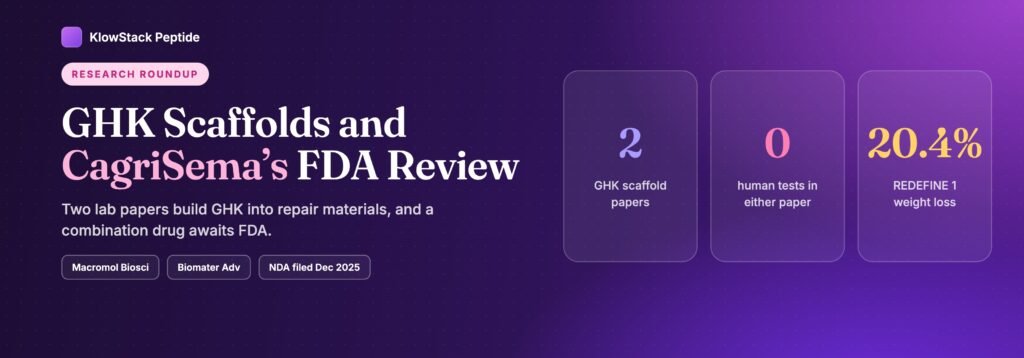
The evidence behind it: The application rests mainly on REDEFINE 1 and 2. In REDEFINE 1, 3,417 adults without diabetes lost 20.4% of body weight over 68 weeks on CagriSema, against 3.0% on placebo, counting everyone regardless of whether they stayed on treatment [3].
The complication: In REDEFINE 4, an open-label 84-week trial in 809 people announced February 23, CagriSema produced 23.0% weight loss against 25.5% for tirzepatide among people who stayed on treatment, missing its goal of showing it was at least as good [4]. FDA judges an obesity drug against placebo, so that result doesn’t by itself decide approval, but it shapes how the drug would compete.
Where it stops: Until FDA acts, CagriSema remains investigational. New low-dose data from REDEFINE 9 arrive at ObesityWeek on November 15, covered in today’s preview.
The pattern this time
Both GHK papers use the peptide as one building block in a larger material, aimed at injuries the body struggles to bridge on its own: a cut spinal cord and an irregular bone defect. CagriSema shows the other end of the pipeline, where a peptide combination has cleared phase 3 and waits on a regulator.
Except for approved prescription medicines, the peptides in this roundup are laboratory research materials. We summarize papers for education, and nothing here should steer a medical decision.
Sources
- Zoughaib M, Lavrov IA, Dayob K, Yergeshov A, Andrianov VV, Vikherev NV, Kamalov M, Amirova LM, Nemtarev AV, Abdullin TI. Macromolecular Bioscience, 2026;26(10):e70275. https://doi.org/10.1002/mabi.70275
- Su J, Zhang Y, Cao Y, Ren T, Zhang K, Chen D, Yin J. Biomaterials Advances, 2026;188:215017. https://doi.org/10.1016/j.bioadv.2026.215017
- Novo Nordisk. “Novo Nordisk files for FDA approval of CagriSema,” PR Newswire, December 18, 2025. https://www.prnewswire.com/news-releases/novo-nordisk-files-for-fda-approval-of-cagrisema-the-first-once-weekly-combination-of-glp1-and-amylin-analogues-for-weight-management-302645862.html
- BioSpace. “Novo Nordisk A/S: CagriSema demonstrated 23% weight loss in an open-label head-to-head REDEFINE 4 trial in people with obesity; the primary endpoint was not achieved,” February 23, 2026. https://www.biospace.com/press-releases/novo-nordisk-a-s-cagrisema-demonstrated-23-weight-loss-in-an-open-label-head-to-head-redefine-4-trial-in-people-with-obesity-the-primary-endpoint-was-not-achieved