
Research Roundup · Reviewed by Thomas Okafor, Peptide Chemist · Published October 6, 2026
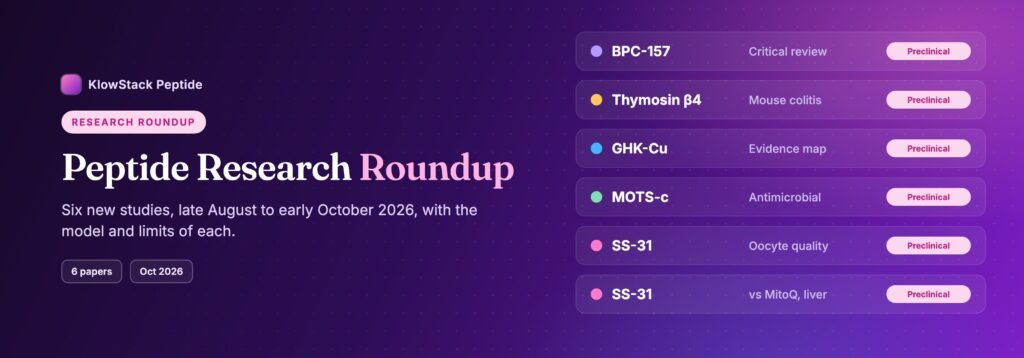
Each month we pull new papers on the compounds this site covers from PubMed and summarize them in a fixed format: what was studied, in what model, what the authors reported, and where the study stops. The evidence label on each entry tells you whether the work was done in cells, animals or people.
1. BPC-157: a critical look at the rodent evidence
Preclinical (review of rodent studies)
Paper: Demirtaş H. “BPC 157 in Rodent Ischemia-Reperfusion Injury: A Critical Review of Preclinical Evidence.” International Journal of Molecular Sciences, September 19, 2026. PubMed
What they looked at: Published rodent studies of BPC-157 in ischemia-reperfusion injury, the tissue damage that can follow when blood flow returns after a blockage. The search covered PubMed, Web of Science, Scopus, ClinicalTrials.gov, FDA and WADA materials through June 2026.
What they reported: Across the rodent literature, BPC-157 was associated with lower oxidative-stress and inflammatory markers and changes in nitric-oxide and VEGF-related signaling, in models of muscle, brain, gut and liver injury.
Where it stops: The author describes the evidence as heterogeneous, often short-term and single-dose, with risk of bias not fully characterized. The review calls BPC-157 a hypothesis-generating candidate for further animal research rather than an established therapy, and lists blinded replication, toxicology and controlled human studies as next steps.
2. Thymosin beta-4 in mouse models of colitis
Preclinical (mouse and tissue study)
Paper: Zhao TR, Hu EB, et al. “Recombinant human Thymosin β4 ameliorates experimental colitis and intestinal fibrosis through suppression of mineralocorticoid receptor signaling.” Molecular Biomedicine, August 17, 2026. PubMed
What they looked at: Whether thymosin beta-4 (Tβ4), the 43-amino-acid protein that TB-500 is modeled on, plays a role in gut inflammation. The team looked at gene activity in colon tissue from people with inflammatory bowel disease, then used mice with chemically induced colitis.
What they reported: The Tβ4 gene was less active in IBD colon tissue. Mice lacking the gene developed more severe colitis. In both preventive and treatment designs, oral recombinant human Tβ4 was linked to better survival, less weight loss, less epithelial damage and lower fibrosis markers. The authors traced part of the effect to reduced mineralocorticoid-receptor signaling.
Where it stops: This study used the full-length recombinant protein, not the short synthetic TB-500 fragment, so the results don’t transfer directly to TB-500. Chemically induced colitis in mice is a standard model, but it doesn’t reproduce human IBD.
3. GHK-Cu: an evidence map of the copper peptide
Preclinical, with small human cosmetic studies
Paper: Mateescu DM, et al. “GHK-Cu as a Bioactive Metallopeptide and Drug-Delivery Cargo.” Pharmaceutics, August 27, 2026. PubMed
What they looked at: A structured review of GHK-Cu research through August 2026, grading biological evidence and formulation quality separately, and pulling in ClinicalTrials.gov and regulatory sources.
What they reported: Preclinical data consistently support effects on tissue remodeling, epithelial repair, inflammation and blood-vessel growth. Clinical data are sparse: a 13-person study after CO2 laser treatment found no benefit on objective measures, while a 2026 18-person study comparing treated and untreated sides of the face reported positive cosmetic results for eyebrow hair. A phase 2 acute-wound trial (NCT07437586) is recruiting and has no results yet.
Where it stops: The authors point out that many studies don’t define the chemical form of GHK-Cu they used, which makes results hard to compare. They describe GHK-Cu as promising but unproven as a therapeutic agent until controlled clinical efficacy is shown.
4. MOTS-c as a mitochondria-encoded antimicrobial peptide
Preclinical (lab and mouse study)
Paper: Rice MC, Imun M, Jung SW, et al. “MOTS-c is a mitochondrial-encoded interferon-linked host defense peptide.” eLife, August 18, 2026 (version of record; first posted as a preprint in 2023). PubMed
What they looked at: Whether MOTS-c, a 16-amino-acid peptide encoded in mitochondrial DNA, behaves like the body’s antimicrobial “host defense” peptides.
What they reported: In lab tests, MOTS-c acted against E. coli and MRSA by targeting bacterial membranes. In a mouse model of abdominal infection, it neutralized MRSA. Immune signals raised MOTS-c levels in human immune cells, and mouse immune cells exposed to MOTS-c developed into macrophages with stronger bacterial clearance.
Where it stops: These are cell and mouse results. The senior author discloses a consulting role and shareholding in CohBar, a company that has developed MOTS-c analogs.
5. SS-31 (elamipretide) and egg-cell quality in aged mice
Preclinical (mouse, pig and lab human cell study)
Paper: Zhang HL, et al. “Elamipretide Rejuvenates Oocyte Quality and Restores Female Fertility During Reproductive Aging.” Aging Cell, October 2026. PubMed
What they looked at: Whether elamipretide, a peptide that binds the inner mitochondrial membrane, changes egg-cell (oocyte) quality in aged female mice.
What they reported: Aged mice given elamipretide had larger litters and better oocyte maturation markers. The team linked the effect to vitamin B6 and VEGF signaling. In the lab, it also improved maturation and early development of aged human oocytes and of pig oocytes under oxidative stress.
Where it stops: The human work was on donated cells in a dish, not in people. Mouse reproductive aging differs from human aging in timing and biology.
6. SS-31 vs MitoQ in a mouse model of fatty liver disease
Preclinical (mouse study)
Paper: Xiao D, et al. “Targeting Mitochondria in MASLD: Comparative Evaluation of MitoQ and SS-31 (Elamipretide) in Aged Female Mice under Nutritional Stress.” Physiological Research, August 31, 2026. PubMed
What they looked at: A head-to-head of two mitochondria-targeted compounds in aged female mice fed a high-fat, high-fructose diet for 16 weeks to induce metabolic fatty liver disease (MASLD).
What they reported: Both compounds improved mitochondrial protein markers, reduced inflammation markers and liver fat on tissue staining. MitoQ mainly raised antioxidant defenses, while SS-31 better preserved mitochondrial structure.
Where it stops: Most outcomes are protein measurements from liver tissue in one mouse model, and the two compounds were given by different routes.
The pattern this month
The two reviews in this batch reach a similar conclusion from different directions: the lab and animal signals for BPC-157 and GHK-Cu are consistent enough to justify more research, and the controlled human studies needed to confirm them haven’t been done yet. The mitochondrial peptides, MOTS-c and SS-31, keep drawing new mechanistic work, much of it in aging models.
For background on the compounds in KLOW and GLOW, see KLOW vs GLOW.
All compounds in this roundup except approved prescription products are sold for laboratory research only. This summary is for education and is not medical advice.
Sources
- Demirtaş H. “BPC 157 in Rodent Ischemia-Reperfusion Injury: A Critical Review of Preclinical Evidence.” International Journal of Molecular Sciences, September 19, 2026. https://pubmed.ncbi.nlm.nih.gov/42794771/
- Zhao TR, Hu EB, et al. “Recombinant human Thymosin β4 ameliorates experimental colitis and intestinal fibrosis through suppression of mineralocorticoid receptor signaling.” Molecular Biomedicine, August 17, 2026. https://pubmed.ncbi.nlm.nih.gov/42606759/
- Mateescu DM, et al. “GHK-Cu as a Bioactive Metallopeptide and Drug-Delivery Cargo.” Pharmaceutics, August 27, 2026. https://pubmed.ncbi.nlm.nih.gov/42797253/
- Rice MC, Imun M, Jung SW, et al. “MOTS-c is a mitochondrial-encoded interferon-linked host defense peptide.” eLife, August 18, 2026 (version of record; first posted as a preprint in 2023). https://pubmed.ncbi.nlm.nih.gov/42611943/
- Zhang HL, et al. “Elamipretide Rejuvenates Oocyte Quality and Restores Female Fertility During Reproductive Aging.” Aging Cell, October 2026. https://pubmed.ncbi.nlm.nih.gov/42827331/
- Xiao D, et al. “Targeting Mitochondria in MASLD: Comparative Evaluation of MitoQ and SS-31 (Elamipretide) in Aged Female Mice under Nutritional Stress.” Physiological Research, August 31, 2026. https://pubmed.ncbi.nlm.nih.gov/42708867/