
Clinical Trial Tracker · Reviewed by Thomas Okafor, PhD · Published October 23, 2026
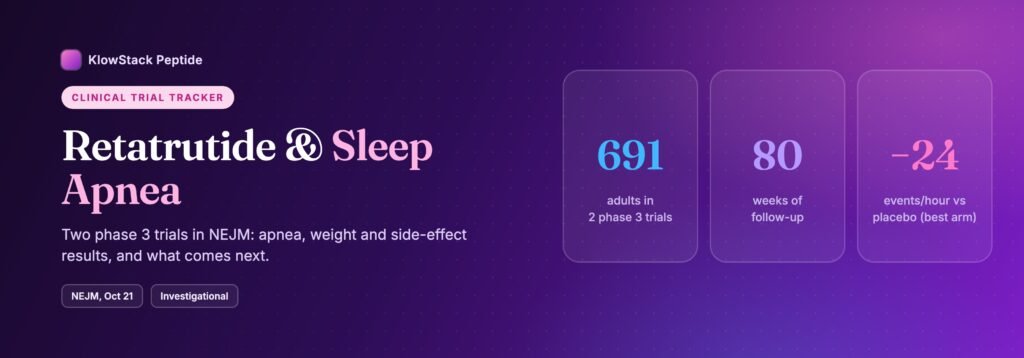
Picture a night where breathing stops or turns shallow nearly once a minute. That was roughly where participants started: their average apnea-hypopnea index, the count of those pauses per hour of sleep, was 58.6 in one trial and 55.9 in the other [1]. Anything above 30 counts as severe. These are the people the new retatrutide sleep apnea trials set out to study.
The trials at a glance
| Detail | TRIUMPH-1-OSA | TRIUMPH-2-OSA |
|---|---|---|
| Participants | 243 adults, no type 2 diabetes | 448 adults with type 2 diabetes |
| Design | Phase 3, randomized, double-blind, placebo-controlled | Same |
| Length | 80 weeks | 80 weeks |
| Starting AHI (average) | 58.6 events per hour | 55.9 events per hour |
| AHI change vs placebo, higher doses | About 22 to 24 fewer events per hour | About 14 to 15 fewer events per hour |
| Weight change on retatrutide | 12.5% to 22.2% lower | 12.1% to 18.5% lower |
| Weight change on placebo | 4.8% lower | 5.6% lower |
Both studies were nested inside Lilly’s larger TRIUMPH obstructive sleep apnea and obesity programs (ClinicalTrials.gov NCT05929066 and NCT05929079) and were funded by the company [1]. All participants had moderate-to-severe sleep apnea and a body-mass index of at least 27.
What the trials found
The primary goal was the change in apnea-hypopnea index at 80 weeks on the two higher doses. In TRIUMPH-1-OSA, participants on the middle dose averaged 34.3 fewer events per hour, against 9.9 fewer on placebo. In TRIUMPH-2-OSA, the highest dose brought a 25.4-event drop, against 10.3 on placebo [1]. Results held under the stricter intention-to-treat analysis, which counts everyone as randomized regardless of what happened later. The most common side effects were gastrointestinal, a familiar pattern for this drug class [1]. One detail stands out: people with type 2 diabetes saw smaller reductions in both apnea events and weight. That matches earlier results for other incretin drugs, where diabetes tends to blunt weight loss.
Why this trial counts
Sleep apnea is closely tied to excess weight, and in December 2024 the FDA approved tirzepatide, retatrutide’s dual-agonist predecessor, for moderate-to-severe obstructive sleep apnea in adults with obesity. Retatrutide adds a third target, the glucagon receptor, to the GLP-1 and GIP receptors tirzepatide acts on. These trials are the first published phase 3 evidence of how the triple agonist performs on an outcome beyond weight. The author list combines academic sleep specialists, including researchers at the Woolcock Institute in Sydney, Mayo Clinic and Harvard Medical School, with Lilly scientists [1].
What comes next
Lilly has said it plans to submit retatrutide for FDA review in the first quarter of 2027, with data intended to support obesity, knee osteoarthritis pain and obstructive sleep apnea [2]. Until a decision, retatrutide remains an investigational drug. That’s also why products sold online as “retatrutide” deserve caution. The FDA has said retatrutide can’t legally be used in compounding, and as we reported last week, journal investigations found unapproved versions sold widely online [3]. Those products aren’t the trial drug, and these results say nothing about them. For background, read our coverage of retatrutide’s earlier phase 3 results, unapproved retatrutide sold online, and our tirzepatide guide.
This article summarizes published trial results for education and isn’t medical advice.
Sources
- Grunstein RR, Somers VK, Azarbarzin A, et al., for the TRIUMPH-1-OSA and TRIUMPH-2-OSA Investigators. “Retatrutide Once Weekly for Treatment of Obstructive Sleep Apnea.” New England Journal of Medicine, October 21, 2026. https://doi.org/10.1056/NEJMoa2611477
- HCPLive, “Retatrutide meets phase 3 weight loss endpoints in 2 obesity trials,” July 23, 2026. https://www.hcplive.com/view/retatrutide-meets-phase-3-weight-loss-endpoints-in-2-obesity-trials
- FDA, “FDA’s Concerns with Unapproved GLP-1 Drugs Used for Weight Loss,” current as of October 1, 2026. https://www.fda.gov/drugs/drug-alerts-and-statements/fdas-concerns-unapproved-glp-1-drugs-used-weight-loss