Reviewed by Thomas Okafor, Peptide Chemist · Updated October 2026
BPC-157 is a synthetic peptide made of 15 amino acids, based on a sequence from a protective protein found in human gastric juice. It’s studied mainly for tissue repair (tendons, ligaments, muscle and the gut lining), almost entirely in animals. A 2025 systematic review found 36 studies, 35 of them preclinical, and BPC-157 is not FDA-approved.
Few research peptides have climbed from obscure lab papers to gym-locker talk as fast as this one. Search for it and you’ll find glowing recovery stories, worried doctors, Amazon capsules and a federal advisory vote, often on the same page. This guide sorts all of it: what the BPC-157 peptide is, how it seems to work in animals, what the handful of human studies found, and where its legal status stood as of October 2026.
The information here is general education, and nothing in it is medical advice. BPC-157 is sold for research use only; our Medical Disclaimer explains what that means.
What Is BPC-157?
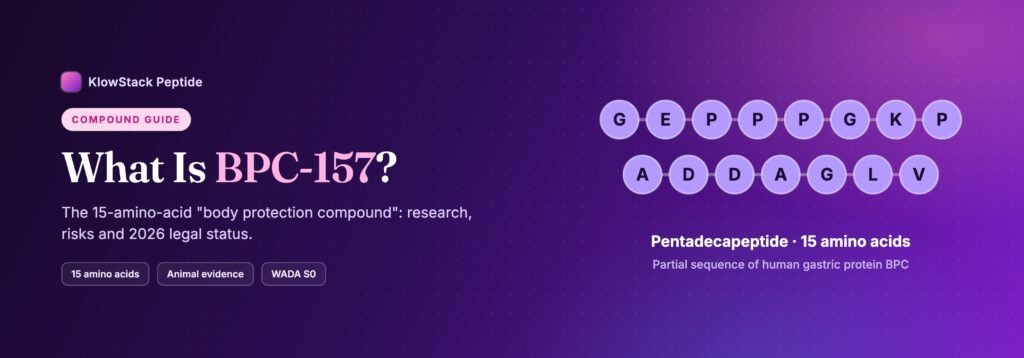
BPC-157 is a lab-made pentadecapeptide (15 amino acids) derived from a protein in human gastric juice. Croatian researcher Predrag Sikirić’s group described it in 1993, and most research on it since has come from that group, largely in rats. It’s a short, stable chain that scientists can make cheaply and study in many tissue models.
Here is the full sequence, one amino acid at a time: Gly-Glu-Pro-Pro-Pro-Gly-Lys-Pro-Ala-Asp-Asp-Ala-Gly-Leu-Val. That string of three-letter codes is the whole molecule. For comparison, insulin has 51 amino acids, so BPC-157 is small even by peptide standards.
In older papers and trial records you’ll see two other names: bepecin and PL 14736, the code used when a drug company tested it for bowel disease in the 2000s. All three names refer to the same 15-amino-acid chain. Most of the early papers came out of the University of Zagreb’s medical school, and Sikirić’s team has published hundreds of BPC-157 studies since, which is both why the research base is large and why critics would like to see more independent labs repeat the work.
A few facts clear up common confusion:
- It’s synthetic. The full parent protein comes from stomach juice, but this exact 15-amino-acid piece is made in a lab.
- It isn’t a hormone. BPC-157 doesn’t act like testosterone, estrogen or growth hormone.
- It isn’t a steroid. Steroids have a ring-shaped structure built from cholesterol; BPC-157 is a chain of amino acids.
What Does BPC Stand For?
BPC stands for “Body Protection Compound.” The name came from early studies in which the parent protein seemed to protect the stomach lining from damage caused by stress, alcohol and anti-inflammatory drugs in rats. The “157” is simply part of its identifier in that research series.
How Does BPC-157 Work?
In animal and cell studies, BPC-157 appears to act through several repair pathways: it promotes new blood-vessel growth (via VEGFR2 and nitric oxide), raises growth-hormone receptor levels in tendon cells, and dampens inflammatory signals. How much of this applies to people is unknown, since the mechanism work comes from rats and cell cultures.
A 2025 narrative review by McGuire and colleagues at the University of Utah pulls these pathways together. Here’s what the animal and lab work points to, in plain English:
- New blood vessels (lab and animal): BPC-157 switches on a receptor called VEGFR2 and boosts nitric oxide through a signaling chain known as Akt-eNOS. More blood vessels mean more oxygen and nutrients reaching an injury.
- Growth-hormone receptors (lab): in rat tendon cells, it raised the number of receptors for growth hormone, which could make those cells more responsive to the body’s own repair signals.
- Cell growth and movement (lab): it activates ERK1/2, a pathway that tells cells to divide and migrate.
- Calmer inflammation (animal): it lowered inflammatory messengers such as TNF-α and IL-6 and nudged immune cells called macrophages toward a “repair” mode (often labeled M2).
- Nerve-muscle protection (animal): some rat studies show protection at the junction where nerves meet muscle.
Why do tendons get so much attention? They have a poor blood supply, which is why a tendon injury can drag on for months. A compound studied for growing new blood vessels naturally attracts interest there. The same goes for the spot where muscle turns into tendon, another area with a thin blood supply, which the McGuire review singles out.
There’s also a puzzle in the data. BPC-157 has a half-life of under 30 minutes in plasma, shorter than a sitcom episode, yet some animal studies report effects lasting weeks. Researchers haven’t explained that gap, and it’s one of the open questions in the field. One idea is that BPC-157 kicks off a chain of repair signals that keeps running after the peptide itself is gone, the way a starter pistol is over in a second while the race goes on. That’s a hypothesis for now. Our deeper explainer on how BPC-157 works covers each pathway in more detail.
What Is BPC-157 Studied For?
BPC-157 is studied most for tendon, ligament and muscle healing, and for protecting the stomach and gut lining. Smaller bodies of animal research cover bone, nerve and organ protection. None of these uses has been confirmed in controlled human trials, so every area below is a research question still waiting for its human answer.
Tendons, Ligaments and Muscle
This is where BPC-157 built its reputation. In a 2011 Journal of Applied Physiology paper, Chang and colleagues in Taiwan exposed rat Achilles tendon tissue to BPC-157 in the lab. The tendon explants grew outward faster, the cells survived stress better, and they migrated more, with stronger effects at higher amounts.
Muscle injuries get similar treatment in the animal literature, with rat studies of crushed and torn muscle reporting faster recovery of structure and function. Other rat studies looked at torn tendons and ligaments and at the spot where tendon attaches to bone, often reporting better structure and strength. A 2025 systematic review in the HSS Journal, led by Vasireddi at Case Western Reserve, screened 544 articles and kept 36. Across those, BPC-157 improved functional, structural and biomechanical outcomes in animal muscle, tendon, ligament and bone injuries. The authors concluded that it “shows promise” for musculoskeletal recovery while calling for proper human trials.
Most of these studies share a design worth knowing about. Researchers cut or crush a rat’s tendon or ligament, give BPC-157 to one group and not another, then compare healing after a few weeks. That’s a solid way to test an idea in animals. It also means the injuries are clean, controlled and fresh, quite unlike a weekend warrior’s years-old tennis elbow.
Our guide to BPC-157 for tendon and joint research goes study by study.
Stomach and Gut Lining
BPC-157’s story started in the stomach, so gut research is its home turf. Rat studies tested it against ulcers caused by alcohol, stress and anti-inflammatory painkillers, and against damage in the intestines. Sven Seiwerth’s 2018 review ties much of that protection to blood-vessel signaling in the gut lining.
The gut angle also explains a later chapter. A drug company tested BPC-157 under the code PL 14736 for inflammatory bowel disease, and in July 2026 the FDA’s advisory panel reviewed it specifically for ulcerative colitis. Our guide to BPC-157 for gut healing research covers those studies. The gut work is also the reason oral BPC-157 gets so much attention, a topic covered further down.
Bone and Joints
Animal studies have tested BPC-157 in fracture models and joint injuries, with reports of faster bone healing in rats. The only human joint data comes from one small knee-pain case series, described in the human studies section below.
Nerves and Other Tissues
A smaller set of animal studies looks at nerve injury, the nerve-muscle junction and protection of organs like the liver and brain. This research is very early, mostly single studies from the Zagreb group that haven’t been repeated by independent labs. It’s interesting as a sign of how widely BPC-157 has been tested, and it’s a long way from showing anything in people.
What BPC-157 Hasn’t Been Shown to Do
There’s no evidence in people that BPC-157 speeds up injury recovery, builds muscle, burns fat or slows aging. Those claims show up in marketing, and they come from stretching animal results to humans. Does BPC-157 work immediately? No human study has measured how quickly anything happens. Our BPC-157 benefits page sorts each claimed benefit by its evidence level.
What Human Studies Exist on BPC-157?
Only three small human studies of BPC-157 have been published, none of them randomized or placebo-controlled. They include a knee-pain case series, a bladder-pain study and a two-person IV safety test. A 2025 systematic review found that no study had assessed BPC-157’s safety in humans in a rigorous way.
All three come from the same Florida-based physician, Edwin Lee, and his colleagues, and all three appeared in the journal Alternative Therapies in Health and Medicine.
| Study | Design | Participants | Route | Reported result | Limitation |
|---|---|---|---|---|---|
| Lee & Padgett 2021 | Retrospective chart review | 16 people with knee pain (12 BPC-157 only, 4 with TB-500 added) | Injection into the knee joint | 11 of 12 on BPC-157 alone reported clear improvement; 14 of 16 overall | No control group; phone survey; follow-up varied |
| Lee et al. 2024 | Pilot study | 12 women with interstitial cystitis | Injected into the bladder wall during cystoscopy | 10 of 12 reported complete symptom relief; no adverse events | No control group; single clinic |
| Lee & Burgess 2025 | Pilot safety study | 2 healthy adults | IV infusion, up to 20 mg | No changes in heart, liver, kidney, thyroid or blood-sugar markers; no side effects | Two people; both had received BPC-157 before |
Why do you see “7 of 12” in some articles and “14 of 16” in others? Both come from the knee study. Fourteen of 16 is everyone who reported relief. Among the 12 who received BPC-157 alone, 11 reported a clear improvement, and 7 said the relief lasted more than six months, which is the figure the Vasireddi review highlighted.
Before these, a drug company registered trials of PL 14736 for inflammatory bowel disease in the 2000s, but full results were never published.
What does all this add up to? In medical terms, these are level IV and V studies: case series and pilot reports without comparison groups. It’s like asking three friends whether a new diet worked. Their answers are real and worth hearing, and they can’t tell you what would have happened without it. What would a convincing study look like? It would randomly assign people to BPC-157 or a placebo, keep both the participants and the doctors unaware of who got which (blinding), and measure healing with scans or strength tests, which are far more objective than a phone survey. That’s the kind of trial the FDA relies on, and none has been published for BPC-157. Our Editorial Policy explains how we label each level of evidence.
What Are the Side Effects and Risks of BPC-157?
BPC-157’s side effects in humans haven’t been properly studied. The few small human reports describe no adverse events, and animal tests found no toxicity, but researchers flag theoretical risks such as promoting blood-vessel growth in tumors. Product quality is the most concrete risk, since unapproved products have no manufacturing oversight.
The animal safety picture is reassuring as far as it goes. A 2020 preclinical safety evaluation by Xu and colleagues, published in Regulatory Toxicology and Pharmacology, tested BPC-157 in mice, rats, rabbits and dogs. It found no toxic effects, no damage to DNA and no harm to developing offspring at the amounts tested.
The concerns researchers raise are mostly theoretical:
- Unwanted blood-vessel growth: the same angiogenesis that might help a tendon could, in principle, help an existing tumor grow its blood supply. Nobody has shown this happens, and nobody has ruled it out.
- Nitric oxide and oxidative stress: BPC-157 influences nitric oxide signaling, which the body keeps in careful balance.
- Product quality: unregulated vials and capsules can contain the wrong amount, a different compound, bacterial toxins or leftover solvents.
- Missing long-term data: no study, in animals or people, has followed exposure over months or years.
Is BPC-157 Hard on Your Liver?
There’s no human liver data beyond the two-person IV study, which found no change in liver markers over three days. Animal studies actually suggest BPC-157 protects the liver from several kinds of damage. That’s encouraging, and it still doesn’t establish liver safety in people.
Does BPC-157 Affect Testosterone?
No human study has measured BPC-157’s effect on testosterone, so there’s no evidence either way. It isn’t a hormone and isn’t known to act on the hormone system that controls testosterone, but “not known” is different from “tested.”
A few groups have extra reasons for caution with any unapproved peptide: anyone pregnant or breastfeeding, anyone with a current or past cancer (because of the blood-vessel question), people on blood thinners or with bleeding disorders, competitive athletes, and anyone under 18.
Is BPC-157 safe to take every day? No study has looked at daily or long-term exposure in people, so nobody can say. Anyone with a health condition, a cancer history or a pregnancy is best off talking to a licensed clinician first. Our BPC-157 side effects page goes deeper into each risk.
Oral vs Injectable BPC-157: What’s the Difference?
BPC-157 is sold both as injectable powder and as oral capsules. Animal studies used both routes, and its gastric origin is often cited for oral use, but no human study has compared them, and oral products are unapproved drugs, not supplements.
BPC-157 is unusually stable in stomach acid for a peptide, which is part of why rat studies could add it to the animals’ water and report effects. Most peptides break down in the gut long before they could do anything. That stability is the main argument people make for capsules.
The catch is that rats aren’t people, and BPC-157’s half-life in blood is under 30 minutes either way. No human study has measured how much of an oral dose reaches the bloodstream, or compared it with an injection. Until that data exists, any claim that one route “works better” for people is a guess. The capsules on the market, often labeled as supplements, fall into the same unapproved category as vials. Some products also list BPC-157 as an “arginine salt” or acetate. Those are different salt forms of the same peptide, which manufacturers use to change stability or how the powder dissolves. The form should match what the COA reports. Our oral vs injectable BPC-157 page covers the animal data on each route.
Is BPC-157 Legal? FDA, Supplements, WADA and 2026 Status
BPC-157 is not FDA-approved and cannot legally be sold as a dietary supplement. In 2026 the FDA removed it from its Category 2 safety list, and an advisory panel voted 8–6 to recommend it for compounding, but as of October 2026 it isn’t on the 503A list. WADA bans it at all times.
| Date | What happened | What it means |
|---|---|---|
| July 23, 2026 | The FDA’s Pharmacy Compounding Advisory Committee votes 8–6, with 1 abstention, to recommend BPC-157 (alongside KPV and TB-500). The indication reviewed was ulcerative colitis. | Advisory only. The FDA must accept it and complete rulemaking. |
| April 2026 | The FDA removes BPC-157 from Category 2 after the underlying nomination was withdrawn | Removal leaves it in no category; it isn’t approval |
| September 2023 | BPC-157 placed in Category 2 over insufficient safety evidence | Compounding pharmacies effectively barred from using it |
| 2022 | WADA names it under class S0; the UFC and NFL ban it | Banned in tested sport |
The April change confused a lot of people, so it’s worth one plain sentence. As The National Law Review explained, coming off Category 2 doesn’t put a substance on the approved compounding list; it simply leaves it in a regulatory grey zone. AJMC reported that the July vote is also advisory, and the FDA still has to run a proposed rule, a comment period and a final rule. The compounding pharmacy New Drug Loft tracks each step.
Is BPC-157 on Amazon Legit?
The Department of Defense’s Operation Supplement Safety program says BPC-157 isn’t a dietary ingredient and is an unapproved drug, so it can’t legally be sold as a supplement. Capsules listed on Amazon or anywhere else as supplements are in breach of that position. Their contents are also unverified, since supplement-style listings rarely come with a lab-tested certificate of analysis.
Athletes: BPC-157 is on the WADA Prohibited List under S0, banned in and out of competition, and modern testing can detect it. USADA has issued its own warning. Checked against FDA and WADA sources on October 5, 2026. For the bigger legal picture, see our peptide legality guide.
BPC-157 in Peptide Blends: Wolverine, GLOW and KLOW
BPC-157 is the one ingredient shared by all three common repair blends. Wolverine pairs it with TB-500; GLOW adds GHK-Cu; KLOW adds GHK-Cu and KPV. In the standard GLOW and KLOW ratios it’s 10 mg per vial, which makes it a small share of the copper-heavy blends.
| Blend | BPC-157 per vial | Other peptides |
|---|---|---|
| Wolverine | Usually 10 mg (some sellers use 5 mg) | TB-500 |
| GLOW (standard 70 mg) | 10 mg | GHK-Cu 50 mg, TB-500 10 mg |
| KLOW (standard 80 mg) | 10 mg | GHK-Cu 50 mg, TB-500 10 mg, KPV 10 mg |
Because every blend in the family contains it, BPC-157’s research record and legal status shape all three. If the FDA eventually adds BPC-157 to the 503A list, that change would apply only to compounded BPC-157 itself, and it wouldn’t approve any blend. Some GLOW and KLOW vials use a 30/20/20 recipe with 20 mg of BPC-157 instead, so the label and COA are the only way to know.
Each combination has its own guide: the Wolverine stack, the GLOW blend and the KLOW stack. The peptide blends hub shows how they fit together.
How Is BPC-157 Different From TB-500?
BPC-157 is a 15-amino-acid gastric-derived peptide studied mainly for blood-vessel growth and gut and tendon repair; TB-500 is based on thymosin beta-4 and studied for cell migration. They’re often paired because they act on different steps of repair, which is the whole idea behind the Wolverine blend.
One way to picture the pair: BPC-157 is studied for building the roads into an injury, and TB-500 for getting the work crews moving along them. Both are banned in sport, both are mostly animal-tested, and both were part of the July 2026 FDA panel vote. They also look nothing alike chemically: BPC-157 is 15 amino acids from a stomach protein, while the thymosin beta-4 family comes from a protein found in nearly every cell. The research bases differ in size too. BPC-157’s comes mostly from one Croatian group, while thymosin beta-4 has been studied by many labs and even reached human eye-drop trials in its full-length form. Our BPC-157 vs TB-500 comparison puts them side by side.
How Much Does BPC-157 Cost, and How Do You Check Quality?
In October 2026, research-grade BPC-157 vials listed at roughly $25–80 in US searches, while clinic-supervised programs advertised $150–445 per month or cycle. Price says little about quality; a third-party certificate of analysis does, and it costs a seller money to get one.
| Option | Typical price (US, October 2026) | What you get |
|---|---|---|
| Research-grade vial | About $25 to $80 | Freeze-dried powder, sold for research use only |
| Clinic program | About $150 to $445 per month or cycle | Compounded product plus consultation, at clinics’ published prices |
That clinic range can run higher than a monthly car payment, and it mostly reflects visits, lab work and markup. Clinics also note that compounded BPC-157 falls in the legal grey area described above. As always on KlowStack, we don’t publish dosing.
Whatever the source, a solid COA should cover five things:
- ☐ Identity, confirmed by HPLC and mass spectrometry
- ☐ Purity, as a percentage of the vial’s contents
- ☐ Measured mg, compared against the label
- ☐ Endotoxin results
- ☐ Lot number and test date, plus the name of an independent lab you can contact
Our guide on how to verify a peptide COA shows what each line should look like.
Frequently Asked Questions
What does BPC-157 do?
In animal and lab studies, BPC-157 promotes new blood-vessel growth, supports tendon and gut-lining repair, and calms inflammatory signals. What BPC-157 does in people hasn’t been shown in controlled trials.
Is BPC-157 safe?
BPC-157’s safety in humans hasn’t been properly studied. Animal tests found no toxicity, and three tiny human pilots reported no side effects. Product quality and unknown long-term effects are the main concerns.
What are the side effects of BPC-157?
No controlled study has catalogued BPC-157 side effects in people. Researchers flag theoretical risks, such as feeding blood vessels to tumors, plus quality problems like contamination and mislabeling in unregulated products.
Is BPC-157 hard on your liver?
There’s no meaningful human liver data. A two-person IV pilot found no change in liver markers, and rat studies suggest liver protection. Neither establishes liver safety in people.
Does BPC-157 affect testosterone?
No study has measured BPC-157’s effect on testosterone in people. It isn’t a hormone and isn’t known to act on the testosterone system, so there’s no evidence either way.
Is BPC-157 a steroid or a hormone?
Neither. BPC-157 is a peptide, a short chain of 15 amino acids. Steroids are ring-shaped molecules built from cholesterol, and BPC-157 doesn’t act like testosterone, estrogen or growth hormone.
Does BPC-157 work immediately?
No human study has measured how quickly BPC-157 does anything. Its half-life in blood is under 30 minutes, while some animal studies report effects lasting weeks, which researchers haven’t explained yet.
Is BPC-157 legal in the US?
BPC-157 isn’t FDA-approved and can’t legally be sold as a supplement. It’s sold as research use only. A July 2026 FDA panel recommended it for compounding, and rulemaking hasn’t finished.
Is BPC-157 FDA-approved?
No. BPC-157 has never been approved by the FDA. As of October 2026, it also isn’t on the 503A list that compounding pharmacies use.
Is BPC-157 banned in sports?
Yes. WADA has listed BPC-157 under class S0 since 2022, banned at all times, and leagues like the UFC and NFL also prohibit it. Testing can detect it.
Is BPC-157 on Amazon legit?
The Department of Defense’s supplement program says BPC-157 isn’t a legal dietary ingredient, so supplement listings breach that position. Their contents also usually lack an independent COA.
How much does BPC-157 cost?
In October 2026, research-grade BPC-157 vials listed at about $25 to $80 in US searches. Clinic programs advertised about $150 to $445 per month or cycle.
Sources
Studies and reviews
- Vasireddi N, et al. 2025. Emerging Use of BPC-157 in Orthopaedic Sports Medicine: A Systematic Review. HSS Journal. doi:10.1177/15563316251355551
- McGuire FP, et al. 2025. Regeneration or Risk? A Narrative Review of BPC-157 for Musculoskeletal Healing. Current Reviews in Musculoskeletal Medicine. doi:10.1007/s12178-025-09990-7
- Chang CH, et al. 2011. The promoting effect of pentadecapeptide BPC 157 on tendon healing. Journal of Applied Physiology. doi:10.1152/japplphysiol.00945.2010
- Seiwerth S, et al. 2018. BPC 157 and Standard Angiogenic Growth Factors. Current Pharmaceutical Design. doi:10.2174/1381612824666180712110447
- Sikiric P, et al. 1993. A new gastric juice peptide, BPC. An overview of the stomach-stress-organoprotection hypothesis. Journal of Physiology (Paris). PMID 8298609
- Lee E, Padgett B. 2021. Intra-Articular Injection of BPC 157 for Multiple Types of Knee Pain. Alternative Therapies in Health and Medicine. PMID 34324435
- Lee E, Walker C, Ayadi B. 2024. Effect of BPC-157 on Symptoms in Patients with Interstitial Cystitis: A Pilot Study. Alternative Therapies in Health and Medicine. PMID 39325560
- Lee E, Burgess K. 2025. Safety of Intravenous Infusion of BPC157 in Humans: A Pilot Study. Alternative Therapies in Health and Medicine. PMID 40131143
- Xu C, et al. 2020. Preclinical safety evaluation of body protective compound-157. Regulatory Toxicology and Pharmacology. doi:10.1016/j.yrtph.2020.104665
Regulatory and news
- OPSS: BPC-157, a Prohibited Peptide and an Unapproved Drug
- FDA: July 23-24, 2026 Meeting of the Pharmacy Compounding Advisory Committee
- The National Law Review: What FDA’s Latest Actions Mean for Peptide Compounding
- AJMC: FDA Panel Backs 6 Peptides for Compounding
- New Drug Loft: Regulatory Updates on Compounded Peptides
- USADA: BPC-157, Experimental Peptide Creates Risk for Athletes
- WADA Prohibited List
Pricing: InCare and Perfect B clinic price pages, checked October 2026.
Disclaimer: BPC-157 is sold for research use only and isn’t approved for human use. This guide is for education and doesn’t give medical advice. Read our Medical Disclaimer and Editorial Policy to see how we source our claims.