
Reviewed by Thomas Okafor, Peptide Chemist · Updated October 2026
A peptide blend is two or more research peptides combined in one vial at a fixed ratio, usually as a freeze-dried powder. The best-known blends, Wolverine, GLOW and KLOW, build on each other: each adds one peptide to the last. Blends are sold for convenience and to pair complementary pathways, yet almost none has been tested as a combination in people.
Search for peptide blends and you’ll mostly find shop pages, each with its own names, ratios and prices. That makes it hard to see the basic pattern underneath. This hub lays out what a blend is, how the common ones relate, what the research does and doesn’t say, and what to look for on a certificate of analysis. Each blend also has its own deep-dive guide, linked as we go.
Nothing on this page is medical advice. Blends are sold for research use only, and our Medical Disclaimer has the details.
What Is a Peptide Blend?
A peptide blend is a product that combines two or more peptides in one vial at a set ratio, so they’re dissolved and handled together. It’s different from a peptide stack, where separate peptides are combined by the user or a clinic. With a blend, the maker decides the recipe, and every vial in a lot shares it.
The word “peptide” itself just means a short chain of amino acids, the same building blocks that make up proteins. Most research peptides are tiny by protein standards, often between 3 and 45 amino acids long. When several of these short chains go into a single vial, you get a blend. Most blends are sold freeze-dried (lyophilized), meaning the water has been removed to leave a dry cake of powder. Dry peptides keep far better than dissolved ones, so the format helps the product survive shipping and storage.
What’s the Difference Between a Peptide Blend and a Peptide Stack?
The easiest way to picture it: a blend is a pre-made smoothie, and a stack is buying the fruit separately and making your own.
| Peptide blend | Peptide stack | |
|---|---|---|
| Who combines it | The maker, before sale | The person or clinic, later |
| Ratio | Fixed | Adjustable |
| Lots and COAs | One lot, one COA | One lot and one COA per vial |
The peptide blend vs stack choice comes down to convenience against control. Is it better to stack peptides or not? From a research angle, it depends on whether you need to adjust or test each ingredient on its own. Our guide to what a peptide stack is covers the stack side in more depth.
Is a GLOW Blend the Same as a “Glow” IV Drip?
No. Some clinics and med spas sell “Glow” IV drips, which are usually vitamin and antioxidant infusions with the same catchy name. A GLOW research blend is a vial of three peptides priced by the vial, with its total listed in milligrams. A Glow IV is priced per session. Same word, completely different products.
Why Are Peptides Combined Into Blends?
Peptides are blended so that compounds studied for different steps of the same process, such as inflammation, blood supply, cell migration and tissue rebuilding in repair, come together in one product. Blends are also simpler to handle: one vial, one lot, one certificate of analysis to check.
Makers and sellers give four main reasons:
- Complementary pathways: each peptide is researched for its own piece of the same biological process.
- Convenience: one product to buy, label and store.
- One COA per lot: a single certificate covers everything in the vial, as long as it tests each peptide.
- Fewer handling steps: one vial to dissolve and track, which means fewer chances for a handling error.
That “one lot” point is easy to overlook. A lot is a single production batch, and everything in it should match. With separate vials, each peptide comes from its own batch, made on its own day, with its own paperwork.
That logic has limits. Combination trials are rare, so the reasoning comes from studies of each peptide alone. And once peptides share a vial, the amount of each one is locked in. So what peptides can you blend together? In practice, the combinations on the market are the ones sellers have chosen, built around shared research themes. Nobody has tested most of them as pairs or trios.
Medicine does combine ingredients all the time. A typical cold-and-flu tablet pairs a pain reliever with a decongestant, for instance. The difference is that each of those ingredients was tested in people first, and the combination was then tested as a product. Research peptide blends skip that last step, because no company has run combination trials on them.
What Are the Three Repair Blends? Wolverine, GLOW and KLOW
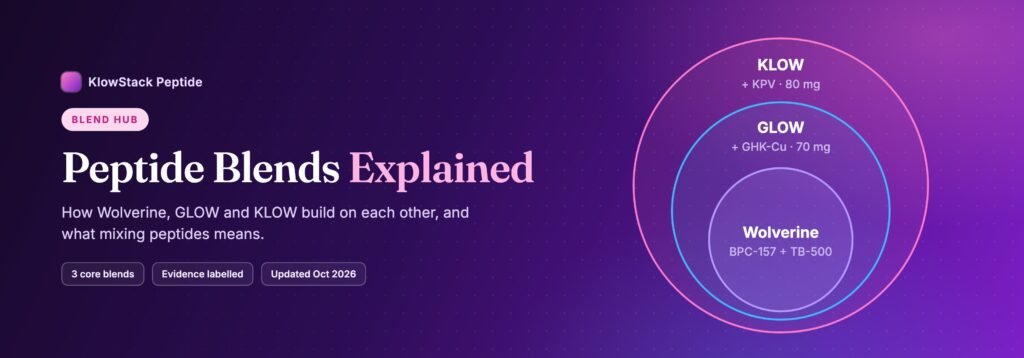
The three most common repair blends form a ladder. Wolverine is BPC-157 plus TB-500; GLOW adds GHK-Cu; KLOW adds KPV on top. Each step adds one peptide and one research area, from repair to skin remodeling to inflammation, like adding a topping to the same pizza each time.
Wolverine (2 Peptides), the Repair Core
Wolverine pairs BPC-157 and TB-500, usually in equal amounts. The vial size varies by seller: some sell two separate 5 mg vials, others a premixed 20 mg vial with 10 mg of each.
The name borrows from the Marvel character known for healing fast, and the marketing follows suit. It’s pitched at tendon, ligament and injury recovery. BPC-157 is studied for new blood-vessel growth and tendon repair, mostly in rats. TB-500 is a short synthetic peptide based on thymosin beta-4, a protein involved in cell movement toward an injury.
The evidence for both is preclinical. Because Wolverine is the shared core of all three blends, anything you learn about it carries into GLOW and KLOW too. Separate vials and premixed vials of Wolverine also differ in testing. Two separate vials come with two COAs, while a premix needs one COA that reports both peptides. Our Wolverine stack guide covers it in full.
GLOW (3 Peptides), Repair Plus Skin
GLOW takes the Wolverine pair and adds GHK-Cu, a copper peptide your body makes naturally. The standard recipe is 50 mg GHK-Cu, 10 mg BPC-157 and 10 mg TB-500, for 70 mg in total. A 30/20/20 version also exists, with less copper peptide and more of the repair pair, so only the label and COA can tell you which one is in the vial.
GHK-Cu is the reason GLOW is marketed for skin and hair as well as repair. Its human research comes mainly from topical creams and serums, which makes it the only ingredient in the family with small human studies. Its copper is also why the powder looks blue. GLOW is also where name confusion starts, since “glow” is a common beauty word. A Sephora moisturizer, an IV drip and a peptide vial can all carry it. The GLOW guide explains the blend in detail.
KLOW (4 Peptides), Repair Plus Skin Plus Inflammation
KLOW is GLOW plus 10 mg of KPV, for 80 mg in total. KPV is a three-amino-acid fragment of a hormone called alpha-MSH, studied for calming inflammatory signals, especially in the gut.
That extra ingredient is why KLOW is marketed for gut and inflammation research on top of everything GLOW covers. KPV’s research comes from cells and mouse colitis studies. It was also one of the peptides reviewed by an FDA advisory panel in July 2026. Each rung up the ladder also adds one more peptide to verify. A KLOW certificate has four sets of identity, purity and amount results to check, against two for Wolverine. Our guide to what the KLOW stack is breaks down its ratio and each ingredient.
How Do KLOW, GLOW and Wolverine Compare?
KLOW has four peptides (80 mg), GLOW three (70 mg) and Wolverine two. They share BPC-157 and TB-500; GLOW and KLOW add GHK-Cu, and only KLOW adds KPV. None of the three has been tested as a blend in human trials, so the useful comparison is ingredient by ingredient.
| Wolverine | GLOW | KLOW | |
|---|---|---|---|
| GHK-Cu | None | 50 mg | 50 mg |
| KPV | None | None | 10 mg |
| BPC-157 | Usually 10 mg | 10 mg | 10 mg |
| TB-500 | Usually 10 mg | 10 mg | 10 mg |
| Total | Varies (often 20 mg) | 70 mg | 80 mg |
| Marketed for | Tendon and injury recovery | Skin, hair and repair | Repair, skin, gut and inflammation |
| Evidence | Preclinical | Preclinical, plus topical GHK-Cu studies | Preclinical, plus topical GHK-Cu studies |
| Human trials of the blend | None | None | None |
| Price range (US listings, October 2026) | From about $30 to $50 for small vials | About $48 to $158 | About $90 to $180 |
What about GLOW vs Wolverine? GLOW is Wolverine with GHK-Cu added, so the difference is entirely about copper peptide research: skin, collagen and hair. If those topics aren’t part of the research question, Wolverine covers the same repair pair at a lower price. The price ranges above come from US research-supply listings in October 2026 and change often, so treat them as a rough guide.
The best way to use this table is to match the blend to the research question. “Strongest” isn’t a meaningful label when none of the three has been compared in people. For deeper head-to-heads, see KLOW vs GLOW and KLOW vs GLOW vs Wolverine.
What Other Peptide Blends Are Common?
Beyond the repair blends, the most common pre-mixed combinations pair two growth-hormone peptides (CJC-1295 with Ipamorelin, or Tesamorelin with Ipamorelin) or two nootropic peptides (Semax with Selank). Each is sold as a fixed-ratio vial, and each rests on research into the separate compounds.
Peptide Blends List
| Blend | Peptides | Research area | Evidence level |
|---|---|---|---|
| Wolverine | BPC-157 + TB-500 | Repair | Preclinical |
| GLOW | GHK-Cu + BPC-157 + TB-500 | Repair + skin | Preclinical; topical human studies for GHK-Cu |
| KLOW | GLOW + KPV | Repair + skin + inflammation | Preclinical; topical human studies for GHK-Cu |
| CJC-1295 + Ipamorelin | 2 GH secretagogues | GH pulse, sleep, body composition | Small human studies of each peptide alone |
| Tesamorelin + Ipamorelin | GHRH analog + secretagogue | GH axis, visceral fat | Tesamorelin FDA-approved alone; blend untested |
| Semax + Selank | 2 nootropic peptides | Cognition, stress | Mostly Russian research on each peptide |
The growth-hormone blends work on a different system from the repair blends. CJC-1295 and Ipamorelin both nudge the pituitary gland to release more of the body’s own growth hormone, through two separate signals. A 2006 study by Teichman and colleagues found that a single injection of CJC-1295 raised growth hormone and IGF-1 levels in healthy adults for days. Raun and colleagues described Ipamorelin in 1998 as the first selective growth hormone secretagogue, meaning it raised growth hormone without large effects on other hormones in animal studies.
Tesamorelin is the unusual one on this list. On its own, it’s an FDA-approved drug (Egrifta), prescribed for excess belly fat in people with HIV. Blending it with Ipamorelin creates a product that has never been approved or tested as a pair.
Why pair two growth-hormone peptides at all? The pituitary gland responds to two separate signals: one from GHRH (the role CJC-1295 and Tesamorelin mimic) and one from ghrelin (the role Ipamorelin mimics). Pairing them is meant to press both buttons at once. That logic comes from physiology, and the combination itself hasn’t been tested in a trial.
Growth-hormone blends carry their own cautions, such as changes in IGF-1 and blood sugar, which our compound guides for Ipamorelin, CJC-1295 and Tesamorelin explain. Semax and Selank come from Russian research programs and are approved medicines in Russia, though not in the US. You can browse every research area on our Needs & Symptoms hub.
Do Peptide Blends Work? What the Research Shows
There’s no good evidence yet that peptide blends work better than their single ingredients, because blends are almost never studied as blends. The ingredients themselves have research, mostly in cells and animals, which is where blend claims come from. That makes “do peptide blends work?” a question science hasn’t answered.
Think of evidence like the stages a movie goes through before release. Cell studies are the table read: useful, but far from the finished film. Animal studies are the rehearsals. Small human studies are test screenings, and large randomized trials are the wide release. Most blend ingredients are somewhere between the table read and rehearsals, and topical GHK-Cu has had a few test screenings.
What the evidence supports
- Individual ingredients show repair, skin or anti-inflammatory effects in cells and animals.
- Topical GHK-Cu has small human skin studies.
- Some growth-hormone peptides, like CJC-1295 and Ipamorelin, have small human studies on their own.
What it doesn’t support
- Claims that any repair blend works in people.
- Long-term safety for any blend, at any ratio.
- “Synergy,” meaning the ingredients doing more together than apart.
- Any particular ratio being better than another.
Why are blends so rarely studied? Clinical trials cost millions of dollars, and companies usually fund them for products they can patent and sell as approved drugs. Generic research peptides mixed in a vial don’t fit that model, so nobody has a strong financial reason to sponsor a combination trial.
Medical voices are cautious and open-minded at the same time. In a January 2026 Henry Ford Health article, athletic trainer Nick Parkinson noted that peptides “show promise in specific medical settings,” while describing stacking as “unregulated and under-researched.” That pairing sums up the field well: real promise, and a long way to go before blends have their own data. For an ingredient-by-ingredient breakdown, our guides to each blend label every claim with its evidence level.
Forum stories are another layer. People post detailed reports about blends they’ve tried, and those reports are useful for spotting patterns. They can’t stand in for evidence, since nobody in them is compared against a control group.
Is It Safe to Mix Peptides in One Vial?
No one has published independent stability data for common blends like GLOW or KLOW. Some suppliers claim their blends stay stable, while some clinics refuse to mix peptides in one syringe. With more peptides in a vial, there are also more ways a product can be wrong, which is why testing carries extra weight for blends.
Here’s what the debate looks like:
- Stability claims: a vendor video in the top search results claims “zero degradation over 30 days.” That’s a seller’s claim, with no independent study behind it yet.
- Clinic caution: some clinics won’t combine peptides in one syringe, on the basis that untested mixes might break down or interact.
- The copper question: GHK-Cu carries a copper ion, and copper ions react chemically with certain amino acids. Whether it affects the other peptides in GLOW or KLOW hasn’t been published.
- Quality risk: each added component is another chance for a wrong amount, a mislabel or a contaminant.
- Contamination: bacterial toxins (endotoxins) and leftover solvents are risks in any research vial, blend or single.
Stability questions apply mostly once a powder is dissolved. Freeze-dried peptides are generally much more stable than peptides in liquid, which is why blends ship as powder in the first place.
Peptide degradation is a bit like milk going off: you often can’t tell by looking. Is peptide stacking safe? For people, nobody knows, because the combinations haven’t been tested. Anyone with a health condition should start with a licensed clinician. Our peptide storage guide explains how freeze-dried powders are normally kept.
How Do You Check a Peptide Blend’s COA?
A peptide blend’s certificate of analysis should identify and measure every peptide in the vial separately. One overall purity figure isn’t enough for a blend, because a single component could be missing or under-dosed while the total still looks fine. Think of it like a group project: one grade doesn’t show who did the work.
A strong blend COA covers six things:
- Identity of each peptide, checked by both HPLC and mass spectrometry
- Purity per peptide, with a separate figure for every ingredient
- Measured mg of each against the label
- Endotoxin results for the vial
- A lot number that matches the one printed on the vial
- An independent lab and a test date you can verify
HPLC (high-performance liquid chromatography) separates the ingredients and shows how pure each is. Mass spectrometry weighs the molecules to confirm each one is what it claims to be. A blend needs both, applied to every peptide. If a report shows one tidy chromatogram with a single big peak for a four-peptide blend, that’s a reason to ask questions, since four different peptides should show up as four separate peaks. Many labs also print a report number or QR code on the certificate. Checking that number with the lab directly confirms the report is genuine and belongs to the same lot. Our KLOW COA guide walks through a four-peptide report, and our guides on how to read a peptide blend COA and how to verify a peptide COA cover the details.
Single Peptides or a Blend: Which Makes More Sense?
A blend is simpler (one vial, one COA, one lot) but locks in the ratio. Single peptides let you control each amount and verify each separately, at the cost of more steps. Neither is “better”; it depends on what you need to study and how much testing you want to see.
It’s the classic combo meal vs ordering à la carte. The combo is quicker and usually cheaper, and you take the sides it comes with.
| Blend | Single peptides | |
|---|---|---|
| Simplicity | One vial, one label | Several vials to track |
| Control of amounts | Fixed ratio | Each amount chosen separately |
| Testing | One COA, which must cover every peptide | One COA per peptide |
| Cost | Often lower overall | Often higher overall |
| Handling | Fewer steps | More steps |
From a research view, single peptides make it easier to tell which ingredient caused an effect. If a study uses a four-peptide blend and sees a change, it can’t say which of the four did it. That’s a big reason scientists usually test compounds one at a time before combining them. Blends make sense when the goal is to study a fixed combination as sold, such as testing whether a commercial GLOW vial matches its label. In that case, the blend itself is the subject. The KLOW vs buying the 4 peptides separately page runs those numbers for the biggest blend.
Are Peptide Blends Legal in the US?
Peptide blends like KLOW, GLOW and Wolverine aren’t FDA-approved and are sold as research use only. As of October 2026 none of their peptides is on the FDA’s 503A compounding list; an advisory panel recommended BPC-157, TB-500 and KPV in July 2026. GHK-Cu wasn’t reviewed.
“Research use only” is a legal label. It means the product is sold for laboratory study and isn’t approved for use in people. It says nothing about quality, which is why the COA checks above carry so much weight.
The FDA’s July 2026 meeting page lists the peptides the panel considered. As AJMC reported, those votes carry no legal force on their own. The FDA must finish a full rulemaking process before compounding pharmacies can use any of them.
For athletes, the picture is simpler. BPC-157 and TB-500 appear on the WADA Prohibited List, and USADA flags BPC-157 specifically, so all three repair blends would fail a test. Status checked October 5, 2026. For the rest of the rules, see our guide on whether research peptides are legal.
Frequently Asked Questions
What is the best peptide blend?
There’s no evidence-based “best” peptide blend, since none has been compared in human trials. The right match depends on the research question being asked: repair, skin, inflammation, growth hormone or cognition. Each blend leans on a different set of studies.
What peptides can be blended together?
The blends on the market pair peptides studied for related processes, such as BPC-157 and TB-500 for repair, or CJC-1295 and Ipamorelin for growth hormone. Most combinations on the market haven’t been tested as pairs, only as separate compounds.
What’s the difference between a peptide blend and a stack?
A peptide blend is pre-mixed by the maker in one vial, with a fixed ratio and one COA. A stack is separate vials combined later, with adjustable amounts and a COA for each vial.
What are the most popular peptide blends?
The most popular are the repair blends, Wolverine, GLOW and KLOW, followed by growth-hormone pairs like CJC-1295 with Ipamorelin, and the nootropic pair Semax with Selank.
Do peptide blends work?
There’s no good evidence yet that blends work better than single ingredients, because blends are almost never studied as blends. The ingredients have mostly cell and animal research, plus small human skin studies for topical GHK-Cu.
Is it safe to mix peptides in one vial?
Nobody has published independent stability data for common blends. Some sellers claim stability; some clinics refuse to mix peptides. More ingredients also mean more chances for quality errors.
Is GLOW the same as a Glow IV drip?
No. A GLOW research blend is three peptides in a vial, priced by the vial. A “Glow” IV drip is a clinic infusion, usually vitamins and antioxidants, priced per session.
How much does a peptide blend cost?
In US listings in October 2026, peptide blends cost about $60 to $220 per vial, depending on the blend, size and seller. Sellers with stronger testing, such as per-peptide COAs and endotoxin checks, usually charge more.
How should a peptide blend be stored?
Freeze-dried blends are usually stored chilled, dry and away from light. The supplier’s label and COA give specifics, and our peptide storage guide has general handling tips.
Are peptide blends FDA-approved?
No peptide blend is FDA-approved. KLOW, GLOW and Wolverine are sold for research use only, and as of October 2026 none of their ingredients has been added to the 503A compounding list.
Sources
Medical and news
- Henry Ford Health: Should You Try Peptide Stacking? (January 2026)
- AJMC: FDA Panel Backs 6 Peptides for Compounding
Regulatory
- FDA: July 23-24, 2026 Meeting of the Pharmacy Compounding Advisory Committee
- USADA: BPC-157, Experimental Peptide Creates Risk for Athletes
- WADA Prohibited List
Component studies
- Pickart L, Margolina A. 2018. International Journal of Molecular Sciences. doi:10.3390/ijms19071987
- Chang CH, et al. 2011. Journal of Applied Physiology. doi:10.1152/japplphysiol.00945.2010
- Seiwerth S, et al. 2018. Current Pharmaceutical Design. doi:10.2174/1381612824666180712110447
- Malinda KM, et al. 1999. Journal of Investigative Dermatology. doi:10.1046/j.1523-1747.1999.00708.x
- Dalmasso G, et al. 2008. Gastroenterology. doi:10.1053/j.gastro.2007.10.026
- Teichman SL, et al. 2006. Prolonged stimulation of growth hormone and IGF-I secretion by CJC-1295. Journal of Clinical Endocrinology & Metabolism. doi:10.1210/jc.2005-1536
- Raun K, et al. 1998. Ipamorelin, the first selective growth hormone secretagogue. European Journal of Endocrinology. doi:10.1530/eje.0.1390552
Disclaimer: Peptide blends and their ingredients are sold for research use only and aren’t approved for human use. This hub is for education only and doesn’t give medical advice. Read our Medical Disclaimer and Editorial Policy to see how we source our information.