
Reviewed by Thomas Okafor, Peptide Chemist · Updated October 2026
GHK-Cu is a small copper-binding peptide (glycine-histidine-lysine) that occurs naturally in human blood, saliva and urine. It’s best known as a skincare ingredient, copper tripeptide-1, and is studied for collagen production, wound healing and hair growth. Topical use has small human studies, while injected and oral use, now trending, have almost none.
If you’ve walked down a skincare aisle lately, you’ve probably seen “copper peptide” on a serum bottle. Over the past two years, the same molecule jumped from creams to vials, with people injecting it after watching videos about it. That jump left the science behind. This guide explains what GHK-Cu is, how it seems to work, what each form has actually been tested for, and where it stands legally as of October 2026.
Nothing here is medical advice. Injectable and research-grade GHK-Cu are sold for research use only; see our Medical Disclaimer.
What Is GHK-Cu?
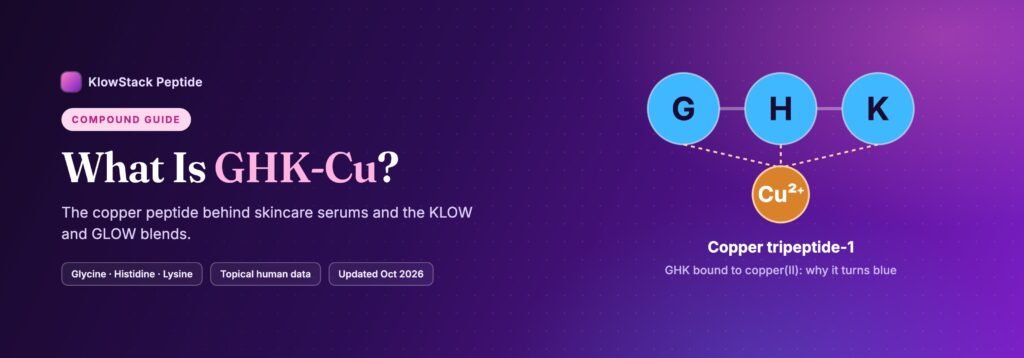
GHK-Cu is the copper complex of GHK, a three-amino-acid peptide (glycyl-L-histidyl-L-lysine). Loren Pickart identified it in human plasma in 1973. It binds copper(II) tightly, which gives it its blue color and is thought to explain much of its activity. Your own body makes it, so it isn’t a foreign drug.
The discovery story is a good one. Pickart noticed that blood plasma from young people made old liver tissue in the lab behave younger, producing proteins more like young tissue. He traced part of that effect to a tiny peptide, GHK, which grabs copper from its surroundings. Later work found GHK can also be released from tissues when they’re injured, which fits the idea that it acts as an early repair signal.
GHK levels fall as we get older. According to a 2018 review by Pickart and Anna Margolina, plasma GHK runs around 200 ng/mL at age 20 and drops to about 80 ng/mL by 60. Researchers often connect that decline to slower skin repair with age, though nobody has shown that topping it up reverses aging.
On a skincare label, GHK-Cu goes by its cosmetic name, “copper tripeptide-1.” It isn’t a hormone, and in the US it’s regulated as a cosmetic ingredient when it’s in a cream.
Is GHK-Cu the Same as “Copper Peptides”?
Not quite. “Copper peptides” is a broad marketing label, and GHK-Cu (copper tripeptide-1) is the best-studied member of the group. Other copper ingredients show up too, such as AHK-Cu (a related copper peptide often used in hair products) and plain copper salts, and they aren’t interchangeable.
A bigger percentage on the bottle doesn’t automatically mean a better copper peptide product, either. Formulation, pH and packaging all affect whether the peptide stays stable. When a serum just says “copper peptides,” check the ingredient list for the exact name.
How Does GHK-Cu Work?
GHK-Cu appears to work by delivering copper to enzymes involved in collagen formation and antioxidant defense, and by shifting the activity of many genes tied to tissue repair. In lab studies it promotes both new collagen and the breakdown of damaged tissue: it remodels skin, clearing out the old as it builds the new.
Think of a good home renovation crew. They don’t just add new drywall; they tear out the water-damaged sections first. GHK-Cu’s lab profile looks similar:
- Copper delivery (lab): copper is a helper for enzymes such as lysyl oxidase, which cross-links collagen fibers, and superoxide dismutase, an antioxidant enzyme. GHK can carry copper to where these enzymes work.
- Collagen and elastin (lab and topical human): GHK-Cu raises production of collagen, elastin and the gel-like molecules (glycosaminoglycans) that hold skin together.
- Remodeling (lab): it influences both the enzymes that break down old tissue (MMPs) and their brakes (TIMPs), helping balance demolition and rebuilding.
- Calmer inflammation and oxidation (lab and animal): in a mouse lung-injury model, GHK-Cu lowered inflammatory messengers like TNF and IL-6 and raised antioxidant enzyme activity.
- Safe copper handling (lab): free copper can spark damaging chemical reactions. GHK holds it tightly, a bit like a safe-deposit box, which lets cells use the copper without the side effects of loose copper ions.
- Gene expression (lab data): Pickart and Margolina report that GHK changes the activity of 31.2% of human genes by 50% or more in gene-database studies.
That last point gets quoted a lot online, so it’s worth a caveat. The gene numbers come from a large gene-expression database built by exposing cultured human cells to thousands of compounds. It shows GHK can switch large numbers of genes in a dish. It doesn’t show what happens in a person’s skin, let alone their whole body. Most of the mechanism data, like most of this section, comes from cells and gene databases.
Size helps explain GHK-Cu’s skincare success. At three amino acids, it’s small enough to work its way into the outer layers of skin from a cream, something many larger peptides and proteins can’t do. That’s one reason the topical research exists at all.
What Is GHK-Cu Used For?
GHK-Cu is used mainly in skincare, for firmness, fine lines and skin thickness, and studied for wound healing and hair growth. Topical skin use has small human trials; wound-healing evidence is mostly in animals; claims for injected or oral GHK-Cu aren’t backed by trials. So what is GHK-Cu used for? Mostly your face.
Skin: Collagen, Wrinkles and Firmness
This is GHK-Cu’s strongest area, and the numbers are genuinely interesting. As summarized in the Pickart and Margolina review:
- A facial cream with GHK-Cu, used for 12 weeks by 71 women with mild to advanced sun damage, increased skin density and thickness and reduced laxity, fine lines and wrinkle depth.
- A GHK-Cu eye cream, used for 12 weeks by 41 women, beat both a placebo and a vitamin K cream at reducing lines and improving skin density around the eyes.
- On thigh skin, 12 weeks of GHK-Cu improved collagen production in 70% of women, compared with 50% using a vitamin C cream and 40% using retinoic acid.
- In a randomized, double-blind 8-week study, GHK-Cu in a nano-lipid carrier cut wrinkle volume by 31.6% compared with Matrixyl 3000, another popular skincare peptide, and by 55.8% compared with a plain carrier.
Dermatologists take this seriously. Speaking to NPR in September 2026, Mount Sinai dermatologist Dr. David Goldberg said of topical copper peptides, “The science behind this is very solid.”
The studies are small and often industry-funded, so they aren’t the final word. Each one is broken down in our GHK-Cu for skin guide.
Hair Growth
GHK-Cu turns up in a lot of hair serums. Lab and early studies suggest it can enlarge hair follicles and support growth and thickness, which Pickart’s reviews list among its effects. Human hair data is limited, though, and related copper peptides like AHK-Cu often get mixed into the same claims. Our guide to GHK-Cu for hair growth looks at what’s been tested.
Wound Healing
Animal studies make a consistent case here. In rabbits, GHK helped wounds contract and grow new tissue and blood vessels. In both healthy and diabetic rats, a collagen dressing with GHK built into it healed wounds faster, with more new collagen.
One complication: GHK breaks down quickly in some wound fluids, which may be why it hasn’t become a wound product. There’s no approved GHK-Cu wound treatment in the US.
Other Areas Under Study
Researchers have also tested GHK in animal models of lung injury, nerve growth and even anxiety-like behavior. These are early, scattered findings. University of Washington aging researcher Dr. Warren Ladiges told NPR he thinks GHK could play a major role in longevity research, while adding that self-injecting it isn’t something he’d do.
What GHK-Cu Hasn’t Been Shown to Do
GHK-Cu hasn’t been shown to “reverse aging,” produce whole-body anti-aging effects from injections, or cause fat loss. Those claims stretch skin and lab findings far past what they show. Is GHK-Cu worth the hype? For topical skincare, there’s real if modest evidence. Beyond that, the hype is ahead of the data. Our GHK-Cu benefits page rates each claim.
How Strong Is the Evidence for GHK-Cu?
The evidence is strongest for topical GHK-Cu on skin, where several small human studies report gains in collagen and firmness. It’s weaker for hair, mostly animal-based for wound healing, and close to nonexistent for injected or oral GHK-Cu, which are the forms trending on social media.
| Use and route | Evidence level | Best evidence | Biggest gap |
|---|---|---|---|
| Topical, skin | Clinical (small studies) | 12-week cream studies; an 8-week randomized wrinkle trial | Small samples; few independent trials |
| Topical, hair | Early and limited | Lab and early follicle studies | Few controlled human studies |
| Wound healing | Preclinical | Rabbit and rat wound models | No human wound trials or approved product |
| Injected | None | No published human trials | Safety and effect unknown |
| Oral | None | No published human trials | Unclear if it survives digestion |
A few caveats apply to the topical work. Most studies are small, many were run by or for cosmetic companies, and the results mostly reach the public through reviews. Large independent randomized trials are rare.
There’s a structural reason for that. In the US, cosmetics don’t need FDA approval before they go on sale, so skincare companies have little incentive to run expensive, large trials. They run smaller studies that support their marketing. That’s normal for the cosmetics industry, and it’s why the evidence for most skincare peptides, GHK-Cu included, tends to be modest in size.
What would strengthen the case? Larger trials run by independent university groups, with placebo creams, blinded assessors and follow-up beyond 12 weeks. For injected GHK-Cu, the first step would simply be a basic human safety study.
NPR’s headline captured the injected side neatly: the trend has gone from creams to injections “ahead of the science.” One more nuance: the strongest human results come from specific formulations, such as a nano-lipid carrier or a particular cream base. A different serum with the same ingredient may not perform the same way, because delivery into skin depends heavily on the formula. Our Editorial Policy explains how we grade each level of evidence.
Topical, Injectable or Oral GHK-Cu: What’s the Difference?
Topical GHK-Cu (serums and creams) is a legal cosmetic ingredient with the most research behind it. Injectable GHK-Cu is sold as a research chemical or through clinics, with no controlled trials. Oral tablets and drops have no published evidence that they work, and peptides usually get broken down in the gut.
| Form | How it’s sold | Evidence | Legal status (US, October 2026) | Main risk |
|---|---|---|---|---|
| Topical serum or cream | Drugstores, Sephora, Amazon | Small human skin studies | Legal cosmetic ingredient | Irritation, breakouts |
| Injectable vial | Research suppliers, some clinics | No human trials | Not FDA-approved; injectable compounding nomination withdrawn in 2026 | Copper overload, infection, unknown dosing effects |
| Oral drops or tablets | Online sellers | No published trials | Not an approved drug | Unknown absorption; product quality |
Why would the same molecule behave so differently by route? On skin, it works locally, right where collagen is made. Injected, it enters the bloodstream with all its copper, and nobody has studied what that does over time. Swallowed, it faces stomach acid and digestive enzymes, which break most peptides into pieces before they’re absorbed. Clinics that offer injections usually present them as a stronger version of the serum. NPR’s reporting suggests dermatologists see it the other way around: in their clinical experience, topicals work better for skin and hair, and injections add risk without clear benefit. Until a trial compares the two, that’s informed opinion, and it’s the most expert view on record.
Research-grade vials also look different from serums. They contain freeze-dried powder, often several hundred times more concentrated than a cosmetic, which is part of why copper overload becomes possible when people self-inject. Our injectable vs topical GHK-Cu page goes deeper.
What Are the Side Effects of GHK-Cu?
Topical GHK-Cu is generally well tolerated, though some people report irritation or worse breakouts. Injected GHK-Cu carries more risk: NPR reported cases of high copper and liver-enzyme levels in people injecting too much without lab checks. Research vials add product-quality risks on top.
Topical: The most common complaints are redness, stinging and breakouts, especially in acne-prone skin or at high concentrations. Dr. Jennifer Gordon, a board-certified dermatologist at Westlake Dermatology, advises cutting back or stopping if skin becomes irritated. Those “copper peptides ruined my skin” posts usually describe irritation from overuse or harsh pairings. Most settle when the product is stopped. Starting with a lower-strength product a few times a week, and adding one new active ingredient at a time, makes it much easier to tell what’s causing a reaction.
Injected: In NPR’s reporting, Dr. Erik Marks described patients who self-injected copper peptides bought online and developed injection-site infections, elevated liver enzymes and high blood copper. Some told him they’d been injecting far more than they realized. Copper is essential in tiny amounts, and too much builds up in the liver. That’s the same reason doctors watch copper closely in people with Wilson’s disease, whose bodies can’t clear it well.
Research vials: contamination, wrong amounts and bacterial toxins are possible in any unregulated product.
What Shouldn’t You Mix With Copper Peptides?
The usual dermatology advice is to avoid layering copper peptides with strong acids or high-strength vitamin C (L-ascorbic acid) in the same step, since low pH can destabilize the copper complex. Westlake Dermatology also suggests using retinoids and copper peptides on alternate nights, to limit irritation. Using vitamin C in the morning and copper peptides at night is a common workaround.
Who Should Not Use Copper Peptides?
People with copper-metabolism disorders such as Wilson’s disease, anyone pregnant or breastfeeding without medical advice, and people with very reactive or acne-prone skin should be careful. A dermatologist or clinician is the right person to ask first.
Can You Use Copper Peptides Every Day?
Many topical products are designed for daily use, often once a day, so follow the directions on the product. No comparable guidance exists for injections, and we don’t publish dosing for any research compound. Our GHK-Cu side effects page has more detail.
Is GHK-Cu Legal?
Yes, as a cosmetic ingredient. Topical copper tripeptide-1 products are sold legally in the US. Injectable GHK-Cu is not FDA-approved, and its compounding status in 2026 is unsettled: it wasn’t on the FDA advisory committee’s July 2026 agenda, and the FDA plans a separate review before the end of February 2027.
Here’s what the FDA’s own records show, as of its list updated May 14, 2026:
- Injectable GHK-Cu: the nomination for injectable routes was withdrawn in April 2026. It had been listed among substances raising safety concerns (Category 2), and it no longer appears there. Removal isn’t approval.
- Non-injectable GHK-Cu: after a May 5, 2026 clarification from a nominator, GHK-Cu for non-injectable routes was placed back in Category 1, meaning “under evaluation” for compounding.
- Next step: the FDA says it intends to consult its Pharmacy Compounding Advisory Committee before the end of February 2027 about adding GHK-Cu to the 503A list.
Cosmetics follow a different set of rules. Under the Modernization of Cosmetics Regulation Act of 2022, cosmetic makers must register facilities and keep safety substantiation for their products. A cosmetic also can’t claim to change the body’s structure or function, which is why serum labels talk about the “look” of firmness or lines.
That’s why you’ll see conflicting claims online. The July 2026 advisory meeting reviewed BPC-157, KPV, TB-500 and others, but not GHK-Cu. NPR also reported that the administration has signaled openness to loosening compounding restrictions on injectable peptides, which hasn’t changed the rules yet. Updates are logged by New Drug Loft, a compounding pharmacy.
GHK-Cu isn’t named on the WADA Prohibited List, though athletes should check the current list before using any unapproved substance. Status checked against the FDA’s list on October 5, 2026; because the review is ongoing, it’s worth re-checking before relying on any claim. The bigger legal picture is in our guide to whether peptides are legal.
GHK-Cu in Peptide Blends: GLOW and KLOW
GHK-Cu is the largest ingredient in both GLOW and KLOW: 50 mg per vial in the standard ratio, which is 71% of GLOW and 62.5% of KLOW. It’s also why both blends are blue. Some vendors sell a 30 mg version, which tilts the balance toward the repair peptides.
| Blend | GHK-Cu per vial | Share of the vial |
|---|---|---|
| GLOW (standard 70 mg) | 50 mg | 71.4% |
| GLOW (30/20/20 version) | 30 mg | 42.9% |
| KLOW (standard 80 mg) | 50 mg | 62.5% |
That big share is the reason GLOW and KLOW are marketed for skin and hair. It also makes GHK-Cu the ingredient most likely to dominate a blend’s lab results, so a COA should report it separately from the smaller ingredients. It also means GHK-Cu’s legal status shapes both blends more than any other ingredient. Since injectable GHK-Cu wasn’t part of the July 2026 vote, a blend containing it can’t benefit from that vote even if the other ingredients are eventually listed. Its own review, planned before the end of February 2027, carries just as much weight for GLOW and KLOW as for GHK-Cu alone.
For the combinations themselves, see GLOW and the KLOW stack. Our KLOW vs GHK-Cu and GHK-Cu vs BPC-157 comparisons cover the single-ingredient angle, and the peptide blends hub maps the whole family.
How Does GHK-Cu Compare to Retinol, Matrixyl and Argireline?
Retinol is the most proven anti-aging ingredient; GHK-Cu has smaller studies but tends to be gentler. Matrixyl is another collagen-signaling peptide, and Argireline targets expression lines, so each works differently and many routines use more than one.
| Ingredient | Type | Main use | Evidence |
|---|---|---|---|
| Retinol / retinoids | Vitamin A derivative | Wrinkles, texture, acne | Decades of strong human trials (prescription tretinoin is FDA-approved) |
| GHK-Cu | Copper peptide | Firmness, fine lines, density | Small human studies |
| Matrixyl | Signal peptide (palmitoyl pentapeptide) | Collagen support | Small human studies |
| Argireline | Neurotransmitter-modulating peptide | Expression lines | Small human studies |
Each works differently. Retinoids speed up skin-cell turnover and boost collagen through vitamin A receptors. Matrixyl (palmitoyl pentapeptide-4) acts as a messenger that tells skin to make more collagen. Argireline (acetyl hexapeptide-8) is marketed as a topical way to soften expression lines by relaxing tiny facial muscles, a much gentler cousin of the idea behind Botox.
Retinoids are the Toyota Camry of anti-aging: not flashy, endlessly tested, and reliable. Copper peptides appeal to people whose skin doesn’t tolerate retinoids well. Many dermatologists don’t treat it as an either-or choice: a common approach is a retinoid on some nights and a copper peptide on others, so each gets its turn without the two irritating skin at once. Our GHK-Cu vs Retinol, vs Matrixyl and vs Argireline pages go head to head.
How Much Does GHK-Cu Cost, and How Do You Choose a Product?
Copper peptide serums cost roughly 13–50 in US listings in October 2026, with some clinic products above $150. When choosing one, check for “copper tripeptide-1” on the ingredient list. For research vials, look for a third-party COA that confirms identity and purity.
A few dated price examples from October 2026 US listings:
- The Ordinary Multi-Peptide + Copper Peptides: about $32
- Remedy copper peptide serum: about $30
- Peach & Lily: about $28 to $49
- Budget serums: from about $13
Prices change, so re-check them before buying. A higher price often reflects branding more than copper content; several budget serums list copper tripeptide-1 just as prominently as luxury ones. When you compare serums, look for:
- The exact ingredient name, copper tripeptide-1, high on the list
- Opaque, airtight packaging, since light and air can degrade peptides
- Sensible claims, with no promises of “reversing” age
- A patch test, on a small area of skin for a few days before full use
Don’t judge by the percentage alone; formulation counts as much as concentration. For research-grade vials, a COA should confirm identity by HPLC and mass spectrometry, purity, the measured amount and endotoxin results, with a lot number that matches the vial. Research vials of GHK-Cu are usually far bluer than serums, simply because they’re so concentrated. A deep color confirms copper is present and nothing else. Our guide on how to verify a peptide COA explains each line. We don’t publish dosing for research compounds.
Frequently Asked Questions
What is GHK-Cu used for?
GHK-Cu is used mainly in skincare to improve firmness, fine lines and skin density, backed by small human studies. It’s also studied for wound healing (mostly animals) and hair growth (early data).
Is GHK-Cu worth the hype?
For topical skincare, there’s real if modest evidence from small human studies. Claims for injected or oral GHK-Cu, such as whole-body anti-aging, aren’t supported by published trials.
What are the negative side effects of GHK-Cu?
Topical GHK-Cu can cause redness, stinging or breakouts. Injected GHK-Cu has been linked in NPR’s reporting to infections, high copper and raised liver enzymes in people self-injecting without lab checks.
Is GHK-Cu legal?
Yes, as a cosmetic ingredient in creams and serums. Injectable GHK-Cu isn’t FDA-approved. The FDA plans to consult its compounding committee about GHK-Cu before the end of February 2027.
Are copper peptides and GHK-Cu the same?
GHK-Cu, listed as copper tripeptide-1, is the best-studied copper peptide, but “copper peptides” also covers others like AHK-Cu and copper salts. Check the ingredient list for the exact name.
Can you use copper peptides every day?
Many topical copper peptide products are made for daily use, often once a day. Follow the product’s directions, and cut back if your skin gets irritated. No such guidance exists for injections.
What should you not mix with copper peptides?
Avoid layering copper peptides with strong acids or high-strength vitamin C in the same step, and alternate nights with retinoids. Many people use vitamin C in the morning and copper peptides at night.
Who should not use copper peptides?
People with copper-metabolism disorders like Wilson’s disease, anyone pregnant or breastfeeding without medical advice, and people with very reactive or acne-prone skin should check with a clinician first.
Does GHK-Cu help hair growth?
Lab and early studies suggest GHK-Cu can enlarge hair follicles and support thickness. Human data is limited, and claims often mix GHK-Cu with other copper peptides used in hair products.
Does your body make GHK-Cu naturally?
Yes. GHK occurs naturally in blood, saliva and urine and binds copper. Levels drop from about 200 ng/mL at age 20 to about 80 ng/mL by age 60.
Does oral GHK-Cu work?
There’s no published evidence that oral GHK-Cu drops or tablets work. Peptides are usually broken down by digestion, and nobody has published data on how much oral GHK-Cu reaches the blood.
Why is GHK-Cu blue?
GHK-Cu is blue because of its copper(II) ion. Copper compounds are famous for blue and green colors, from copper sulfate crystals to the Statue of Liberty’s green coat.
Sources
Studies and reviews
- Pickart L, Margolina A. 2018. Regenerative and Protective Actions of the GHK-Cu Peptide in the Light of the New Gene Data. International Journal of Molecular Sciences. doi:10.3390/ijms19071987
- Pickart L, Vasquez-Soltero JM, Margolina A. 2015. GHK Peptide as a Natural Modulator of Multiple Cellular Pathways in Skin Regeneration. BioMed Research International. doi:10.1155/2015/648108
News and dermatology
- NPR: The copper peptide trend has gone from creams to injections, ahead of the science (September 7, 2026)
- Westlake Dermatology: A Dermatologist’s Take on the Copper Peptide (GHK-Cu) Trend
Regulatory
Disclaimer: Injectable and research-grade GHK-Cu are sold for research use only and aren’t approved for human use. This guide is for education and doesn’t give medical advice. Read our Medical Disclaimer and Editorial Policy.