
Reviewed by Thomas Okafor, Peptide Chemist · Updated October 2026
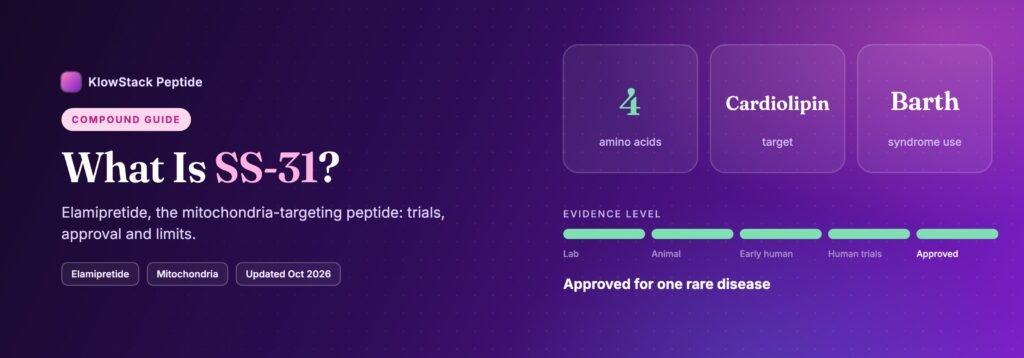
SS-31, known as elamipretide, is a synthetic four-amino-acid peptide that travels into mitochondria and binds cardiolipin, a fat molecule that holds the energy-making machinery in place. By stabilizing it, SS-31 is thought to help mitochondria make energy more efficiently with less damage. It’s studied mainly for rare mitochondrial diseases, heart failure and eye disease.
SS-31 has more human data than almost any other peptide in our longevity section, from more than 20 clinical trials. Many of those trials missed their main goals, but in September 2025 the FDA granted it accelerated approval, as Forzinity, for one ultra-rare genetic condition, Barth syndrome. Claims online that it reverses aging go well beyond that evidence.
Forzinity is a prescription medicine for one approved use. Research-grade SS-31 isn’t approved for human use. This guide is educational; see our Medical Disclaimer.
What Is SS-31 (Elamipretide)?
SS-31 is a lab-made peptide discovered by Hazel Szeto of Weill Cornell Medicine and Peter Schiller of the Montreal Clinical Research Institute; “SS” stands for their initials. They originally explored this family of small peptides as pain medicines, then found that some of them collected inside mitochondria. Stealth BioTherapeutics later developed SS-31 as a drug, under the names MTP-131, Bendavia and finally elamipretide.
Why mitochondria? Mitochondria are the power plants inside nearly every cell. Their inner membrane is folded into ridges called cristae, packed with the protein machinery that turns food into ATP, the cell’s energy currency. A special fat called cardiolipin acts like the scaffolding that holds those machines together. When cardiolipin is damaged, as it is in some genetic diseases and with aging, the machinery works less efficiently and leaks more damaging oxygen byproducts.
The chemistry. SS-31 is four amino acids: D-arginine, dimethyltyrosine, lysine and phenylalanine, with an amide cap. Two features stand out. It alternates positive charges and aromatic rings, which helps it slip across membranes and settle near negatively charged cardiolipin. And the “D” form of arginine plus the modified tyrosine make it resistant to enzymes.
The history. Stealth tested elamipretide in heart attacks, heart failure, kidney disease, eye disease and mitochondrial disorders from about 2012 onward. Several large trials missed their primary goals. In Barth syndrome, a rare inherited cardiolipin disorder, results were more encouraging, and after a complete response letter in May 2025, the FDA granted accelerated approval on September 19, 2025.
Also known as: SS-31, elamipretide, MTP-131, Bendavia and Forzinity
These are all the same molecule. SS-31 is the original lab name, MTP-131 and Bendavia were early development names, elamipretide is the official generic name, and Forzinity is the brand. “SS-31” on a research-chemical site means unapproved powder, not the prescription product.
How Does SS-31 Work?
SS-31 crosses into cells and concentrates in the inner mitochondrial membrane, where it binds cardiolipin. That’s thought to stabilize the cristae and the energy-making protein complexes, helping electrons flow smoothly so mitochondria make more ATP and leak fewer reactive oxygen molecules. It doesn’t simply mop up free radicals the way a vitamin does.
What’s known about each step, and from what kind of research:
- Mitochondrial uptake (lab and animal): labeled SS-31 accumulates in mitochondria many times over its level outside the cell.
- Cardiolipin binding (lab): SS-31 binds cardiolipin directly and changes how it interacts with cytochrome c, a protein in the energy chain.
- More ATP, less oxidative stress (animal): in aged mice and models of heart and kidney injury, SS-31 improved mitochondrial function and reduced damage.
- Faster ATP production in older adults (human): in a 2021 randomized trial, one infusion raised peak mitochondrial ATP production in older adults’ hand muscle right after dosing, with no difference a week later.
- Muscle strength in Barth syndrome (human): the FDA’s approval rests on improved knee muscle strength, an intermediate measure.
What does SS-31 do? Picture the folded inner membrane as a factory floor and cardiolipin as the floor bolts holding the machines in place. SS-31 is thought to tighten loose bolts so the assembly line runs more smoothly. It works best where the bolts are clearly loose, as in Barth syndrome. Whether healthy-but-aging factories need it is another question.
What Is SS-31 Used For / Studied For?
SS-31 is approved for Barth syndrome. It has also been tested in primary mitochondrial myopathy, heart attack and heart failure, dry age-related macular degeneration, and muscle aging. Most of those trials missed their primary endpoints, though some showed signals that led to further studies.
Barth syndrome
What was studied: Barth syndrome is an X-linked genetic disease, mostly affecting boys, in which cardiolipin is abnormal, causing heart muscle disease, weakness and fatigue. Only about 150 people in the US have it. The TAZPOWER trial enrolled 12 patients in a placebo-controlled crossover followed by an open-label extension.
What it found: the 12-week crossover part missed both primary endpoints. In the open-label extension, at 36 weeks, six-minute walk distance improved by about 96 meters and symptom scores improved. A 168-week follow-up reported sustained benefits.
What it doesn’t show: a placebo-controlled long-term benefit. The approval is “accelerated,” meaning confirmatory evidence is still required.
Primary mitochondrial myopathy
What was studied: the MMPOWER-3 trial randomized 218 adults with genetic mitochondrial muscle disease to elamipretide or placebo for 24 weeks.
What it found: it didn’t meet its primary endpoints of six-minute walk distance or fatigue. A later analysis suggested people with certain nuclear DNA defects might respond, and a new Phase 3 trial is testing that group.
Heart attack and heart failure
What was studied: the EMBRACE STEMI trial gave intravenous elamipretide during treatment for a first major heart attack. Other Phase 2 trials tested it in heart failure.
What it found: EMBRACE STEMI found no reduction in heart-attack size or improvement in other outcomes. In the PROGRESS-HF trial, 71 people with weakened hearts received daily elamipretide or placebo for four weeks, and heart size and pumping didn’t improve compared with placebo, though the drug was well tolerated.
What it doesn’t show: benefit for common heart disease. Short treatment periods may have been a limit, but the results so far are negative.
Inherited eye disease (LHON)
What was studied: a 2024 Ophthalmology trial tested elamipretide eye drops in 12 adults with Leber hereditary optic neuropathy, a mitochondrial cause of vision loss.
What it found: visual sharpness didn’t improve compared with the untreated eye, though some secondary measures, like central visual field, looked better in after-the-fact analyses.
What it doesn’t show: a treatment effect strong enough to rely on. It’s a tiny, early study.
Dry macular degeneration and aging muscle
What was studied: the ReCLAIM-2 Phase 2 trial in 176 adults with dry age-related macular degeneration, and trials of muscle function in older adults.
What it found: ReCLAIM-2 didn’t meet its main vision endpoint, though some imaging measures looked encouraging, and a Phase 3 trial (ReNEW) is under way. In older adults, a single dose briefly boosted muscle ATP production without changing fatigue resistance.
What SS-31 hasn’t been shown to do
SS-31 hasn’t been shown to slow aging, extend life, improve endurance or boost energy in healthy people. It’s sometimes sold online as a “mitochondrial reset” for anti-aging, but the only approval is for a rare genetic disease, and its trials in common conditions mostly fell short.
What Does the Human Research Show?
SS-31 has an unusually large clinical program for a peptide: more than 20 registered trials, mostly sponsored by Stealth BioTherapeutics. The pattern is consistent: good safety, encouraging biology, and frequent misses on primary endpoints. Its strongest case is Barth syndrome, which led to accelerated approval in 2025.
| Study | Year | Design | Participants | Result | Limitation |
|---|---|---|---|---|---|
| EMBRACE STEMI | 2016 | Phase 2a RCT | About 300 adults with first anterior heart attack | No reduction in infarct size | Single infusion |
| TAZPOWER | 2021 | Phase 2/3 crossover + open-label extension | 12 people with Barth syndrome | Crossover missed endpoints; extension: walk +96 m at 36 weeks | Tiny, open-label extension |
| Roshanravan et al. | 2021 | RCT, single dose | Older adults | Brief rise in muscle ATP capacity | One dose; no functional benefit |
| MMPOWER-3 | 2023 | Phase 3 RCT | 218 adults with mitochondrial myopathy | Missed primary endpoints | Mixed genetic causes |
| ReCLAIM-2 (NCT03891875) | 2023 | Phase 2 RCT | 176 adults with dry AMD | Missed main vision endpoint | Phase 3 ongoing |
PubMed (538 records) and ClinicalTrials.gov (21 elamipretide trials) searched October 5, 2026.
The Barth syndrome approval relied partly on open-label data and natural history comparisons, which is common for ultra-rare diseases and drew public debate about how flexible the FDA should be. When only about 150 people in a country have a disease, a large randomized trial may be impossible, and regulators have to decide how much uncertainty is acceptable for patients with no other option. That reasoning doesn’t extend to healthy people seeking an energy boost, where the trade-off is entirely different. Our Editorial Policy explains how we label approvals based on intermediate endpoints.
SS-31 Side Effects and Safety
Across trials, elamipretide was generally well tolerated. The most common side effects were injection-site reactions, such as redness, itching and pain, which were frequent with daily injections. Serious drug-related problems were uncommon in published trials. Long-term safety in healthy people hasn’t been studied.
Reported in human studies: injection-site reactions were the main complaint in trials using daily injections, and some participants stopped for that reason. Other reported effects included headache and dizziness. Trials in heart disease and kidney disease didn’t show major safety signals.
Expected from the mechanism: because SS-31 changes how mitochondria run, effects in tissues with very high energy demands, such as the heart, eyes and brain, are plausible and are monitored in trials. Its interaction with other medicines that affect mitochondria hasn’t been well studied.
Anecdotal only: online self-reports mention feeling more energetic, better workouts or no noticeable effect at all. Users also describe itchy, red welts at injection sites, which matches trial data. None of the “energy” claims has been tested in healthy people.
Product quality: research-grade SS-31 isn’t made to drug standards, and its modified amino acid (dimethyltyrosine) makes it harder and costlier to synthesize correctly. Our peptide COA guide explains how identity testing confirms the right molecule.
Who should avoid SS-31
Outside the approved use, anyone pregnant or breastfeeding, under 18, or with serious kidney disease has extra reason for caution, along with people with heart conditions who aren’t under a specialist’s care. People with Barth syndrome should discuss Forzinity with their specialist, who can weigh the approved data.
Can SS-31 reverse aging?
No study shows that it does. In aged mice, SS-31 improved heart and muscle function, which drives the anti-aging interest. In older adults, a single infusion briefly raised muscle energy capacity but didn’t improve fatigue. A trial of physical function in healthy aging is now recruiting, which shows the question is still open.
SS-31 vs MOTS-c
SS-31 and MOTS-c are both “mitochondrial peptides,” but they act in opposite directions. SS-31 is a synthetic drug that goes into mitochondria and stabilizes the membrane. MOTS-c is a natural peptide made by mitochondria that sends signals out to the rest of the cell.
| SS-31 (elamipretide) | MOTS-c | |
|---|---|---|
| Mechanism | Binds cardiolipin in the inner membrane | AMPK activation and nuclear gene signaling |
| Half-life | A few hours | Not established in humans |
| Evidence | 20+ human trials; FDA accelerated approval | Mostly mice; one analog trial |
| Status | Approved (Forzinity) for Barth syndrome | Research use only |
The full comparison is in MOTS-c, SS-31 and the Mitochondrial Theory of Aging, and our MOTS-c guide covers the other side.
Is SS-31 Legal?
Elamipretide is legal in the US as a prescription drug, Forzinity, approved under accelerated approval for Barth syndrome in patients weighing at least 30 kg. Any other use is off-label or unapproved. Research-grade SS-31 isn’t approved for human use, and because Forzinity is now on the market, pharmacies generally can’t compound copies of it.
Approved drug. The FDA granted accelerated approval on September 19, 2025, based on improved knee-extensor muscle strength from the TAZPOWER program. Accelerated approval means the company must confirm the clinical benefit in further studies, and Stealth has a Phase 4 Barth syndrome trial recruiting. The FDA label has the full prescribing details.
Compounding. Since an approved version now exists, routine compounded copies are generally restricted under federal law. Before approval, elamipretide wasn’t on the FDA’s compounding lists either.
Research use only. “SS-31” vials sold online under a research label aren’t Forzinity, and their contents haven’t been checked to drug standards. Our guide to whether research peptides are legal explains the rules.
Sport. Elamipretide isn’t named on the 2026 WADA Prohibited List, and it no longer falls under the S0 catch-all for unapproved substances now that it’s an approved drug. Athletes should still confirm with their anti-doping organization, especially for research-grade products.
FDA and WADA status checked October 5, 2026.
Where SS-31 Fits: Needs & Symptoms
SS-31 appears in Longevity & Cellular Health, for its role in protecting mitochondrial membranes, and Sleep & Energy, where the card ties it to how efficiently cells produce usable energy. Its human data are stronger than most compounds on either page, but they come from disease populations, not healthy people.
Related guides on those pages include MOTS-c and humanin, the other mitochondrial peptides, and epitalon in aging research. The mitochondrial peptides are compared side by side in MOTS-c vs SS-31.
Frequently Asked Questions
What does SS-31 do?
SS-31 enters mitochondria and binds cardiolipin, a membrane fat that holds the energy machinery together. That’s thought to improve energy production and reduce oxidative damage.
Is SS-31 FDA-approved?
Yes, for one use. Elamipretide (Forzinity) received accelerated approval in September 2025 for Barth syndrome in patients weighing at least 30 kg.
Is SS-31 safe?
In trials, it was generally well tolerated, with injection-site reactions the main side effect. Safety in healthy people taking research-grade SS-31 hasn’t been studied.
What is SS-31 used for?
Its approved use is Barth syndrome, a rare inherited mitochondrial disease. It has also been tested in mitochondrial myopathy, heart failure, heart attack and dry macular degeneration, with mostly negative primary results.
Can SS-31 help with aging or energy?
It’s unproven. In older adults, one dose briefly increased muscle energy capacity but didn’t reduce fatigue. No trial has shown anti-aging benefits in healthy people.
Is SS-31 legal?
Forzinity is legal by prescription for Barth syndrome. Research-grade SS-31 isn’t approved for human use.
Is SS-31 banned in sports?
It isn’t named on the 2026 WADA list. Athletes should confirm with their anti-doping body before using any unprescribed product.
Has SS-31 been tested in humans?
Yes, in more than 20 clinical trials, including Phase 3 studies. Most missed their main goals, but the Barth syndrome program led to accelerated approval.
What’s the difference between SS-31 and MOTS-c?
SS-31 is a synthetic drug that protects the mitochondrial membrane; MOTS-c is a natural signal made by mitochondria. See MOTS-c vs SS-31.
What dose of SS-31 is used?
Approved dosing for Forzinity is set by the FDA label and a specialist. We don’t publish dosing; see our Medical Disclaimer.
Sources
Primary studies
- Gibson CM, et al. 2016. EMBRACE STEMI study: a Phase 2a trial to evaluate the safety, tolerability, and efficacy of intravenous MTP-131 on reperfusion injury. European Heart Journal. doi:10.1093/eurheartj/ehv597
- Reid Thompson W, et al. 2021. A phase 2/3 randomized clinical trial followed by an open-label extension to evaluate the effectiveness of elamipretide in Barth syndrome. Genetics in Medicine. doi:10.1038/s41436-020-01006-8
- Roshanravan B, et al. 2021. In vivo mitochondrial ATP production is improved in older adult skeletal muscle after a single dose of elamipretide. PLoS One. doi:10.1371/journal.pone.0253849
- Karaa A, et al. 2023. Efficacy and safety of elamipretide in individuals with primary mitochondrial myopathy: the MMPOWER-3 randomized clinical trial. Neurology. doi:10.1212/WNL.0000000000207402
- Thompson WR, et al. 2024. Long-term efficacy and safety of elamipretide in patients with Barth syndrome: 168-week open-label extension results of TAZPOWER. Genetics in Medicine. doi:10.1016/j.gim.2024.101138
- Butler J, et al. 2020. Effects of elamipretide on left ventricular function in patients with heart failure with reduced ejection fraction: the PROGRESS-HF phase 2 trial. Journal of Cardiac Failure. doi:10.1016/j.cardfail.2020.02.001
- Karanjia R, et al. 2024. Elamipretide topical ophthalmic solution for the treatment of subjects with Leber hereditary optic neuropathy. Ophthalmology. doi:10.1016/j.ophtha.2023.10.033
Reviews
- Shirley M. 2026. Elamipretide: first approval. Drugs. doi:10.1007/s40265-025-02269-8
Regulatory and news
Disclaimer: Forzinity (elamipretide) should be used only under a specialist’s care for its approved use. Research-grade SS-31 is sold for research use only and isn’t approved for human use. This guide is educational and doesn’t give medical advice. Read our Medical Disclaimer and Editorial Policy.