
Reviewed by Thomas Okafor, Peptide Chemist · Updated October 2026
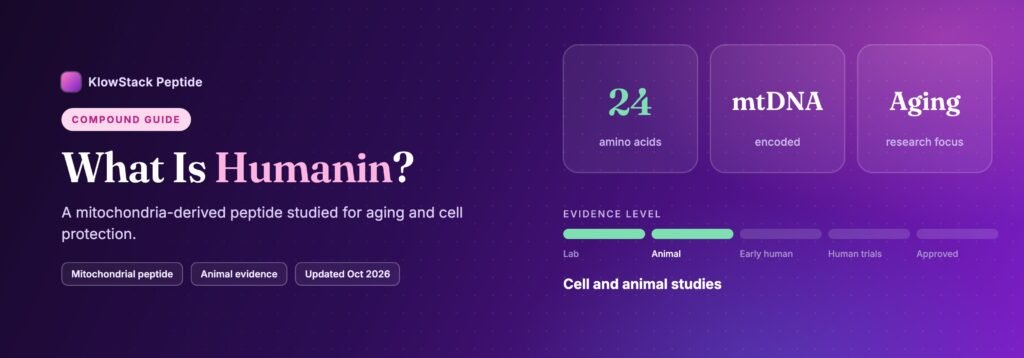
Humanin is a small peptide, 21 to 24 amino acids long, encoded inside the DNA of mitochondria, the cell’s power plants. Discovered in 2001 while Japanese scientists searched for what kept some neurons alive in an Alzheimer’s brain, it protects cells from dying in lab and animal studies, and it’s studied for brain aging, diabetes and heart injury.
Humanin hasn’t been given to people in any published clinical trial. What’s known in humans comes from measuring natural blood levels, which tend to fall with age and run higher in the children of centenarians. Everything about humanin as a treatment, including its anti-aging reputation, rests on cells, worms and rodents as of October 2026.
Humanin isn’t approved for any use, and research-grade humanin is sold for research use only. This guide is educational; see our Medical Disclaimer.
What Is Humanin?
Humanin is one of a handful of peptides coded by mitochondrial DNA, a separate set of genes that mitochondria carry, inherited from the mother. It’s hidden inside a gene for ribosomal RNA, which is why it went unnoticed for decades. Scientists now call it a mitochondrial-derived peptide, or MDP, along with MOTS-c and several smaller peptides.
How it was found. In 2001, Ikuo Nishimoto’s team at Keio University in Tokyo screened genetic material from the part of an Alzheimer’s patient’s brain that had been spared, looking for anything that kept neurons alive. They found a short sequence that protected neurons from several Alzheimer’s-related triggers and named its peptide “humanin,” reflecting their hope for its value to human health.
Two more discoveries in 2003. Within two years, a California team showed in Nature that humanin binds Bax, a protein that tells cells to self-destruct, and another group found it binds IGFBP-3, a protein linked to growth and cell survival. Those findings broadened interest from Alzheimer’s to aging and metabolism generally.
The lab-made version. Swapping one amino acid (serine 14 for glycine) produces HNG, or humanin-G, which is far more potent in lab tests. Many animal studies, and many research products, use HNG.
Also known as: HN, HNG and MT-RNR2
HN is the standard abbreviation. HNG and S14G-humanin are the potent synthetic variant. MT-RNR2 is the mitochondrial gene that holds the humanin code, and the nuclear genome carries about a dozen similar “MT-RNR2-like” genes. Don’t confuse humanin with MOTS-c, a separate mitochondrial peptide focused more on metabolism and exercise.
How Does Humanin Work?
Humanin protects cells in two main ways. Inside cells, it latches onto Bax and related proteins, stopping them from punching holes in mitochondria and triggering cell death. Outside cells, it binds receptors on the cell surface that switch on survival and anti-inflammatory signals. All of this comes from lab and animal work.
What’s known, and from what kind of research:
- Blocking cell death (lab): humanin stops Bax from moving to mitochondria and releasing the signals that start cell death, shown in the 2003 Nature study.
- Surface receptors (lab): humanin activates a receptor called FPRL1 and a three-part receptor complex that turns on STAT3, a survival pathway.
- Insulin action (animal): a 2009 study in rats found humanin infused into the brain improved insulin sensitivity body-wide, working through the hypothalamus.
- Brain aging (animal): in 2018, USC researchers reported humanin improved memory in aged mice.
- Lifespan (worm and mouse): extra humanin extended lifespan in tiny worms, and HNG improved several health markers in middle-aged mice in a 2020 study.
What does humanin do? Picture a building’s fire suppression system that kicks in before a small fire spreads. Humanin seems to stop the “self-destruct” signal in stressed cells before it reaches the point of no return. Whether boosting that system helps in people, or could protect cells that ought to die, is unknown.
What Is Humanin Used For / Studied For?
Humanin is studied for Alzheimer’s disease and brain aging, type 2 diabetes and insulin resistance, heart damage after blocked blood flow, and lifespan. All treatment studies are in cells or animals. Human studies measure natural humanin levels in blood and connect them to age, disease or genetics.
Alzheimer’s and brain aging
What was studied: neuron cultures exposed to amyloid and Alzheimer’s gene mutations, aged mice given humanin, and genetic data from older adults.
What it found: humanin protected neurons in culture and improved memory tests in aged mice. In people, a gene variant linked to lower humanin levels went with faster cognitive aging, and a 2024 study found a rare humanin variant enriched among centenarians carrying the Alzheimer’s risk gene APOE4.
What it doesn’t show: that giving humanin protects human memory. These are associations in people and treatment effects in mice.
Insulin resistance and metabolism
What was studied: rats and mice given humanin or HNG, and blood levels in people with diabetes.
What it found: humanin improved insulin action in rats and reduced inflammation markers in mice. Several studies report lower humanin in people with type 2 diabetes, and a 2021 Swedish study found a single endurance workout raised blood humanin in 10 adults.
What it doesn’t show: a metabolic benefit from humanin treatment in people.
Longevity
What was studied: worms, mice, naked mole-rats and the families of centenarians.
What it found: humanin levels fell with age in most species but stayed steady in naked mole-rats, which age unusually slowly. Children of centenarians had much higher humanin than people of similar age.
What it doesn’t show: that humanin causes longer life. High levels could be a marker of good health and nothing more.
What humanin hasn’t been shown to do
It hasn’t been shown to slow aging, prevent Alzheimer’s, treat diabetes, improve endurance or extend lifespan in people. Those claims extrapolate from mice, worms and blood-level associations.
What Does the Human Research Show?
There are no published trials giving humanin to people. Human research consists of observational studies measuring natural humanin in blood, muscle or heart tissue, and genetic studies of humanin variants. Those link higher levels to healthier aging but can’t show cause and effect.
| Study | Year | Design | Participants | Result | Limitation |
|---|---|---|---|---|---|
| Yen et al. | 2018 | Genetic association plus mouse study | National sample of older adults | Low-humanin gene variant tied to faster cognitive aging | Association only |
| Yen et al. | 2020 | Observational, plus animal work | Centenarians’ children vs controls | Much higher blood humanin | Association only |
| von Walden et al. | 2021 | Randomized exercise study | 30 adults | Endurance exercise raised humanin | Natural levels; no treatment |
| Miller et al. | 2024 | Genetic study, plus lab and mouse work | Centenarians with APOE4 | Rare P3S variant enriched | Association only |
PubMed (570 records) and ClinicalTrials.gov (3 registered studies, all measuring natural levels) searched October 5, 2026.
Much of this work comes from one USC lab, whose senior author disclosed consulting for and holding stock in CohBar, a company that developed mitochondrial peptide drugs. That’s common in early research, and it’s why we look for independent replication. Our Editorial Policy explains how we handle it.
Humanin Side Effects and Safety
Humanin’s safety in people is unknown, because it’s never been tested in a human trial. Animal studies haven’t flagged obvious toxicity. The main theoretical concern is cancer: a peptide that helps stressed cells avoid death might also help tumor cells survive.
Reported in human studies: none; no human dosing studies exist.
Expected from the mechanism: humanin blocks cell death, and cancer cells depend on avoiding that same process. A 2020 mouse study found humanin promoted tumor growth in an aggressive breast cancer model and reduced the effect of chemotherapy. Some studies also find higher humanin in tumor tissue.
Anecdotal only: people using research-grade humanin or HNG online report injection-site redness and occasional headaches. These reports haven’t been studied.
Product quality: vials may contain natural humanin or HNG, and labels don’t always say which. Our peptide COA guide explains how mass testing can tell them apart.
Who should avoid humanin
Anyone with active or past cancer, or getting chemotherapy, has the clearest reason to avoid it, given the 2020 tumor findings. Pregnancy, breastfeeding, being under 18 and competing in tested sport are other clear reasons.
Humanin vs MOTS-c
Humanin and MOTS-c are both mitochondrial-derived peptides, often studied by the same labs. Humanin leans toward cell survival and brain protection; MOTS-c leans toward metabolism and exercise. MOTS-c has gone further toward human testing.
| Humanin | MOTS-c | |
|---|---|---|
| Mechanism | Blocks Bax-driven cell death; survival receptors | Activates AMPK; metabolic stress response |
| Half-life | Short in blood; not well defined | Short in blood; not well defined |
| Evidence | Lab, animal and association studies | Animal studies; an analog reached early human trials |
| Status | Not nominated for compounding | Favorable PCAC vote (July 2026); not approved |
Our MOTS-c guide covers its research and the July 2026 FDA review.
Is Humanin Legal?
Humanin isn’t FDA-approved for any use, and it hasn’t been nominated to the FDA for compounding, so pharmacies can’t legally prepare it. In the US, it’s sold only as a research chemical labeled “research use only.” No country has approved it as a drug.
FDA. Humanin doesn’t appear on the FDA’s 503A nomination lists and wasn’t part of the July 2026 peptide review. Without a nomination or an approved drug containing it, there’s no legal pathway for a pharmacy to compound it.
Research use only. This label means the product hasn’t been tested or approved for people. Our guide to whether research peptides are legal explains the rules.
Sport. Humanin isn’t named on the 2026 WADA Prohibited List, but WADA’s S0 class bans unapproved pharmacological substances, which would appear to include it.
FDA and WADA status checked October 5, 2026.
Where Humanin Fits: Needs & Symptoms
Humanin appears in Longevity & Cellular Health, described as a mitochondrial-derived peptide researched for its proposed cytoprotective role. “Proposed” is the right word: the protection is clear in cells and animals, and untested in people.
Other guides in that category include MOTS-c, SS-31, a mitochondria-targeting peptide with an approved drug form, and epitalon, studied for telomeres and the pineal gland.
Frequently Asked Questions
What is humanin?
Humanin is a 21- to 24-amino-acid peptide encoded in mitochondrial DNA. It protects cells from dying in lab and animal studies and was discovered in 2001.
What does humanin do in the body?
It appears to help stressed cells survive by blocking self-destruct signals and switching on survival pathways. Its normal role in healthy people is still being worked out.
Has humanin been tested in humans?
Not as a treatment. Human studies only measure natural humanin levels and genetic variants, linking higher levels to healthier aging.
Is humanin safe?
Unknown, since no human trials exist. A 2020 mouse study found it helped aggressive breast tumors grow, so cancer is the main theoretical concern.
What is HNG?
HNG, or humanin-G, is a lab-made humanin with one amino acid changed. It’s much more potent in lab tests and is used in many animal studies.
Does exercise increase humanin?
A 2021 Swedish study found a single endurance workout raised blood humanin in adults, while weight training didn’t. Long-term effects aren’t known.
Is humanin legal?
It isn’t FDA-approved or nominated for compounding. In the US it’s sold only as a research chemical.
How much humanin should be used?
There’s no research-based dosing for non-approved use, and we don’t publish dosing for any compound. See our Medical Disclaimer.
Sources
Primary studies
- Hashimoto Y, et al. 2001. A rescue factor abolishing neuronal cell death by a wide spectrum of familial Alzheimer’s disease genes and Aβ. PNAS. doi:10.1073/pnas.101133498
- Guo B, et al. 2003. Humanin peptide suppresses apoptosis by interfering with Bax activation. Nature. doi:10.1038/nature01627
- Muzumdar RH, et al. 2009. Humanin: a novel central regulator of peripheral insulin action. PLoS One. doi:10.1371/journal.pone.0006334
- Yen K, et al. 2018. Humanin prevents age-related cognitive decline in mice and is associated with improved cognitive age in humans. Scientific Reports. doi:10.1038/s41598-018-32616-7
- Yen K, et al. 2020. The mitochondrial derived peptide humanin is a regulator of lifespan and healthspan. Aging. doi:10.18632/aging.103534
- Moreno Ayala MA, et al. 2020. Humanin promotes tumor progression in experimental triple negative breast cancer. Scientific Reports. doi:10.1038/s41598-020-65381-7
- von Walden F, et al. 2021. Acute endurance exercise stimulates circulating levels of mitochondrial-derived peptides in humans. Journal of Applied Physiology. doi:10.1152/japplphysiol.00706.2019
- Miller B, et al. 2024. Humanin variant P3S is associated with longevity in APOE4 carriers and resists APOE4-induced brain pathology. Aging Cell. doi:10.1111/acel.14153
Regulatory
Disclaimer: Humanin isn’t approved for any use, and research-grade humanin is sold for research use only. This guide is educational and doesn’t give medical advice. Read our Medical Disclaimer and Editorial Policy.