Reviewed by Thomas Okafor, Peptide Chemist · Updated October 2026
GHK-Cu has had quite a year. It’s been the bright blue star of skincare videos, the subject of a September 2026 NPR investigation, and one of the twelve peptides the FDA moved off its compounding risk list in April. Most pages listing “GHK-Cu benefits” pile every finding into one bullet list, so a result from a petri dish reads exactly like one from a clinical study.
This page sorts them. Every finding below carries a label showing what kind of research produced it, because a copper peptide that changes gene activity in a dish and one that’s been tested on 71 women are two very different claims.
What Is GHK-Cu? A Quick Recap
GHK-Cu is a natural tripeptide, three amino acids (glycine, histidine and lysine), bound to a single copper ion. It’s found in human blood plasma, saliva and urine. Plasma levels reported in the research fall from about 200 ng/mL at age 20 to about 80 ng/mL by age 60.
Biochemist Loren Pickart first isolated GHK from human plasma in the early 1970s, and his group has led much of the research since. That decline with age is a big reason skin scientists became interested in it. Our full GHK-Cu explainer covers its structure, history and forms.
How GHK-Cu Works: The Copper vs the Peptide
GHK-Cu does two jobs at once. The copper half supplies copper to enzymes that build and protect tissue. The peptide half acts as a signal, binding copper safely and nudging cells to remodel tissue. Researchers think the combination explains why GHK-Cu shows up in so many different findings.
The copper. Copper is a working part of several enzymes. Lysyl oxidase uses it to cross-link collagen and elastin fibers, which gives tissue its strength. Superoxide dismutase uses it to neutralize a damaging form of oxygen. Free copper ions can be reactive and harmful, so the body moves copper around bound to carriers. GHK grips copper tightly enough to carry it, and loosely enough to hand it over to cells.
The peptide. GHK appears to do things that go beyond copper delivery. In cell studies, it changes the activity of thousands of genes and tips the balance between enzymes that break down old tissue and those that rebuild it. Pickart’s group describes GHK as a modulator: it tends to push cells back toward a healthier, younger pattern of activity.
Think of it as a delivery driver who also brings the work orders. The copper is the package, and the peptide tells the cell what to do with it.
GHK-Cu Benefits at a Glance: Evidence Table
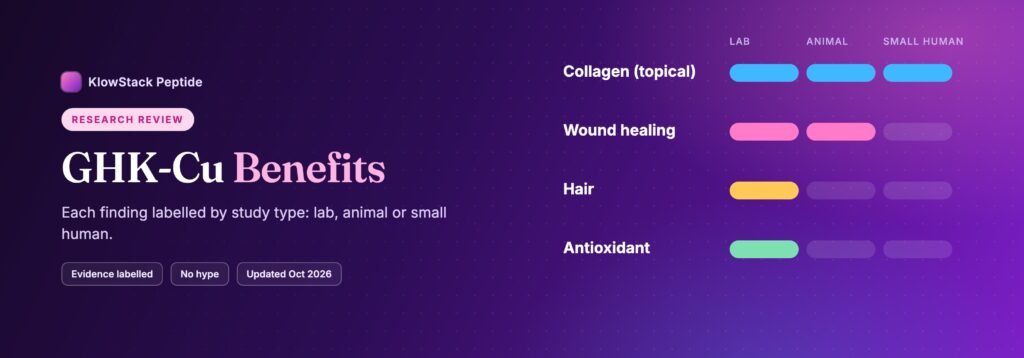
The strongest GHK-Cu evidence is in skin, where small human cosmetic studies back up lab findings on collagen. Wound healing rests mainly on animal studies. Hair, antioxidant and gene-expression findings are mostly lab-based, and newer areas like lung and nerve research are at an early stage.
| Research area | Strongest evidence so far | Key finding | How strong |
|---|---|---|---|
| Collagen and skin | 👤 Human (topical creams) | More collagen, density and thickness; fewer fine lines in 8 to 12 week studies | Moderate: small studies, mostly one research network |
| Wound healing | 🐭 Animal | Faster wound closure and more collagen in rats and rabbits | Moderate in animals, no human trials completed |
| Hair follicles | 🧪 Lab | Follicle and dermal papilla cell growth in culture | Limited |
| Antioxidant effects | 🧪 Lab | Blocks copper-driven oxidation and iron release | Limited to lab |
| Gene expression | 🧪 Lab (gene database) | Changes 31.2% of human genes by 50% or more | Early, predictive only |
| Emerging areas (lung, nerve, bone) | 🧪 Lab and 🐭 Animal | Scattered early findings | Very early |
Skin Research: Collagen, Elastin and Wrinkles
Skin is the best-studied GHK-Cu research area. In the lab, it raises collagen and elastin production by skin cells. In small human studies, topical GHK-Cu creams used for 8 to 12 weeks were linked to more collagen, greater skin density and reduced wrinkle depth, measured against placebo or comparison creams.
Lab findings: collagen and elastin production
🧪 When human dermal fibroblasts (the cells that make the skin’s support structure) were exposed to GHK-Cu at very low concentrations, they produced more collagen and elastin, according to Pickart and Margolina’s 2018 review. Earlier work reported higher production of glycosaminoglycans and decorin, molecules that keep collagen fibers organized and hydrated.
Human cosmetic studies: topical creams over 8 to 12 weeks
👤 These studies tested creams applied to the skin, and all of them are small.
- Thigh skin: A GHK-Cu cream improved collagen production in 70% of women studied, compared with 50% for a vitamin C cream and 40% for retinoic acid.
- Face, 12 weeks, 71 women: Measurements showed greater skin density and thickness, reduced laxity and reduced fine lines and wrinkle depth.
- Face, 12 weeks, 67 women aged 50 to 59: Biopsies showed more keratinocyte proliferation, according to the 2015 review by Pickart and colleagues.
- Randomized, double-blind, 8 weeks: A GHK-Cu serum in a nano-lipid carrier reduced wrinkle volume by 55.8% and depth by 32.8% compared with a control serum.
Our GHK-Cu skin research page looks at each study’s design and limits in more detail.
Wound Healing Research
Most GHK-Cu wound research comes from animals, and the findings are fairly consistent. In rats and rabbits, GHK and GHK-Cu have been linked to faster wound contraction, more new tissue, more collagen and lower levels of tissue-breakdown enzymes.
🐭 In rabbits, GHK improved wound contraction and the growth of granulation tissue, the new tissue that fills a wound. In healthy rats, a collagen dressing with GHK built into it raised wound collagen nine-fold. In rats with poor blood flow to the wound, GHK-Cu lowered levels of the tissue-breakdown enzymes MMP-2 and MMP-9.
👤 Human data are still to come. A phase 2 trial of GHK-Cu in acute wounds (NCT07437586) was recruiting as of an August 2026 evidence review in Pharmaceutics, with no results yet. When it reports, it’ll be the first controlled human wound data on the compound.
Hair Follicle Research
GHK-Cu hair research is mostly lab-based. Reviews list hair growth, thickness and larger follicles among its reported effects, but the detailed hair data are thin. One frequently cited hair study actually tested a different copper peptide, AHK-Cu, so it helps to check which peptide a hair study actually used.
🧪 Pickart’s reviews list enlarged follicles and increased hair growth and thickness among GHK-Cu’s effects, without much published data behind the hair claims specifically. The study most often cited for “copper peptide hair growth” is a 2007 paper by Pyo and colleagues, which found that a copper tripeptide lengthened human hair follicles in culture and boosted dermal papilla cell growth. That peptide was AHK-Cu, with alanine in place of glycine. It’s a cousin of GHK-Cu, and its results don’t automatically transfer.
👤 A 2026 study of 18 people, comparing treated and untreated sides of the face, reported positive cosmetic findings for eyebrow hair with a GHK-Cu product, per the Pharmaceutics review. It’s small, but it’s new. Our GHK-Cu hair growth guide covers the full picture.
Antioxidant and Anti-Inflammatory Research
GHK-Cu’s antioxidant and anti-inflammatory findings come almost entirely from lab work. In cell and chemical tests, it blocked copper-driven oxidation of LDL cholesterol, cut iron release from ferritin by 87% and lowered secretion of the inflammatory signal IL-6 by skin cells.
🧪 In one lab comparison, GHK completely blocked copper-driven oxidation of LDL particles, while the antioxidant enzyme superoxide dismutase gave only 20% protection. This is relevant because loose iron and copper can fuel the production of damaging free radicals. GHK-Cu also reduced iron release from ferritin, the protein that stores iron, by 87%.
🧪 On inflammation, GHK-Cu lowered the release of IL-6, a signaling molecule involved in inflammation, from human skin fibroblasts that had been stimulated with another inflammatory signal, TNF-alpha.
🐭 In animal wound models, GHK-Cu was linked to lower TNF-alpha levels.
Gene Expression and Emerging Research Areas
Gene-database studies suggest GHK changes the activity of 31.2% of human genes by 50% or more, turning about 59% of them up and 41% down. These are predictions from cell-line data. Early lab and animal work has also looked at lung, nerve and bone tissue.
🧪 The gene data come from the Broad Institute’s Connectivity Map, a database of how thousands of compounds change gene activity in cultured cells. GHK stood out for broad effects on genes involved in tissue repair and the ubiquitin-proteasome system, which clears damaged proteins. These findings show what GHK might do in cells, and they need testing in living tissue.
🧪 In a 2012 lung-cell study, GHK reversed a gene-activity pattern linked to tissue breakdown in cultured lung fibroblasts and restored their normal remodeling of collagen gels in the dish. 🐭 Animal work has also explored nerve outgrowth and bone tissue. All of it is early.
“Before and After”: What Studies Measured Over Time
Published GHK-Cu studies track change over 8 to 12 weeks, measuring collagen, skin density, thickness, wrinkle depth and wrinkle volume with instruments and biopsies. We don’t publish before-and-after photos, because photos can’t show study design, lighting or what was actually applied.
| Study duration | What was measured | Study type |
|---|---|---|
| 8 weeks | Wrinkle volume and depth vs control serum and Matrixyl 3000 | 👤 Randomized, double-blind |
| 12 weeks | Skin density, thickness, laxity, fine lines, wrinkle depth (71 women) | 👤 Cosmetic cream study |
| 12 weeks | Lines, wrinkles, density around the eyes vs placebo and vitamin K cream (41 women) | 👤 Cosmetic cream study |
| 12 weeks | Keratinocyte growth in biopsies (67 women) | 👤 Cosmetic cream study |
| Days to weeks | Wound closure and collagen | 🐭 Animal (rats, rabbits) |
Instrument readings such as ultrasound skin thickness and wrinkle profilometry are harder to fake than a selfie, and they come with a comparison group. That’s the trade we make by skipping photo galleries.
GHK-Cu vs Retinol, and GHK-Cu in Blends
In the one study that compared them directly on thigh skin, GHK-Cu cream improved collagen in 70% of women, compared with 40% for retinoic acid. That’s a single small study, and retinoids have far more research overall. Our GHK-Cu vs retinol comparison goes through the details.
GHK-Cu is also the largest ingredient by weight in the KLOW combination, alongside BPC-157, TB-500 and KPV. Researchers studying combinations look at whether compounds acting on different pathways behave differently together. Our page on KLOW stack benefits covers what’s been studied for each ingredient.
Limits of the Research
The biggest limits are that human GHK-Cu trials are few, small and almost all cosmetic studies of creams, many studies come from one research network, and chemical forms are often poorly defined. The August 2026 Pharmaceutics review called GHK-Cu promising but unproven as a therapy until controlled clinical studies are done.
- Few human trials. The human data are a handful of small topical studies, and a 13-person study after CO2 laser treatment found no benefit on objective measures.
- A small group of researchers. Many key papers come from Pickart and colleagues at a skin-biology company.
- Undefined forms. Reviewers note that many studies don’t specify which chemical form of GHK-Cu was used, making comparisons hard.
- Short timelines. No human study followed participants beyond 12 weeks, so longer-term changes are unknown.
- One form tested in people. Every completed human study used a topical cream or serum. Other forms have no published human data.
- Side effects. Studies have reported few adverse effects for topical use. See our page on GHK-Cu side effects.
For a framework you can apply to any study, see how to read a peptide study.
Frequently Asked Questions
Is GHK-Cu natural?
Yes. GHK is a tripeptide found naturally in human plasma, saliva and urine, where it binds copper. The GHK-Cu used in research and skincare is made synthetically, with the same structure as the natural molecule.
Is GHK-Cu the same as the copper peptides in skincare?
GHK-Cu is the best-studied copper peptide, and many skincare “copper peptides” contain it. The term also covers relatives such as AHK-Cu. Skincare products are cosmetics, while research-grade GHK-Cu is a laboratory chemical.
Is copper peptide better than retinol in studies?
One small thigh-skin study found GHK-Cu cream improved collagen in 70% of women versus 40% for retinoic acid. Retinoids have decades of larger trials behind them, so a single study can’t settle the comparison.
What side effects have studies reported?
Published topical studies of GHK-Cu report few adverse effects, with irritation the most commonly mentioned. Human studies of other forms are lacking, so their side-effect profile hasn’t been established.
Is GHK-Cu FDA-approved?
No. GHK-Cu isn’t an FDA-approved drug. It’s used as a cosmetic ingredient and sold as a research chemical. The FDA’s compounding advisory committee is set to review it at a meeting planned before the end of February 2027.
Conclusion
GHK-Cu’s research record is real and uneven. Skin has small human studies, wound healing has consistent animal data, and hair, antioxidant and gene findings are mostly from the lab. Mount Sinai dermatologist David Goldberg described the science behind topical copper peptide creams as “very solid” in NPR’s September 2026 report. The next step is larger, independent trials.
Sources
- Pickart L, Margolina A. 2018. Regenerative and Protective Actions of the GHK-Cu Peptide in the Light of the New Gene Data. International Journal of Molecular Sciences. doi:10.3390/ijms19071987
- Pickart L, Vasquez-Soltero JM, Margolina A. 2015. GHK Peptide as a Natural Modulator of Multiple Cellular Pathways in Skin Regeneration. BioMed Research International. doi:10.1155/2015/648108
- Mateescu DM, et al. 2026. GHK-Cu as a Bioactive Metallopeptide and Drug-Delivery Cargo. Pharmaceutics. PubMed
- Pyo HK, et al. 2007. The effect of tripeptide-copper complex on human hair growth in vitro. Archives of Pharmacal Research. PubMed
- The copper peptide trend has gone from creams to injections, ahead of the science, NPR, September 7, 2026