
Reviewed by Thomas Okafor, Peptide Chemist · Updated October 2026
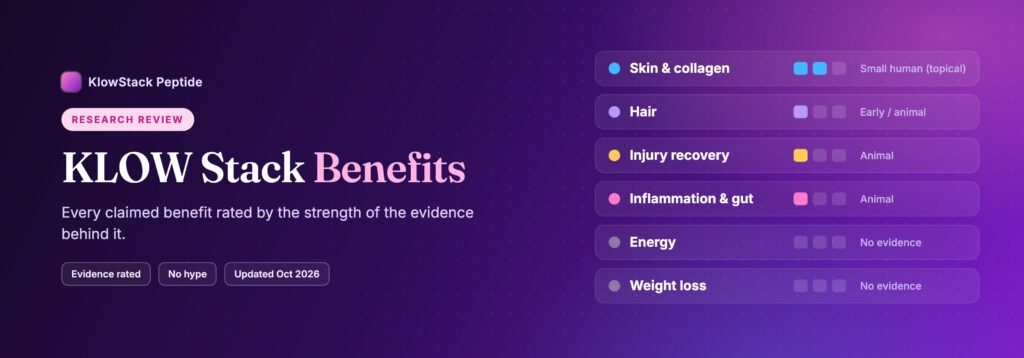
KLOW is promoted for four main benefits: firmer skin, hair support, faster recovery from injury, and calmer inflammation. Each claim comes from research on one of its four peptides, mostly in animals. No study has tested KLOW itself in humans, so its benefits as a blend are unproven.
That’s the short version. The longer version is more interesting, because each claimed KLOW benefit has a very different amount of science behind it, from small human skin trials to nothing at all. Below, we rate every benefit you’ll see on a clinic page, explain where it comes from, correct the week-by-week timelines that keep circulating, and cover what before-and-after reports can and can’t tell you. If you’re new to KLOW itself, start with what the KLOW stack is.
This page rates research claims; it doesn’t offer medical advice. KLOW carries a research-use-only label, and the Medical Disclaimer explains what that label means for every claim below.
Where Do KLOW’s Benefits Come From?
KLOW’s claimed benefits are borrowed from its four ingredients: GHK-Cu (50 mg) for skin and collagen, BPC-157 (10 mg) and TB-500 (10 mg) for tissue repair, and KPV (10 mg) for inflammation. The idea is that combining them covers more repair pathways, but that has never been tested, so every claimed KLOW peptide benefit traces to a single-ingredient study.
Here’s how the borrowing works in practice. A clinic reads that GHK-Cu creams improved skin density in a 12-week study, that BPC-157 helped rat tendons heal, and that KPV calmed colitis in mice. It then lists “skin, recovery and gut health” as KLOW stack benefits. Each claim has a real study behind it. None of those studies used KLOW, injected the way it’s sold, in people.
It’s a bit like a car ad that lists the engine’s horsepower, the stereo’s wattage and the tires’ grip rating, all measured on separate test benches. Each number is accurate. None tells you how the finished car drives, because nobody took it out on the road.
The synergy idea, that four peptides working on four repair steps should beat any one alone, is a hypothesis. Clinic pages sometimes present it as established, using words like “amplifies” or “multiplies.” It’s a sensible one on paper. Testing it would take a trial comparing KLOW with each ingredient alone and with a placebo, and that trial doesn’t exist.
Each ingredient has its own deep dive: GHK-Cu, BPC-157, TB-500 and KPV. Reading those alongside this page shows exactly which benefit belongs to which molecule.
One more thing shapes every benefit claim: amount and route. The skin studies used creams, the tendon studies mostly used injections in rats, and the gut studies gave KPV in drinking water to mice. Whether it comes as a premixed KLOW blend or a KLOW stack of separate vials, KLOW delivers all four peptides together, at amounts chosen by the seller. None of the original studies matches that setup.
KLOW Benefits for Skin
Skin is KLOW’s best-supported benefit on paper, because GHK-Cu, which makes up 62.5% of the vial, has small human studies showing improved collagen, firmness and fine lines. But those studies used creams on the skin, not injections, so they don’t confirm what injected KLOW does.
Two findings from Pickart and Margolina’s 2018 review get quoted most. In one, 71 women with sun-damaged faces applied a GHK-Cu cream for three months, and their skin grew denser and thicker with shallower wrinkles. In the other, thigh-skin collagen rose in seven of ten women using GHK-Cu, against five of ten on vitamin C cream and four of ten on retinoic acid.
The gap between a cream and a vial is bigger than it sounds. A cream works on the outer layers of skin, where those studies measured results. Injected GHK-Cu enters tissue under the skin and the bloodstream, carrying copper with it, and no trial has measured what that does to skin quality. Dermatologists quoted by NPR in September 2026 said topical copper peptides have the stronger track record. One, Mount Sinai’s Dr. David Goldberg, called the science behind topical use “very solid” while saying he’d want human studies before trusting injections.
You’ll also see claims that KPV reduces redness or calms skin inflammation. KPV’s parent hormone, alpha-MSH, is active in skin, and lab and animal studies support an anti-inflammatory effect. There are no human skin studies of KPV.
The repair peptides get pulled into skin marketing too. Thymosin beta-4 has wound-healing data in animals and wound-gel trials in people, and BPC-157 has rat skin-wound studies. Healing a wound and reversing visible aging are different goals, though, and none of these studies measured wrinkles or firmness.
Does KLOW Make You Look Younger?
There’s no evidence that KLOW makes anyone look younger. The closest data are the topical GHK-Cu studies, which found modest improvements in firmness and fine lines over about three months. Those results came from creams and can’t be transferred to an injected four-peptide blend. Our GHK-Cu benefits and GHK-Cu for skin pages cover the topical research.
KLOW Benefits for Hair
Hair claims rest on GHK-Cu and thymosin beta-4 studies in cells and rodents showing larger follicles and more growth. There are no human trials of KLOW for hair. Viral success stories often involve other treatments, like finasteride or growth-hormone peptides, taken at the same time, which makes them hard to read.
The rodent work is real. At the NIH, Philp’s team reported in 2004 that full-length thymosin beta-4 woke up follicle stem cells and boosted hair growth in rodents. GHK-Cu has lab data on follicle size and appears in many topical hair serums.
Then there’s the internet. One widely shared hair-loss thread credits a combination of KLOW and growth-hormone peptides with saving the poster’s hair, with hundreds of comments. Read closely, the poster was also using finasteride, an FDA-approved hair-loss drug with solid trial evidence. When three things change at once, there’s no way to know which one did the work.
Hair also grows slowly and in cycles, with each follicle spending months in a growing phase before resting. That means a change someone notices in a few weeks is unlikely to reflect new growth from anything started recently, and seasonal shedding can make hair look thinner or fuller at different times of year.
Is KLOW good for hair? Based on current evidence, nobody can say. Does KLOW help hair growth? There’s rodent evidence for one ingredient’s parent protein and lab evidence for another, and no human data for the blend. Hair loss also has well-tested options with FDA approval, such as minoxidil and finasteride, which is why dermatologists usually start there. Our GHK-Cu for hair growth page goes deeper into the copper peptide’s hair research.
KLOW Benefits for Recovery and Injuries
Recovery claims come from BPC-157 and TB-500 animal studies on tendons, ligaments, muscle and wounds. They suggest faster healing in rats and mice, but no human trial has confirmed this for either peptide alone, or for KLOW. Some plastic surgeons now promote KLOW after surgery without trial data.
Tendons, Ligaments and Muscle
BPC-157 carries most of this claim, and it’s the KLOW ingredient with the most animal studies behind it. In rat studies, it helped tendon cells grow and migrate and improved healing of torn tendons, ligaments and muscle; in a 2025 HSS Journal review, every qualifying study but one came from animals or the lab. Faster wound closure in animals is the main claim for TB-500’s parent protein, thymosin beta-4, laid out in a 2012 review led by Allan Goldstein. In those rat studies, injuries were usually fresh, surgically made and measured over weeks, which is quite different from a long-running tendon problem in a person. Our BPC-157 benefits and TB-500 benefits pages, plus the BPC-157 vs TB-500 comparison, break down each study.
After Surgery
A handful of plastic surgery and aesthetics practices now market KLOW for recovery after procedures, often alongside facelifts, liposuction or laser treatments. No trial has tested KLOW, or any of its ingredients, for post-surgical healing in people. Most surgical teams ask patients to pause any unapproved compound ahead of an operation, since effects on bleeding and healing are unknown. The surgeon performing the procedure is the person to ask.
Joint Pain and Arthritis
Forum threads include reports of less joint pain, including from people with rheumatoid arthritis. These are anecdotes. The only human joint data for any KLOW ingredient is a single uncontrolled BPC-157 knee-pain case series, with no comparison group. Rheumatoid arthritis in particular is an autoimmune disease with effective prescription treatments, and anyone managing it should keep their rheumatologist in the loop.
The same repair pair, without the copper peptide and KPV, is sold as the Wolverine stack.
KLOW Benefits for Inflammation and Gut Health
This is what KPV adds. In mice, KPV reduced colitis by calming inflammatory signals in gut cells, and BPC-157 has animal gut data too, which means KLOW carries two ingredients studied for gut questions. No human study has tested KPV or KLOW for gut conditions, rheumatoid arthritis or other inflammatory diseases, so these remain research questions.
KPV’s mechanism is one of the more elegant in peptide research. Lining cells in the intestine carry a transporter named PepT1, built to absorb small protein fragments from food, and it becomes more active in an inflamed colon. KPV fits through it. Once inside, it turned down inflammation switches in a 2008 Gastroenterology study by Dalmasso and colleagues, and mice with two kinds of colitis improved.
People living with Crohn’s disease, Ehlers-Danlos syndrome and other chronic conditions ask about KLOW in online groups. Those conditions have specialists and approved treatments, and a gastroenterologist or rheumatologist is the right person to discuss any new idea with. Crohn’s disease and ulcerative colitis in particular can flare unpredictably, so a stretch of feeling better is common with or without any new product, which makes self-experiments especially hard to interpret.
On the regulatory side, the FDA’s compounding panel reviewed KPV in July 2026 for wound healing and inflammatory conditions, and voted to recommend it. That vote is advisory and isn’t evidence that KPV works. The panel was judging whether pharmacies should be allowed to compound it, which is a different question from whether it helps anyone. Our KPV benefits page and the Anti-Inflammatory Signaling category page cover this research area.
Claims Without Evidence: Energy, Weight Loss and Anti-Aging
Some clinics list energy, focus, weight loss or whole-body anti-aging as KLOW benefits. There is no research supporting any of these for KLOW or its ingredients. For weight loss specifically, the peptides with strong human evidence are GLP-1 drugs such as semaglutide and tirzepatide, not repair peptides.
Does KLOW peptide give you energy? Energy and fatigue simply aren’t outcomes any of its four ingredients has been tested for. One top-ranking med spa lists “enhances energy levels” among KLOW’s benefits with no source, which is a good example of how marketing outruns science.
Weight loss works the same way, and it’s one of the most searched KLOW questions. KLOW’s ingredients target repair, skin and inflammation, not appetite or metabolism. What is the most powerful peptide for fat loss? The peptide-based drugs with large human trials are the prescription GLP-1 medicines, semaglutide (Wegovy) and tirzepatide (Zepbound), which are FDA-approved for weight management and prescribed by doctors. Our Weight & Metabolism page covers that area. Some online “protocols” pair KLOW with retatrutide, an investigational weight-loss drug; any weight change in that setup would come from the GLP-1-type drug, not the repair peptides.
“Whole-body anti-aging” is the vaguest claim of all, and the one with the least behind it. Lab findings that GHK-Cu can switch many genes up or down are often stretched into anti-aging promises, which those cell studies never tested. Changing gene activity in a dish is a long way from changing how a person ages, and no study has measured aging outcomes for any KLOW ingredient.
KLOW Before and After: What People Report vs What Research Can Show
Online KLOW “before and after” reports describe smoother skin, less joint pain or thicker hair. These reports can’t show KLOW caused the change: lighting, angles, other treatments, natural healing and placebo all affect results. That’s why we don’t publish result photos, and why klow results online need careful reading.
Users commonly report a handful of recurring changes:
- Smoother skin texture and fewer breakouts
- Less joint or tendon discomfort
- Thicker-looking hair
- Faster recovery from workouts
- Better sleep or mood, which often get credited to whatever someone started most recently
Those reports come from real people, and here’s why they still can’t count as evidence:
- Other treatments: many posters are also using finasteride, growth-hormone peptides, retatrutide, physical therapy or new skincare at the same time.
- Selection bias: people with great results post; people with no change usually don’t.
- Regression to the mean: people try new things when a problem is at its worst, and problems at their worst tend to improve on their own. It’s the same reason chicken soup gets credit for curing a cold.
- Photo conditions: a ring light, a better angle, a tan or a good night’s sleep can transform a photo.
- Unknown products: without a COA, nobody knows what was in the vial.
Some reports describe the opposite experience too: no change at all, or side effects that made people stop. Those posts get far fewer likes, which skews what most people see.
What would a real study need? A control group that gets a placebo, blinding so neither participants nor assessors know who got what, and measured outcomes like skin-imaging scores or strength tests. How we weigh reports against studies is set out in our Editorial Policy, and the Medical Disclaimer explains why we don’t publish result photos.
KLOW Before and After for Women and Men
There’s no sex-specific data for KLOW or its ingredients beyond the topical GHK-Cu studies, which enrolled women. Interests tend to differ online, with women’s posts focusing more on skin and men’s more on recovery, but the evidence is the same for everyone. KLOW benefits for women and KLOW benefits for men are the same unproven list. Pregnancy and breastfeeding are worth a specific mention, since no KLOW ingredient has any safety data there.
How Long Does KLOW Take to Work?
There’s no research-based answer. Week-by-week KLOW timelines online, including those in search summaries, come from clinics and users, not studies. The closest data point: the topical GHK-Cu skin trials looked for changes after 8 to 12 weeks of cream use.
You may have seen a tidy timeline: weeks 1–2 for early changes, weeks 2–4 for recovery, weeks 4–8 for skin, weeks 8–12 and beyond for full results. Google’s AI summary for “klow before and after” has shown one like it. No study produced that timeline. It’s assembled from clinic marketing pages, a bit like the “results in 30 days” promise on a diet ad. AI summaries repeat whatever the top-ranking pages say, so a timeline invented by one clinic can end up looking like settled fact.
Klow results week by week can’t be predicted because nobody has measured them. Any change a person notices in the first couple of weeks is more likely to come from expectation, a new routine or ordinary healing than from collagen remodeling, which takes months. How long should someone stay on KLOW? There’s no evidence-based duration either, and KlowStack doesn’t publish protocols or dosing for any research compound.
Is KLOW Worth It?
From a research point of view, KLOW combines ingredients with interesting early research, but no human data for the blend, unknown long-term safety, legal gray-area sourcing, and a price of roughly $90 to $180 per vial in US listings. Several ingredients with better evidence exist in legal forms, such as topical GHK-Cu in skincare.
| What’s encouraging | What’s missing |
|---|---|
| Each ingredient has published research | No human study of the blend |
| Topical GHK-Cu has small human skin trials | No trials of injected GHK-Cu |
| BPC-157 and TB-500 have extensive animal work | Long-term safety in people is unknown |
| KPV has a clear, studied gut mechanism in mice | Product quality varies; sourcing is a legal gray area |
Which KLOW peptide is the best? Since every vendor sells the same recipe, the real difference is quality, and that shows up on the certificate of analysis. A good KLOW COA tests all four peptides separately for identity, purity and amount, plus endotoxins. The KLOW COA guide shows what a complete report includes, the KLOW side effects page lays out the risks, and KLOW vs GLOW compares it with its three-peptide sibling. Prices checked October 2026.
It’s also fair to ask what the money buys compared with alternatives. A copper peptide serum costs a fraction of a KLOW vial and has the only human skin data in this whole family. For recovery and gut questions, approved treatments and physical therapy have far more evidence behind them. None of that makes KLOW’s research uninteresting; it puts it in perspective.
Frequently Asked Questions
What are the benefits of KLOW?
KLOW is marketed for skin, hair, recovery and inflammation, borrowing from studies of its four peptides, mostly in animals. Only topical GHK-Cu has human data, for skin. KLOW peptide benefits as a blend haven’t been tested.
Is KLOW good for skin?
Skin is its best-supported claim, through GHK-Cu, which has small human studies of topical creams lasting about three months. Injected KLOW hasn’t been studied for skin, so its effect there is unknown.
Does KLOW help hair growth?
There’s no human evidence. Thymosin beta-4 grew hair in rodents and GHK-Cu has lab follicle data, but viral success stories usually involve other treatments like finasteride.
Does KLOW give you energy?
Energy claims on clinic pages have no study behind them. Fatigue and energy were never outcomes in any KLOW ingredient’s research.
Does KLOW help with weight loss?
No research supports KLOW for weight loss, and none of its ingredients targets appetite or metabolism. The peptide-based drugs with strong weight-loss evidence are prescription GLP-1 medicines like semaglutide and tirzepatide.
Does KLOW make you look younger?
There’s no evidence it does. Topical GHK-Cu creams improved firmness and fine lines modestly in small studies, which doesn’t translate to an injected blend.
How long does KLOW take to work?
No study has measured it. The week-by-week timelines online come from clinics, and the only reference point is cream studies of GHK-Cu that ran two to three months.
How long should you stay on KLOW?
There’s no evidence-based duration, since no human trial has tested the blend over time. We don’t publish protocols or dosing.
Are KLOW before-and-after photos reliable?
Not as evidence. Lighting, angles, other treatments, natural healing and placebo can all change results, and people mostly post successes. That’s why we don’t publish result photos.
Is KLOW worth it?
From an evidence standpoint, KLOW’s ingredients have early research and the blend has none in people. Quality, legal status and cost are real factors, and topical GHK-Cu offers the best-studied skin option.
Is KLOW better than GLOW for benefits?
KLOW only differs where KPV’s gut and inflammation research comes in, since it’s GLOW’s recipe plus 10 mg of KPV. Otherwise, the two share the same ingredients and the same evidence gaps.
Sources
Studies and reviews
- Pickart L, Margolina A. 2018. Regenerative and Protective Actions of the GHK-Cu Peptide in the Light of the New Gene Data. International Journal of Molecular Sciences. doi:10.3390/ijms19071987
- Dalmasso G, et al. 2008. PepT1-Mediated Tripeptide KPV Uptake Reduces Intestinal Inflammation. Gastroenterology. doi:10.1053/j.gastro.2007.10.026
- Vasireddi N, et al. 2025. Emerging Use of BPC-157 in Orthopaedic Sports Medicine: A Systematic Review. HSS Journal. doi:10.1177/15563316251355551
- Goldstein AL, et al. 2012. Thymosin β4: a multi-functional regenerative peptide. Expert Opinion on Biological Therapy. doi:10.1517/14712598.2012.634793
- Philp D, et al. 2004. Thymosin β4 increases hair growth by activation of hair follicle stem cells. The FASEB Journal. doi:10.1096/fj.03-0244fje
- Mayfield CK, et al. 2026. Injectable Peptide Therapy: A Primer for Orthopaedic and Sports Medicine Physicians. American Journal of Sports Medicine. doi:10.1177/03635465251357593
Regulatory and news
Disclaimer: KLOW and its ingredients are sold for research use only and aren’t approved for human use. This page is educational, doesn’t give medical advice and doesn’t publish result photos. Read our Medical Disclaimer and Editorial Policy.