
Reviewed by Thomas Okafor, Peptide Chemist · Last reviewed October 19, 2026
BPC-157 Tendon Research at a Glance
Few research peptides have attracted orthopedic interest like BPC-157. Surgeons, sports-medicine physicians and athletes ask about it, and three review articles on its musculoskeletal research appeared between 2025 and 2026 alone. Those reviews agree on a striking pattern: a large, consistent animal literature, and almost nothing in people. Here’s that pattern, finding by finding, with each result marked 🧪 lab, 🐭 animal or 👤 human. BPC-157 belongs in the lab and has no approval for human use of any kind; our Medical Disclaimer has details.
Why Researchers Study BPC-157 in Tendons
Tendons repair slowly because they have a poor blood supply and relatively few active cells. BPC-157 research focuses on exactly those two limits: its reported effects on new blood vessel growth and on the fibroblasts that rebuild tendon tissue. A tendon is dense, rope-like collagen with sparse blood vessels running through it. That design makes tendons strong, and it also means injured tendons get limited oxygen, nutrients and repair cells. Ligaments and the myotendinous junction, where muscle meets tendon, face similar challenges. BPC-157’s best-known lab effects line up with those challenges. 🧪 Hsieh and colleagues showed in a 2017 paper that it switches on VEGFR2, the main receptor behind new capillary growth, and it influences how tendon fibroblasts move and survive. The peptide’s origins are covered in our BPC-157 explainer.
Lab (In Vitro) Findings
Cell studies from Chang Gung University in Taiwan found that BPC-157 sped the outgrowth of rat tendon cells from tissue samples, improved their survival under oxidative stress, increased their migration and raised their growth hormone receptor levels. Cell proliferation itself didn’t change directly. 🧪 Outgrowth, survival and migration. In a 2011 study in the Journal of Applied Physiology, Chang and colleagues cultured pieces of rat Achilles tendon with and without BPC-157. Cells grew out of the BPC-157 tissue samples faster. Under hydrogen peroxide stress, more of the exposed cells survived. For interpretation, BPC-157 didn’t directly make the cells multiply, so its effect looked more like helping cells move and endure than simply adding more of them. They also migrated further, in a dose-dependent pattern, and spread across culture dishes faster, with signs of activation in the FAK-paxillin pathway that cells use to grip and move. 🧪 Growth hormone receptors. A 2014 follow-up in Molecules found growth hormone receptor among the genes most increased by BPC-157 in rat tendon fibroblasts. When growth hormone was added, cells exposed to BPC-157 multiplied more, with activation of JAK2, the receptor’s signaling partner. These results count for extra partly because they come from a lab independent of the Zagreb group behind most BPC-157 research. They still describe cells in a dish, where there’s no immune system, no mechanical loading and no blood supply. A cell that migrates faster in culture doesn’t guarantee a tendon that repairs faster in a body.
Animal Findings: Tendon, Ligament and Muscle-Tendon Models
Rat studies have tested BPC-157 after cutting the Achilles tendon, detaching it from bone, cutting the knee’s medial collateral ligament, separating muscle from tendon, and detaching the quadriceps from bone. Each reported better function, strength or tissue structure in BPC-157 groups. Most came from one lab.
Achilles Tendon Transection Model
🐭 The foundational study, Staresinic and colleagues in 2003, cut rats’ Achilles tendons and reported stronger, better-organized repair in BPC-157 groups. A 2006 study by Krivic and colleagues went further, detaching the tendon from the heel bone, a junction that doesn’t reattach on its own in rats, and reported improved tendon-to-bone repair.
Medial Collateral Ligament and Myotendinous Junction Models
🐭 Cerovecki and colleagues cut the medial collateral ligament of the rat knee and followed animals for 90 days, reporting functional and biomechanical improvements. In 2021, Japjec and colleagues separated the quadriceps tendon from its muscle, an injury that doesn’t repair spontaneously in rats, and reported that BPC-157 groups recovered function and lost less muscle over 42 days.
Muscle-to-Bone Reattachment and Other Musculoskeletal Injury Models
🐭 A 2025 study by Matek and colleagues surgically detached the quadriceps from bone, causing lasting walking problems and knee contracture in rats left without the peptide. With BPC-157, they reported muscle reattaching to newly formed bone over 90 days, tracked by ultrasound, MRI and biomechanics.
What Was Measured: Biomechanics, Histology, Function Scores
- Biomechanics: load to failure, stiffness and elasticity of the repaired tissue
- Histology: collagen organization and inflammatory cells under the microscope
- Function: walking-pattern scores such as the Achilles functional index
- Imaging: ultrasound and MRI in the newest studies
🐭 An independent 2026 Turkish study, Biçer and colleagues, found BPC-157 rats had better tendon tissue scores that didn’t reach significance on total measures, while TB-500 performed best.
BPC-157 and Joint Research
Joint research on BPC-157 is mostly indirect: animal studies of ligaments and bone around the knee. The only human joint data come from a 2021 retrospective phone survey of 17 knee-pain patients with no control group, which can’t show whether BPC-157 had any effect. 🐭 Joints are more than cartilage: ligaments, tendons, bone and the joint capsule all contribute to stability and pain. The ligament and quadriceps-to-bone studies above involve structures around the knee, and Matek’s group reported new bone formation at the reattachment site. We found no controlled animal study focused on cartilage. 👤 The human report is Lee and Padgett’s 2021 study from a Florida hormone clinic. Researchers reviewed charts of 17 patients who’d had knee injections of BPC-157, some combined with thymosin beta-4, and reached 16 by phone months later to ask about pain. Of 12 who received BPC-157 alone, 11 reported significant improvement. Several features keep this from being strong evidence:
- No comparison group, so natural improvement and placebo can’t be ruled out
- Retrospective design, relying on memory months after the fact
- No standardized measures of function, stiffness or quality of life, as the authors note
- Mixed causes of knee pain, from arthritis to ligament tears
- Clinic-run, by practitioners offering the injections
What Human Evidence Exists for Tendon and Injury Research
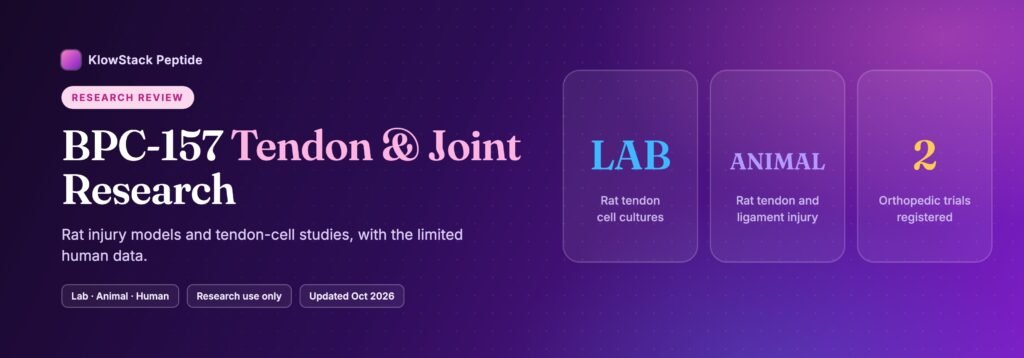
No randomized human trial of BPC-157 for tendon or injury research has been published. Reviewers count three small pilot studies in total, only one musculoskeletal, and two orthopedic trials are now registered. Every recent review calls for controlled human trials. The reviews read the same evidence and reach the same conclusion:
- 2025 systematic review, HSS Journal. Vasireddi and colleagues identified 36 musculoskeletal papers, and all but one were preclinical.
- 2025 narrative review, Current Reviews in Musculoskeletal Medicine. In “Regeneration or Risk?”, Utah physicians McGuire and colleagues describe BPC-157 as “a potentially valuable tool in musculoskeletal medicine,” noting that only three human pilot studies exist and that “no adverse effects were reported.”
- 2026 scoping review, American Journal of Sports Medicine. Tewari and colleagues at UCLA reported that two-thirds (67%) of the papers they screened relied on animal models.
- 2026 review, Pharmaceutics. Mateescu and colleagues note that no phase II trial has been completed and that fewer than 30 people took part across all the pilots.
👤 The other two pilots. Beyond the knee survey, the human record holds a 12-woman bladder pain pilot and a 2025 intravenous safety pilot in 2 healthy adults, both from the same Florida-based clinical group and neither involving tendons or joints. 👤 Registered trials. ClinicalTrials.gov lists a 30-person phase 1 rotator cuff repair study (NCT07803250), not yet recruiting with an estimated start in January 2027, and a 120-person phase 2 hamstring strain trial (NCT07437547), recruiting since February 2026. An earlier phase 1 safety study (NCT02637284), registered in 2015, has unknown status and no posted results.
Evidence Table: Tissue, Model, Study Type, Finding, Limits
| Tissue | Model | Study type | Reported finding | Limits | Citation |
|---|---|---|---|---|---|
| Tendon cells | Rat Achilles explants | 🧪 Lab | Faster outgrowth, migration, survival | No tissue context | Chang 2011 |
| Tendon cells | Rat tendon fibroblasts | 🧪 Lab | More growth hormone receptors | Single lab | Chang 2014 |
| Tendon | Achilles transection | 🐭 Rat | Stronger, organized repair | Originating lab | Staresinic 2003 |
| Tendon-to-bone | Achilles detachment | 🐭 Rat | Improved reattachment | Originating lab | Krivic 2006 |
| Ligament | MCL transection | 🐭 Rat | Functional gains to 90 days | Originating lab | Cerovecki 2010 |
| Muscle-tendon | Myotendinous junction | 🐭 Rat | Function restored, less atrophy | Originating lab | Japjec 2021 |
| Muscle-bone | Quadriceps detachment | 🐭 Rat | Reattachment with new bone | Originating lab | Matek 2025 |
| Knee | Retrospective survey, 17 people | 👤 Human | Most reported less pain | No controls | Lee & Padgett 2021 |
| Rotator cuff | Phase 1 pilot | 👤 Registered | Not yet recruiting | No data yet | NCT07803250 |
[image]
How BPC-157 Tendon Research Relates to TB-500 and the Wolverine Stack
The Wolverine stack pairs BPC-157 with TB-500, a fragment of thymosin beta-4 studied for cell migration. The two have been tested together only once, in the 2026 rat Achilles study, where the combination added no measurable benefit over either alone. Our Wolverine stack recovery research page covers that study, our BPC-157 vs TB-500 comparison contrasts the two, and our TB-500 guide explains the fragment. A dedicated TB-500 injury research page is on the way, and our recovery and tissue repair hub lists related compounds.
Limits of the Evidence
- One dominant lab. Most animal tendon studies come from the University of Zagreb group, with the Taiwanese cell studies and the 2026 Turkish study as independent exceptions.
- Small rodent studies, often with a handful of animals per group
- No randomized human trials published
- Long-term effects unknown, in animals or people
- Translation questions. Rat tendons repair faster than human tendons and carry far less load.
For safety findings, see the BPC-157 side effects page, and our BPC-157 benefits page rates other research areas.
Regulatory and Sport Status (Dated)
BPC-157 remains unapproved by the FDA on October 19, 2026. Its April 22, 2026 compounding safety-risk update places BPC-157 with withdrawn Category 2 nominations and says the agency has “no, or only limited, safety-related information for the proposed routes of administration.” In July 2026, compounding advisers voted 8 to 6 in favor of listing it, AJMC reported. Sports rules handle it separately: the WADA Prohibited List, names it in section S0, the class for substances with no government approval for human use. More on US categories in our peptide law explainer.
FAQ
What tendon models has BPC-157 been studied in?
Rat models of Achilles tendon transection, Achilles detachment from bone, medial collateral ligament transection, myotendinous junction separation and quadriceps detachment from bone, plus cultured rat tendon fibroblasts.
Are there human studies on BPC-157 and tendons or joints?
Only one: a 2021 retrospective phone survey of 17 knee-pain patients with no control group. A rotator cuff pilot and a hamstring strain trial are registered, with no results yet.
Why are most BPC-157 tendon studies in rats?
Rat tendon injury models are standard, cheap and quick, and they allow biomechanical testing of repaired tissue. BPC-157 has also never gone through the drug development process that would fund large human trials.
What do reviewers say about the quality of BPC-157 musculoskeletal research?
They describe consistent preclinical findings and very limited human data. A 2025 systematic review found 35 of 36 musculoskeletal studies were preclinical, and every recent review calls for controlled human trials.
Is BPC-157 on the WADA prohibited list?
Yes. The World Anti-Doping Agency lists it by name in section S0, the category for non-approved substances.
Bottom Line + Disclaimer
BPC-157’s tendon research is a rich rat literature with independent support from cell studies, set against a near-empty human record. The registered orthopedic trials, if completed, will be the first controlled human tests.
Sources
- [In vitro] Chang CH, et al. 2011. The promoting effect of pentadecapeptide BPC 157 on tendon healing involves tendon outgrowth, cell survival, and cell migration. Journal of Applied Physiology. doi:10.1152/japplphysiol.00945.2010
- [In vitro] Chang CH, et al. 2014. Pentadecapeptide BPC 157 enhances the growth hormone receptor expression in tendon fibroblasts. Molecules. doi:10.3390/molecules191119066
- [In vitro + animal] Hsieh MJ, et al. 2017. Therapeutic potential of pro-angiogenic BPC157 is associated with VEGFR2 activation and up-regulation. Journal of Molecular Medicine. doi:10.1007/s00109-016-1488-y
- [Animal] Staresinic M, et al. 2003. Gastric pentadecapeptide BPC 157 accelerates healing of transected rat Achilles tendon and in vitro stimulates tendocytes growth. Journal of Orthopaedic Research. doi:10.1016/S0736-0266(03)00110-4
- [Animal] Krivic A, et al. 2006. Achilles detachment in rat and stable gastric pentadecapeptide BPC 157. Journal of Orthopaedic Research. doi:10.1002/jor.20096
- [Animal] Cerovecki T, et al. 2010. Pentadecapeptide BPC 157 (PL 14736) improves ligament healing in the rat. Journal of Orthopaedic Research. doi:10.1002/jor.21107
- [Animal] Japjec M, et al. 2021. Stable gastric pentadecapeptide BPC 157 as a therapy for the disable myotendinous junctions in rats. Biomedicines. doi:10.3390/biomedicines9111547
- [Animal] Matek D, et al. 2025. Stable gastric pentadecapeptide BPC 157 as therapy after surgical detachment of the quadriceps muscle from its attachments for muscle-to-bone reattachment in rats. Pharmaceutics. doi:10.3390/pharmaceutics17010119
- [Animal] Biçer O, Adanir O, et al. 2026. Effects of BPC-157 and TB-500 on Achilles tendon healing in rats. Joint Diseases and Related Surgery. doi:10.52312/jdrs.2026.2951
- [Human, retrospective] Lee E, Padgett B. 2021. Intra-articular injection of BPC 157 for multiple types of knee pain. Alternative Therapies in Health and Medicine. PubMed
- [Systematic review] Vasireddi N, et al. 2025. Emerging use of BPC-157 in orthopaedic sports medicine: a systematic review. HSS Journal. doi:10.1177/15563316251355551
- [Narrative review] McGuire FP, et al. 2025. Regeneration or risk? A narrative review of BPC-157 for musculoskeletal healing. Current Reviews in Musculoskeletal Medicine. doi:10.1007/s12178-025-09990-7
- [Scoping review] Tewari K, et al. 2026. Peptide supplements and their therapeutic applications in sports medicine. American Journal of Sports Medicine. doi:10.1177/03635465261464420
- [Review] Mateescu DM, et al. 2026. BPC-157 as an investigational peptide therapeutic. Pharmaceutics. doi:10.3390/pharmaceutics18050625
- [Human pilot] Lee E, et al. 2024. Effect of BPC-157 on symptoms in patients with interstitial cystitis: a pilot study. Alternative Therapies in Health and Medicine. PubMed
- [Human pilot] Lee E, Burgess K. 2025. Safety of intravenous infusion of BPC157 in humans: a pilot study. Alternative Therapies in Health and Medicine. PubMed
- [Trial registry] Impact of BPC-157 on Recovery Following Rotator Cuff Repair Surgery (NCT07803250), ClinicalTrials.gov
- [Trial registry] BPC 157 for Acute Hamstring Muscle Strain Repair (NCT07437547), ClinicalTrials.gov
- [Regulatory] Certain Bulk Drug Substances for Use in Compounding that May Present Significant Safety Risks, FDA, current as of April 22, 2026
- [News] FDA Panel Backs 6 Peptides for Compounding, AJMC
- [Regulatory] The Prohibited List, World Anti-Doping Agency