
Reviewed by Thomas Okafor, Peptide Chemist · Updated October 2026
TB-500 is a lab-made peptide based on thymosin beta-4 (Tβ4), a natural protein found in almost every cell that helps cells move and repair tissue. It’s promoted for injury recovery, but it has never been tested in human clinical trials. Most of the research people cite was done on full thymosin beta-4, a much bigger molecule.
That last point is the whole story in miniature. TB-500 borrows its reputation from its parent protein, much like a movie trailer borrows its buzz from the full film. The trailer and the movie are related, and you can’t judge one by watching only the other. This guide explains what TB-500 is, how it differs from thymosin beta-4, what each has been tested for, the cancer question people keep asking, and its legal position in October 2026.
This guide is for learning only and isn’t medical advice. TB-500 is sold for research use only; the details are in our Medical Disclaimer.
What Is TB-500?
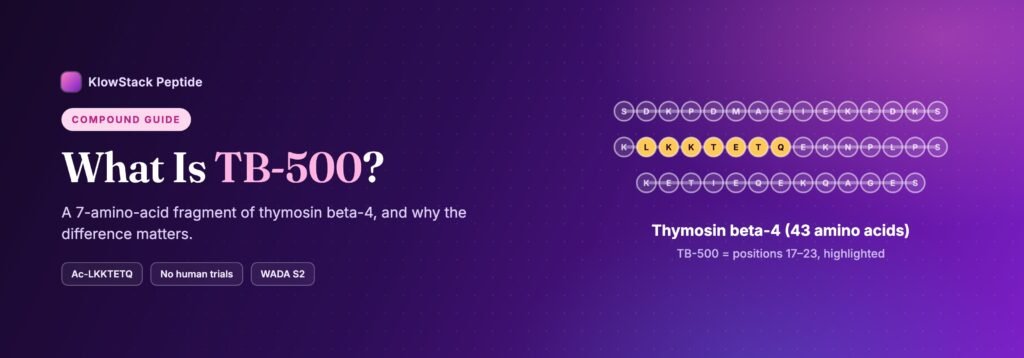
TB-500 is a synthetic version of the most active region of thymosin beta-4: seven amino acids (LKKTETQ, positions 17–23) with an acetyl group added. That segment is where Tβ4 binds actin, the protein cells use to move and change shape, which is thought to drive its role in healing.
The “Ac” at the front of Ac-LKKTETQ stands for that acetyl cap, a small chemical tag that can help a short peptide resist breakdown. Written out, the seven amino acids are leucine, lysine, lysine, threonine, glutamic acid, threonine and glutamine. The molecule weighs about 889 g/mol (grams per mole), and chemists track it under CAS number 885340-08-9.
Before it reached gyms and biohacking forums, TB-500 made its name in horse racing, where it was marketed for faster recovery in racehorses. Racing regulators eventually started testing for it. A 2012 paper by Esposito and colleagues in Drug Testing and Analysis confirmed that the active ingredient in products sold as TB-500 was this acetylated 17–23 fragment, which gave anti-doping labs a reference to test against.
The parent protein has a longer history. Thymosin beta-4 was first sequenced in 1981 by Teresa Low and Allan Goldstein, who found it in extracts of the thymus gland, the source of the “thymosin” name. It later turned out to be present in nearly every cell type, far beyond the thymus.
The name itself causes confusion. “TB-500” is a product code that stuck, not a scientific name. Scientists write “thymosin beta-4 (17–23)” or “Ac-LKKTETQ,” and that difference in vocabulary is why the research is so easy to misread.
What Does TB-500 Do?
In short, nobody has measured what TB-500 does in people. In lab and animal studies, its parent protein helps cells migrate into injured tissue, supports new blood vessels and reduces scarring. The fragment is thought to carry the cell-migration part of that job. Our TB-500 benefits page breaks down each claim by evidence level.
Is TB-500 the Same as Thymosin Beta-4?
No. Thymosin beta-4 is the full 43-amino-acid protein your body makes; TB-500 is a 7-amino-acid fragment of it. Most published research, including the human eye and wound trials, used full Tβ4, so it doesn’t automatically apply to TB-500. Some products labeled TB-500 actually contain full Tβ4.
| Thymosin beta-4 (Tβ4) | TB-500 | |
|---|---|---|
| Length | 43 amino acids | 7 amino acids (positions 17–23) |
| Natural? | Yes, made in almost every cell | No, synthetic fragment with an acetyl cap |
| Molecular weight | About 4,960 g/mol | About 889 g/mol |
| Research base | Decades of lab, animal and human studies | Very little research on the fragment itself |
| Human trials | Yes, for eye drops and wound gels | None published |
| How it’s sold | Studied as drug candidates (eye drops, gels) | Research chemical vials, some clinics |
Here’s a quick decoder for online articles. When you read “TB-500 has been studied for heart repair” or “TB-500 reached Phase 3 trials,” the study almost always used full thymosin beta-4. Science communicator Nick Norwitz made this point in a widely shared video: the late-stage trials exist for thymosin beta-4, not TB-500.
There’s also a labeling problem. Some vials sold as TB-500 contain full-length Tβ4, and others contain the fragment, often without saying which. A Reddit thread on the topic was titled, fittingly, “What you’re really buying.” Why make a fragment at all? A 7-amino-acid peptide is much cheaper and easier to manufacture than a 43-amino-acid protein, and it contains the stretch thought to do the actin work. That’s a reasonable chemistry shortcut. Whether the shortcut keeps the biology is the open question.
The only way to know what’s in a vial is a certificate of analysis that confirms the molecule’s identity by mass, since a 4,960 g/mol protein and an 889 g/mol fragment look very different to a mass spectrometer. Prices hint at the difference too: making a 43-amino-acid protein costs far more than a 7-amino-acid chain, so an unusually cheap “thymosin beta-4” vial deserves a closer look at its paperwork.
How Does TB-500 Work?
TB-500 and thymosin beta-4 are thought to work by binding actin, a building block of the cell’s internal skeleton. This helps cells migrate into injured areas. Lab and animal studies also link Tβ4 to new blood-vessel growth, lower inflammation and less scarring, though most of that work used the full protein.
Picture actin as the poles of a tent. To move, a cell has to take down poles at the back and put them up at the front. Tβ4 holds onto loose actin pieces (scientists call this “G-actin sequestering”) and helps control when they get used, which lets cells crawl toward a wound.
Tβ4 is also one of the body’s first responders, and it’s one of the most common small proteins inside many cells. According to the Goldstein review, after an injury it’s released by platelets, macrophages and many other cell types, where it helps protect tissue and limit inflammation.
Here’s what the research links to thymosin beta-4:
- Cell migration (lab): actin binding helps skin, blood-vessel and other cells move into damaged tissue.
- New blood vessels (lab and animal): Tβ4 promotes angiogenesis, the growth of new blood vessels into healing tissue.
- Less inflammation and scarring (animal): Tβ4 reduces inflammatory signals and the number of scar-forming cells called myofibroblasts, as Goldstein and colleagues’ 2012 review summarizes.
- Stem and progenitor cells (animal): in heart studies, Tβ4 activated cells that help regenerate tissue.
Angiogenesis cuts both ways, and it’s worth understanding why. New blood vessels help wounds heal. Tumors also need new blood vessels to grow, which is why the cancer question in the safety section below comes up so often.
One caveat underpins this whole section: whether the 7-amino-acid fragment does all of this hasn’t been established. The actin-binding region is part of TB-500, so the cell-migration effect is the most plausible. The other effects may depend on parts of the full protein that TB-500 doesn’t include. Proteins often work like a key with several teeth, and cutting out one section can keep some functions while losing others. Only direct tests of the fragment can show which ones survive.
What Is TB-500 Used For?
TB-500 is used mostly for injury and workout recovery: tendons, ligaments, muscles and post-surgery healing. The supporting research is almost entirely on thymosin beta-4, in animals and cell studies, plus a handful of human trials of Tβ4 eye drops and wound gels.
Tendon, Muscle and Soft-Tissue Injuries
This is what TB-500 is marketed for, and it’s where the evidence is thinnest. A 2026 primer in the American Journal of Sports Medicine, written by orthopedic surgeons at USC’s Keck School of Medicine, reviewed the injectable peptides patients now ask about. The authors found that Tβ4 and TB-500 promoted blood-vessel growth and tissue repair in preclinical models, while human orthopedic data were lacking. They also noted both are banned in sport.
When a gym story credits TB-500 for a healed shoulder, the scientific position is simply that no study has tested it yet. That’s different from saying it can’t work.
Wound Healing
Tβ4’s wound record is solid in animals. Malinda and colleagues showed in 1999 that it sped up wound closure in rats, and later work extended that to other models.
Humans come next. The company RegeneRx ran Phase 2 trials of a Tβ4 gel (RGN-137) for venous stasis ulcers and pressure ulcers, both of which are listed as completed on ClinicalTrials.gov, and a later gel trial for a rare blistering skin disease was terminated. Wound healing was also the indication the FDA advisory panel considered for TB-500 in July 2026.
Clinics sometimes market TB-500 for recovery after surgery, too. No study has tested it for post-surgical healing in people, and surgeons generally ask patients to stop unapproved compounds before an operation because of unknown effects on bleeding and healing.
Heart Repair
You may have seen a mouse-heart image circulating with TB-500 posts. It traces back to a 2004 study in Nature by Bock-Marquette and colleagues at UT Southwestern, which found that Tβ4 helped heart muscle cells survive and improved heart function in mice after a heart attack. It’s a striking result. It used full Tβ4, in mice, and there’s no approved human cardiac use of Tβ4 or TB-500.
Eyes
This is where thymosin beta-4 has its strongest human data. RGN-259, a Tβ4 eye drop, has been tested in several Phase 2 and Phase 3 trials for dry eye, including ARISE-3, which enrolled 700 people. A Phase 3 trial (SEER-2) for neurotrophic keratopathy, a hard-to-treat corneal condition, was still recruiting as of October 2026, according to ClinicalTrials.gov. All of this is Tβ4 in eye drops, not TB-500 by injection.
The eye is a smart place to test a repair protein. Doctors can see the cornea directly, measure healing precisely and apply the drug right where it’s needed, with little of it reaching the rest of the body. That’s why eye trials came first for thymosin beta-4.
Hair Growth
Does TB-500 help with hair growth? A 2004 study in The FASEB Journal by Philp and colleagues at the NIH found that Tβ4 stimulated hair growth in rats and mice by activating stem cells in the hair follicle. That’s an interesting rodent finding for the full protein. There’s no human evidence for TB-500 and hair. Our TB-500 benefits page tracks each of these areas.
How Strong Is the Evidence for TB-500?
For TB-500 itself, very weak: no published human trials. Thymosin beta-4 has a much larger base, including animal studies in top journals and human trials for eye and wound uses. But results for the full protein can’t simply be transferred to the fragment, so the two evidence bases need to be kept apart.
| Use | TB-500 evidence | Thymosin beta-4 evidence |
|---|---|---|
| Tendon and muscle | None published | Animal studies |
| Wounds | None published | Animal studies; Phase 2 human gel trials |
| Heart | None published | Mouse studies, including Nature 2004 |
| Eye | None published | Several Phase 2 and Phase 3 eye-drop trials |
| Hair | None published | Rodent studies |
What about the Wolverine stack, TB-500 paired with BPC-157? No human study of the combination has been published. A LinkedIn post about a “July 2026 study” of the stack circulated in the summer; we couldn’t find any such paper, so we don’t cite it.
The labels we use are defined in our Editorial Policy. The short version for TB-500: promising parent protein, untested fragment.
What would close that gap? A first step would be a basic human safety study of the fragment, measuring how long it stays in the blood and whether it causes side effects. A second would be a placebo-controlled trial in a specific injury, with imaging or strength testing to measure healing. Neither has been published, so for now TB-500’s evidence base is borrowed from Tβ4.
TB-500 and BPC-157: The “Wolverine Stack”
TB-500 and BPC-157 are often combined as the “Wolverine stack” for injury recovery. The theory is that BPC-157 acts locally on blood flow and tissue repair while TB-500 supports cell migration more broadly. No human study has tested the combination, so the pairing rests on separate animal studies of each.
| TB-500 | BPC-157 | |
|---|---|---|
| Size | 7 amino acids (fragment of a 43-amino-acid protein) | 15 amino acids |
| Origin | Thymosin beta-4, found in almost every cell | A protein in human gastric juice |
| Main research | Cell migration, wound healing (via Tβ4) | Tendon repair, blood-vessel growth, gut lining |
| July 2026 FDA panel | Recommended (8–6) | Recommended (8–6) |
What’s the difference between BPC-157 and TB-500 in everyday terms? They come from different parts of the body and point at different steps of healing: BPC-157 research centers on blood supply and local tissue, while TB-500’s parent protein is about cells moving. The name Wolverine borrows from the Marvel hero who heals from almost anything, which says more about the marketing than the data. The stack is sold either as two separate vials, often 5 mg each, or as a premixed vial with 10 mg of each, and the two formats come with different COAs to check. Both versions rest on the same evidence base, which is to say separate animal studies of each ingredient. Our TB-500 vs BPC-157 comparison, the BPC-157 guide and the Wolverine stack page cover the pair in depth.
Is TB-500 Safe? Side Effects and Cancer Concerns
TB-500’s safety in humans is unknown because it has never been through clinical trials. Reported side effects are anecdotal, such as fatigue, headaches and injection-site reactions. The bigger open question is cancer: Tβ4 promotes blood-vessel growth, and higher Tβ4 levels are linked to some tumors.
Here’s what’s known and what isn’t:
- Online self-reports: people describe tiredness, headaches, lightheadedness and redness at injection sites. No controlled study has looked at any of them.
- Product purity: vials may contain the fragment, the full protein, the wrong amount, or something else entirely.
- Infection risk: injecting a product that wasn’t made under sterile, pharmaceutical conditions carries a risk of infection and bacterial toxins.
- Long-term effects: completely unknown for the fragment.
Endotoxins are worth a special mention. They’re fragments of bacteria that can cause fever and inflammation even when the bacteria themselves are dead, and they’re one of the standard tests a pharmaceutical-grade injectable must pass. Many research-grade vials don’t report them at all.
Full thymosin beta-4 does have human safety data from its eye-drop and wound-gel trials, where it was generally well tolerated. Those were local, low-exposure uses, though, quite different from injecting a synthetic fragment.
Does TB-500 or Thymosin Beta-4 Cause Cancer?
There’s no evidence that TB-500 causes cancer in humans. The concern comes from a different direction. Because Tβ4 helps cells move and grow new blood vessels, scientists have looked at its role in tumors.
Some tumor-tissue studies find more Tβ4 in cancer than in healthy tissue. In a 2017 study in Scientific Reports, Chi and colleagues in Taiwan identified the gene for Tβ4 (TMSB4X) as one of the most overexpressed proteins in head and neck squamous cell carcinoma, and higher levels were linked to worse outcomes. That’s a link inside tumors, and it doesn’t show that taking Tβ4 or TB-500 causes cancer.
Still, it’s enough that some clinicians advise people with active or past cancer to steer clear of TB-500, and a physician’s post on X making that point was widely shared. Anyone with a cancer history should raise it with their oncologist before going near any growth-related compound.
Other groups with extra reasons for caution include anyone pregnant or breastfeeding, people with bleeding disorders or on blood thinners (given the blood-vessel effects), competitive athletes subject to testing, and anyone under 18.
Does TB-500 Raise Testosterone?
There’s no evidence that TB-500 affects testosterone. It isn’t a hormone, it isn’t known to interact with the pituitary signals that drive testosterone production, and no study has measured testosterone after TB-500 exposure.
Can You Take TB-500 Every Day?
There’s no research-based schedule for TB-500, because no human study has tested it. The daily or weekly patterns posted online are copied between vendor sites and forums; we don’t publish protocols. How long TB-500 takes to work is likewise unknown. Our TB-500 side effects page goes into each risk.
Is TB-500 Legal? Why Is It Banned in Sports?
TB-500 isn’t FDA-approved. In April 2026 the FDA removed it from Category 2, its list of substances flagged for safety concerns. On 23 July 2026, an FDA advisory committee voted 8–6 to recommend allowing it in compounding. The FDA must still finalize that, so licensed pharmacies can’t compound TB-500 yet.
Here’s the 2026 sequence in plain terms. Category 2 is a list of ingredients the FDA had flagged as raising safety concerns for compounding. TB-500 came off it in April when the nominations behind those listings were withdrawn, which left it uncategorized. In July, the FDA’s Pharmacy Compounding Advisory Committee reviewed TB-500 for wound healing and voted to recommend it for the 503A list, the ingredients compounding pharmacies may use. As AJMC reported, that vote is advisory, and formal rulemaking comes next.
Until then, TB-500 is sold mainly as “research use only,” a label meaning it’s meant for lab experiments, with no approval for use in people. Before April, TB-500 had been listed in Category 2 alongside BPC-157, which effectively kept it out of compounding pharmacies. Rules differ abroad: New Zealand’s medicines regulator, Medsafe, classifies thymosin beta-4 and TB-500 as prescription medicines, so importing them without a prescription is an offense there. For the US rules in full, see our peptide legality guide.
Why Is Thymosin Beta-4 Banned in Sports?
The WADA Prohibited List bans thymosin beta-4 and its derivatives, including TB-500, under class S2 (peptide hormones, growth factors and related substances), at all times. The reasoning is that faster tissue repair could give athletes an edge in training and recovery, whether or not it’s been proven in people.
S2 is the same class that covers growth hormone, EPO and other growth factors, which tells you how anti-doping agencies view the whole thymosin beta-4 family. It’s also detectable. Horse-racing labs have caught it for years, and human anti-doping labs test for it too; agencies like USADA and Sport Integrity Australia list it as prohibited. Checked October 5, 2026.
TB-500 in Peptide Blends: KLOW and GLOW
TB-500 is one of the core peptides in both the KLOW and GLOW blends, typically 10 mg per vial alongside 10 mg of BPC-157 and 50 mg of GHK-Cu. KLOW adds 10 mg of KPV. Vendors don’t always say whether their “TB-500” is the fragment or full Tβ4, which affects what’s really in the blend.
| Blend | TB-500 per vial | Share of the vial |
|---|---|---|
| KLOW (standard 80 mg) | 10 mg | 12.5% |
| GLOW (standard 70 mg) | 10 mg | 14.3% |
| GLOW or KLOW (30/20/20 recipe) | 20 mg | 25% to 28.6% |
TB-500 is the cell-migration piece of the blends’ repair story, paired with BPC-157’s blood-vessel research and GHK-Cu’s collagen work. For a blend, the fragment-versus-protein question gets harder to answer, since a four-peptide COA has more peaks to sort out. A good blend report lists TB-500’s measured mass on its own line, separate from the other three peptides, which shows whether the vial holds the 889 g/mol fragment or the full protein.
Combination guides: the KLOW stack and GLOW, compared in KLOW vs GLOW. The other blend ingredients are covered in our GHK-Cu and KPV guides, while the peptide blends hub shows how they connect.
Frequently Asked Questions
What does TB-500 do?
In lab and animal studies, its parent protein, thymosin beta-4, helps cells migrate into injuries, supports new blood vessels and reduces scarring. What the TB-500 fragment does in people hasn’t been tested.
Is TB-500 the same as thymosin beta-4?
No. Thymosin beta-4 is a 43-amino-acid natural protein. TB-500 is a synthetic 7-amino-acid fragment of it (Ac-LKKTETQ). Most research, including human trials, used the full protein.
Why is thymosin beta-4 banned?
WADA bans thymosin beta-4 and derivatives like TB-500 under class S2, because faster tissue repair could give athletes an edge. It’s banned at all times and can be detected in testing.
What’s the difference between BPC-157 and TB-500?
BPC-157 is a 15-amino-acid peptide from a gastric protein, researched for new blood vessels plus tendon and gut repair. TB-500 is a thymosin beta-4 fragment studied for cell migration.
Is TB-500 safe?
Nobody knows how safe TB-500 is in humans, because it’s never been through clinical trials. Online self-reports mention fatigue and injection-site reactions. Purity, infection risk and the cancer question are the main concerns.
Does TB-500 cause cancer?
There’s no evidence TB-500 causes cancer in humans. Some tumor studies find higher thymosin beta-4 levels in cancers, so many clinicians advise against it for anyone with active or past cancer.
Does TB-500 raise testosterone?
There’s no evidence TB-500 affects testosterone. It isn’t a hormone, and no study has measured testosterone after TB-500 exposure.
Does TB-500 help with hair growth?
Full thymosin beta-4 stimulated hair growth in rats and mice in a 2004 NIH study. No study has tested TB-500 for hair in people.
Can you take TB-500 every day?
No research-based schedule exists, because TB-500 hasn’t been studied in humans, so there’s nothing to base a daily or weekly pattern on. Schedules online are vendor and forum creations, and KlowStack doesn’t publish any.
How long does TB-500 take to work?
Nobody knows. No human study has measured TB-500’s effects or how fast they might appear, so any timeline online is anecdotal, and natural healing over the same weeks makes those stories hard to interpret.
Is there oral TB-500?
Some sellers offer oral or under-the-tongue TB-500, but there’s no published evidence it survives digestion or reaches the bloodstream. Like most peptides, it would likely be broken down in the gut.
Did the FDA approve TB-500 in 2026?
No. The FDA dropped TB-500 from Category 2 in April 2026, and in July its compounding advisers recommended it. Neither step is approval, and rulemaking was still pending in October 2026.
Sources
Studies and reviews
- Esposito S, et al. 2012. Synthesis and characterization of the N-terminal acetylated 17-23 fragment of thymosin beta 4 identified in TB-500. Drug Testing and Analysis. doi:10.1002/dta.1402
- Goldstein AL, et al. 2012. Thymosin β4: a multi-functional regenerative peptide. Expert Opinion on Biological Therapy. doi:10.1517/14712598.2012.634793
- Bock-Marquette I, et al. 2004. Thymosin β4 activates integrin-linked kinase and promotes cardiac cell migration, survival and cardiac repair. Nature. doi:10.1038/nature03000
- Malinda KM, et al. 1999. Thymosin β4 Accelerates Wound Healing. Journal of Investigative Dermatology. doi:10.1046/j.1523-1747.1999.00708.x
- Philp D, et al. 2004. Thymosin β4 increases hair growth by activation of hair follicle stem cells. The FASEB Journal. doi:10.1096/fj.03-0244fje
- Mayfield CK, et al. 2026. Injectable Peptide Therapy: A Primer for Orthopaedic and Sports Medicine Physicians. American Journal of Sports Medicine. doi:10.1177/03635465251357593
- Chi LH, et al. 2017. Thymosin Beta-4 X-Linked as a Prognostic Marker for Head and Neck Squamous Cell Carcinoma. Scientific Reports. doi:10.1038/s41598-017-09539-w
Trials (ClinicalTrials.gov, checked October 5, 2026)
- RGN-259 ARISE-3 Phase 3 dry eye trial (NCT03937882)
- RGN-259 SEER-2 Phase 3 neurotrophic keratopathy trial (NCT05555589)
- Thymosin beta-4 venous stasis ulcer Phase 2 trial (NCT00832091)
Regulatory and anti-doping
Disclaimer: TB-500 is sold for research use only and isn’t approved for human use. This guide is educational and doesn’t give medical advice. Read our Medical Disclaimer and Editorial Policy.