
Reviewed by Thomas Okafor, Peptide Chemist · Updated October 2026
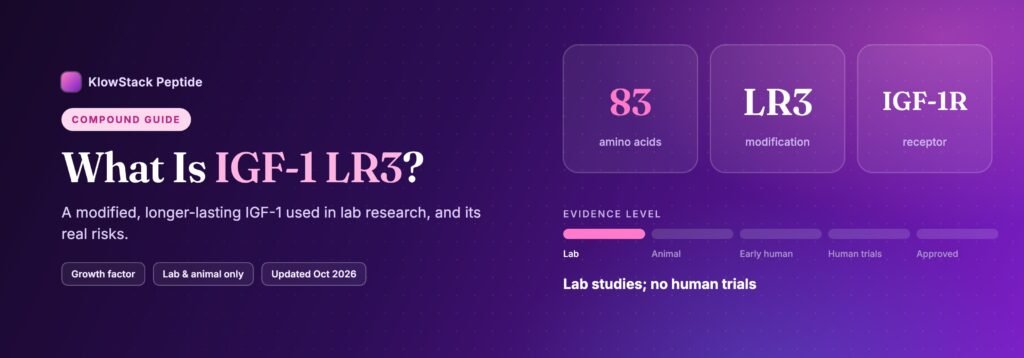
IGF-1 LR3 (Long R3 IGF-1) is a lab-made version of insulin-like growth factor 1, a hormone that drives cell growth, with one amino acid swapped and 13 extra amino acids added to the front. Those changes stop it from being held back by the body’s IGF-binding proteins, so it acts more strongly on cells. It was designed as a tool for growing cells in labs and is studied in animals for growth and gut repair.
There are no human trials of IGF-1 LR3. Its evidence comes from cell culture and from rat and pig studies in the 1990s, and one of those studies contradicts a common online claim: it’s cleared from the blood faster than natural IGF-1, not slower. An approved form of ordinary IGF-1 does exist for a rare growth disorder, but that’s a different molecule.
IGF-1 LR3 is sold for research use only. This guide is educational and isn’t medical advice; see our Medical Disclaimer.
What Is IGF-1 LR3?
IGF-1 LR3 is a modified IGF-1 created in the early 1990s by Australian scientists at the Cooperative Research Centre for Tissue Growth and Repair in Adelaide, later commercialized by the company GroPep. They built it to be a more potent growth supplement for cells grown in labs, especially for making biotech drugs in cell culture.
IGF-1 itself is the hormone your liver makes in response to growth hormone. It carries much of growth hormone’s effect to tissues, telling cells to grow, divide and take up nutrients. In the blood, though, almost all IGF-1 is held by IGF-binding proteins (IGFBPs), which act like chaperones that keep it from acting too freely.
The chemistry. The Adelaide team, in a 1992 Journal of Molecular Endocrinology paper, made two kinds of change. They replaced glutamic acid at position 3 with arginine, the “R3,” and added a 13-amino-acid extension to the front end, the “Long.” The result binds IGF-binding proteins about 1,000 times more weakly than natural IGF-1 while still activating the IGF-1 receptor. In cultured muscle cells, it was 5 to 10 times more potent.
The history. Through the 1990s, the same group tested LR3 in rats and pigs. It became a standard ingredient in cell culture media, which is still its main legitimate commercial use. Since the 2000s, it has also turned up in bodybuilding circles and in doping cases.
Also known as: IGF-1 LR3 vs IGF-1 vs mecasermin
IGF-1 LR3, Long R3 IGF-1 and LR3IGF-I are all the same analog. Plain IGF-1 is the natural 70-amino-acid hormone. Mecasermin, sold as Increlex, is a lab-made copy of natural IGF-1 approved by the FDA for children with severe primary IGF-1 deficiency. Results or safety data for mecasermin don’t carry over to LR3, which behaves differently in the body.
How Does IGF-1 LR3 Work?
IGF-1 LR3 binds and activates the IGF-1 receptor on cells, the same receptor natural IGF-1 uses, switching on signals for growth, survival and nutrient uptake. Because it largely escapes IGF-binding proteins, more of it is free to reach the receptor, which makes it more potent in cell culture.
What’s known, and from what kind of study:
- IGF-1 receptor activation (lab): LR3 activates the receptor and its downstream growth pathways, including PI3K-Akt and MAPK.
- Escapes binding proteins (lab): its affinity for IGFBP-3 and IGFBP-4 is about 1,000 times lower than natural IGF-1’s.
- More potent on cells (lab): in cultured rat muscle cells, it was 5 to 10 times more potent than IGF-1.
- Faster clearance from blood (animal): in rats, a 1993 study found LR3 was removed from plasma “much more rapidly” than IGF-1, because binding proteins normally protect IGF-1 from clearance.
- Growth effects depend on species (animal): it boosted growth in rats but reduced growth, food intake and the body’s own IGF-1 in pigs.
What does IGF-1 LR3 do? It’s a stronger, more freely acting IGF-1 for cells. The big catch is that its “freedom” from binding proteins also means it leaves the blood faster, and the body’s own feedback loops push back.
What Is IGF-1 LR3 Studied For?
IGF-1 LR3 has been studied mainly as a cell culture supplement, for body growth and nitrogen retention in rats, for gut growth in rats, and for growth in pigs. All of this is lab or animal research. There are no published human studies of IGF-1 LR3 for muscle, recovery or anything else.
Growth and muscle in rats
What was studied: normal and catabolic rats given LR3 or natural IGF-1 for one to two weeks.
What it found: LR3 increased body weight, nitrogen retention (a sign of building protein) and food efficiency, and was about six times more potent than IGF-1 for these effects.
What it doesn’t show: muscle gains in people, or safety over months.
Gut growth
What was studied: in a 1992 Journal of Endocrinology study, rats made catabolic with the steroid dexamethasone were given IGF-1 or analogs including LR3 for seven days. Another study fed LR3 to newborn rat pups.
What it found: IGF-1 and its analogs caused marked growth of the gut lining and muscle layers.
What it doesn’t show: any benefit for human gut conditions.
Growth in pigs
What was studied: a 1997 study infused LR3 into growing pigs.
What it found: the opposite of the rat results: lower daily weight gain, less food intake, and lower blood levels of the pig’s own IGF-1, IGFBP-3 and growth hormone.
What it doesn’t show: which species better predicts humans. That disagreement between species is itself a warning.
What IGF-1 LR3 hasn’t been shown to do
It hasn’t been shown to build muscle, burn fat, speed injury recovery or improve performance in humans. Claims that it “lasts 20 to 30 hours” aren’t supported by published data; the rat study found it was cleared faster than natural IGF-1.
Has IGF-1 LR3 Been Tested in Humans?
No. PubMed and ClinicalTrials.gov list no human trials of IGF-1 LR3. Human data on IGF-1 come from natural IGF-1 and from mecasermin, the approved drug for severe IGF-1 deficiency, which is a different molecule with different behavior in the body.
PubMed (92 records, mostly cell culture studies) and ClinicalTrials.gov (no trials) searched October 5, 2026.
Mecasermin’s label is a useful reminder of what IGF-1 activity can do in people: its main safety concern is low blood sugar, since IGF-1 acts partly like insulin. Our Editorial Policy explains why we label LR3 as lab and animal evidence only.
IGF-1 LR3 Side Effects and Safety
There are no human safety studies of IGF-1 LR3. Expected risks come from IGF-1 biology: low blood sugar, because IGF-1 acts partly like insulin; swelling and joint pain; and, over the long term, concerns about promoting the growth of abnormal cells. Product quality is a major additional risk.
Reported in human studies: none for LR3. For mecasermin, a related approved drug, low blood sugar is the main risk, along with others listed on its label.
Expected from the mechanism: IGF-1 signaling lowers blood sugar, so hypoglycemia is the most immediate concern, especially without food. IGF-1 is also a powerful growth and survival signal for cells, and higher IGF-1 levels in large population studies have been linked to higher risk of some cancers, such as breast and prostate cancer. That doesn’t prove LR3 causes cancer, but it’s why a cancer history is a firm red flag.
Anecdotal only: online self-reports describe low-blood-sugar symptoms (shakiness, sweating, hunger), “pumps,” headaches and injection-site soreness. None of these has been studied in a controlled setting.
Product quality: in 2010, German anti-doping scientists analyzed a black-market product sold as LR3 and found a version carrying a “His-tag,” a protein-purification label that shouldn’t be in a finished product. That shows how unreliable gray-market growth factors can be. Our peptide COA guide explains identity testing.
Who should avoid IGF-1 LR3
Anyone with a cancer history, diabetes or blood sugar problems, pregnancy or breastfeeding, an eye disease that involves abnormal blood vessels (such as diabetic retinopathy), or who is under 18 has strong reasons to stay away. So does anyone in tested sport.
Is IGF-1 LR3 linked to cancer?
There’s no direct evidence that LR3 causes cancer, because it hasn’t been studied in people. The concern comes from IGF-1 biology: IGF-1 helps cells survive and divide, many cancer cells use IGF-1 signaling, and population studies link higher natural IGF-1 levels to higher risk of some cancers. A more potent, freely acting analog raises the same question.
IGF-1 LR3 vs Mecasermin (IGF-1)
IGF-1 LR3 is a modified analog designed to escape binding proteins; mecasermin is a copy of natural IGF-1, FDA-approved as Increlex for severe primary IGF-1 deficiency in children. LR3 is more potent in cell culture and cleared faster in rats; mecasermin has human trials and a label.
| IGF-1 LR3 | Mecasermin (Increlex) | |
|---|---|---|
| Mechanism | IGF-1 receptor agonist, weak IGFBP binding | IGF-1 receptor agonist, normal IGFBP binding |
| Half-life | Shorter than IGF-1 in rats; not measured in humans | Hours in humans, extended by binding proteins |
| Evidence | Lab and animal | Human trials; FDA-approved |
| Status | Research use only | Prescription drug for a rare disease |
Our peptide half-life explainer covers why binding proteins change how long a peptide lasts.
Is IGF-1 LR3 Legal?
IGF-1 LR3 isn’t FDA-approved for any human use, and it hasn’t been nominated for the FDA’s compounding lists. It’s legally sold in the US as a cell culture reagent and as a “research use only” chemical. WADA bans it in sport at all times.
FDA. LR3 doesn’t appear on the FDA’s 503A nomination lists, which means no pharmacy has a legal path to compound it for patients. Its legitimate commercial market is laboratory cell culture.
Research use only. Vials sold online as research chemicals aren’t checked like medicines, and the black-market analysis above shows the contents can differ from the label. Our guide to whether research peptides are legal explains the rules.
Sport. The 2026 WADA Prohibited List bans insulin-like growth factor 1 and its analogues under S2, prohibited in and out of competition. Anti-doping labs have developed tests for LR3 specifically.
FDA and WADA status checked October 5, 2026.
Where IGF-1 LR3 Fits: Needs & Symptoms
IGF-1 LR3 is listed under Muscle & Performance and Recovery & Tissue Repair, for its role in cell growth signaling. On both pages, it’s one of the compounds with the least human evidence.
Related guides there include follistatin 344 and PEG-MGF, also lab and animal compounds, and CJC-1295 and ipamorelin, which raise the body’s own growth hormone and IGF-1.
Frequently Asked Questions
What does IGF-1 LR3 do?
IGF-1 LR3 activates the IGF-1 receptor, signaling cells to grow and take up nutrients. It escapes IGF-binding proteins, making it more potent in cell culture. Human effects haven’t been studied.
What is the half-life of IGF-1 LR3?
It hasn’t been measured in humans. In rats, it was cleared from blood faster than natural IGF-1, contradicting online claims of a 20-to-30-hour half-life.
Is IGF-1 LR3 safe?
Its safety in people is unknown. Expected risks include low blood sugar and, longer term, concerns about promoting abnormal cell growth.
Is IGF-1 LR3 legal?
It’s legal to sell as a lab reagent or research chemical, but it isn’t approved for human use and can’t be compounded by pharmacies.
Is IGF-1 LR3 banned in sports?
Yes. WADA bans IGF-1 and its analogues under S2, at all times.
Has IGF-1 LR3 been tested in humans?
No. All published research is in cells, rats and pigs.
What’s the difference between IGF-1 LR3 and IGF-1?
LR3 has an arginine at position 3 and 13 extra amino acids, so it barely binds IGF-binding proteins. Natural IGF-1 is mostly held by those proteins in the blood.
How much IGF-1 LR3 should be used?
There’s no research-based dosing for human use, and we don’t publish dosing for any compound. See our Medical Disclaimer.
Sources
Primary studies
- Francis GL, et al. 1992. Novel recombinant fusion protein analogues of insulin-like growth factor (IGF)-I indicate the relative importance of IGF-binding protein and receptor binding for enhanced biological potency. Journal of Molecular Endocrinology. doi:10.1677/jme.0.0080213
- Read LC, et al. 1992. Insulin-like growth factor-I and its N-terminal modified analogues induce marked gut growth in dexamethasone-treated rats. Journal of Endocrinology. doi:10.1677/joe.0.1330421
- Ballard FJ, et al. 1993. Effects of interactions between IGFBPs and IGFs on the plasma clearance and in vivo biological activities of IGFs and IGF analogs. Growth Regulation. PMID 7683526
- Dunaiski V, et al. 1997. Long [R3] insulin-like growth factor-I reduces growth, plasma growth hormone, IGF binding protein-3 and endogenous IGF-I concentrations in pigs. Journal of Endocrinology. doi:10.1677/joe.0.1550559
- Kohler M, et al. 2010. Detection of His-tagged Long-R3-IGF-I in a black market product. Growth Hormone & IGF Research. doi:10.1016/j.ghir.2010.07.001
Regulatory
Disclaimer: IGF-1 LR3 is sold for research use only and isn’t approved for human use. This guide is educational and doesn’t give medical advice. Read our Medical Disclaimer and Editorial Policy.