
Reviewed by Thomas Okafor, Peptide Chemist · Last updated October 14, 2026 · Checked monthly
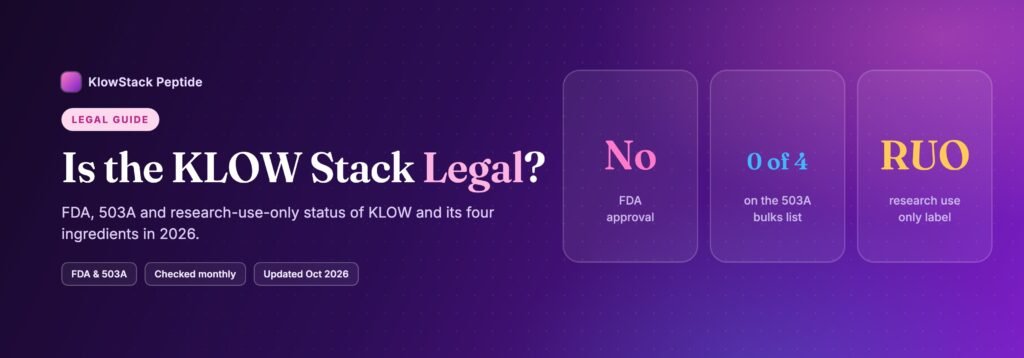
KLOW isn’t an FDA-approved product, and none of its four ingredients, GHK-Cu, BPC-157, TB-500 and KPV, is an approved drug. In the US it’s sold as a research-use-only material for laboratory work. Whether a pharmacy could compound it depends on the status of each ingredient under Section 503A, and that status moved several times during 2026.
Online answers to “is KLOW legal” contradict each other, mostly because they were written at different points in that year. This page lays out each ingredient’s status with dates and primary sources, explains what the FDA’s compounding categories mean, and untangles the claims that don’t line up. It’s general information, not legal advice. The product itself is a lab reagent, not something meant for people to consume.
Quick Answer: KLOW’s Legal Status at a Glance
Check the FDA’s records on October 14, 2026 and every KLOW ingredient shows up as a withdrawn compounding nomination, a change that pulled each one out of Category 2. None is on the 503A Bulks List, so none is eligible for routine pharmacy compounding, and the KLOW blend has no FDA approval.
| Ingredient | FDA-approved? | 503A status | Last change | Primary source | WADA list |
|---|---|---|---|---|---|
| GHK-Cu | No | Withdrawn nomination (injectable routes); advisory review planned by end of Feb 2027 | April 2026 | FDA safety-risk page | Not named; S0 may apply |
| BPC-157 | No | Withdrawn nomination; advisers voted 8–6 to recommend listing | July 23, 2026 | FDA page; PCAC meeting | S0, named |
| TB-500 | No | Withdrawn nomination; advisers recommended listing | July 23, 2026 | FDA page; PCAC meeting | S2 |
| KPV | No | Withdrawn nomination; advisers voted 8–6 to recommend listing | July 23, 2026 | FDA page; PCAC meeting | Not named; S0 may apply |
| KLOW blend | No | Not a bulk substance; follows its ingredients | n/a | n/a | Contains listed substances |
Sources: the FDA’s compounding risk listing (last updated April 22, 2026) and the July 23–24, 2026 Pharmacy Compounding Advisory Committee meeting page.
What KLOW Is (and Why Its Status Depends on Four Ingredients)
KLOW packs four peptides into 80 mg, led by 50 mg of the copper peptide GHK-Cu, with a 10 mg share each for BPC-157, TB-500 and KPV. Because US drug rules apply to individual substances, a blend’s status is set by its ingredients, and a combination can never be less restricted than its most restricted part.
Think of it like a group trying to get into a 21-and-over venue. The group gets in only if every member is cleared. If one ingredient can’t be compounded, the blend can’t be either. The formula and its two packaging options, premixed or split into four vials, are covered in what the KLOW stack is.
Is KLOW FDA-Approved?
No. FDA approval requires a company to submit clinical trial evidence of safety and effectiveness in a new drug application, and no KLOW product or ingredient has been through that process. FDA reviews of compounding nominations are a separate track that doesn’t approve anything.
What FDA approval requires
Approval is the FDA’s verdict that a specific drug product is safe and effective for a specific use, based on controlled human trials, manufacturing inspections and labeling review. It typically follows years of phase 1, 2 and 3 studies. The Drugs@FDA database lists every approved product, and none contains BPC-157, TB-500, KPV or GHK-Cu as an approved active ingredient.
Has FDA reviewed BPC-157, TB-500 or KPV?
Yes, for a different purpose. When someone nominated these peptides for the 503A compounding list, the FDA evaluated the available safety information and sent several to its Pharmacy Compounding Advisory Committee. That’s a review of whether pharmacies may use a bulk ingredient, and it doesn’t touch approval. On its April 2026 page, the agency reported zero human exposure records for KPV and for TB-500’s thymosin fragment, sparse safety information on BPC-157, and thin human data on injectable GHK-Cu.
The 503A Bulks List Explained
Under Section 503A, a licensed pharmacy may compound a patient-specific prescription only from bulk ingredients that already belong to an approved drug, carry a USP monograph, or have been added to the FDA’s 503A Bulks List. Pending nominations get parked in interim categories that tell pharmacies whether compounding is tolerated during the review.
Category 1 vs Category 2
The FDA’s interim policy uses categories as holding pens. Category 1 holds nominated substances the agency is still evaluating, which pharmacies may compound while the review runs. Category 2 is the red-flag group: substances the agency considers a significant safety risk, off limits to compounders. A third group covers nominations that were withdrawn, which places a substance in neither category. The categories are tracked in the FDA’s list of bulk drug substances nominated under 503A.
The 2023 restrictions
In 2023, the FDA placed BPC-157 and several other popular peptides in Category 2, citing gaps in safety information and concerns such as peptide-related impurities and, for BPC-157, possible immune reactions. That’s the change many online sources describe as a “ban.” It ended routine pharmacy compounding of those peptides and pushed much of the market toward research-use-only products.
What changed in 2026
| Date | Event | Source type |
|---|---|---|
| February 27, 2026 | HHS Secretary Robert F. Kennedy Jr. said most Category 2 peptides would move back toward Category 1 | Public statement |
| April 15–22, 2026 | Nominators withdrew 12 peptides, including all four KLOW ingredients, removing them from Category 2 | FDA list |
| April 16, 2026 | Federal Register notice announced a July advisory meeting | Federal Register |
| July 23–24, 2026 | Advisers recommended six peptides, including BPC-157, TB-500 and KPV; FDA staff had recommended against | Advisory committee |
| October 7, 2026 | Washington Post reported a planned temporary sales pathway for some unapproved peptides | News report |
| By end of February 2027 | A second advisory meeting is planned, including GHK-Cu | FDA plan |
The April Federal Register notice is FR Doc. 2026-07361.
Why Sources Disagree on KLOW’s Status
Sources disagree because they describe different steps in the same process: a 2023 category placement, a 2026 withdrawal, an advisory vote, staff briefing documents and news reports. Each step changes something, and none of them, so far, has added a KLOW ingredient to the 503A Bulks List.
Four claims cause most of the confusion:
- “The FDA banned these peptides in 2023.” Shorthand for the Category 2 placement. It restricted compounding and didn’t make owning research peptides illegal.
- “They came off Category 2 in April 2026.” Confirmed by the FDA’s own list. That emptied one category without moving them into another.
- “The FDA proposed not adding them.” This traces to the FDA staff briefing documents for the July meeting, where reviewers recommended against all seven peptides. It wasn’t a proposed rule, and the advisers voted the other way.
- “They’re legal again.” Not accurate as of October 14, 2026. A listing requires FDA rulemaking with a public comment period, which hasn’t happened.
The habit that helps most is checking the date on any source. A page written in March describes a different situation from one written in August. If a claim doesn’t point to an FDA page, a Federal Register document or an advisory committee record, treat it as unconfirmed.
Research Use Only vs Compounded: Two Different Legal Paths
Research-use-only peptides are chemicals sold for laboratory work and labeled not for human use. Compounded drugs are prescription medicines made by licensed pharmacies from eligible bulk ingredients. KLOW sold today travels the first path, because its ingredients aren’t eligible for the second.
Research use only. Suppliers sell these materials to laboratories, label them for research and avoid any health claims or dosing instructions. The label describes the intended use, and the FDA looks at how a product is actually marketed. A product presented with dosing charts or health promises is treated as a drug, whatever the label says.
Compounded. A licensed pharmacy prepares a medicine for a specific patient’s prescription under 503A, using an eligible bulk ingredient and following USP standards. None of KLOW’s ingredients currently qualifies.
Federal rules on marketing. Federal drug law treats an unapproved substance sold for people as a potential misbranded or unapproved new drug, and the FDA’s attention has usually landed on the companies selling it. Possession is a different matter: none of KLOW’s ingredients appears on the DEA’s schedules, so having a research vial isn’t a drug offense.
State Laws That Can Apply
State governments layer their own controls over the federal ones, usually via the boards that license pharmacists and doctors. A recent case is Louisiana’s Act 374, in force from August 1, 2026, which limits board action against prescribers and pharmacists using peptides from compounding facilities that meet federal standards.
The law’s enrolled text concerns compounded products only, and research-use-only materials and federal law stay as they were. Other states handle peptides through board guidance, and those rules change faster than federal law. Your state board of pharmacy is the authoritative source for local rules. National rules are summarized in our legality explainer.
KLOW Components and Sport Prohibited Lists
The WADA Prohibited List places BPC-157, by name, in S0, the non-approved substances class, while TB-500 falls under S2 with peptide hormones and growth factors. Both are prohibited at all times. The 2027 list, approved in September 2026, keeps those entries.
GHK-Cu and KPV aren’t named on the list. WADA’s S0 class covers any pharmacological substance without government approval for human therapeutic use, which is relevant to both. Because KLOW contains BPC-157 and TB-500, the blend contains listed substances.
How We Keep This Page Current
We review this page every month and whenever the FDA, the Federal Register or the advisory committee publishes something new. Every regulatory statement links to a primary source, and the change log below records what changed and when.
The sources we monitor are the FDA’s compounding safety-risk page, the FDA’s 503A nominations list, the Federal Register, the Pharmacy Compounding Advisory Committee calendar and the WADA Prohibited List.
Change log
- October 14, 2026: Page published. Status reflects the FDA page dated April 22, 2026, the July 23–24 advisory votes and the October 7 Washington Post report.
FAQs
Is KLOW legal in the US?
KLOW is sold legally as a research-use-only material for laboratory work. It isn’t FDA-approved, none of its ingredients is a controlled substance, and none is currently eligible for 503A compounding. Selling it for human use would break federal drug law.
Is KLOW FDA-approved?
No. The FDA hasn’t approved the blend, and it hasn’t approved any of the four peptides inside it. No company has submitted clinical trial evidence for them, and the FDA’s 2026 compounding reviews concern pharmacy eligibility, which is a different question from approval.
Can KLOW be compounded by a 503A pharmacy?
Not as of October 14, 2026. None of KLOW’s four ingredients is on the 503A Bulks List or in Category 1. The July 2026 panel favored three of them, but the FDA hasn’t started the rulemaking needed to list them.
Which peptides were removed from FDA Category 2 in 2026?
Twelve, after their nominations were withdrawn in April 2026: BPC-157, TB-500, KPV, GHK-Cu (injectable routes), MOTS-c, Epitalon, Semax, emideltide (DSIP), Melanotan II, LL-37, Dihexa acetate and PEG-MGF. Removal didn’t place any of them on the Bulks List.
What does “research use only” mean for KLOW?
It means KLOW is sold as a laboratory chemical, labeled not for human or veterinary use, with no dosing instructions or health claims. The label reflects the product’s intended use, and regulators judge sellers by how they actually market it.
Is KLOW safe?
The FDA hasn’t evaluated KLOW for safety, and no study has tested the four-peptide combination. What cell and animal studies report about each ingredient is collected in the KLOW side effects guide, sorted by study type.
Conclusion
KLOW’s legal status comes down to its four ingredients, and in October 2026 all four are in the same place: off the Category 2 list, short of the Bulks List, and waiting on FDA rulemaking. We’ll update this page as that changes.
Sources
- Certain Bulk Drug Substances for Use in Compounding that May Present Significant Safety Risks, FDA, content current as of April 22, 2026
- Bulk Drug Substances Nominated for Use in Compounding Under Section 503A, FDA
- July 23–24, 2026 Meeting of the Pharmacy Compounding Advisory Committee, FDA
- Pharmacy Compounding Advisory Committee; Notice of Meeting, Federal Register, April 16, 2026
- FDA Panel Backs 6 Peptides for Compounding, AJMC
- Trump administration paving way for temporary sale of some unapproved peptides, The Washington Post, October 7, 2026
- Louisiana Act 374 (SB 253), enrolled text, Louisiana State Legislature
- The Prohibited List, World Anti-Doping Agency
- Drugs@FDA, FDA
- Controlled Substance Schedules, Drug Enforcement Administration