
Regulatory Watch · Reviewed by Thomas Okafor, Peptide Chemist · Published October 6, 2026
When someone nominates a bulk ingredient for the 503A Bulks List, FDA sorts it into interim categories while the review is pending. Category 1 covers substances that may be compounded during the review. Category 2 covers substances FDA has flagged as raising significant safety risks, which effectively means pharmacies should not compound them [3]. Several of the most discussed research peptides, including BPC-157 and TB-500, had been in Category 2 before this change.
What happened in April
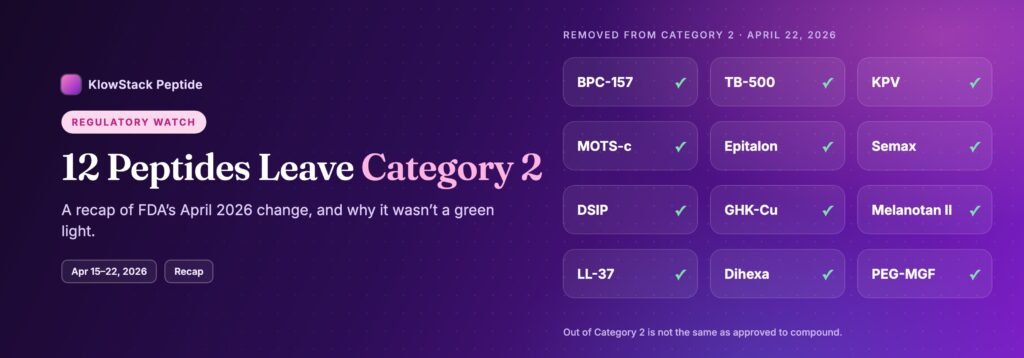
FDA’s updated interim category list, dated April 15, 2026, records that the nominators had withdrawn their nominations for 12 peptides. Under FDA’s interim policy, a withdrawal removes the substance from its category seven calendar days later, so the change took effect on April 22 [1][4]. The next day, a Federal Register notice announced a July advisory committee meeting to review several of them [2].
The 12 peptides
| Peptide | Advisory committee review |
|---|---|
| BPC-157 | July 2026 (recommended) |
| TB-500 (thymosin beta-4 fragment LKKTETQ) | July 2026 (recommended) |
| KPV | July 2026 (recommended) |
| MOTS-c | July 2026 (recommended) |
| Epitalon | July 2026 (recommended) |
| Semax | July 2026 (recommended) |
| Emideltide (DSIP) | July 2026 (not recommended) |
| GHK-Cu (injectable routes) | Planned before end of February 2027 |
| Melanotan II | Planned before end of February 2027 |
| LL-37 (cathelicidin) | Planned before end of February 2027 |
| Dihexa acetate | Planned before end of February 2027 |
| PEG-MGF | Planned before end of February 2027 |
Review outcomes and timing as reported in [4] and [5].
What the removal means, and what it doesn’t
Removal means FDA no longer lists these peptides as flagged for a significant safety risk in compounding. It does not place them in Category 1, and Category 1 or a Bulks List entry is what makes a bulk substance eligible for 503A compounding [3]. In other words, April took the peptides out of one box without putting them in another. The open question moved to the advisory committee and, after that, to FDA rulemaking.
None of the 12 is an FDA-approved drug, and their status as unapproved drugs didn’t change on April 22 [3].
See our July update in this section for how the advisory committee voted. For the research on two of the peptides, read BPC-157 vs TB-500; GHK-Cu, BPC-157 and TB-500 are compared in KLOW vs GLOW.
This article summarizes a regulatory process and is not legal advice.
Sources
- FDA, Bulk Drug Substances Nominated for Use in Compounding Under Section 503A (interim categories list). https://www.fda.gov/media/94155/download
- Federal Register, Pharmacy Compounding Advisory Committee; Notice of Meeting, April 16, 2026 (FR Doc. 2026-07361). https://www.federalregister.gov/documents/2026/04/16/2026-07361/pharmacy-compounding-advisory-committee-notice-of-meeting-establishment-of-a-public-docket-request
- D.J. Holt Law, “BPC-157 in 2026: Why Regulatory Limbo Is Not the Same as a Green Light.” https://djholtlaw.com/regulatory-alert-the-legal-status-of-bpc-157-in-compounding-and-clinical-practice/
- Frier Levitt, “FDA to Remove 12 Popular Peptides from the Category 2 ‘Do Not Compound’ List.” https://www.frierlevitt.com/articles/fda-peptides-do-not-compound-list-update-2026/
- Restore Health Consulting, “FDA’s PCAC Votes in Favor of Six Peptides for 503A Bulks List.” https://www.restorehealthconsulting.com/news/fdas-pcac-votes-in-favor-of-six-peptides-for-potential-inclusion-on-the-503a-bulks-list-what-compounders-need-to-know