
Regulatory Watch · Reviewed by Thomas Okafor, Peptide Chemist · Published October 10, 2026
“Research use only” (RUO) is a label meant for chemicals sold to laboratories, not for products meant for people. A set of FDA warning letters sent in August shows how the agency decides which one a product really is: it looks at the whole website, not just the label.
Who received letters, and for what
The letters went to NuScience Peptides, Royal Peptides, Peptide Partners, Peak Performance Peptides and TXP Innovations (Tex Peptides) [1][2]. Products named across the letters included semaglutide, tirzepatide, retatrutide, tesamorelin, ipamorelin, SS-31 (elamipretide), PT-141 (bremelanotide), survodutide and mazdutide, plus bacteriostatic water [1][2]. FDA cited the sections of the Federal Food, Drug, and Cosmetic Act covering unapproved new drugs and misbranding, and gave each company 15 business days to respond [1].
What FDA treated as evidence of human use
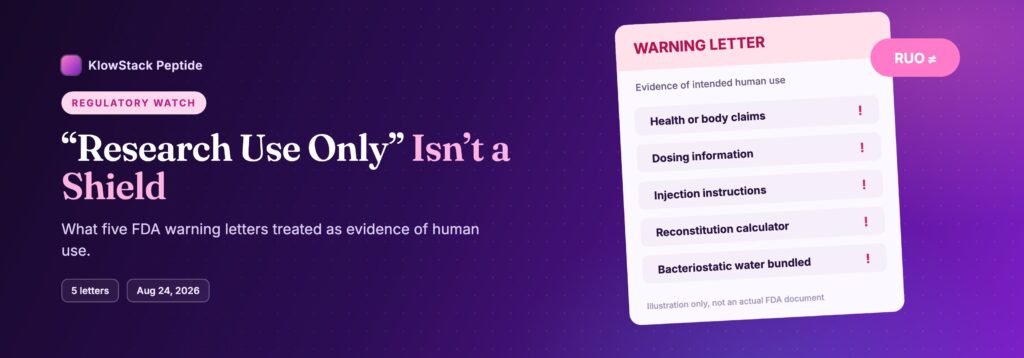
- Claims about treating disease or changing body function.
- Dosing information and injection instructions.
- Peptide reconstitution calculators. In one letter, FDA said a calculator “provides the means to prepare an injectable drug for human administration” [1].
- Bacteriostatic water sold with injectable peptides, which FDA in some cases treated as an unapproved drug itself [1][2].
Despite the RUO labeling, FDA wrote that the website evidence “establishes that your products are intended to be drugs for human use” [1].
Part of a wider pattern
The August letters follow earlier actions. FDA sent a warning letter to Gram Peptides in March 2026 over retatrutide and tirzepatide products [3]. In July 2026, the owner of Paradigm Peptides was sentenced to 70 months in federal prison in a case involving forged certificates of analysis [2]. State boards are acting too: Alabama’s medical board said in June 2026 that physicians may not compound, administer or dispense non-approved or research-grade peptides [2].
Meanwhile the market keeps growing. Blockchain analytics firm Chainalysis estimated that cryptocurrency payments to gray-market peptide vendors reached about $32 million in the first quarter of 2026, up from roughly $12 million the quarter before, as card processors and banks turn this trade away [4].
What this means for reading a peptide website
The letters give a useful checklist. A legitimate research supplier sells to laboratories, publishes independent certificates of analysis, and avoids dosing advice, injection guides and claims about the body. When those lines blur, FDA’s position is that the label no longer decides the question. Our guides on what “research use only” means in US law and how to verify a peptide COA go deeper.
New to these terms? Start with New to Peptides. Read how we cover sellers in our Editorial Policy.
This article summarizes public enforcement documents and is not legal advice.
Sources
- Arent Fox Schiff, “RUO-ined: Five Peptide Vendors Learn That ‘Research Use Only’ Is Not a Legal Strategy.” https://www.afslaw.com/perspectives/alerts/ruo-ined-five-peptide-vendors-learn-research-use-only-not-legal-strategy
- McDermott Will & Schulte, client alert on FDA peptide enforcement, September 24, 2026. https://www.mcdermottlaw.com/?p=50381208
- FDA, Warning Letter to Gram Peptides, March 31, 2026. https://www.fda.gov/inspections-compliance-enforcement-and-criminal-investigations/warning-letters/gram-peptides-721806-03312026
- The Block, “Chainalysis says ‘top-tier’ gray market peptide vendors turn to bitcoin and stablecoins,” June 4, 2026. https://www.theblock.co/post/403683/chainalysis-says-top-tier-gray-market-peptide-vendors-turn-to-bitcoin-and-stablecoins