
Reviewed by Thomas Okafor, Peptide Chemist · Updated October 2026
Semaglutide is a synthetic peptide modeled on GLP-1, a gut hormone that tells the pancreas to release insulin after meals and tells the brain you’re full. It’s studied mainly for type 2 diabetes and weight management, and it’s the active ingredient in the prescription drugs Ozempic, Wegovy and Rybelsus.
Unlike most compounds in our library, semaglutide is an FDA-approved medicine with some of the largest clinical trials in modern medicine behind it, involving tens of thousands of people. That makes it a useful benchmark. It also means there’s a sharp line between the approved, prescription products and the “research-grade” semaglutide powder sold online, which is a different thing entirely.
This guide is educational and isn’t medical advice. Prescription semaglutide should only be used under a licensed clinician’s care. Research-grade semaglutide isn’t approved for human use; see our Medical Disclaimer.
What Is Semaglutide?
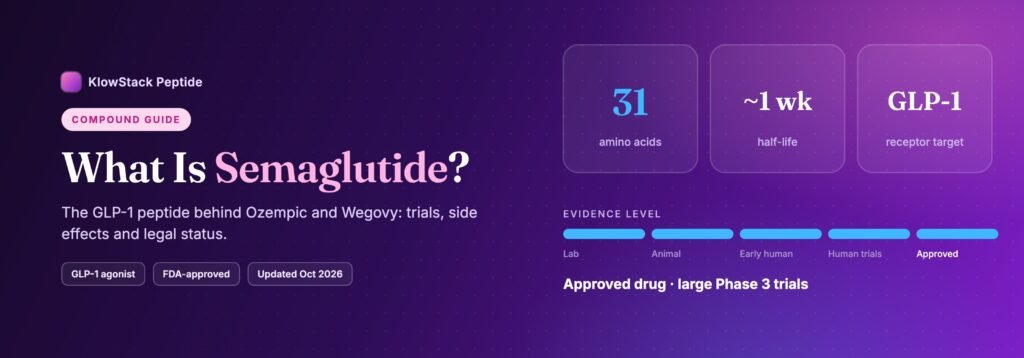
Semaglutide is a lab-made version of the body’s GLP-1 hormone, re-engineered by Novo Nordisk so it lasts about a week in the bloodstream, where natural GLP-1 lasts a couple of minutes. It was designed in the 2000s as a once-weekly diabetes drug, first approved in the US in December 2017 as Ozempic, and later approved for weight management.
To see why the engineering mattered, start with natural GLP-1. Your gut releases it after you eat, and an enzyme called DPP-4 breaks it down within about two minutes. That’s perfect for fine-tuning a single meal and useless for a medicine. Novo Nordisk’s chemists made three changes, described in their 2015 Journal of Medicinal Chemistry paper:
- A swapped amino acid at position 8 (Aib in place of alanine), which blocks DPP-4 from cutting it.
- A fatty-acid chain attached through a linker, which lets semaglutide grip albumin, the most common protein in blood. Bound to albumin, it’s shielded from the kidneys and from enzymes.
- One more swap at position 34, so the fatty chain attaches at exactly one spot.
The result keeps about 94% of human GLP-1’s sequence and has a half-life of roughly a week. Think of it as the difference between a sparkler and a slow-burning candle: same flame, very different staying power.
The history. Ozempic (weekly injection) was approved for type 2 diabetes in 2017. Rybelsus, the first oral GLP-1 tablet, followed in 2019. Wegovy, a higher-strength weekly injection for weight management, was approved in June 2021, extended to teenagers in December 2022, and to heart-risk reduction in March 2024. A liver indication came in August 2025, and a once-daily Wegovy pill was approved on December 22, 2025.
Also known as: Ozempic, Wegovy, Rybelsus and “research semaglutide”
These are all the same molecule. Ozempic and Rybelsus are approved for type 2 diabetes; Wegovy (injection and pill) is approved for weight management and related outcomes. “Semaglutide peptide” or “SEMA-GLP1” in an online listing usually means research-grade powder, a separate product with no FDA approval and no guaranteed quality. “GLP-1” is the hormone family, which also includes liraglutide and, partly, tirzepatide.
How Does Semaglutide Work?
Semaglutide binds and activates the GLP-1 receptor, the same docking site natural GLP-1 uses. In the pancreas, that boosts insulin and lowers glucagon when blood sugar is high. In the stomach, it slows emptying. In the brain, it turns down hunger signals. Together, these lower blood sugar and calorie intake.
Here’s how each piece is known, and from what kind of research:
- Glucose-dependent insulin release (human): semaglutide raises insulin mainly when glucose is elevated, which is why it lowers blood sugar with a lower risk of lows on its own. This is well established in diabetes trials.
- Slower stomach emptying (human): food leaves the stomach more slowly, especially early in treatment, which helps explain both fullness and nausea.
- Appetite signals in the brain (animal and human): in rodents, labeled semaglutide reaches appetite centers in the hypothalamus and brainstem. In people, trials show lower hunger ratings and calorie intake.
- Heart and blood vessels (human, mechanism partly unclear): semaglutide reduced heart attacks, strokes and heart deaths in large trials. How much comes from weight loss and how much from direct effects on blood vessels and inflammation is still being worked out.
What does semaglutide do, in plain terms? It turns up a signal your body already sends after a meal, and keeps it turned up all week. The “full” feeling stays on, the stomach empties slower, and the pancreas responds better to sugar.
One thing known mostly from animal work: rodent thyroid C-cells carry GLP-1 receptors, and semaglutide caused thyroid C-cell tumors in rats and mice. Human thyroid cells carry far fewer of these receptors, and a clear human link hasn’t been shown, but the finding is why the FDA requires a boxed warning.
What Is Semaglutide Used For / Studied For?
Semaglutide is approved for type 2 diabetes, chronic weight management, cutting heart-attack and stroke risk in certain adults, kidney protection in diabetes with kidney disease, and a form of fatty liver disease. All five have large human trials behind them. Newer research areas, such as addiction and Alzheimer’s, are still unproven.
Type 2 diabetes and blood sugar
What was studied: the SUSTAIN program enrolled thousands of adults with type 2 diabetes. SUSTAIN-6 followed 3,297 high-risk patients for two years.
What it found: semaglutide lowered blood sugar more than several older drugs, and in SUSTAIN-6, heart attacks, strokes and heart deaths combined fell by 26% against placebo.
What it doesn’t show: benefits in people without diabetes. That needed separate trials.
Weight management
What was studied: STEP 1 randomized 1,961 adults with obesity or overweight, without diabetes, to weekly semaglutide or placebo for 68 weeks, alongside diet and activity advice.
What it found: average weight loss was 14.9% with semaglutide and 2.4% with placebo. The OASIS 4 trial of the daily pill reported weight loss in a similar range, which led to its 2025 approval.
What it doesn’t show: lasting results after stopping. In the STEP 1 extension, people regained about two-thirds of the lost weight within a year of stopping.
Heart attack and stroke risk
What was studied: SELECT enrolled 17,604 adults with heart disease and overweight or obesity, but no diabetes, for about three years.
What it found: major heart events fell from 8.0% to 6.5%, a 20% relative reduction.
What it doesn’t show: benefit in people without existing heart disease, who weren’t studied.
Kidney disease
What was studied: FLOW followed 3,533 people with type 2 diabetes and chronic kidney disease.
What it found: a 24% lower risk of kidney failure, major kidney decline or death from kidney or heart causes. The trial stopped early because the benefit was clear, and Ozempic gained a kidney indication in January 2025.
Fatty liver disease (MASH)
What was studied: the ESSENCE trial studied adults with MASH, an inflamed fatty liver with scarring, using liver biopsies.
What it found: at 72 weeks, 62.9% on semaglutide had resolution of liver inflammation without worse scarring, against 34.3% on placebo. That led to Wegovy’s accelerated approval for MASH in August 2025.
Newer research: alcohol use and Alzheimer’s disease
What was studied: two very different questions. A small Phase 2 trial in JAMA Psychiatry gave weekly semaglutide or placebo to 48 adults with alcohol use disorder for nine weeks. Separately, Novo Nordisk’s EVOKE and EVOKE+ trials gave oral semaglutide or placebo to 3,808 adults with early Alzheimer’s disease.
What it found: in the alcohol trial, semaglutide reduced how much people drank in a lab drinking session and on the days they drank, and it eased cravings. In the Alzheimer’s trials, announced in November 2025, some blood and brain biomarkers improved, but the disease didn’t progress any slower.
What it doesn’t show: the alcohol finding is early, short and small, and needs a larger trial before it means anything for treatment. The Alzheimer’s result is a clear no for slowing the disease.
What semaglutide hasn’t been shown to do
Online, semaglutide is sometimes pitched for anti-aging, longevity or “resetting metabolism” so weight stays off for good. None of that has been shown. The best long-term data point the other way: weight tends to return when people stop, which is why doctors treat obesity as a chronic condition, much like high blood pressure.
What Does the Human Research Show?
The human research on semaglutide is extensive and high quality: large, randomized, placebo-controlled Phase 3 trials with tens of thousands of participants, covering blood sugar, weight, heart, kidney and liver outcomes. The main open questions are long-term effects over decades and what happens after people stop.
| Study | Year | Design | Participants | Result | Limitation |
|---|---|---|---|---|---|
| SUSTAIN-6 | 2016 | Phase 3 RCT | 3,297 adults with type 2 diabetes | 26% fewer major heart events | Two-year follow-up |
| STEP 1 | 2021 | Phase 3 RCT | 1,961 adults with obesity or overweight | 14.9% vs 2.4% weight loss at 68 weeks | Weight regain after stopping |
| SELECT | 2023 | Phase 3 RCT | 17,604 adults with heart disease, no diabetes | 20% fewer major heart events | High dropout from side effects |
| FLOW | 2024 | Phase 3 RCT | 3,533 adults with diabetes and kidney disease | 24% lower kidney outcome risk | Diabetes population only |
| ESSENCE | 2025 | Phase 3 RCT, biopsy-based | Adults with MASH and fibrosis | 62.9% vs 34.3% MASH resolution | Long-term liver outcomes still pending |
| OASIS 4 | 2025 | Phase 3 RCT | Adults with obesity or overweight | Pill produced weight loss similar to injections | 64-week duration |
PubMed and ClinicalTrials.gov searched October 5, 2026. Semaglutide has thousands of PubMed records and hundreds of registered trials, so this table lists the landmark studies behind each approval.
All of these trials used the approved, prescription products made under FDA-regulated manufacturing. None of them used research-grade semaglutide powder, so their results can’t be assumed to carry over to it. Our Editorial Policy explains how we grade evidence.
Semaglutide Side Effects and Safety
The most common semaglutide side effects in trials were digestive: nausea, diarrhea, vomiting, constipation and stomach pain, usually worst early on. Rarer but serious risks include gallbladder problems, pancreatitis and dehydration-related kidney injury. Animal tumor findings led to a boxed thyroid warning.
Reported in human studies: in STEP 1, digestive side effects affected most participants and were mostly mild to moderate, though they were the main reason people quit. Gallbladder problems, including gallstones, were more common with semaglutide. Rapid weight loss also brings loss of some muscle along with fat. In June 2025, the European Medicines Agency’s safety committee concluded that NAION, a sudden optic-nerve problem that can damage vision, is a very rare side effect, affecting up to 1 in 10,000 people.
Expected from the mechanism: slower stomach emptying raises the risk of food staying in the stomach during anesthesia, so surgeons ask about GLP-1 drugs before operations. Low blood sugar can occur when semaglutide is combined with insulin or sulfonylureas. “Ozempic face,” the hollow look some people describe, reflects fast fat loss from the face more than a direct drug effect.
Anecdotal only: online self-reports mention fatigue, “food noise” going quiet, hair shedding, and changes in taste or cravings for alcohol. Some of these are being studied; none should be treated as established.
Product quality: this risk belongs mainly to research-grade and gray-market semaglutide. When researchers bought semaglutide online without a prescription, every vial they received was judged probably substandard or falsified, all contained bacterial endotoxin, and measured purity was far below the 99% printed on labels. The FDA has also warned about counterfeit Ozempic pens. Our peptide COA guide explains what lab reports should show.
Who should avoid semaglutide
Per the FDA label, people with a personal or family history of medullary thyroid cancer or the genetic syndrome MEN 2 shouldn’t use it. It isn’t recommended in pregnancy, and people planning a pregnancy are usually advised to stop ahead of time. People with a history of pancreatitis, severe stomach-emptying problems or diabetic eye disease need careful medical review, as do teenagers, who are covered only for specific approved uses.
Does semaglutide cause muscle loss?
Some lean mass goes along with fat during any big weight loss, and semaglutide is no exception. In a body-scan subgroup of STEP 1, lean mass made up roughly two-fifths of the total weight lost, though fat fell more in proportion, so body composition improved overall. Lean mass includes water and organs as well as muscle, so it isn’t a direct muscle count. Researchers are now testing whether strength training or added drugs can protect muscle during treatment.
Do you gain weight back after stopping semaglutide?
For most people, yes, at least partly. In the STEP 1 extension, participants regained about two-thirds of their lost weight within a year of stopping, and blood pressure and blood sugar gains faded too. That’s why doctors describe it as a long-term treatment for a chronic condition, much like blood pressure medication.
Semaglutide vs Tirzepatide
Semaglutide activates one hormone receptor (GLP-1); tirzepatide activates two (GLP-1 and GIP). In a head-to-head trial, tirzepatide produced more weight loss, while semaglutide has more years of outcome data on the heart and kidneys.
| Semaglutide | Tirzepatide | |
|---|---|---|
| Mechanism | GLP-1 receptor agonist | Dual GIP and GLP-1 receptor agonist |
| Half-life | About 1 week | About 5 days |
| Evidence | Phase 3 trials for diabetes, weight, heart, kidney, liver | Phase 3 trials for diabetes, weight, sleep apnea |
| Status | Approved (Ozempic, Wegovy, Rybelsus) | Approved (Mounjaro, Zepbound) |
Our full semaglutide vs tirzepatide comparison walks through the mechanisms and the head-to-head data.
Is Semaglutide Legal? Prescription, Compounding and Research Vials
Semaglutide is legal as a prescription drug in the US, sold as Ozempic, Wegovy and Rybelsus. Compounded versions were allowed during the shortage that ran from 2022 into 2025, but that ended when the FDA declared the shortage resolved in February 2025. Research-grade semaglutide isn’t approved for any human use.
Approved products. Ozempic (2017) and Rybelsus (2019) are approved for type 2 diabetes, with Ozempic also approved for heart and kidney risk reduction. Wegovy is approved for chronic weight management in adults and teens 12 and older, heart-risk reduction in adults with heart disease, and MASH with moderate to advanced scarring. The Wegovy pill (December 2025) and a higher-dose Wegovy injection (March 2026) followed. All require a prescription, and the full details are on the FDA label.
The compounding story. When demand outran supply in 2022, semaglutide went on the FDA’s drug shortage list, which legally allowed pharmacies to make compounded copies. The FDA declared the shortage resolved in February 2025 and gave pharmacies until spring 2025 to wind down. Since then, compounding “essentially a copy” of an approved drug is generally not allowed, and the FDA has sent warning letters to compounders and telehealth sellers. Narrow exceptions for documented individual medical needs remain.
Research-grade semaglutide. Powder labeled “research use only” or “not for human consumption” isn’t an approved drug, isn’t compounded under a prescription, and has no quality guarantee, which is exactly what the online purchase study found. It’s a separate legal category from Ozempic, even though the molecule has the same name. Our guide to whether research peptides are legal explains the wider rules.
Sport. Semaglutide isn’t on the 2026 WADA Prohibited List. Athletes should still check with their sport’s anti-doping body, especially for any medication used without a prescription.
FDA, compounding and WADA status checked October 5, 2026.
Where Semaglutide Fits: Needs & Symptoms
Semaglutide belongs in the Weight & Metabolism research area, where it’s the most clinically tested compound on the page by a wide margin. That makes it a reference point: when you read claims about other weight-related peptides, it helps to compare their evidence with semaglutide’s dozens of large trials.
On the same page, tirzepatide is its closest relative, tesamorelin is an approved drug for a narrower fat-related use, and AOD-9604 is a growth hormone fragment whose fat-loss trials didn’t pan out. For the two GLP-1 drugs side by side, see semaglutide vs tirzepatide.
Frequently Asked Questions
What does semaglutide do?
Semaglutide mimics the gut hormone GLP-1. It raises insulin when blood sugar is high, slows stomach emptying and reduces appetite, which lowers blood sugar and helps with weight loss in trials.
Is GLP-1 the same as semaglutide?
Not exactly. GLP-1 is a natural hormone your gut makes. Semaglutide is a long-lasting synthetic version that activates the same receptor. Other GLP-1 drugs include liraglutide and dulaglutide.
What are the dangers of taking semaglutide?
Common risks are nausea and other digestive effects. Rarer ones include gallbladder disease, pancreatitis, kidney injury from dehydration and, very rarely, an optic-nerve problem. There’s a boxed warning based on thyroid tumors in rodents.
Is semaglutide safe?
As an FDA-approved prescription drug, its benefits and risks have been studied in tens of thousands of people. Safety depends on medical supervision. Research-grade semaglutide has no such safety record.
Is semaglutide legal?
Yes, by prescription, as Ozempic, Wegovy or Rybelsus. Compounded copies are now largely restricted since the 2025 end of the shortage, and research-grade powder isn’t approved for human use.
Is semaglutide banned in sports?
No. Semaglutide isn’t on the 2026 WADA Prohibited List. Athletes should still confirm with their own anti-doping organization.
Has semaglutide been tested in humans?
Extensively. Large Phase 3 trials such as SUSTAIN-6, STEP 1, SELECT, FLOW and ESSENCE enrolled from hundreds to more than 17,000 people each, leading to multiple FDA approvals.
Semaglutide vs tirzepatide: which is stronger?
In head-to-head testing, tirzepatide produced more weight loss on average. Semaglutide has longer outcome data on heart and kidney protection. See our semaglutide vs tirzepatide comparison.
Are peptides better than semaglutide for weight loss?
No research peptide has weight-loss evidence close to semaglutide’s. Several, including AOD-9604, failed in trials or were never properly tested. Only tirzepatide and a few other approved drugs match or exceed it.
Do you gain weight back after stopping semaglutide?
Usually, at least partly. In the STEP 1 extension, people regained about two-thirds of the weight they’d lost within a year of stopping.
What dose of semaglutide is used?
Approved doses are set by the FDA label and a prescribing clinician. We don’t publish dosing for any compound; see our Medical Disclaimer.
Sources
Primary studies
- Lau J, et al. 2015. Discovery of the once-weekly glucagon-like peptide-1 (GLP-1) analogue semaglutide. Journal of Medicinal Chemistry. doi:10.1021/acs.jmedchem.5b00726
- Marso SP, et al. 2016. Semaglutide and cardiovascular outcomes in patients with type 2 diabetes (SUSTAIN-6). New England Journal of Medicine. doi:10.1056/NEJMoa1607141
- Wilding JPH, et al. 2021. Once-weekly semaglutide in adults with overweight or obesity (STEP 1). New England Journal of Medicine. doi:10.1056/NEJMoa2032183
- Wilding JPH, et al. 2022. Weight regain and cardiometabolic effects after withdrawal of semaglutide: the STEP 1 trial extension. Diabetes, Obesity and Metabolism. doi:10.1111/dom.14725
- Lincoff AM, et al. 2023. Semaglutide and cardiovascular outcomes in obesity without diabetes (SELECT). New England Journal of Medicine. doi:10.1056/NEJMoa2307563
- Perkovic V, et al. 2024. Effects of semaglutide on chronic kidney disease in patients with type 2 diabetes (FLOW). New England Journal of Medicine. doi:10.1056/NEJMoa2403347
- Sanyal AJ, et al. 2025. Phase 3 trial of semaglutide in metabolic dysfunction-associated steatohepatitis (ESSENCE). New England Journal of Medicine. doi:10.1056/NEJMoa2413258
- Wharton S, et al. 2025. Oral semaglutide at a dose of 25 mg in adults with overweight or obesity (OASIS 4). New England Journal of Medicine. doi:10.1056/NEJMoa2500969
- Ashraf AR, et al. 2024. Multifactor quality and safety analysis of semaglutide products sold by online sellers without a prescription. Journal of Medical Internet Research. doi:10.2196/65440
Regulatory
Disclaimer: Prescription semaglutide (Ozempic, Wegovy, Rybelsus) should be used only under a licensed clinician’s care. Research-grade semaglutide is sold for research use only and isn’t approved for human use. This guide is educational and isn’t medical advice. Read our Medical Disclaimer and Editorial Policy.