
Reviewed by Thomas Okafor, Peptide Chemist · Updated October 2026
Sermorelin is a synthetic copy of the first 29 amino acids of growth hormone-releasing hormone (GHRH), the brain signal that tells the pituitary to release growth hormone. It’s studied mainly for diagnosing and treating growth hormone deficiency in children, and more recently for age-related declines in growth hormone.
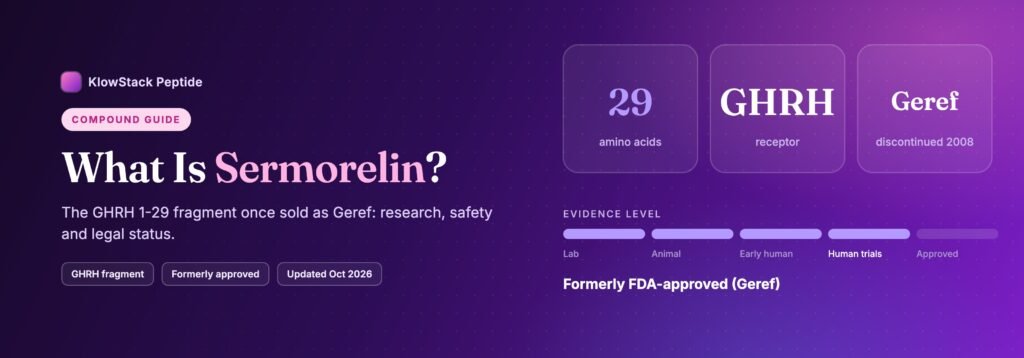
Sermorelin is unusual in this library: it was once an FDA-approved drug, sold as Geref until 2008, and the FDA has confirmed it wasn’t pulled for safety or effectiveness reasons. Its human research is older but real, including a one-year study in 110 children. Studies in older adults are small and short, and the anti-aging claims you’ll see online go well beyond them.
This guide is educational and isn’t medical advice. Research-grade sermorelin isn’t approved for human use; see our Medical Disclaimer.
What Is Sermorelin?
Sermorelin is GHRH(1-29), the shortest piece of the natural 44-amino-acid hormone that still works fully. Scientists isolated GHRH in 1982 from rare pancreatic tumors that caused acromegaly, found that the first 29 amino acids carried all the activity, and Serono developed that fragment into the drug Geref.
The story of how GHRH was found is a good one. In the early 1980s, two teams studied patients with acromegaly, a condition of too much growth hormone, whose cause turned out to be tumors in the pancreas pumping out a growth hormone-releasing substance. Those tumors gave researchers enough material to finally identify the hormone, which the brain makes in tiny amounts. Some fragments of it were then tested to find the shortest version that still worked. That version, 29 amino acids with an amide cap, became sermorelin.
The chemistry. Sermorelin has the same sequence as the first 29 amino acids of human GHRH. Unlike its newer cousin CJC-1295, it has no protective swaps, so enzymes break it down quickly, within minutes in the blood. That short life means it produces a short, natural-looking growth hormone pulse after each dose.
The history. The FDA approved Geref in two forms: a diagnostic version in December 1990, to test whether the pituitary can release growth hormone, and a treatment version in September 1997, for children with idiopathic growth hormone deficiency and growth failure. EMD Serono told the FDA in December 2008 that it was discontinuing Geref, and the approvals were withdrawn in 2009. In a March 2013 Federal Register notice, the FDA determined Geref “was not withdrawn from sale for reasons of safety or effectiveness.”
Also known as: Geref, GRF(1-29) and “sermorelin acetate”
Older papers call sermorelin GRF(1-29)NH2 or GHRH(1-29)-NH2, and you’ll see both throughout this guide’s sources. Geref was the brand name. Sermorelin acetate is the salt form in most vials. It’s different from CJC-1295 and tesamorelin, which are modified GHRH analogs built to last longer.
How Does Sermorelin Work?
Sermorelin binds the GHRH receptor on growth hormone-making cells in the pituitary, the same receptor natural GHRH uses. That triggers a release of growth hormone, which prompts the liver to make IGF-1. Because sermorelin is cleared quickly, the response is a short pulse, similar to the body’s own pattern.
What’s known about each step:
- GHRH receptor activation (human): intravenous sermorelin reliably raises growth hormone within minutes, which is why it was approved as a diagnostic test of pituitary function.
- Pulse-like release (human): in older men, twice-daily injections raised average 24-hour growth hormone and pulse size while keeping the pulsing pattern.
- Natural brakes still work (human): because sermorelin acts upstream, the body’s feedback system, mainly somatostatin and IGF-1, can still rein growth hormone in. That’s one reason it’s described as more “physiologic” than injecting growth hormone itself.
- Hypothalamic vs pituitary problems (human): sermorelin only works if the pituitary is healthy. A child whose problem lies in the hypothalamus can respond; one whose pituitary can’t make growth hormone won’t.
What does sermorelin do? It knocks on the pituitary’s GHRH door, briefly. The pituitary answers with a growth hormone pulse, and the usual feedback loops decide how big it gets. Think of it as pressing a doorbell, where growth hormone injections are more like kicking the door in.
That feedback is the part people often miss. Your body runs growth hormone like a home thermostat: when IGF-1 climbs, the brain releases more somatostatin, the hormone that tells the pituitary to ease off. Sermorelin works upstream of that thermostat, so the system can still turn itself down. Injected growth hormone skips the thermostat entirely.
Some details still come from animal and lab work, such as how repeated GHRH exposure changes the number of growth hormone cells over time.
What Is Sermorelin Used For / Studied For?
Sermorelin was approved for diagnosing growth hormone deficiency and treating it in children, and has been studied in small trials of older adults and in sleep research. The childhood uses have the best evidence. Effects on muscle, fat, energy and aging in adults are thinly studied.
Diagnosing growth hormone deficiency
What was studied: intravenous sermorelin as a stimulation test, measuring how much growth hormone the pituitary releases.
What it found: according to a 1999 BioDrugs review, it was a rapid and fairly specific test, with fewer false positives than some older tests, especially when combined with arginine.
What it doesn’t show: a normal response doesn’t rule out deficiency caused by the hypothalamus, so other tests are still needed.
Treating children with growth hormone deficiency
What was studied: the Geref International Study Group treated 110 previously untreated children with nightly sermorelin injections for up to a year, in an open-label study.
What it found: average growth rate nearly doubled, from 4.1 to 8.0 centimeters a year at six months, and 74% responded well. Bone age didn’t race ahead, and no harmful changes in blood tests were seen.
What it doesn’t show: that it beats growth hormone itself. In a randomized comparison of 60 children, those on growth hormone grew faster (14.6 versus about 9.2 centimeters a year), and nearly all children on sermorelin developed antibodies to it.
Growth hormone decline with aging
What was studied: two small trials in healthy older men. In one, 10 men aged about 68 took sermorelin twice daily for 14 days. In another, 11 men aged 64 to 76 took one nightly injection for six weeks.
What it found: twice-daily doses restored growth hormone and IGF-1 to levels seen in young men. The nightly regimen raised growth hormone but not IGF-1; two of six strength measures improved, while body fat, muscle on scans and blood sugar didn’t change.
What it doesn’t show: lasting benefits, effects in women, or anything about longevity. These were tiny, short studies.
Sleep
What was studied: GHRH and sleep are closely linked. Pulses of GHRH given at night increased deep, slow-wave sleep in earlier human studies.
What it found: the relationship isn’t simple. When University of Michigan researchers blocked the GHRH receptor in healthy young men overnight, growth hormone fell by more than 90%, but deep sleep didn’t change.
What it doesn’t show: that sermorelin injections improve sleep. No modern trial has tested that.
What sermorelin hasn’t been shown to do
Sermorelin hasn’t been shown to reverse aging, burn fat, build meaningful muscle or boost energy in adults. Clinics often market it as “anti-aging,” borrowing from growth hormone research and from small, short studies like those above.
What Does the Human Research Show?
Sermorelin’s human research is genuine but dated. It includes approval-era studies in children, diagnostic studies, and a handful of small trials in older men, most from the 1990s. No large modern trial has tested it in adults, which is a big gap given how widely clinics offer it today.
| Study | Year | Design | Participants | Result | Limitation |
|---|---|---|---|---|---|
| Corpas et al. | 1992 | Randomized dose crossover | 10 older men (plus 9 young controls) | GH and IGF-1 restored to young-adult levels at the higher dose | 14 days per dose |
| Chen et al. | 1993 | Randomized comparison with GH | 60 children with GH deficiency | Grew less than on GH; almost all formed antibodies | Six months |
| Thorner et al. (Geref Study Group) | 1996 | Multicenter, open-label | 110 children with GH deficiency | Growth rate rose from 4.1 to 8.0 cm/year | No control group |
| Vittone et al. | 1997 | Open-label, before and after | 11 older men | GH up; IGF-1 unchanged; 2 of 6 strength tests improved | Six weeks, no placebo |
PubMed (333 records) and ClinicalTrials.gov searched October 5, 2026. Most registered “GHRH” trials since 2005 tested tesamorelin, a different analog.
Why was Geref discontinued? EMD Serono notified the FDA in December 2008 that it was stopping production, and the FDA later confirmed the withdrawal wasn’t for safety or effectiveness. The decision is widely attributed to business reasons: recombinant growth hormone had become the standard treatment and worked better in head-to-head testing. Our Editorial Policy explains how we label approved, formerly approved and research-only evidence.
Why hasn’t anyone run a big modern trial? Sermorelin is an old, unpatented molecule, so no company stands to recoup the cost of a large study, which can run into tens of millions of dollars. Academic groups have moved on to newer analogs like tesamorelin, which has a patent and a sponsor. The result is a compound that’s prescribed widely today on the strength of decades-old, mostly pediatric data.
Sermorelin Side Effects and Safety
In clinical studies, sermorelin was generally well tolerated. The most common side effects were injection-site reactions, flushing and headache. Many children developed antibodies to it, though these didn’t clearly reduce growth. Long-term safety in healthy adults hasn’t been studied.
Reported in human studies: pain, redness or swelling at the injection site was the most frequent complaint. Facial flushing, headache and nausea occurred less often. In the randomized children’s study, 39 of 40 children on sermorelin developed GHRH antibodies, which faded within nine months of stopping. The older-adult studies reported no serious adverse effects.
Expected from the mechanism: raising growth hormone and IGF-1 can bring fluid retention, joint aches and higher blood sugar, as seen with growth hormone therapy. Because sermorelin works through the body’s own feedback loops, these effects may be milder, though that hasn’t been tested directly against growth hormone in adults.
Anecdotal only: online self-reports mention vivid dreams, better sleep, morning tiredness and changes in appetite. These are personal accounts that haven’t been confirmed in trials.
Product quality: prescription sermorelin from licensed pharmacies and research-grade “sermorelin” vials are different products. Research vials aren’t made to drug standards. Our peptide COA guide explains what a lab report should show.
Who should avoid sermorelin
The clearest no is anyone with an active cancer or a history of cancer, because growth hormone and IGF-1 support cell growth. Caution also applies in pregnancy and breastfeeding, diabetes, untreated thyroid problems, pituitary or brain tumors, and in anyone competing in drug-tested sport.
What does sermorelin do to your face?
There’s no study showing sermorelin changes facial appearance. “Glow” stories online are anecdotal. The one face-related effect seen in studies is temporary flushing shortly after a dose.
Sermorelin vs Tesamorelin
Sermorelin and tesamorelin both activate the GHRH receptor. Sermorelin is the plain 29-amino-acid fragment and was approved for children until 2008. Tesamorelin is a stabilized 44-amino-acid version, FDA-approved today (as Egrifta) to reduce belly fat in adults with HIV-related lipodystrophy.
| Sermorelin | Tesamorelin | |
|---|---|---|
| Mechanism | GHRH(1-29), unmodified | Full GHRH(1-44) with a stabilizing group |
| Half-life | Minutes | About half an hour |
| Evidence | Pediatric trials; small adult studies | Two Phase 3 trials in HIV lipodystrophy |
| Status | Formerly approved (Geref, discontinued 2008) | Approved (Egrifta) |
Sermorelin also gets compared with a different kind of growth hormone releaser, covered in sermorelin vs ipamorelin. Our tesamorelin guide has the details on its trials.
Is Sermorelin Legal? Why Is It Banned in Sports?
Sermorelin isn’t currently an FDA-approved drug in the US, because Geref was discontinued and its approvals were withdrawn in 2009. Because it was an approved drug that wasn’t withdrawn for safety, it holds a different position from most research peptides, and it’s commonly prescribed through compounding pharmacies. WADA bans it in sport.
Formerly approved. Geref’s diagnostic form was approved in 1990 and its treatment form in 1997. After discontinuation, the FDA’s 2013 determination that it wasn’t withdrawn for safety or effectiveness means a generic version could, in principle, be approved again. No company has done so as of October 2026.
Compounding. Federal compounding law generally lets licensed pharmacies use bulk ingredients that are components of FDA-approved drugs, and it bars drugs withdrawn for safety reasons. Sermorelin’s history puts it on the permitted side of that line, which is why compounding pharmacies widely prepare it with a prescription. It isn’t on the FDA’s Category 2 safety-risk list. In practice, that means a licensed prescriber writes a prescription for a specific patient, and a state-licensed compounding pharmacy prepares it. That doesn’t make compounded sermorelin FDA-approved: compounded drugs aren’t checked by the FDA for safety, effectiveness or quality the way approved drugs are, and the details are worth confirming with a pharmacist.
Research use only. Sermorelin vials sold online for research aren’t compounded under a prescription and have no quality oversight. Our guide to whether research peptides are legal explains the wider rules.
Sport. The 2026 WADA Prohibited List names sermorelin under S2.2.4, growth hormone-releasing factors, prohibited in and out of competition. That’s the short answer to “why is sermorelin banned”: it raises growth hormone, which anti-doping rules treat as performance-enhancing.
FDA and WADA status checked October 5, 2026.
Where Sermorelin Fits: Needs & Symptoms
Sermorelin is listed under Sleep & Energy, where it’s described as an earlier-generation GHRH analog studied for growth hormone pulsing, a pattern closely tied to deep sleep. As the research above shows, the sleep connection is real at the level of hormones, but sermorelin itself hasn’t been tested as a sleep treatment.
On the same page, DSIP and epitalon are studied for sleep and circadian signaling, and the CJC-1295 and ipamorelin guides cover the other growth hormone releasers. For a direct comparison, see sermorelin vs ipamorelin.
Frequently Asked Questions
What does sermorelin do?
Sermorelin activates the GHRH receptor on the pituitary, prompting a short pulse of the body’s own growth hormone. It was approved for testing and treating growth hormone deficiency in children until 2008.
Is sermorelin FDA-approved?
Not anymore. It was approved as Geref (1990 and 1997) and discontinued in 2008. The FDA confirmed in 2013 that it wasn’t withdrawn for safety or effectiveness reasons.
What are the downsides of taking sermorelin?
Injection-site reactions, flushing and headache are the common ones. Children often developed antibodies. Long-term effects in adults are unknown, and no current FDA-approved product exists.
Is it safe to take sermorelin?
It was well tolerated in clinical studies, mostly in children and in small groups of older men. Safety for long-term use in healthy adults hasn’t been studied.
Why is sermorelin banned?
WADA bans it because it raises growth hormone, which can enhance performance. It’s listed under class S2.2.4, prohibited at all times.
Is sermorelin legal?
It’s no longer an approved drug, but because it wasn’t withdrawn for safety reasons, compounding pharmacies prepare it with a prescription. Research-grade vials aren’t approved for human use.
Has sermorelin been tested in humans?
Yes. Studies include a one-year trial in 110 children and small trials in older men. Most are from the 1990s.
Sermorelin vs ipamorelin: what’s the difference?
Sermorelin works through the GHRH receptor; ipamorelin works through the ghrelin receptor. See our sermorelin vs ipamorelin comparison.
What not to mix with sermorelin?
No formal drug-interaction studies exist for sermorelin today. Medicines that affect the growth hormone system, such as steroids, thyroid hormone and some diabetes drugs, can change how the pituitary responds. That’s a question for the prescriber and pharmacist, who can review a full medication list.
Do sermorelin tablets work?
There’s no approved oral sermorelin, and Geref was an injection. Peptides like sermorelin are broken down in the gut, and no published trial shows a tablet raises growth hormone. A nasal spray version was tested in children in the early 1990s, but it never became a product.
How long can you stay on sermorelin?
No study has defined a safe duration for adults. The longest published trials ran about a year, in children under medical supervision.
What is the sermorelin dosage?
There’s no research-based dosing for non-approved use, and we don’t publish dosing for any compound. See our Medical Disclaimer.
Sources
Primary studies
- Corpas E, et al. 1992. Growth hormone (GH)-releasing hormone-(1-29) twice daily reverses the decreased GH and insulin-like growth factor-I levels in old men. Journal of Clinical Endocrinology & Metabolism. doi:10.1210/jcem.75.2.1379256
- Chen RG, et al. 1993. A comparative study of growth hormone (GH) and GH-releasing hormone(1-29)-NH2 for stimulation of growth in children with GH deficiency. Acta Paediatrica Supplement. doi:10.1111/j.1651-2227.1993.tb12834.x
- Thorner M, et al. (Geref International Study Group). 1996. Once daily subcutaneous growth hormone-releasing hormone therapy accelerates growth in growth hormone-deficient children during the first year of therapy. Journal of Clinical Endocrinology & Metabolism. doi:10.1210/jcem.81.3.8772599
- Vittone J, et al. 1997. Effects of single nightly injections of growth hormone-releasing hormone (GHRH 1-29) in healthy elderly men. Metabolism. doi:10.1016/s0026-0495(97)90174-8
- Jessup SK, et al. 2004. Blockade of endogenous growth hormone-releasing hormone receptors dissociates nocturnal growth hormone secretion and slow-wave sleep. European Journal of Endocrinology. doi:10.1530/eje.0.1510561
Reviews
- Prakash A, Goa KL. 1999. Sermorelin: a review of its use in the diagnosis and treatment of children with idiopathic growth hormone deficiency. BioDrugs. doi:10.2165/00063030-199912020-00007
Regulatory
Disclaimer: Sermorelin isn’t a currently FDA-approved drug, and research-grade sermorelin is sold for research use only. This guide is educational and doesn’t give medical advice. Read our Medical Disclaimer and Editorial Policy.