
Reviewed by Thomas Okafor, Peptide Chemist · Updated October 2026
Tirzepatide is a synthetic peptide that activates two gut-hormone receptors at once, GIP and GLP-1, which boosts insulin after meals and reduces appetite. It’s studied mainly for type 2 diabetes and obesity, and it’s the active ingredient in the prescription drugs Mounjaro and Zepbound.
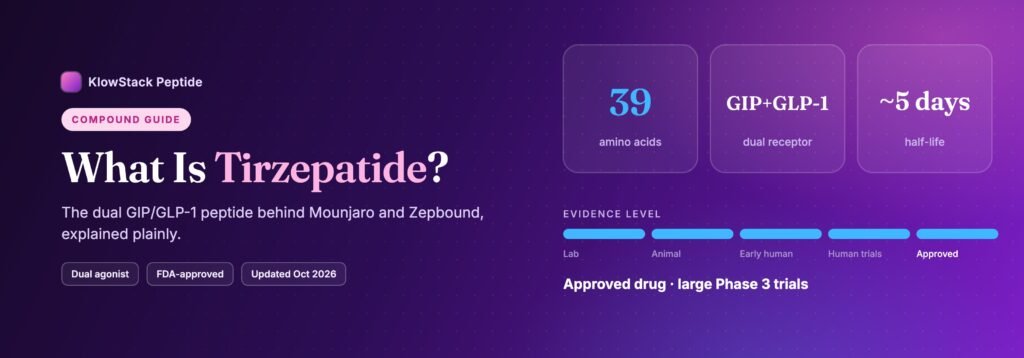
Tirzepatide is an FDA-approved medicine with large Phase 3 trials behind it, including a head-to-head trial in which it beat semaglutide for weight loss. As with any approved drug, the evidence applies to the prescription products. “Research-grade” tirzepatide sold online as powder is a separate, unapproved product.
This guide is educational and isn’t medical advice. Mounjaro and Zepbound should only be used under a licensed clinician’s care, and research-grade tirzepatide isn’t approved for human use. See our Medical Disclaimer.
What Is Tirzepatide?
Tirzepatide is a lab-made peptide designed by Eli Lilly to act like two incretin hormones in one molecule. Lilly scientists described it in 2018 under the code LY3298176, and the FDA approved it in May 2022 as Mounjaro for type 2 diabetes and in November 2023 as Zepbound for chronic weight management.
Incretins, in plain English. When you eat, your gut releases two hormones, GIP and GLP-1, that tell the pancreas to get ready with insulin. Together they explain why sugar you swallow raises insulin more than the same sugar given into a vein. For years, drug makers focused on GLP-1 because GIP seemed to do little in type 2 diabetes. Lilly bet that combining the two would do more than either alone, a bet that paid off in the trials.
The chemistry. Tirzepatide is a chain of 39 amino acids whose backbone mostly follows GIP, with some GLP-1 features mixed in. Like semaglutide, it carries a fatty-acid chain (a C20 diacid) that grips albumin in the blood and stretches its half-life to about five days. It also contains Aib, a modified amino acid that blocks the enzyme DPP-4 from breaking it down. The 2018 Molecular Metabolism paper describing it found it activated the GIP receptor about as strongly as natural GIP, and the GLP-1 receptor somewhat more weakly than natural GLP-1. That imbalance turns out to be part of its character.
Why build one molecule and skip prescribing two drugs? A single peptide locks in the balance between the two signals, needs one injection, and moves through the body as one unit, so the GIP and GLP-1 effects rise and fall together. It’s a bit like a combination cold medicine, where the ratio is fixed by design, except that here both actions live in the same chain of amino acids.
Also known as: Mounjaro, Zepbound and “twincretin”
Mounjaro and Zepbound contain the same molecule. Mounjaro is the diabetes brand; Zepbound is for weight management and sleep apnea. Early papers used the code LY3298176, and some researchers called it a “twincretin” because it hits two incretin receptors. Online listings for “tirzepatide peptide” or “TZ” vials usually mean unapproved research powder.
How Does Tirzepatide Work?
Tirzepatide binds two receptors: the GIP receptor and the GLP-1 receptor. In the pancreas, both boost insulin when blood sugar is high. GLP-1 action also slows the stomach and quiets hunger in the brain. GIP action seems to improve how fat tissue stores energy and may soften nausea, though that part is still being studied.
Here’s what’s known about each piece:
- Insulin release from both receptors (human): in people with type 2 diabetes, tirzepatide lowered blood sugar more than semaglutide did in the SURPASS-2 trial.
- Appetite and stomach emptying (human): people eat less and feel full sooner, which drives most of the weight loss.
- GIP’s role in fat tissue (animal and early human): fat cells carry GIP receptors, and in animals GIP activity improves how fat handles sugar and fatty acids. How much this adds in people is debated.
- Biased signaling at GLP-1 (lab): cell studies show tirzepatide triggers the GLP-1 receptor in a slightly different way from natural GLP-1, with less receptor “pull-in” from the cell surface. Researchers think this may keep the signal working longer, but it’s a lab finding.
What does tirzepatide do in everyday terms? Picture a sound system with two speakers. Semaglutide turns up one speaker loud. Tirzepatide turns up both, one fully and the other partway, and in trials the combined volume moved the needle further on weight.
A puzzle worth knowing: blocking GIP also causes weight loss in animals, and Amgen is testing a drug that blocks the GIP receptor while activating GLP-1. So the field still argues about whether GIP’s benefit comes from activating its receptor or from wearing it out over time. The answer doesn’t change what the trials showed, but it’s a reminder that even approved drugs aren’t fully understood.
What Is Tirzepatide Used For / Studied For?
Tirzepatide is approved for type 2 diabetes, chronic weight management, obstructive sleep apnea with obesity, and cutting heart risk in adults with type 2 diabetes and heart disease. It has also been tested in heart failure and fatty liver disease. All of these have human trials; the newer areas are still awaiting approval.
Type 2 diabetes
What was studied: the SURPASS program included SURPASS-2, which compared tirzepatide with semaglutide in 1,879 adults with type 2 diabetes for 40 weeks.
What it found: every tirzepatide dose lowered blood sugar (HbA1c) and weight more than semaglutide did.
What it doesn’t show: the comparison used the semaglutide dose approved for diabetes at the time, lower than the dose used for weight management.
Weight management
What was studied: SURMOUNT-1 randomized 2,539 adults with obesity or overweight, without diabetes, to tirzepatide or placebo for 72 weeks.
What it found: average weight loss was 15.0% to 20.9% depending on the dose, against 3.1% on placebo. At the two higher doses, half or more of participants lost at least 20% of their body weight.
What it doesn’t show: results after stopping. In SURMOUNT-4, people switched to placebo after 36 weeks regained a large share of the weight, while those who stayed on tirzepatide kept losing.
Head-to-head with semaglutide
What was studied: SURMOUNT-5 randomized 751 adults with obesity, without diabetes, to the highest tolerated dose of tirzepatide or semaglutide for 72 weeks.
What it found: weight loss averaged 20.2% with tirzepatide and 13.7% with semaglutide. Waist size also fell more.
What it doesn’t show: heart or kidney outcomes, which weren’t measured.
Obstructive sleep apnea
What was studied: the SURMOUNT-OSA trials enrolled adults with obesity and moderate-to-severe sleep apnea, with and without CPAP machines.
What it found: tirzepatide cut breathing interruptions per hour of sleep far more than placebo, and some participants no longer met the definition of moderate sleep apnea. That led to Zepbound’s sleep apnea approval in December 2024.
Heart outcomes
What was studied: SURPASS-CVOT compared tirzepatide with dulaglutide, an older GLP-1 drug with proven heart benefits, in 13,299 adults with type 2 diabetes and heart disease.
What it found: heart attacks, strokes and heart deaths occurred in 12.2% on tirzepatide and 13.1% on dulaglutide. Tirzepatide met the goal of being at least as good, and the FDA added a heart-risk indication to Mounjaro in August 2026. Separately, the SUMMIT trial enrolled 731 adults with obesity and heart failure with preserved ejection fraction, a form in which the heart muscle is stiff and fills poorly. Over about two years, the combined rate of heart-failure worsening or heart death was 38% lower on tirzepatide, and people reported less breathlessness and could walk farther.
Fatty liver disease (MASH)
What was studied: the Phase 2 SYNERGY-NASH trial gave tirzepatide or placebo for 52 weeks to 190 adults with MASH and moderate or severe liver scarring, confirmed by biopsy.
What it found: liver inflammation resolved without worse scarring in 44% to 62% of the tirzepatide groups, depending on dose, against 10% on placebo. Scarring improved more often too.
What it doesn’t show: whether these biopsy changes prevent cirrhosis or liver failure. Larger Phase 3 trials are needed, and MASH isn’t an approved use of tirzepatide as of October 2026.
What tirzepatide hasn’t been shown to do
It hasn’t been shown to slow aging, build muscle or keep weight off after stopping. Claims that research-grade tirzepatide “works the same” as Zepbound also have no evidence behind them, because no trial has tested research powder.
What Does the Human Research Show?
The human research on tirzepatide is large and strong: the SURPASS and SURMOUNT programs together enrolled tens of thousands of people in randomized trials, with outcomes for blood sugar, weight, sleep apnea and heart events. Open questions include decades-long safety and what maintenance looks like after stopping.
| Study | Year | Design | Participants | Result | Limitation |
|---|---|---|---|---|---|
| SURPASS-2 | 2021 | Phase 3 RCT vs semaglutide | 1,879 adults with type 2 diabetes | Bigger HbA1c and weight drops | Lower semaglutide dose |
| SURMOUNT-1 | 2022 | Phase 3 RCT | 2,539 adults with obesity or overweight | 15.0–20.9% weight loss vs 3.1% | No outcome endpoints |
| SURMOUNT-4 | 2024 | Randomized withdrawal | 670 adults after a 36-week lead-in | Weight regained on placebo | Short follow-up after stopping |
| SURMOUNT-OSA | 2024 | Two Phase 3 RCTs | 469 adults with sleep apnea and obesity | Large drop in breathing interruptions | One-year duration |
| SURMOUNT-5 | 2025 | Phase 3 RCT vs semaglutide | 751 adults with obesity | 20.2% vs 13.7% weight loss | Open-label |
| SURPASS-CVOT | 2025 | Phase 3 RCT vs dulaglutide | 13,299 adults with diabetes and heart disease | Heart events 12.2% vs 13.1% (noninferior) | Not placebo-controlled |
PubMed and ClinicalTrials.gov searched October 5, 2026. Tirzepatide has thousands of PubMed records and hundreds of registered trials; this table lists the landmark studies.
A few limits apply across the whole program. Most trials ran one to two years, so data beyond that come from extensions and pharmacy and insurance records. Many enrolled more white participants than the US population, and people with very high body weight or kidney disease were sometimes excluded. These are normal gaps for a drug this new, and Lilly has longer trials running.
All of these trials used Lilly’s manufactured product. The Editorial Policy explains why we never assume trial results transfer to unregulated research powder.
Tirzepatide Side Effects and Safety
In trials, tirzepatide’s most common side effects were digestive: nausea, diarrhea, vomiting and constipation, usually during dose increases. Serious but less common risks include gallbladder disease, pancreatitis and kidney strain from dehydration. It also has a boxed warning, because tirzepatide caused thyroid C-cell tumors in rats.
Reported in human studies: in SURMOUNT-1, nausea was the most frequent complaint, and digestive effects were the main reason people stopped. Gallbladder events were more common than on placebo. Fast weight loss also brings some loss of lean mass alongside fat.
Expected from the mechanism: slower stomach emptying can reduce how well birth control pills are absorbed, so the label advises backup contraception for a few weeks after starting and after each increase. Low blood sugar is possible when combined with insulin or sulfonylureas, and anesthesia teams ask about it because food can stay in the stomach longer.
Anecdotal only: people posting online describe tiredness, headaches, hair shedding, “sulfur burps” and injection-site itching. Some match trial data; others haven’t been measured.
Product quality: this applies mainly to unapproved tirzepatide. FDA has warned about counterfeit and unapproved tirzepatide products sold online, and research vials have no required sterility or endotoxin testing. Our peptide COA guide explains what a credible lab report contains.
Who should avoid tirzepatide
According to the FDA label, people with a personal or family history of medullary thyroid cancer or MEN 2 shouldn’t use it. It isn’t recommended during pregnancy, and people with past pancreatitis, severe digestive conditions or diabetic eye disease need close medical review.
Does tirzepatide cause muscle loss?
Some. In a body-scan subgroup of SURMOUNT-1, fat mass fell by about a third, while lean mass fell by roughly a tenth. So most of the weight lost was fat, and the share of the body made of fat went down. Lean mass also includes water and organs, so it isn’t a direct measure of muscle. Whether resistance training can protect strength during treatment is now being studied.
Is tirzepatide hard on your body?
For most trial participants, the main burden was digestive side effects in the first months. Large outcome trials have so far shown heart benefits and no new organ damage signal, but tirzepatide has been on the market only since 2022, so decades-long data don’t exist yet.
Tirzepatide vs Semaglutide
Tirzepatide activates GIP and GLP-1 receptors; semaglutide activates GLP-1 only. In SURMOUNT-5, tirzepatide produced about 6.5 percentage points more weight loss. Semaglutide has a longer track record and approved kidney and liver indications that tirzepatide doesn’t yet have.
| Tirzepatide | Semaglutide | |
|---|---|---|
| Mechanism | Dual GIP and GLP-1 receptor agonist | GLP-1 receptor agonist |
| Half-life | About 5 days | About 1 week |
| Evidence | Phase 3 for diabetes, weight, sleep apnea, heart | Phase 3 for diabetes, weight, heart, kidney, liver |
| Status | Approved (Mounjaro, Zepbound) | Approved (Ozempic, Wegovy, Rybelsus) |
Our semaglutide vs tirzepatide comparison covers the mechanisms and trial data in depth.
Is Tirzepatide Legal? Prescriptions, Compounding and Research Vials
Tirzepatide is legal in the US as a prescription drug, sold as Mounjaro and Zepbound. Compounded copies were allowed while it was on the FDA shortage list, which ended in late 2024. Research-grade tirzepatide isn’t approved for any human use.
Approved products. Mounjaro was approved in May 2022 for type 2 diabetes and gained a heart-risk-reduction indication in August 2026. Zepbound was approved in November 2023 for chronic weight management and in December 2024 for moderate-to-severe obstructive sleep apnea in adults with obesity. Lilly also sells Zepbound in single-dose vials through its own pharmacy program. Full prescribing details are on the FDA label.
Compounding. Tirzepatide was on the FDA’s shortage list from late 2022. In December 2024, the FDA confirmed the shortage was resolved, and its grace period for compounders ended in February 2025 for pharmacies and March 2025 for larger outsourcing facilities. Since then, routinely compounding copies of an approved drug isn’t allowed, apart from narrow, documented individual needs.
Research powder. “Tirzepatide” vials labeled for research only aren’t Mounjaro or Zepbound, carry no FDA approval and have no quality guarantee. They’re a different legal category altogether. The FDA has also warned consumers about counterfeit Mounjaro and Zepbound pens and about websites selling “tirzepatide” without a prescription, some of which ship products with the wrong ingredient or none at all. A real pen comes from a licensed pharmacy with a prescription label, the way any other prescription would. Our guide to whether research peptides are legal has the broader rules.
Sport. Tirzepatide isn’t named on the 2026 WADA Prohibited List, and incretin drugs aren’t a banned class. Anyone in tested sport is still wise to ask their governing body, since rules can change between list updates.
FDA, compounding and WADA status checked October 5, 2026.
Where Tirzepatide Fits: Needs & Symptoms
Tirzepatide belongs in Weight & Metabolism, alongside semaglutide as one of the two compounds there with large, approved-drug evidence. It’s a useful yardstick when you read about research peptides marketed for fat loss: few of them have even a single controlled human trial.
On the same page, semaglutide is its closest comparison, tesamorelin targets belly fat in one specific condition, and MOTS-c is an early-stage mitochondrial peptide studied for metabolism. The two incretin drugs are compared in semaglutide vs tirzepatide. If you’re reading the Weight & Metabolism page for the first time, the evidence labels there show how far apart these two approved drugs are from the research-only compounds listed beside them.
Frequently Asked Questions
What does tirzepatide do?
Tirzepatide activates GIP and GLP-1 receptors. That raises insulin when blood sugar is high, slows digestion and lowers appetite, which reduced blood sugar and body weight in large trials.
What are the drawbacks of tirzepatide?
Digestive side effects are common, especially early. There’s a boxed thyroid warning from rodent studies, a gallbladder risk, and weight tends to return after stopping. It also requires a prescription.
Is tirzepatide safe?
As an approved drug, its benefits and risks are documented in large trials and on the FDA label. It’s meant to be used with medical supervision. Research-grade tirzepatide has no safety record.
Is tirzepatide legal?
Yes, by prescription as Mounjaro or Zepbound. Compounded copies are now restricted after the shortage ended, and research vials aren’t approved for human use.
Is tirzepatide banned in sports?
No. WADA’s 2026 list doesn’t include tirzepatide or other incretin drugs. Rules can change, so tested athletes should confirm with their federation.
Has tirzepatide been tested in humans?
Yes, extensively. The SURPASS and SURMOUNT programs include trials with up to 13,299 participants, leading to four FDA-approved uses.
Tirzepatide vs semaglutide: which works better for weight loss?
In the SURMOUNT-5 head-to-head trial, tirzepatide led to 20.2% average weight loss and semaglutide to 13.7% over 72 weeks.
How long does it take to lose 20 lbs on tirzepatide?
There’s no single answer, because trial results are averages across very different people. In SURMOUNT-1, weight loss built gradually over many months and hadn’t fully leveled off at 72 weeks. Individual results depend on starting weight, dose and other health factors, which is a conversation for a prescriber.
What should you not do on tirzepatide?
The FDA label flags a few things: telling surgeons and anesthesia teams before procedures, using backup birth control after starting or increasing the dose if taking the pill, and watching for dehydration during stomach upset. Using unapproved research tirzepatide in place of a prescription product is a separate risk.
What happens when you stop tirzepatide?
In SURMOUNT-4, people who switched to placebo regained much of their lost weight within a year, while those who continued kept losing. Doctors treat obesity as a long-term condition for this reason.
What dose of tirzepatide is used?
Dosing for Mounjaro and Zepbound comes from the FDA label and the prescriber, so we leave it to them. KlowStack doesn’t publish dosing; our Medical Disclaimer explains why.
Sources
Primary studies
- Coskun T, et al. 2018. LY3298176, a novel dual GIP and GLP-1 receptor agonist for the treatment of type 2 diabetes mellitus. Molecular Metabolism. doi:10.1016/j.molmet.2018.09.009
- Frías JP, et al. 2021. Tirzepatide versus semaglutide once weekly in patients with type 2 diabetes (SURPASS-2). New England Journal of Medicine. doi:10.1056/NEJMoa2107519
- Jastreboff AM, et al. 2022. Tirzepatide once weekly for the treatment of obesity (SURMOUNT-1). New England Journal of Medicine. doi:10.1056/NEJMoa2206038
- Aronne LJ, et al. 2024. Continued treatment with tirzepatide for maintenance of weight reduction in adults with obesity (SURMOUNT-4). JAMA. doi:10.1001/jama.2023.24945
- Malhotra A, et al. 2024. Tirzepatide for the treatment of obstructive sleep apnea and obesity. New England Journal of Medicine. doi:10.1056/NEJMoa2404881
- Aronne LJ, et al. 2025. Tirzepatide as compared with semaglutide for the treatment of obesity (SURMOUNT-5). New England Journal of Medicine. doi:10.1056/NEJMoa2416394
- Packer M, et al. 2025. Tirzepatide for heart failure with preserved ejection fraction and obesity (SUMMIT). New England Journal of Medicine. doi:10.1056/NEJMoa2410027
- Nicholls SJ, et al. 2025. Cardiovascular outcomes with tirzepatide versus dulaglutide in type 2 diabetes (SURPASS-CVOT). New England Journal of Medicine. doi:10.1056/NEJMoa2505928
Regulatory
Disclaimer: Mounjaro and Zepbound should be used only under a licensed clinician’s care. Research-grade tirzepatide is sold for research use only and isn’t approved for human use. This guide is educational and isn’t medical advice. Read our Medical Disclaimer and Editorial Policy.