
Reviewed by Thomas Okafor, Peptide Chemist · Updated October 2026
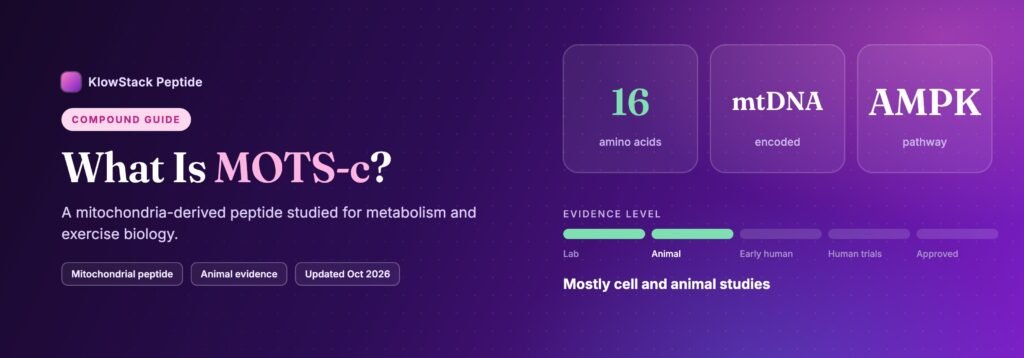
MOTS-c is a 16-amino-acid peptide encoded inside mitochondrial DNA, the small set of genes your cells’ power plants carry. It’s thought to act as a metabolic messenger that helps muscle handle sugar, partly by switching on the energy sensor AMPK. It’s studied mainly for insulin resistance, obesity and age-related physical decline.
Almost all MOTS-c research is in cells and mice. In people, scientists have measured natural MOTS-c levels, for example after exercise, but no trial of MOTS-c itself has published results. The closest human data come from a four-week study of a modified version called CB4211. That gap didn’t stop an FDA advisory panel from narrowly voting in July 2026 to consider it for compounding, a recommendation the FDA hasn’t acted on yet.
MOTS-c is sold for research use only. This guide is educational and isn’t medical advice; see our Medical Disclaimer.
What Is MOTS-c?
MOTS-c is a short peptide made from instructions in mitochondrial DNA. It was discovered in 2015 by Changhan Lee, Pinchas Cohen and colleagues at the University of Southern California, who found a tiny hidden gene within a mitochondrial gene called 12S rRNA. It was only the second peptide ever found coded this way, after humanin.
Here’s why that’s surprising. Mitochondria, the parts of your cells that turn food into usable energy, carry their own small loop of DNA, a leftover from when they were free-living bacteria billions of years ago. For decades, scientists thought that DNA held just 37 genes, all for running the power plant. Then researchers started finding very short stretches, called small open reading frames, that code for tiny peptides with jobs elsewhere in the body. MOTS-c’s name spells out where it comes from: Mitochondrial Open reading frame of the Twelve S rRNA, type c.
The chemistry. MOTS-c is a chain of 16 amino acids (MRWQEMGYIFYPRKLR). Research vials usually contain a synthetic copy, often as an acetate salt. It’s small enough to circulate in blood, where scientists can measure it.
The history. The original 2015 Cell Metabolism paper showed that MOTS-c protected mice from diet-induced obesity and insulin resistance. CohBar, a company co-founded by the discoverers, later developed a modified version, CB4211, and tested it in a small human study in 2021. The FDA reviewed MOTS-c at its July 2026 compounding advisory meeting.
Also known as: MOTS-c, MOTSc and CB4211
You’ll see MOTS-c written with or without the hyphen, and sometimes all in capitals. CB4211 is a different molecule: a modified, drug-like analog of MOTS-c. Results from CB4211 don’t automatically apply to the natural peptide sold in research vials.
How Does MOTS-c Work?
In cells and mice, MOTS-c disrupts a step in the folate cycle, which lets a natural compound called AICAR build up. AICAR switches on AMPK, the cell’s fuel gauge, pushing muscle to take up and burn more glucose. Under stress, MOTS-c also travels into the cell nucleus and helps turn on protective genes.
What’s known, and from what kind of study:
- Folate cycle and AICAR buildup (lab): in human cells, MOTS-c blocked a folate-cycle step, raising AICAR levels.
- AMPK activation (lab and animal): AICAR activates AMPK, the same switch that exercise flips, which increases glucose uptake in muscle.
- Moves into the nucleus under stress (lab): when cells are stressed, for example by low glucose, MOTS-c moves from mitochondria into the nucleus and helps regulate stress-response genes.
- Binds a muscle enzyme (lab): a 2024 iScience study found MOTS-c binds and activates CK2, an enzyme involved in muscle function.
- Rises with exercise (human): in people, exercise raised MOTS-c levels in muscle and blood.
What does MOTS-c do, in everyday terms? Think of it as a text message from your cells’ power plants to the rest of the cell, saying “fuel is running low, start burning more sugar.” That’s why it gets called an “exercise mimetic,” though that label goes further than the data. Every step above except the exercise link comes from cells or mice.
What Is MOTS-c Used For / Studied For?
MOTS-c has been studied for insulin resistance and obesity, for physical capacity in aging, and for bone loss. All three areas rely on mouse studies. In people, research has measured natural MOTS-c levels and tested one modified analog for four weeks. No study has shown health benefits of MOTS-c in humans.
Insulin resistance and obesity
What was studied: in the 2015 discovery paper, mice on a high-fat diet received MOTS-c injections.
What it found: treated mice gained less weight and fat and kept better insulin sensitivity than untreated mice on the same diet. Older mice became more insulin-sensitive too.
What it doesn’t show: whether this happens in people. Mouse metabolism differs from ours, and the doses don’t translate directly.
Physical capacity and aging
What was studied: a 2021 Nature Communications study treated young, middle-aged and old mice with MOTS-c and measured running and grip performance. The same paper measured MOTS-c in human muscle and blood before and after exercise.
What it found: MOTS-c improved physical performance at all three ages, and treatment started late in life (about 23.5 months, very old for a mouse) increased physical capacity and healthspan measures. In people, exercise raised MOTS-c in muscle and in blood.
What it doesn’t show: that giving MOTS-c to people improves fitness or slows aging. The human part only showed that the body makes more during exercise.
Bone and osteoporosis
What was studied: rodent and cell studies, summarized in a 2023 review, looked at MOTS-c’s effects on bone-building and bone-breaking cells.
What it found: MOTS-c supported bone formation and reduced bone loss in some models, which is why osteoporosis was one of the two uses the FDA reviewed.
What it doesn’t show: any effect on human bone density or fractures.
What MOTS-c hasn’t been shown to do
MOTS-c hasn’t been shown to cause weight loss, improve sleep, boost energy or extend life in people. It’s sometimes marketed as “exercise in a bottle,” but the human evidence only shows that exercise raises MOTS-c. Taking a peptide that your body makes during a workout isn’t the same as doing the workout.
What Does the Human Research Show?
Human research on MOTS-c is limited to measuring natural levels and one short trial of a modified analog. No published clinical trial has tested MOTS-c itself for safety or effectiveness, and the FDA’s 2026 review found no human efficacy or safety studies of the substance.
| Study | Year | Design | Participants | Result | Limitation |
|---|---|---|---|---|---|
| Reynolds et al. | 2021 | Exercise sampling study | Healthy young men | Exercise raised MOTS-c in muscle and blood | Measured natural MOTS-c; no treatment |
| von Walden et al. | 2021 | Exercise sampling study | Healthy adults | Endurance exercise raised circulating mitochondrial peptides | Observational |
| CohBar CB4211 Phase 1a/1b (NCT03998514) | 2021 | Randomized, placebo-controlled | 88 enrolled; 20 obese adults with fatty liver in Phase 1b | ALT down 21% vs up 4%; glucose down 6%; liver fat fell in both groups | Analog, four weeks, results only in company releases |
PubMed (263 records) and ClinicalTrials.gov searched October 5, 2026.
The CB4211 results were announced by CohBar in August 2021 and presented as a conference poster. Liver fat fell by a similar amount in the placebo group, and the study was tiny. No full peer-reviewed paper has followed, and the program hasn’t advanced to larger trials.
Why make so much of the analog? Natural MOTS-c breaks down quickly and is hard to make into a drug, so CohBar redesigned it for stability and potency. That’s normal drug development, the same path GLP-1 took on its way to semaglutide. It also means that the only human treatment data belong to a molecule you can’t buy in a research vial.
A few registered “MOTS-c” trials on ClinicalTrials.gov look like observational studies of natural MOTS-c levels in disease, which don’t test treatment. Our Editorial Policy explains how we separate those from intervention trials.
MOTS-c Side Effects and Safety
There’s no clinical safety data for MOTS-c itself. The four-week CB4211 study reported no serious adverse events, but that was a different molecule in a few dozen people. USADA notes reports from people buying it online of racing heart, palpitations, injection-site irritation, insomnia and fever.
Reported in human studies: only for the analog CB4211, which was described as well tolerated with no serious adverse events over four weeks.
Expected from the mechanism: AMPK activation lowers blood sugar, so low blood sugar is a theoretical concern, especially combined with diabetes drugs. Changes in metabolism and gene regulation could have effects that short studies wouldn’t catch.
Anecdotal only: USADA lists reports from people who purchased MOTS-c online, including elevated heart rate, palpitations, injection-site irritation, insomnia, immune reactions and fever. These haven’t been studied in controlled settings.
Product quality: research vials of MOTS-c aren’t held to drug standards. As USADA puts it, “Just because it’s available for sale online doesn’t mean it is safe or effective.” Our peptide COA guide explains what to look for in a lab report.
Who should avoid MOTS-c
People with diabetes or on blood sugar-lowering drugs face an added risk of lows, given the mechanism. Pregnancy, breastfeeding, a cancer history, heart rhythm problems and being under 18 are further reasons for caution, as is competing in drug-tested sport.
Is MOTS-c an “exercise mimetic”?
That’s how it’s often described, because it flips some of the same switches as exercise in mice. In people, all we know is that exercise raises MOTS-c. Whether injecting it reproduces any benefit of exercise hasn’t been tested, and exercise affects far more systems than one peptide can.
MOTS-c vs SS-31
MOTS-c and SS-31 are both called mitochondrial peptides, but they work very differently. MOTS-c is made by mitochondria and acts as a signal to the rest of the cell. SS-31 (elamipretide) is a synthetic peptide that targets the mitochondrial inner membrane to protect it directly.
| MOTS-c | SS-31 (elamipretide) | |
|---|---|---|
| Mechanism | Mitochondria-made signal; AMPK and gene regulation | Binds cardiolipin in the mitochondrial membrane |
| Half-life | Not established in humans | Short, measured in hours |
| Evidence | Animal; one analog trial | Multiple human trials; FDA accelerated approval for Barth syndrome (2025) |
| Status | Research use only | Approved for one rare disease |
The two are compared in depth in MOTS-c, SS-31 and the Mitochondrial Theory of Aging, and our SS-31 guide covers elamipretide’s trials.
Is MOTS-c Legal? Why Is It Banned in Sports?
MOTS-c isn’t FDA-approved for any use and is sold in the US only as a “research use only” chemical. In July 2026, an FDA advisory committee voted 7–5, with two abstentions, to recommend adding it to the list of substances pharmacies may compound. The FDA hasn’t acted on that vote, and WADA bans MOTS-c at all times.
FDA and compounding. MOTS-c was previously in the FDA’s Category 2 of compounding substances with safety concerns, and came off that list after its nominations were withdrawn in 2026. On July 23, 2026, the FDA’s Pharmacy Compounding Advisory Committee reviewed MOTS-c for obesity and osteoporosis. AJMC reported a 7–5 vote in favor, with two abstentions, even though FDA staff had found no human safety or efficacy studies and recommended against it. FDA scientists described the evidence they reviewed as “short in duration, small in sample size, and insufficient to establish safety or effectiveness,” according to AJMC. A favorable vote isn’t approval: the FDA must still propose and finalize a rule, and none of the peptides reviewed had been added as of October 2026.
Research use only. Vials labeled “not for human consumption” can be sold for lab work, without the checks medicines get. Our guide to whether research peptides are legal explains the details.
Sport. The 2026 WADA Prohibited List names MOTS-c under S4.4.1, activators of AMPK, a class of metabolic modulators prohibited in and out of competition. USADA says athletes are “highly unlikely” to get a therapeutic use exemption for it.
FDA and WADA status checked October 5, 2026.
Where MOTS-c Fits: Needs & Symptoms
MOTS-c appears in three research areas: Weight & Metabolism for insulin sensitivity, Longevity & Cellular Health for its role in mitochondrial signaling and stress resistance, and Sleep & Energy, where the card notes it’s studied for cellular energy, not sleep directly.
Related guides on those pages include SS-31 and humanin, the other mitochondrial peptides, and epitalon in longevity research. For weight, the approved comparison points are semaglutide and tirzepatide.
Frequently Asked Questions
What does MOTS-c do?
In cells and mice, MOTS-c activates the energy sensor AMPK and helps muscle burn glucose, and under stress it regulates protective genes. These effects haven’t been tested as treatments in people.
Is MOTS-c safe?
Its safety in people is unknown. No trial of MOTS-c itself has published safety data, and only a modified analog has been tested, for four weeks.
Does MOTS-c help with weight loss?
It reduced weight gain in mice on high-fat diets. No human study has shown weight loss with MOTS-c.
Is MOTS-c legal?
It isn’t FDA-approved and is sold only as a research chemical. An FDA advisory panel voted in favor of considering it for compounding in July 2026, but no rule has followed.
Is MOTS-c banned in sports?
Yes. WADA lists it under S4.4, metabolic modulators that activate AMPK, banned in and out of competition.
Has MOTS-c been tested in humans?
Only indirectly. Studies have measured natural MOTS-c levels in people, and a modified version, CB4211, was tested for four weeks in a small study. No human trial of MOTS-c itself has published results.
Is MOTS-c an exercise mimetic?
It activates some exercise-related pathways in mice, and exercise raises it in people. Whether it reproduces exercise benefits when injected hasn’t been tested.
What’s the difference between MOTS-c and SS-31?
MOTS-c is a natural mitochondrial signal; SS-31 is a synthetic peptide that protects the mitochondrial membrane and has an FDA approval for Barth syndrome. See MOTS-c vs SS-31.
How much MOTS-c should be used?
There’s no research-based dosing for human use, and we don’t publish dosing for any compound. See our Medical Disclaimer.
Sources
Primary studies
- Lee C, et al. 2015. The mitochondrial-derived peptide MOTS-c promotes metabolic homeostasis and reduces obesity and insulin resistance. Cell Metabolism. doi:10.1016/j.cmet.2015.02.009
- Reynolds JC, et al. 2021. MOTS-c is an exercise-induced mitochondrial-encoded regulator of age-dependent physical decline and muscle homeostasis. Nature Communications. doi:10.1038/s41467-020-20790-0
- von Walden F, et al. 2021. Acute endurance exercise stimulates circulating levels of mitochondrial-derived peptides in humans. Journal of Applied Physiology. doi:10.1152/japplphysiol.00706.2019
- Kumagai H, et al. 2024. MOTS-c modulates skeletal muscle function by directly binding and activating CK2. iScience. doi:10.1016/j.isci.2024.111212
Reviews
- Yi X, et al. 2023. Role of MOTS-c in the regulation of bone metabolism. Frontiers in Physiology. doi:10.3389/fphys.2023.1149120
Regulatory, trials and anti-doping
- FDA: July 23-24, 2026 Meeting of the Pharmacy Compounding Advisory Committee
- WADA: 2026 Prohibited List
- USADA: What is the MOTS-c peptide?
- ClinicalTrials.gov: NCT03998514 (CB4211)
News
Disclaimer: MOTS-c is sold for research use only and isn’t approved for human use. This guide is educational and doesn’t give medical advice. Read our Medical Disclaimer and Editorial Policy.