
Reviewed by Thomas Okafor, Peptide Chemist · Updated October 2026
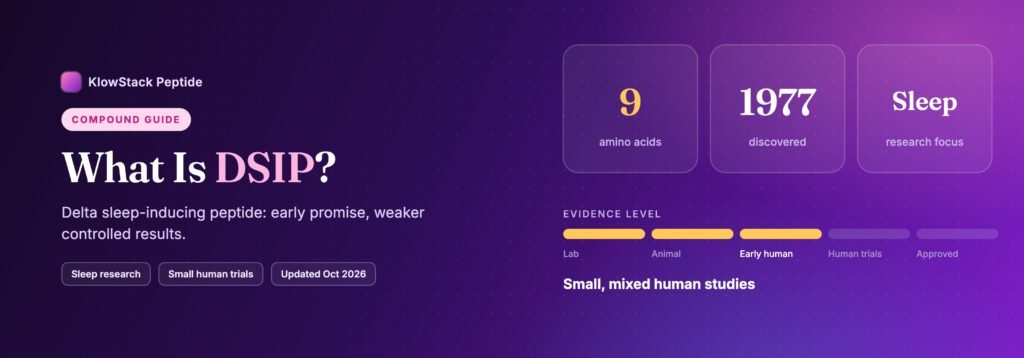
DSIP, short for delta sleep-inducing peptide, is a nine-amino-acid peptide first isolated from the blood of sleeping rabbits in 1977. It was named for its apparent ability to increase deep, slow-wave (“delta”) sleep in animals. It’s studied mainly for insomnia, and more briefly for opioid withdrawal and stress hormones.
DSIP has a surprising amount of human research for a “research peptide,” mostly small studies from the 1980s and 1990s. The results were mixed: some early trials reported better sleep, while a careful double-blind study concluded it was unlikely to help chronic insomnia much. Scientists still haven’t found the gene that makes it or the receptor it acts on, and in July 2026 an FDA advisory panel narrowly voted against allowing pharmacies to compound it.
DSIP is sold for research use only. This guide is educational and isn’t medical advice; see our Medical Disclaimer.
What Is DSIP?
DSIP is a short peptide discovered in 1977 by the Swiss researchers Guido Schoenenberger and Marcel Monnier in Basel. They took blood from rabbits whose brains were electrically stimulated into sleep, transferred it to awake rabbits, and saw more deep sleep. The substance they eventually isolated from that blood was a nine-amino-acid peptide they named delta sleep-inducing peptide.
Delta sleep is the deepest stage of non-REM sleep, named for the slow, large “delta waves” it produces on a brain recording. It’s the stage that leaves you groggy if your alarm goes off in the middle of it, and it’s when the body releases a big pulse of growth hormone. A natural molecule that reliably deepened this stage would be a remarkable find, which is why DSIP drew so much attention in the late 1970s and 1980s.
The chemistry. DSIP’s sequence is tryptophan, alanine, glycine, glycine, aspartic acid, alanine, serine, glycine, glutamic acid (WAGGDASGE). It’s unlike any other known family of peptides. In the body it’s broken down quickly, though some studies suggest it can cross the blood-brain barrier in small amounts.
The puzzle. Nearly 50 years later, scientists still haven’t found a DSIP gene, a larger protein it’s cut from, or a specific receptor. A 2006 Journal of Neurochemistry review called it “a still unresolved riddle” and concluded that the evidence for DSIP as a natural sleep factor was “extremely poorly documented and still weak.” The authors suggested that what scientists detect may be a related, still-unidentified peptide.
Also known as: DSIP, emideltide and Deltaran
The FDA uses the generic name emideltide in its compounding reviews. In Russia, a DSIP-based product called Deltaran has been studied, and a related analog called deltalicin appears in some Russian papers. In online shops, it’s usually just “DSIP.”
How Does DSIP Work?
Nobody knows exactly how DSIP works. In animal and some human studies, it appeared to nudge sleep patterns and stress-hormone release, but without an identified receptor, scientists can’t trace its pathway. Its effects in studies were often small, varied between labs, and sometimes didn’t appear at all.
What has been reported, and from what kind of research:
- More delta sleep in rabbits (animal): the original 1970s experiments found more slow-wave sleep after infusion, the finding that gave DSIP its name.
- Sleep changes in people (human, mixed): early studies reported better sleep in some insomniacs. A 1992 double-blind trial found only weak effects that may have been partly due to chance.
- Stress hormones (human): a 1989 study found lower ACTH, a stress-signaling hormone, after intravenous DSIP. A 1995 study found no effect on cortisol or ACTH responses, and another found no effect on growth hormone in women.
- Other effects (animal): DSIP has been linked in animals to pain relief, body temperature, antioxidant activity and seizure resistance, without a clear unifying mechanism.
What does DSIP do, then? The accurate answer is that its effects are inconsistent and its mechanism is unknown. Imagine a key that sometimes seems to open a door, but nobody has found the lock. That’s roughly where DSIP science stands.
What Is DSIP Used For / Studied For?
DSIP has been studied for insomnia (human, mixed), for opioid and alcohol withdrawal (human, open-label), and for stress hormones and sleep architecture (human and animal). The FDA’s 2026 review covered opioid withdrawal, chronic insomnia and narcolepsy. None has strong, consistent evidence.
Insomnia
What was studied: several small trials in people with chronic insomnia in the 1980s and early 1990s. A 1981 Lancet report by the discovering group described improved sleep in insomniacs. The 1992 Neuropsychobiology study used a double-blind design with 16 patients, eight on DSIP and eight on placebo, measured over several nights in a sleep lab.
What it found: in 1992, sleep efficiency was slightly higher and falling asleep slightly faster on DSIP, but the authors said these effects were weak and might reflect a chance change in the placebo group. Subjective sleep quality didn’t change. They concluded short-term DSIP “is not likely to be of major therapeutic benefit” for chronic insomnia.
What it doesn’t show: a reliable sleep benefit. The larger effects in earlier, less controlled studies weren’t confirmed.
Those earlier studies weren’t trivial. In a 1987 double-blind study, Dieter Schneider-Helmert, one of DSIP’s original researchers, gave seven nights of DSIP or placebo to 14 middle-aged adults with severe chronic insomnia and reported that sleep and daytime alertness improved to the level of healthy controls. That’s a striking result from a well-designed study on paper. The trouble is that independent groups, like the Dutch team behind the 1992 trial, didn’t see anything close to it. When results depend heavily on which lab ran the study, scientists treat the finding as unconfirmed.
Opioid withdrawal
What was studied: a 1998 open clinical trial in Germany gave DSIP during opioid detoxification.
What it found: the authors reported that withdrawal symptoms eased in some patients.
What it doesn’t show: a controlled result. Without a placebo group, natural improvement during detox can’t be separated from any drug effect.
Narcolepsy and other uses
What was studied: narcolepsy was one of the uses nominated to the FDA. Russian groups have also studied DSIP-based products for stress and other conditions.
What it found: the data for narcolepsy are very limited, and the FDA panel didn’t find the overall evidence convincing enough to recommend compounding.
What DSIP hasn’t been shown to do
DSIP hasn’t been shown to reliably improve sleep, reduce stress, relieve pain, extend life or aid weight loss in people. Online claims that it “resets your sleep cycle” rest on early, inconsistent studies and on the appealing name more than the data.
What Does the Human Research Show?
Human research on DSIP comes from a burst of small studies in the 1980s and 1990s, mostly in Switzerland, Germany and the Netherlands. Early open studies were positive; better-controlled ones found weak or no effects. No modern, registered trial of DSIP exists, and research largely stopped once the mechanism couldn’t be pinned down.
| Study | Year | Design | Participants | Result | Limitation |
|---|---|---|---|---|---|
| Schneider-Helmert et al. | 1981 | Clinical report | Adults with insomnia | Improved sleep reported | Short report from the discovering group |
| Schneider-Helmert | 1987 | Double-blind, placebo-controlled | 14 adults with severe chronic insomnia | Sleep and daytime alertness improved | Developer’s group; small |
| Bes et al. | 1992 | Double-blind, placebo-controlled | 16 adults with chronic insomnia | Weak effects; “not likely” a major benefit | Tiny; short |
| Späth-Schwalbe et al. | 1995 | Controlled hormone study | Healthy adults | No effect on cortisol or ACTH responses | Hormones only |
| Backmund et al. | 1998 | Open-label trial | Patients in opioid detox | Some symptom relief reported | No control group |
PubMed (545 records, many unrelated uses of the abbreviation “DSIP”) and ClinicalTrials.gov (no DSIP treatment trials) searched October 5, 2026.
That pattern, enthusiastic early reports followed by weaker controlled results, is common in medicine. It’s why our Editorial Policy gives more weight to double-blind studies than to open-label ones, even when the open-label findings are more exciting.
DSIP Side Effects and Safety
Older human studies reported few side effects with short-term DSIP. But those studies were small, short and decades old, and side effects weren’t tracked the way modern trials track them. Nobody has studied long-term use, and research-grade products today aren’t the same pharmaceutical-grade material used in those trials.
Reported in human studies: short courses in the 1980s and 1990s were generally described as well tolerated, without the detailed adverse-event reporting modern trials require.
Expected from the mechanism: because the mechanism is unknown, it’s hard to predict risks. Effects on stress hormones and sleep could interact with sedatives, alcohol, antidepressants or opioid medicines.
Anecdotal only: online self-reports describe vivid dreams, grogginess, headaches and, often, no noticeable effect. These haven’t been studied.
Product quality: research DSIP isn’t held to drug standards, and the FDA’s 2026 review was based on a nomination from compounders, not a manufacturer with quality data. Our peptide COA guide explains what a credible lab report includes.
Who should avoid DSIP
People taking sleep medicines, sedatives, opioids or antidepressants face unknown interactions. Pregnancy, breastfeeding, epilepsy, serious sleep disorders like sleep apnea that need medical treatment, and being under 18 are reasons to stay away, as is competing in tested sport.
Does DSIP actually work for sleep?
The best evidence says probably not much. A carefully controlled 1992 study found weak effects that might have been chance and no change in how well people felt they slept. Earlier positive reports weren’t designed as rigorously. If insomnia is a problem, approved treatments and cognitive behavioral therapy for insomnia have far stronger evidence.
DSIP vs Epitalon
DSIP and epitalon are both marketed for sleep, but they come from different places. DSIP was isolated from rabbit blood and is linked directly to deep sleep. Epitalon is a synthetic peptide modeled on a pineal gland extract, studied mainly for telomeres and melatonin rhythm.
| DSIP | Epitalon | |
|---|---|---|
| Mechanism | Unknown; no receptor identified | Telomerase activation (lab); pineal effects (extract studies) |
| Half-life | Minutes in blood | Not established in humans |
| Evidence | Small 1980s–90s human trials, mixed | Lab, animal, Russian extract studies |
| Status | FDA panel voted against compounding (2026) | FDA panel narrowly voted for compounding review (2026) |
Our epitalon guide covers its research in detail.
Is DSIP Legal?
DSIP isn’t FDA-approved for any use. In the US it’s sold only under a research-use label. In July 2026, the FDA’s compounding advisory committee voted 7–6, with one abstention, against adding it to the list of substances pharmacies may use, so compounded DSIP has no legal path right now.
FDA and compounding. DSIP, under its generic name emideltide, was previously in the FDA’s Category 2 list of compounding substances with safety concerns, and was removed after its nominations were withdrawn. The FDA then brought it to its Pharmacy Compounding Advisory Committee on July 24, 2026, for opioid withdrawal, chronic insomnia and narcolepsy. AJMC reported that it was the only one of seven peptides the panel voted against, 7–6 with one abstention.
Research use only. “Not for human consumption” vials can be sold for laboratory work, and nobody checks them like medicines. Our guide to whether research peptides are legal explains the rules.
Sport. DSIP isn’t named on the 2026 WADA Prohibited List, but WADA’s S0 class bans any substance without government approval for human use, which can apply to DSIP. Athletes should check with their anti-doping organization.
FDA and WADA status checked October 5, 2026.
Where DSIP Fits: Needs & Symptoms
DSIP is listed in Sleep & Energy, where its card notes its link to slow-wave sleep in early animal studies and that researchers are still mapping how it works. That’s a fair summary: the name is more certain than the science.
Other compounds on that page include epitalon, studied for melatonin rhythm, and sermorelin, whose growth hormone pulses are tied to deep sleep. MOTS-c and SS-31 appear there for cellular energy, with no direct sleep link.
Frequently Asked Questions
What does DSIP do?
DSIP was named for increasing deep sleep in rabbits. In people, its effects on sleep and stress hormones have been inconsistent, and its mechanism and receptor remain unknown.
Does DSIP help with insomnia?
The evidence is weak. A double-blind 1992 study concluded short-term DSIP was “not likely to be of major therapeutic benefit” for chronic insomnia, despite more positive early reports.
Is DSIP safe?
Short courses in older studies were described as well tolerated, but those studies were small and decades old. Long-term safety and the quality of today’s research products are unknown.
Is DSIP legal?
It isn’t FDA-approved, and an FDA advisory panel voted 7–6 in July 2026 against allowing pharmacies to compound it. It’s sold only as a research chemical.
Is DSIP banned in sports?
It isn’t named on the WADA list, but WADA’s S0 category covers unapproved substances, which can include DSIP. Check before use.
Has DSIP been tested in humans?
Yes, in small studies from the 1980s and 1990s for insomnia, opioid withdrawal and stress hormones. Results were mixed, and no modern trial is registered.
Why did the FDA panel vote against DSIP?
The FDA’s reviewers found the evidence insufficient for safety and effectiveness. DSIP was the only one of seven peptides reviewed in July 2026 that the panel didn’t recommend.
How much DSIP should be used?
There’s no research-based dosing for human use, and we don’t publish dosing for any compound. See our Medical Disclaimer.
Sources
Primary studies
- Schneider-Helmert D, et al. 1981. Synthetic delta-sleep-inducing peptide improves sleep in insomniacs. Lancet. doi:10.1016/s0140-6736(81)92417-x
- Bes F, et al. 1992. Effects of delta sleep-inducing peptide on sleep of chronic insomniac patients: a double-blind study. Neuropsychobiology. doi:10.1159/000118919
- Späth-Schwalbe E, et al. 1995. Delta-sleep-inducing peptide does not affect CRH and meal-induced ACTH and cortisol secretion. Psychoneuroendocrinology. doi:10.1016/0306-4530(94)00050-k
- Backmund M, et al. 1998. Opioid detoxification with delta sleep-inducing peptide: results of an open clinical trial. Journal of Clinical Psychopharmacology. doi:10.1097/00004714-199806000-00016
- Schneider-Helmert D. 1987. Effects of delta-sleep-inducing peptide on 24-hour sleep-wake behaviour in severe chronic insomnia. European Neurology. doi:10.1159/000116143
Reviews
- Kovalzon VM, Strekalova TV. 2006. Delta sleep-inducing peptide (DSIP): a still unresolved riddle. Journal of Neurochemistry. doi:10.1111/j.1471-4159.2006.03693.x
Regulatory
Disclaimer: DSIP is sold for research use only and isn’t approved for human use. This guide is educational and doesn’t give medical advice. Read our Medical Disclaimer and Editorial Policy.