
Reviewed by Thomas Okafor, Peptide Chemist · Updated October 2026
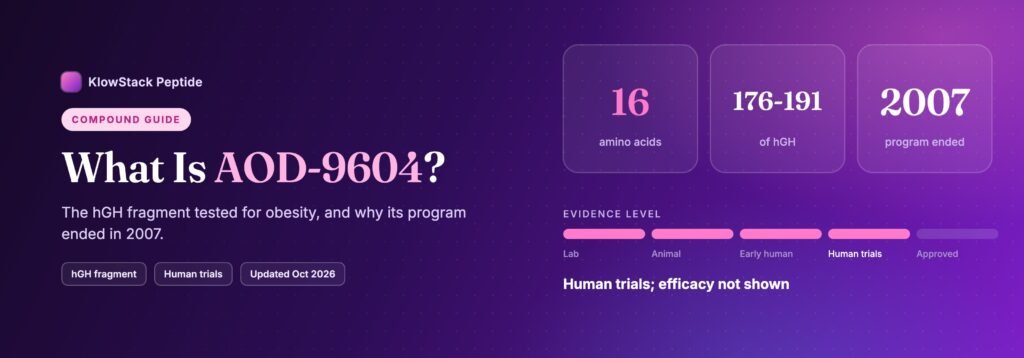
AOD-9604 is a 16-amino-acid fragment of human growth hormone, the tail end of the molecule (amino acids 177 to 191) with one extra tyrosine. It was designed to keep growth hormone’s fat-burning effect without its effects on growth or blood sugar. It’s studied mainly for obesity, and it’s also marketed online for joint and cartilage repair.
AOD-9604 has a real human research record: six randomized trials, mostly for safety, and a large 2007 obesity trial that failed. Its developer stopped work on it as a weight-loss drug after that trial, and FDA advisers voted 12–0 against compounding it in 2024. It’s still one of the most-marketed “fat-loss peptides” online.
AOD-9604 is sold for research use only. This guide is educational and isn’t medical advice; see our Medical Disclaimer.
What Is AOD-9604?
AOD-9604 is a lab-made peptide developed in the 1990s by Frank Ng and colleagues at Monash University in Melbourne, Australia, and later by the company Metabolic Pharmaceuticals. “AOD” stands for anti-obesity drug. It’s built from the last 15 amino acids of human growth hormone’s 191, plus a tyrosine at the front.
The idea behind it. Growth hormone does two quite different jobs. It drives growth, mostly by raising IGF-1, and it also breaks down stored fat. Researchers had noticed that the fat-burning effect seemed to live in one region of the hormone, near its tail. If they could cut out just that piece, they reasoned, they’d get the fat loss without the side effects of growth hormone, such as raised blood sugar, swelling and joint pain. Think of it as trying to keep the furnace and remove the fertilizer.
The chemistry. AOD-9604 is a 16-amino-acid chain, sometimes written as Tyr-hGH(177-191). It contains a ring formed by a disulfide bond between two cysteines, which helps hold its shape. It’s tiny compared with growth hormone, about a twelfth of the size.
The history. In rodent studies around 2000, oral AOD-9604 reduced weight gain in obese mice and rats. Metabolic Pharmaceuticals then ran human trials, culminating in a 24-week Phase 2b obesity trial, called OPTIONS, that enrolled 536 people. In February 2007, the company announced that weight loss wasn’t meaningfully better than placebo and ended its obesity program. The company later repositioned AOD-9604 as a food and supplement ingredient, and it was nominated to the FDA for compounding before the nominations were withdrawn.
Also known as: AOD-9604 vs HGH fragment 176-191
AOD-9604 is often sold as “HGH fragment 176-191,” and the two names get swapped constantly. They’re close but not identical: fragment 176-191 is a slightly different stretch of growth hormone, while AOD-9604 is 177-191 with an added tyrosine. Because research vials often don’t specify which molecule they contain, a product’s label doesn’t settle it. The human trials described here used AOD-9604.
How Does AOD-9604 Work?
In rodents and fat tissue in the lab, AOD-9604 increases lipolysis, the breakdown of stored fat, and reduces lipogenesis, the building of new fat, similar to growth hormone’s effect on fat. Unlike growth hormone, it doesn’t raise IGF-1 or appear to worsen insulin resistance. Its exact receptor isn’t well established.
What’s known, and from what kind of research:
- More fat breakdown in fat tissue (lab): in fat tissue from obese mice and from humans, AOD-9604 increased fat breakdown and reduced fat storage.
- Less weight gain in obese rodents (animal): in a 2000 study, obese mice given oral AOD-9401, a closely related fragment, for 30 days gained less weight without eating less. In obese rats, daily oral AOD-9604 for 19 days cut weight gain by more than half.
- No effect on IGF-1 or blood sugar (animal and human): rodents didn’t develop insulin resistance, and in the human safety trials, IGF-1 and glucose didn’t change.
- Cartilage effects (animal): in rabbit models of osteoarthritis, injections into the joint were reported to support cartilage repair. These were small studies.
- Unclear receptor (lab): AOD-9604 doesn’t bind the growth hormone receptor the way growth hormone does, and its exact target remains uncertain.
What does AOD-9604 do, then? In fat tissue and rodents, it nudges fat cells to release and burn more fat. In people, the same nudge didn’t add up to meaningful weight loss in a large, well-run trial. That gap between a lab signal and a result people can see is the whole story of this compound.
There’s a plausible reason a fragment might fall short. Growth hormone works by grabbing two copies of its receptor at once and pulling them together, a bit like a two-handed handshake. A small piece of the tail can’t do that, so whatever it does to fat cells must run through a different, still-uncertain route. Effects that run through a side door are often weaker and less reliable than the hormone’s main action.
What Is AOD-9604 Used For / Studied For?
AOD-9604 has been studied for obesity (animal and human trials) and for cartilage and joint repair (animal). The human obesity trials showed fat-metabolism signals in blood tests but no meaningful weight loss compared with placebo. The joint claims rest on small animal studies.
Obesity and weight loss
What was studied: early human trials tested intravenous and oral AOD-9604 in adults with obesity for one to four weeks, according to the FDA’s 2024 review. The decisive study was the OPTIONS Phase 2b trial: 536 adults with obesity, aged 18 to 65, randomized to oral AOD-9604 or placebo for 24 weeks alongside a supervised diet and exercise program.
What it found: in the short early trials, blood markers of fat breakdown rose a few hours after dosing, but weight loss wasn’t statistically different from placebo. A 12-week trial of 300 adults, reported only as a 2005 conference abstract, found slightly faster weight loss with some doses, about a fifth of a kilogram (roughly half a pound) a week at best against a fraction of that on placebo. The FDA noted these differences were small and of unclear practical meaning. In OPTIONS, the company reported that weight loss compared with placebo “was too low to reach statistical significance” at 12 or 24 weeks, and it ended development for obesity.
What it doesn’t show: any meaningful weight loss in people. The full OPTIONS results were never published in a medical journal.
Cartilage and joint repair
What was studied: rabbit models of osteoarthritis, with AOD-9604 injected into the knee joint, sometimes alongside hyaluronic acid.
What it found: a 2015 rabbit study reported better cartilage regeneration and joint function in treated animals.
What it doesn’t show: benefit in people. The FDA didn’t evaluate osteoporosis or osteoarthritis in its 2024 review because the nominations didn’t include enough information.
What AOD-9604 hasn’t been shown to do
AOD-9604 hasn’t been shown to cause weight loss, target belly fat, build muscle or repair joints in people. “Burns fat without affecting blood sugar” is half true: it didn’t affect blood sugar in the trials, but it didn’t burn enough fat to show up on the scale either.
What Does the Human Research Show?
AOD-9604’s human research includes six randomized, placebo-controlled trials pooled in a 2013 safety analysis, plus the 536-person OPTIONS Phase 2b trial. Safety looked similar to placebo. Weight loss didn’t. The obesity program was discontinued in 2007 for lack of efficacy.
| Study | Year | Design | Participants | Result | Limitation |
|---|---|---|---|---|---|
| Early IV and oral trials (described in FDA review) | 2000s | Small double-blind, dose-escalation studies | 16 to 36 adults with obesity each | Fat-breakdown markers rose; weight not different from placebo | One to four weeks |
| Herd et al. (conference abstract, described in FDA review) | 2005 | Randomized, double-blind, placebo-controlled | 300 adults with obesity | Slightly faster weight loss at some doses | Abstract only; minimal data |
| OPTIONS Phase 2b (Metabolic Pharmaceuticals) | 2007 | Randomized, double-blind, placebo-controlled | 536 enrolled (502 randomized) adults with obesity | Weight loss vs placebo too small to count as a real effect | Never published in full |
| Stier et al. | 2013 | Pooled safety analysis of six RCTs | Participants across six trials | Safety similar to placebo; no IGF-1 or glucose change; no antibodies | Sponsor-linked authors |
PubMed (27 records) and ClinicalTrials.gov (no registered AOD-9604 trials) searched October 5, 2026.
Why was AOD-9604 discontinued? Metabolic Pharmaceuticals ended its obesity program in 2007 because the OPTIONS trial, which the company had designed with Phase 3-like conditions, didn’t show enough weight loss to support a product. The trial was built to detect a difference of 1.8 kilograms, about 4 pounds, over placebo, a modest bar for an obesity drug, and it still didn’t clear it. According to the company statement quoted by the FDA, “the overall population did not respond consistently.” Our Editorial Policy explains how we treat trials that were announced but never fully published.
AOD-9604 Side Effects and Safety
In its human trials, AOD-9604 had a safety profile similar to placebo, with no serious adverse events attributed to it, no change in blood sugar or IGF-1, and no antibodies detected. Those trials used oral or intravenous forms; most products sold today are injectable research vials, which haven’t been studied the same way.
Reported in human studies: a 2013 pooled analysis of six trials reported no withdrawals or serious adverse events related to AOD-9604, no harmful effect on carbohydrate metabolism, no change in IGF-1, and no anti-AOD-9604 antibodies in tested participants. The authors were linked to the developer.
Expected from the mechanism: because it doesn’t raise IGF-1, AOD-9604 is thought to avoid growth hormone’s main risks, though that’s based on short studies. The FDA flagged possible immune reactions from impurities and peptide clumping in injectable forms.
Anecdotal only: online self-reports mention injection-site redness, headaches and, frequently, no noticeable change in weight. These haven’t been studied.
Product quality: the FDA found too little information about AOD-9604’s impurities and aggregation to rule out immune reactions. Many vials sold as AOD-9604 may actually contain the related fragment 176-191. Our peptide COA guide explains how identity testing can tell them apart.
Who should avoid AOD-9604
Anyone pregnant or breastfeeding, under 18, with a history of cancer, or with a known allergy to peptide products should avoid it. So should competitive athletes, given the WADA ban. People looking for weight-loss treatment have approved options with far stronger evidence.
Does AOD-9604 actually burn fat?
In fat tissue and in rodents, it increased fat breakdown. In a 536-person human trial, that didn’t produce weight loss that beat placebo. So it can change fat metabolism on a lab test, but it hasn’t been shown to burn enough fat to move the scale in a way people would notice.
AOD-9604 vs Semaglutide
AOD-9604 and semaglutide are both pitched for fat loss, but their evidence couldn’t be more different. AOD-9604 is a growth hormone fragment that failed its main obesity trial. Semaglutide is a GLP-1 drug, approved as Wegovy, that produced about 15% average weight loss in large trials.
| AOD-9604 | Semaglutide | |
|---|---|---|
| Mechanism | Growth hormone fragment; fat breakdown in tissue | GLP-1 receptor agonist; lowers appetite |
| Half-life | Short; not well defined in humans | About 1 week |
| Evidence | Six small RCTs; failed 536-person Phase 2b | Many Phase 3 trials with tens of thousands of people |
| Status | Research use only | FDA-approved (Ozempic, Wegovy, Rybelsus) |
Our semaglutide guide covers the GLP-1 evidence, and tesamorelin is the approved growth hormone-axis drug for one kind of belly fat.
Is AOD-9604 Legal? Why Is It Banned in Sports?
There’s no FDA-approved AOD-9604 product. Online sellers offer it under a research label, and in December 2024 the FDA’s compounding advisers unanimously rejected it as a pharmacy ingredient. In sport, WADA lists it by name.
FDA and compounding. AOD-9604 was nominated for compounding for weight loss, osteoporosis and osteoarthritis. The FDA placed it in Category 2 over safety concerns; after the nominations were withdrawn, the FDA still presented it to its Pharmacy Compounding Advisory Committee on December 4, 2024. According to the final minutes, the committee voted 12–0 against including it. FDA reviewers noted that multiple FDA-approved drugs already treat obesity.
The GRAS angle. In 2012, the developer announced that AOD-9604 had gained self-affirmed “generally recognized as safe” (GRAS) status as a food ingredient, through an expert panel it convened. That’s a company-led determination for food use, which doesn’t make it an FDA-approved drug or allow it to be sold as an injectable medicine.
Research use only. Vials marked “not for human consumption” can be sold for laboratory work, without drug-level quality checks. Our guide to whether research peptides are legal explains more.
Sport. The 2026 WADA Prohibited List names AOD-9604 under S2.2.3, growth hormone fragments, prohibited in and out of competition. It was at the center of a 2013 supplements scandal in Australian rules football, when players at the Essendon club were found to have been given injections as part of a team program. WADA later confirmed AOD-9604 was a banned substance, and the case became one of the best-known peptide doping stories outside the US.
FDA and WADA status checked October 5, 2026.
Where AOD-9604 Fits: Needs & Symptoms
AOD-9604 is listed under Weight & Metabolism, described as a growth hormone fragment studied for fat metabolism without the broader growth hormone response. That’s accurate as a description of the hypothesis; the human trials didn’t confirm the weight-loss part.
On the same page, semaglutide and tirzepatide are approved weight-management drugs, tesamorelin targets visceral fat in HIV, and MOTS-c is an early-stage metabolic peptide. Seeing them side by side shows how much evidence separates a marketing claim from an approved treatment.
Frequently Asked Questions
What does AOD-9604 do?
In fat tissue and rodents, AOD-9604 increases fat breakdown and reduces fat storage without raising IGF-1. In human trials, it didn’t produce meaningful weight loss compared with placebo.
Does AOD-9604 work for weight loss?
The best evidence says no. A 536-person, 24-week trial found weight loss too small to beat placebo, and the developer ended its obesity program in 2007.
Is AOD-9604 safe?
Six human trials found safety similar to placebo, with no effect on blood sugar or IGF-1. Injectable research products haven’t been studied the same way, and the FDA flagged impurity and immune risks.
Is AOD-9604 legal?
It isn’t FDA-approved and is sold only as a research chemical. FDA advisers voted 12–0 against compounding it in December 2024.
Is AOD-9604 banned in sports?
Yes. WADA lists it under S2.2.3 as a growth hormone fragment, banned at all times.
Has AOD-9604 been tested in humans?
Yes, in six randomized trials and a larger Phase 2b obesity trial with 536 people. The obesity trial didn’t meet its goals.
Is AOD-9604 the same as HGH fragment 176-191?
No, though they’re often confused. AOD-9604 is growth hormone amino acids 177 to 191 plus a tyrosine; fragment 176-191 is a slightly different piece.
Does AOD-9604 help joints or cartilage?
Only small rabbit studies suggest it might. There’s no human evidence for joint or cartilage repair.
How much AOD-9604 should be used?
There’s no research-based dosing for non-approved use, and we don’t publish dosing for any compound. See our Medical Disclaimer.
Sources
Primary studies
- Heffernan MA, et al. 2000. Effects of oral administration of a synthetic fragment of human growth hormone on lipid metabolism. American Journal of Physiology: Endocrinology and Metabolism. doi:10.1152/ajpendo.2000.279.3.E501
- Ng FM, et al. 2000. Metabolic studies of a synthetic lipolytic domain (AOD9604) of human growth hormone. Hormone Research. doi:10.1159/000053183
- Kwon DR, Park GY. 2015. Effect of intra-articular injection of AOD9604 with or without hyaluronic acid in rabbit osteoarthritis model. Annals of Clinical & Laboratory Science. PMID 26275694
- Stier H, Vos E, Kenley D. 2013. Safety and tolerability of the hexadecapeptide AOD9604 in humans. Journal of Endocrinology and Metabolism. doi:10.4021/jem157w
Reviews
- Wilding J. 2004. AOD-9604 Metabolic. Current Opinion in Investigational Drugs. PMID 15134286
Regulatory
Disclaimer: AOD-9604 is sold for research use only and isn’t approved for human use. This guide is educational and doesn’t give medical advice. Read our Medical Disclaimer and Editorial Policy.