
Reviewed by Thomas Okafor, Peptide Chemist · Updated October 2026
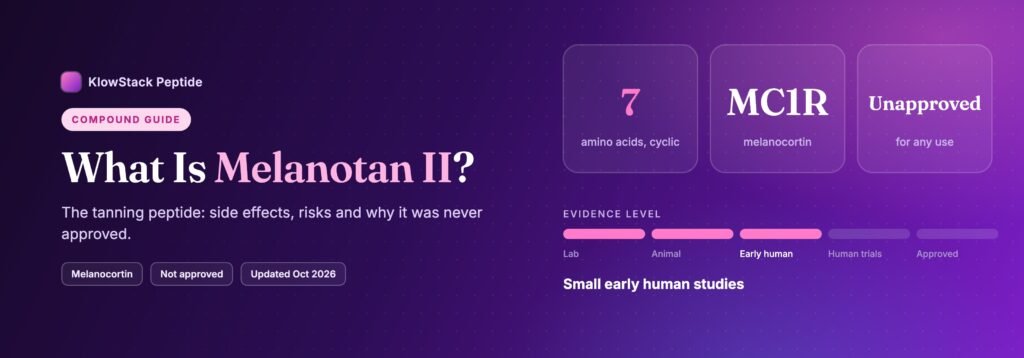
Melanotan II (MT-II) is a lab-made, seven-amino-acid version of alpha-MSH, the hormone that tells skin cells to make pigment. It was created at the University of Arizona in the late 1980s as a possible way to tan skin without sunlight, and early tests in a handful of men also produced unexpected erections, nausea and reduced appetite.
Melanotan II was never developed into an approved drug. Its small human studies ended in the early 2000s, and since then most of what’s published about it comes from doctors writing up problems in people who bought it online: changing moles, a few melanomas, priapism and kidney injury. This guide covers that safety record first and foremost.
Melanotan II isn’t approved for any use, and research-grade MT-II is sold for research use only. This guide is educational; see our Medical Disclaimer.
What Is Melanotan II?
Melanotan II is a synthetic peptide built to copy alpha-MSH, a natural hormone made in the pituitary gland and skin. Researchers at the University of Arizona designed it in the late 1980s, hoping a darker tan made without UV light might lower skin cancer risk in fair-skinned people. That goal was never reached in clinical testing.
The original idea. Arizona has some of the highest skin cancer rates in the US, so the Tucson team had a clear reason to look for a sunless tan. Natural alpha-MSH breaks down within minutes in the blood. The chemists, led by Victor Hruby and Mac Hadley, built two longer-lasting versions: melanotan I, a straight-chain peptide, and melanotan II, a smaller ring-shaped one that proved far more potent in lab tests.
The chemistry. MT-II’s sequence is Ac-Nle-cyclo[Asp-His-D-Phe-Arg-Trp-Lys]-NH2. The ring (a lactam bridge between two amino acids) and the swapped-in D-phenylalanine protect it from enzymes and help it fit tightly into its receptors. That stability is part of why it lasts longer than the natural hormone.
Where it went next. The surprise erections in early volunteers led the developers toward sexual function research. Palatin Technologies then developed bremelanotide (PT-141), a close relative of MT-II that’s also one of its breakdown products, and the FDA approved bremelanotide as Vyleesi in 2019 for low sexual desire in premenopausal women. Melanotan I, under the name afamelanotide, became Scenesse, approved the same year for a rare light-sensitivity disorder. Melanotan II itself stayed on the shelf, and an online gray market grew around it.
Also known as: MT-II, MT2 and the “Barbie drug”
MT-II, MT2 and melanotan 2 all mean the same compound. “Barbie drug” is a tabloid nickname that also shows up in medical papers. Tanning nasal sprays sold online often claim to contain MT-II. Don’t confuse it with melanotan I (afamelanotide), a different molecule that’s been through full trials, or with bremelanotide, which is a separate approved drug.
How Does Melanotan II Work?
Melanotan II switches on melanocortin receptors, a family of five docking sites on cells. Unlike natural alpha-MSH in the skin, it isn’t picky: it activates the skin’s pigment receptor (MC1R) and the brain’s MC3R and MC4R, which affect sexual arousal and hunger. That broad reach explains both the tan and the long list of other effects.
What’s known, and from what kind of research:
- MC1R and pigment (lab and human): activating MC1R on pigment cells (melanocytes) ramps up eumelanin, the brown-black pigment. The 1996 pilot study measured darker skin in two of three volunteers.
- MC4R and erections (animal and human): brain MC4R activation triggers erections in rats, and the 1998 and 2000 trials showed the same in men.
- MC4R and appetite (animal and human): MC4R is a key “I’m full” signal. MT-II cut food intake in rodents, and decreased appetite was reported in human trials.
- Yawning and stretching (human): a stretching-and-yawning pattern often came before erections in the trials, a classic sign of melanocortin activity in the brain.
- Mole cells (case reports): existing moles are clusters of melanocytes, and they respond to the same pigment signal, which is behind the mole changes doctors report.
What does melanotan II do? Picture a house where one master switch turns on the porch lights, the furnace and the kitchen at the same time. The natural hormone in skin works more like a single light switch. MT-II flips many at once, so it’s hard to get one effect without the others.
What Is Melanotan II Used For / Studied For?
Melanotan II was studied for sunless tanning (a three-man pilot study) and erectile dysfunction (two small trials of 10 men each). Appetite effects came up as side observations. No research program has continued with MT-II itself since about 2000; work moved to more selective relatives.
Sunless tanning and skin cancer prevention
What was studied: a 1996 pilot Phase 1 study in three healthy men, given injections on alternating days for two weeks against saltwater placebo.
What it found: two of the three men had measurably darker skin on the face, upper body and buttocks a week after the last injection. Mild nausea, sleepiness, tiredness and spontaneous erections were also reported.
What it doesn’t show: whether an MT-II tan protects against sunburn or skin cancer in people. That question was the original reason for the research, and it was never tested in a trial.
Erectile dysfunction
What was studied: a 1998 double-blind crossover trial in 10 men with erectile dysfunction of psychological origin, and a 2000 trial in 10 men with physical risk factors such as diabetes or high blood pressure.
What it found: in the first trial, 8 of 10 men had erections after MT-II, and rigid erection time averaged 38 minutes against 3 minutes on placebo. In the second, MT-II produced erections after 12 of 19 injections versus 1 of 21 placebo doses, and men reported higher sexual desire.
What it doesn’t show: long-term safety or how it compares with standard treatments. Nausea was common, and 4 of 19 injections in the second trial caused severe nausea.
Appetite and weight
What was studied: mostly rodents. In people, reduced appetite appeared only as a side effect in the erection trials.
What it found: MT-II reliably reduces food intake in animals through MC4R. That pathway is real enough that a different MC4R drug, setmelanotide (Imcivree), is FDA-approved for certain rare genetic forms of obesity.
What it doesn’t show: that MT-II causes lasting weight loss or burns fat in people. No human weight study of MT-II exists.
What melanotan II hasn’t been shown to do
It hasn’t been shown to prevent sunburn or skin cancer, treat acne or vitiligo, burn body fat, or provide a “safe tan.” A trial registered in 2026 claiming to test MT-II for vitiligo comes from a sponsor whose other registry entries we couldn’t verify, so we’ve left it out.
What Does the Human Research Show?
The human research on melanotan II is three small studies with a combined 23 men, all run by the University of Arizona group that created it between 1996 and 2000. None involved women, none lasted beyond a few weeks, and no larger trial followed, because development moved to bremelanotide.
| Study | Year | Design | Participants | Result | Limitation |
|---|---|---|---|---|---|
| Dorr et al. | 1996 | Pilot Phase 1, single-blind, placebo days | 3 healthy men | Darker skin in 2; erections, nausea, sleepiness | Tiny; developers’ lab |
| Wessells et al. | 1998 | Double-blind crossover RCT | 10 men, psychogenic ED | Erections in 8 of 10 | Small; short |
| Wessells et al. | 2000 | Double-blind crossover RCT | 10 men, organic ED | Erections after 12 of 19 doses; desire up | Severe nausea after 4 doses |
PubMed (244 records) and ClinicalTrials.gov searched October 5, 2026. ClinicalTrials.gov lists no MT-II trial from a sponsor we could verify.
Why it stopped. MT-II wasn’t pulled for a single safety event. The developers and Palatin chose to pursue bremelanotide, which acts on a similar set of receptors and became the approved drug. Melanotan I went forward as afamelanotide. That left MT-II without a company paying for the large trials every drug needs. Our Editorial Policy explains how we grade evidence this thin.
Melanotan II Side Effects and Safety
Melanotan II’s safety record has more case reports than trials. The early studies found nausea, flushing, yawning, tiredness and spontaneous erections. Since 2008, doctors have published cases of new and darkening moles, several melanomas, priapism, kidney injury and muscle breakdown in people who used unregulated MT-II products.
Reported in human studies: nausea (sometimes severe), facial flushing, stretching and yawning, tiredness and sleepiness, reduced appetite and spontaneous erections lasting up to several hours. These were short-term studies in small groups of men.
Reported in case reports and reviews:
- Moles and melanoma. A 2017 dermatology review described growing numbers of reports of changing moles and new atypical moles, plus four melanomas arising in existing moles during or soon after melanotan use, while noting the link isn’t proven. A 2019 review of eruptive moles covering 179 patients listed melanotan among the leading drug triggers. Case reports continue: a 2025 report described a melanoma inside the mouth of a 22-year-old woman who’d used an MT-II nasal spray, and a 2026 report described five melanomas in one patient who’d also used tanning beds and anabolic hormones.
- Priapism. A 2019 BMJ case described a man who needed emergency treatment for a prolonged erection after injecting melanotan, with erectile function not yet back four weeks later.
- Kidney and muscle injury. A 2012 Chicago poison center case described a racing heart, muscle breakdown (rhabdomyolysis) and kidney strain in a man who injected a large amount of MT-II bought online to darken his skin in winter. A 2020 Swedish case linked MT-II to a kidney infarction, a blockage of blood flow to part of the kidney.
Expected from the mechanism: the approved relative bremelanotide carries label warnings for nausea, a temporary rise in blood pressure and darkening of the gums, face or breasts. MT-II hits the same receptors with less precision, so similar effects are plausible.
Anecdotal only: online users describe freckles darkening, nausea after the first few uses, and facial flushing. These haven’t been studied.
Product quality: a 2015 lab analysis of MT-II vials bought from three websites found each contained 4.3 to 8.8 mg against a 10 mg label, and two shops’ vials held 4 to 6 percent unknown impurities. Our peptide COA guide explains what HPLC and mass testing can and can’t catch.
Who should avoid melanotan II
Anyone with a personal or family history of melanoma, many moles, or atypical moles has the clearest reason to avoid it. So do people with heart disease or high blood pressure, people with kidney problems, anyone pregnant or breastfeeding, anyone under 18 and athletes in tested sport.
Does melanotan II cause melanoma?
It hasn’t been proven to cause melanoma. What exists is a pattern of case reports, often in people who also used tanning beds, which makes cause and effect hard to sort out. Dermatology reviewers consider the reports serious enough to warn against use, especially for anyone with many moles.
Melanotan II vs Melanotan I (Afamelanotide)
Melanotan I and melanotan II both copy alpha-MSH, but melanotan I is more selective for the skin’s pigment receptor and has been through full clinical trials. As afamelanotide, it’s an FDA-approved implant for a rare light-sensitivity condition. MT-II is broader acting, more potent and never approved.
| Melanotan II | Melanotan I (afamelanotide) | |
|---|---|---|
| Mechanism | Several melanocortin receptors, including brain MC4R | Mostly the pigment receptor MC1R |
| Half-life | Not well defined in people | Implant releases slowly over weeks |
| Evidence | Three small studies, 23 men | Phase 3 trials |
| Status | Not approved; research use only | FDA-approved (Scenesse, 2019) for erythropoietic protoporphyria |
The reason approved afamelanotide doesn’t vouch for MT-II comes down to that receptor spread. Effects like erections, nausea and appetite loss come from the brain receptors that melanotan I mostly leaves alone.
Is Melanotan II Legal?
Melanotan II isn’t approved by the FDA for any use, and it can’t legally be sold as a tanning product in the US. A nomination to let pharmacies compound it was withdrawn in 2026, and it wasn’t reviewed at the FDA’s July 2026 peptide meeting. Gray-market sellers label it “research use only.”
FDA. MT-II has no approved drug application. The FDA had placed it in Category 2, its list of bulk substances that may pose serious safety risks in compounding, until the nomination was withdrawn; it isn’t on the FDA’s current list of substances pharmacies may use. The July 2026 Pharmacy Compounding Advisory Committee reviewed peptides such as BPC-157 and TB-500, and MT-II wasn’t among them.
Approved relatives. Bremelanotide (Vyleesi) and afamelanotide (Scenesse) are prescription drugs with their own labels. Their approvals don’t extend to MT-II, and products sold as “melanotan” aren’t those drugs.
Outside the US. MT-II is unlicensed in the UK, where selling it is illegal, according to the 2025 UK case report. Rules vary country to country.
Research use only. That label doesn’t make a product safe or pure; it means no agency has checked it. Our guide to whether research peptides are legal explains how this label works.
Sport. MT-II isn’t named on the 2026 WADA Prohibited List, but class S0 bans “any pharmacological substance” with no government approval for human therapeutic use. Athletes should treat it as prohibited and check with their anti-doping agency.
FDA and WADA status checked October 5, 2026.
Where Melanotan II Fits: Needs & Symptoms
Melanotan II appears in Skin Health & Regeneration, where the page notes it was studied originally for pigment pathways and carries documented safety considerations. It’s the only compound in that category whose main published literature is case reports of harm.
The other skin-category guides cover very different research. GHK-Cu and Matrixyl are studied in creams for collagen and skin aging, and thymosin beta-4 in eye and wound trials. You can browse every research area from the Needs & Symptoms hub.
Frequently Asked Questions
What is melanotan II?
Melanotan II is a synthetic seven-amino-acid peptide that copies alpha-MSH, the hormone that darkens skin. It was created in Arizona in the 1980s and never approved as a drug.
Is melanotan II safe?
Its safety hasn’t been established. Small 1990s studies found nausea, flushing and spontaneous erections, and later case reports describe changing moles, melanomas, priapism and kidney injury in people using unregulated products.
Does melanotan II affect the kidneys?
Case reports link MT-II to kidney problems, including a 2020 kidney infarction and a 2012 case of muscle breakdown with kidney strain. These are individual cases, so how often it happens isn’t known.
Does melanotan II burn fat?
There’s no human evidence it burns fat. It reduces appetite in animals through the MC4R receptor, and men in early trials reported eating less, but no weight study was ever done.
Can melanotan II affect the brain?
Yes, it acts on brain melanocortin receptors. That’s the source of the yawning, stretching, nausea, appetite changes and erections seen in trials. Longer-term effects on the brain haven’t been studied.
Does melanotan II change eye color?
We found no published study or case report showing MT-II changes eye color. The trials measured skin, and claims about eyes circulate online without documented evidence behind them.
What’s the difference between melanotan I and melanotan II?
Melanotan I mainly targets the skin’s pigment receptor and became the approved drug afamelanotide. Melanotan II acts on more receptors, including brain ones, and was never approved.
Is melanotan II the same as PT-141?
No, but they’re related. PT-141 (bremelanotide) is a close relative and breakdown product of MT-II, developed separately and approved as Vyleesi in 2019 for low sexual desire in women.
Is melanotan II legal in the US?
It isn’t FDA-approved and can’t be legally sold as a tanning product. Its compounding nomination was withdrawn, so pharmacies can’t prepare it.
How much melanotan II should be used?
There’s no research-based dosing for non-approved use, and we don’t publish dosing for any compound. See our Medical Disclaimer.
Sources
Primary studies
- Dorr RT, et al. 1996. Evaluation of melanotan-II, a superpotent cyclic melanotropic peptide in a pilot phase-I clinical study. Life Sciences. doi:10.1016/0024-3205(96)00160-9
- Wessells H, et al. 1998. Synthetic melanotropic peptide initiates erections in men with psychogenic erectile dysfunction: double-blind, placebo controlled crossover study. Journal of Urology. PMID 9679884
- Wessells H, et al. 2000. Effect of an alpha-melanocyte stimulating hormone analog on penile erection and sexual desire in men with organic erectile dysfunction. Urology. doi:10.1016/s0090-4295(00)00680-4
- Breindahl T, et al. 2015. Identification and characterization by LC-UV-MS/MS of melanotan II skin-tanning products sold illegally on the Internet. Drug Testing and Analysis. doi:10.1002/dta.1655
Case reports and reviews
- Nelson ME, et al. 2012. Melanotan II injection resulting in systemic toxicity and rhabdomyolysis. Clinical Toxicology. doi:10.3109/15563650.2012.740637
- Habbema L, et al. 2017. Risks of unregulated use of alpha-melanocyte-stimulating hormone analogues: a review. International Journal of Dermatology. doi:10.1111/ijd.13585
- Dreyer BA, et al. 2019. Melanotan-induced priapism: a hard-earned tan. BMJ Case Reports. doi:10.1136/bcr-2018-227644
- Burian EA, Jemec GBE. 2019. Eruptive melanocytic nevi: a review. American Journal of Clinical Dermatology. doi:10.1007/s40257-019-00444-8
- Peters B, et al. 2020. Melanotan II: a possible cause of renal infarction: review of the literature and case report. CEN Case Reports. doi:10.1007/s13730-020-00447-z
- Yassin Alsabbagh A, et al. 2025. Melanotan II nasal spray: a possible risk factor for oral mucosal malignant melanoma? International Journal of Oral and Maxillofacial Surgery. doi:10.1016/j.ijom.2025.03.014
- Vadner DJ, Smith S. 2026. Five primary melanomas in situ in a patient with recent tanning bed use, melanotan exposure, and anabolic hormone use. JAAD Case Reports. doi:10.1016/j.jdcr.2026.05.009
Regulatory
Disclaimer: Melanotan II isn’t approved for any use, and research-grade MT-II is sold for research use only. This guide is educational and doesn’t give medical advice. Read our Medical Disclaimer and Editorial Policy.