
Reviewed by Thomas Okafor, Peptide Chemist · Updated October 2026
Thymosin beta-4 (Tβ4) is a 43-amino-acid protein made by nearly every cell in the body. Its main job is to hold onto actin, the protein building block that lets cells change shape and crawl. That role makes it important in wound repair, and it’s studied mainly for eye injuries, dry eye, slow-healing skin ulcers and heart damage.
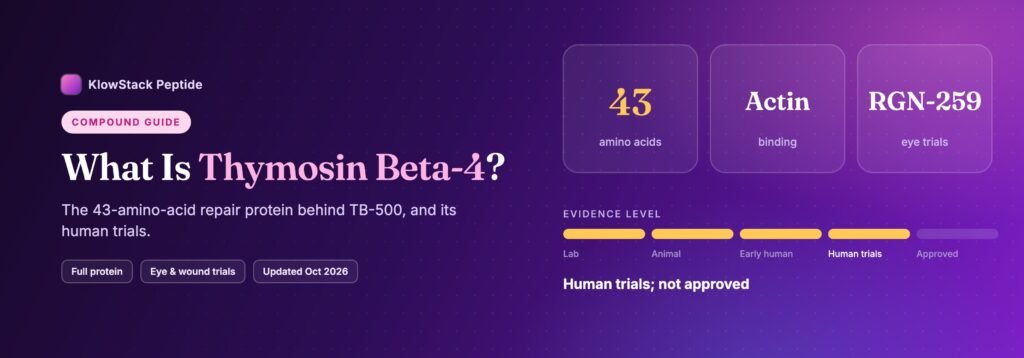
Thymosin beta-4 has a deeper human trial record than TB-500, the short fragment sold online in its name: Phase 2 wound trials, Phase 3 eye-drop trials and early heart studies in China. Those trials have shown good safety but have mostly missed their main goals, and no Tβ4 product is approved anywhere in the US as of October 2026.
Thymosin beta-4 isn’t approved for any use, and research-grade Tβ4 is sold for research use only. This guide is educational; see our Medical Disclaimer.
What Is Thymosin Beta-4?
Thymosin beta-4 is a small natural protein that’s among the most abundant in many cells, especially platelets and white blood cells. It had its sequence worked out in 1981 in Allan Goldstein’s lab, using thymus extracts, which gave it the “thymosin” name. Despite the name, it isn’t a thymus hormone: it’s made throughout the body.
What it does day to day. Every cell keeps a stockpile of actin, the protein it strings into fibers to change shape, divide and move. Tβ4 acts like a warehouse clerk holding single actin pieces on the shelf until the cell needs them. When a wound happens, cells near it need to crawl in fast, and platelets at the wound site release Tβ4 into the area. That’s why repair researchers became interested in it.
The chemistry. Tβ4 is 43 amino acids long, with an acetylated start, weighing about 4,960 daltons. Two of its segments get most of the attention: the actin-binding stretch around positions 17 to 23 (LKKTETQ), which is the basis for TB-500, and the first four amino acids, which can be cut off to form Ac-SDKP, a tiny peptide with anti-scarring effects in animal studies.
The history. In the 1990s and 2000s, researchers at the NIH, including Hynda Kleinman, showed Tβ4 sped wound healing in animals, and the company RegeneRx licensed it for clinical development. In 2004 and 2006, two papers in Nature reported that Tβ4 protected and helped regenerate the mouse heart. Eye-drop trials followed in the US, and a recombinant version entered heart-attack trials in China in the 2020s.
Also known as: Tβ4, TB4, timbetasin and RGN-259
Tβ4 and TB4 are common abbreviations. Timbetasin is the proposed generic name for the drug form. RGN-259 is RegeneRx’s eye-drop formulation, RGN-137 its skin gel, and NL005 a recombinant Tβ4 developed by Beijing Northland Biotech. Don’t confuse Tβ4 with TB-500, a 7-amino-acid fragment, or with thymosin alpha-1, an unrelated immune peptide. Our TB-500 vs thymosin beta-4 comparison covers the first difference in depth.
How Does Thymosin Beta-4 Work?
Thymosin beta-4 binds single actin molecules inside cells, controlling how much actin is available to build the fibers cells need to move. Outside cells, in animal studies, it promotes new blood vessels, calms inflammation, reduces scar-forming cells and activates heart progenitor cells. Its exact receptor for these outside effects isn’t fully known.
What’s known, and from what kind of research:
- Actin sequestering (lab): Tβ4 binds monomeric actin one to one, which is well established in biochemistry.
- Cell migration and wound closure (animal): in rats and mice, topical or injected Tβ4 sped closure of skin and corneal wounds.
- Heart cell survival (animal): a 2004 Nature study found Tβ4 activated a survival enzyme called integrin-linked kinase and limited heart damage after injury in mice.
- Heart progenitor cells (animal): a 2006 Nature study showed Tβ4 roused dormant progenitor cells in the heart’s outer layer and helped form new blood vessels.
- Less scarring (animal): Tβ4 and its fragment Ac-SDKP reduced fibrosis in heart, kidney and liver models.
What does thymosin beta-4 do? Think of a construction site after a storm. Tβ4 helps the work crews get to the site faster, helps lay new supply roads (blood vessels), and keeps the cleanup from turning into a pile of scar tissue. Those effects are clear in animals. In people, they haven’t yet added up to a clearly better outcome in a major trial.
What Is Thymosin Beta-4 Used For / Studied For?
Thymosin beta-4 has been studied for corneal injuries and dry eye (human Phase 2 and 3), chronic skin ulcers (human Phase 2), heart attack (animal and Chinese Phase 2), and hair growth (animal). Safety has been consistently good in human trials, but none has won FDA approval.
Dry eye and corneal healing
What was studied: RGN-259 eye drops in a small Phase 2 dry-eye trial of nine people, then three Phase 3 dry-eye trials (ARISE-1, ARISE-2 and ARISE-3, with 317, 601 and 700 participants), plus a Phase 3 trial in neurotrophic keratopathy, a condition where the cornea loses nerve supply and won’t heal.
What it found: the small Phase 2 trial reported improved signs and symptoms. ARISE-3 didn’t meet its primary endpoints, though a secondary measure, eye grittiness, improved. In the neurotrophic keratopathy trial of 18 patients, complete healing showed a trend toward benefit (p = 0.08) and comfort improved.
What it doesn’t show: enough benefit for FDA approval yet. A second neurotrophic keratopathy trial (SEER-2) is recruiting.
Chronic skin ulcers
What was studied: a Phase 2 European trial of Tβ4 gel in 73 people with venous leg ulcers, and a US Phase 2 trial in pressure ulcers.
What it found: safety was similar to placebo. The authors suggested one dose might speed healing, with complete healing in about a quarter of patients within three months, mostly those with smaller wounds.
What it doesn’t show: a statistically clear benefit. These were exploratory trials.
Heart attack
What was studied: after the mouse heart findings, a Phase 1 study gave intravenous Tβ4 to 40 healthy volunteers. In China, recombinant Tβ4 (NL005) has completed Phase 2 trials in heart-attack patients, with another planned.
What it found: IV Tβ4 was well tolerated, with no dose-limiting side effects over 14 days. The Chinese Phase 2 results haven’t been published in a peer-reviewed journal as of October 2026.
What it doesn’t show: that Tβ4 repairs human hearts. A planned US heart trial was withdrawn before it started.
What thymosin beta-4 hasn’t been shown to do
It hasn’t been shown to speed sports injury recovery, grow hair, build muscle or reverse aging in people. Those claims mostly circulate through TB-500 marketing, and they lean on animal studies of the full Tβ4 protein, not human trials.
What Does the Human Research Show?
Thymosin beta-4 has a moderate human research base: Phase 1 safety data, several Phase 2 wound and eye trials, and Phase 3 eye-drop trials enrolling more than 1,600 people combined. It has been consistently well tolerated. Primary effectiveness goals have mostly been missed, with some secondary or subgroup signals.
| Study | Year | Design | Participants | Result | Limitation |
|---|---|---|---|---|---|
| Ruff et al. | 2010 | Phase 1, randomized, placebo-controlled | 40 healthy adults | IV Tβ4 well tolerated for 14 days | Safety only |
| Guarnera et al. | 2010 | Phase 2, double-blind, dose escalation | 73 adults with venous ulcers | Possible faster healing at one dose | Exploratory |
| Sosne et al. | 2015 | Phase 2 RCT | 9 adults with severe dry eye | Signs and symptoms improved | Very small |
| ARISE-3 (NCT03937882) | 2021 | Phase 3 RCT | 700 adults with dry eye | Missed primary endpoints; grittiness improved | Secondary findings only |
| Sosne et al. (SEER-1) | 2022 | Phase 3 RCT | 18 adults with neurotrophic keratopathy | Healing trend (p = 0.08); comfort better | Small; company-designed |
PubMed (1,056 records) and ClinicalTrials.gov (18 registered studies) searched October 5, 2026.
The eye trials make an interesting case study in how drug development works: a drug can be safe, show promising signals in small studies, and still fall short of the bar for approval when tested in hundreds of people. Our Editorial Policy explains how we label evidence like this.
Thymosin Beta-4 Side Effects and Safety
Across human trials of eye drops, skin gels and intravenous infusions, thymosin beta-4 has been well tolerated, with side effects similar to placebo. The main open question is theoretical: since tumors also depend on mobile cells and fresh blood supply, researchers have asked whether boosting Tβ4 could help a cancer along.
Reported in human studies: in the Phase 1 IV study, adverse events were infrequent and mild or moderate, with no dose-limiting toxicity. The eye and skin trials reported safety comparable to placebo.
Expected from the mechanism: cancer cells also rely on cell movement and new blood vessels, and some tumor studies find high Tβ4 levels. In head and neck cancers, a 2017 Scientific Reports study linked higher Tβ4 gene activity to worse outcomes. That’s a correlation inside tumors, not evidence that Tβ4 treatment causes cancer, but it’s why a cancer history is a red flag.
Anecdotal only: people using research-grade “TB4” online report injection-site soreness, tiredness and headaches, and often say they can’t tell whether it helped. These reports haven’t been studied.
Product quality: full-length Tβ4 is a 43-amino-acid protein that’s harder to make correctly than short peptides, and vials labeled TB-500 or TB4 may contain either molecule. Our peptide COA guide explains how mass testing distinguishes them.
Who should avoid thymosin beta-4
Anyone with active or past cancer has the most reason to avoid it, given its role in cell migration and blood vessel growth. Pregnancy, breastfeeding, being under 18 and competing in drug-tested sport are other clear reasons to stay away.
Is thymosin beta-4 safe for the eyes?
In eye-drop trials involving well over a thousand people, RGN-259 had safety similar to the placebo drops. Those were carefully made pharmaceutical formulations; research-grade powder isn’t sterile eye medication and shouldn’t be confused with it.
Thymosin Beta-4 vs TB-500
Thymosin beta-4 is the full 43-amino-acid natural protein; TB-500 is a 7-amino-acid synthetic fragment of it. Nearly all the human trials used full Tβ4, so they don’t directly tell you about TB-500.
| Thymosin beta-4 | TB-500 | |
|---|---|---|
| Mechanism | Actin binding, migration, blood vessels, anti-scarring | Based on the actin-binding segment |
| Half-life | Short in blood; varies by dose | Not established in humans |
| Evidence | Phase 1 to 3 human trials | No human trials |
| Status | Not approved | Research use only |
The full comparison is in TB-500 vs thymosin beta-4, and our TB-500 guide covers the fragment.
Is Thymosin Beta-4 Legal? Why Is It Banned in Sports?
Thymosin beta-4 isn’t FDA-approved for any use, and the full-length protein hasn’t been nominated to the FDA for compounding. Research-grade Tβ4 is sold in the US with a “research use only” label. WADA bans Tβ4 and its derivatives in sport at all times.
FDA. RGN-259 is an investigational drug in clinical trials; it isn’t approved. Full-length Tβ4 doesn’t appear on the FDA’s 503A nomination lists. Its 7-amino-acid fragment, TB-500, was reviewed separately and received a favorable advisory vote in July 2026, which doesn’t extend to full Tβ4.
Research use only. Vials sold under this label aren’t checked like medicines. Our guide to whether research peptides are legal explains the wider rules.
Sport. The 2026 WADA Prohibited List bans “Thymosin-β4 and its derivatives, e.g. TB-500” under S2, as growth factors and growth factor modulators, in and out of competition.
FDA and WADA status checked October 5, 2026.
Where Thymosin Beta-4 Fits: Needs & Symptoms
Thymosin beta-4 appears in Skin Health & Regeneration, described as the parent peptide of TB-500, researched independently for its actin-binding role in tissue repair. Among skin-related compounds, it’s one of the few with human wound and eye trials, even if those trials fell short.
Related guides on that page include GHK-Cu, the copper peptide with the strongest topical skin data, BPC-157 and TB-500, and Matrixyl, a cosmetic collagen peptide.
Frequently Asked Questions
What does thymosin beta-4 do?
Inside cells, Tβ4 holds single actin molecules ready for use, helping cells move. In animals, it speeds wound healing, promotes blood vessels and limits scarring.
Is thymosin beta-4 the same as TB-500?
No. Tβ4 is the full 43-amino-acid protein. TB-500 is a 7-amino-acid fragment based on part of it, and it has no human trials.
Is thymosin beta-4 safe?
Human trials of eye drops, gels and IV infusions found safety similar to placebo. A theoretical cancer concern exists because of its role in cell migration and blood vessel growth.
Has thymosin beta-4 been tested in humans?
Yes, in Phase 1 to 3 trials for dry eye, corneal healing, skin ulcers and heart attack. Most missed their main effectiveness goals.
Is thymosin beta-4 legal?
It isn’t FDA-approved and isn’t nominated for compounding. It’s sold in the US only as a research chemical.
Is thymosin beta-4 banned in sports?
Yes. WADA bans Tβ4 and its derivatives, including TB-500, under S2 at all times.
Does thymosin beta-4 help with healing?
It sped healing in many animal studies. In human trials, results were promising in small studies but didn’t clearly beat placebo in larger ones.
Does thymosin beta-4 cause cancer?
There’s no evidence it causes cancer in people. Some tumors have high Tβ4 levels, which is why people with a cancer history are advised to avoid it.
How much thymosin beta-4 should be used?
There’s no research-based dosing for non-approved use, and we don’t publish dosing for any compound. See our Medical Disclaimer.
Sources
Primary studies
- Bock-Marquette I, et al. 2004. Thymosin β4 activates integrin-linked kinase and promotes cardiac cell migration, survival and cardiac repair. Nature. doi:10.1038/nature03000
- Smart N, et al. 2006. Thymosin β4 induces adult epicardial progenitor mobilization and neovascularization. Nature. doi:10.1038/nature05383
- Ruff D, et al. 2010. A randomized, placebo-controlled, single and multiple dose study of intravenous thymosin β4 in healthy volunteers. Annals of the New York Academy of Sciences. doi:10.1111/j.1749-6632.2010.05474.x
- Guarnera G, et al. 2010. The effect of thymosin treatment of venous ulcers. Annals of the New York Academy of Sciences. doi:10.1111/j.1749-6632.2010.05490.x
- Sosne G, et al. 2015. Thymosin β4 significantly improves signs and symptoms of severe dry eye in a phase 2 randomized trial. Cornea. doi:10.1097/ICO.0000000000000379
- Chi LH, et al. 2017. Thymosin beta-4 X-linked as a prognostic marker for head and neck squamous cell carcinoma. Scientific Reports. doi:10.1038/s41598-017-09539-w
- Sosne G, et al. 2022. 0.1% RGN-259 (thymosin ß4) ophthalmic solution promotes healing and improves comfort in neurotrophic keratopathy patients in a randomized, placebo-controlled, double-masked phase III clinical trial. International Journal of Molecular Sciences. doi:10.3390/ijms24010554
Regulatory and trials
News
Disclaimer: Thymosin beta-4 isn’t approved for any use, and research-grade Tβ4 is sold for research use only. This guide is educational and doesn’t give medical advice. Read our Medical Disclaimer and Editorial Policy.