
Reviewed by Thomas Okafor, Peptide Chemist · Last updated October 13, 2026
“KLOW for skin” has become a popular search as copper-peptide skincare went mainstream and blended research peptides started circulating on social media. Clinic pages describe glowing results. Search summaries even blend KLOW with an unrelated beauty brand. Underneath all that, a simpler fact gets lost: nobody has published a study of the KLOW combination on skin, or on anything else.
So this page takes KLOW apart. It looks at each of the four ingredients separately, sets out what skin and collagen research exists for each, and labels every finding by the kind of study that produced it. Everything here is educational, and KLOW itself is a laboratory research product. For the combination’s background, see our KLOW stack guide.
What Is KLOW? (Quick Recap)
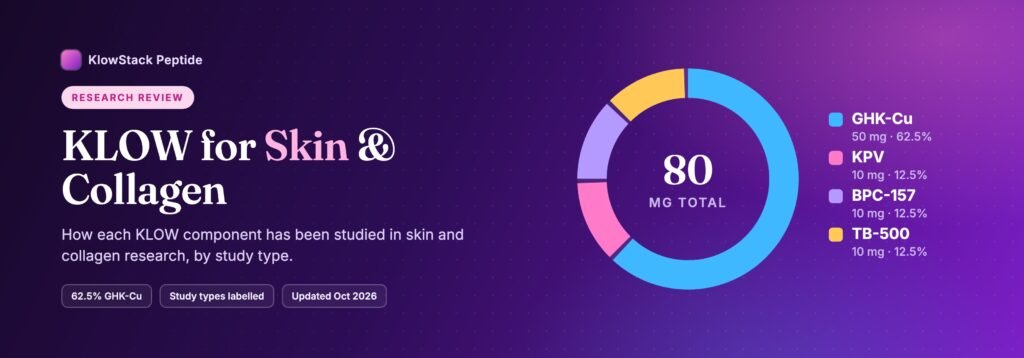
KLOW puts four research peptides into one 80 mg formula, and the copper peptide GHK-Cu makes up 50 mg of it, or 62.5% by weight. The remaining 30 mg is split evenly between BPC-157, TB-500 and KPV. It’s a research-use-only product with no link to skincare brands that have similar-sounding names.
| Ingredient | mg per 80 mg | Skin-relevant research theme |
|---|---|---|
| GHK-Cu | 50 | Collagen, elastin, matrix remodeling |
| BPC-157 | 10 | Skin wound and burn models in rodents |
| TB-500 | 10 | Cell migration in wound models |
| KPV | 10 | Skin inflammation signaling |
The name causes real confusion. Some AI search summaries have mixed KLOW up with “Klo,” an unrelated beauty brand. Here, KLOW means only the four-peptide research formula, whether it arrives premixed or split across separate vials.
Why Skin Researchers Look at KLOW’s Components
Skin researchers study four processes that KLOW’s ingredients touch: collagen and elastin production by fibroblasts, wound closure, the growth of new blood vessels (angiogenesis), and inflammatory signaling. Each ingredient has been studied mainly in one or two of these areas.
Two kinds of aging feed into this. Intrinsic aging is the slow decline that happens to everyone. Photoaging is the extra damage from ultraviolet light, which generates reactive oxygen molecules and switches on collagen-degrading enzymes. Skin research on peptides usually targets one or both.
Think of skin’s support layer, the dermis, as a mattress. Collagen fibers are the springs, elastin gives them bounce, and gel-like molecules called glycosaminoglycans fill the spaces. Fibroblasts are the cells that build and maintain all of it. With age and sun exposure, production slows and breakdown speeds up, so the mattress sags.
Wound research looks at a related chain of events: inflammation clears debris, cells migrate into the gap, new blood vessels form, and fibroblasts lay down fresh collagen. A combination like KLOW rests on the hypothesis that ingredients acting at different points in that chain might work together. That hypothesis is reasonable on paper, and it hasn’t been tested.
The Skin & Collagen Research, Component by Component
The copper peptide does most of the heavy lifting here, and every human study in this section tested a cream rubbed onto skin. BPC-157 has rodent wound and burn studies, TB-500’s record mostly belongs to its parent protein thymosin beta-4, and KPV has cell and animal inflammation work.
GHK-Cu, collagen and skin remodelling research
🧪 In vitro: Fibroblasts taken from adult human skin stepped up their output of both structural proteins when bathed in GHK-Cu across a range from a hundredth of a nanomolar to 100 nanomolar, as Pickart and Margolina’s 2018 review details. Older dish experiments added two more pieces: extra glycosaminoglycans and decorin, and changes in how much of the matrix-clearing MMP enzymes and their TIMP inhibitors the cells made.
🧪 Stem-cell markers: In the bottom layer of the epidermis, keratinocytes exposed to low micromolar GHK-Cu made more p63 and integrins, two proteins associated with the epidermis’s self-renewing cell population.
🧪 Gene-database data: Roughly three in ten human genes shift their activity by half or more when cell lines meet GHK, judging by the Broad Institute’s Connectivity Map. Treat that as a prediction, since no tissue was involved.
👤 Human topical cosmetic studies: The people-based work consists of a handful of cream trials lasting two to three months:
- Faces of 71 women: measured density and thickness went up and wrinkles got shallower over 12 weeks.
- Eye area of 41 women: the copper peptide cream outperformed a placebo and a vitamin K cream.
- Thigh skin: biopsies showed more collagen in seven of every ten women on the GHK-Cu cream, compared with five in ten on vitamin C and four in ten on retinoic acid.
- An 8-week randomized, double-blind serum study: wrinkle volume fell 55.8% against a control serum.
All of these involved products applied to the surface, and a single research circle connected to the molecule’s commercial history produced many of them. Our pages on GHK-Cu skin research and GHK-Cu benefits cover each study’s design.
BPC-157 in wound-healing models
🐭 Animal: BPC-157’s skin research is all in rodents. In a 2001 study in Burns, Mikus and colleagues created deep partial-thickness burns on mice and reported better burn-recovery measures with a BPC-157 cream, including less swelling and fewer inflammatory cells. A 2015 rat study by Huang and colleagues used alkali burns and found faster wound closure, more collagen deposition at day 18 and higher VEGF levels in wounded skin. In lab dishes, the same study found BPC-157 boosted growth of blood-vessel lining cells. Reviews from the Zagreb group, which has published most BPC-157 work, also describe incision, excision and diabetic-ulcer models in rodents, all from animal studies.
👤 Human: No human skin study of BPC-157 has been published. Our BPC-157 guide covers its wider research.
TB-500 / Thymosin β4 fragment in wound research
TB-500 is a 7-amino-acid fragment. Thymosin beta-4 (Tβ4) is the full 43-amino-acid protein it comes from. Most skin research used the full protein, so the two need separate labels.
🐭 Animal, full Tβ4: Malinda and colleagues reported in 1999 that Tβ4 sped wound closure in rats, partly by helping skin cells migrate. Tβ4 works by holding onto actin, the protein scaffolding cells use to crawl.
🐭 Beyond wound closure: Tβ4 has also been studied for its role in new blood-vessel formation and in rodent hair-growth models, again with the full protein.
👤 Human, full Tβ4: RegeneRx, the company developing Tβ4, took a topical gel through phase 2 trials in venous stasis ulcers and pressure ulcers, and ClinicalTrials.gov lists both as completed. A later gel trial in a rare blistering skin condition was terminated.
TB-500 itself: No human skin or wound trial of TB-500 has been published. Our TB-500 guide explains the fragment-versus-protein difference.
KPV and skin inflammation research
🧪🐭 Lab and animal: KPV is the final three amino acids of alpha-MSH, a hormone that skin cells themselves produce. A 2008 review in Endocrine Reviews by Brzoska and colleagues summarized lab and animal work in which alpha-MSH fragments, including KPV, reduced inflammatory signaling in skin and immune cells and in models of skin inflammation. The appeal of the fragment is that it seems to hold on to the hormone’s calming effect on inflammation while dropping the tanning signal. Skin cells such as keratinocytes and fibroblasts make alpha-MSH themselves, which is part of why dermatology researchers took an interest.
👤 Human: KPV has no published skin research in people. Our KPV guide covers the rest of its research.
Evidence at a Glance (Table)
Only one of KLOW’s four ingredients, GHK-Cu, has human skin data, and those data come from topical creams. The other three have animal or cell-based skin research, and thymosin beta-4’s human wound trials apply to the full protein alone, leaving TB-500 itself untested.
| Component | Skin research areas | Study type | Human skin data | Key caveat |
|---|---|---|---|---|
| GHK-Cu | Collagen, elastin, matrix balance, wrinkles | Lab; small human cosmetic studies | Limited (topical creams) | Small studies, mostly one research network |
| BPC-157 | Burn and wound closure, angiogenesis | Mice and rats; lab | None | All animal; mostly one lab group |
| TB-500 | Cell migration, wound closure | Animal (full Tβ4); lab | None for TB-500 | Human gel trials used full Tβ4 |
| KPV | Skin inflammation signaling | Lab; animal models | None | Evidence summarized mainly in reviews |
Notice how the evidence stacks up. Strip out GHK-Cu, and KLOW’s skin case is entirely preclinical.
What Hasn’t Been Studied
The KLOW combination itself has never been studied on skin or anywhere else. There are no data on how the four ingredients interact, no research justifying the 50/10/10/10 ratio, and no human skin data for three of the four components. Most online “KLOW collagen” claims borrow GHK-Cu’s evidence alone.
- The blend. No published study has tested the four peptides together, in cells, animals or people.
- Interactions and ratios. Nobody has measured whether the ingredients help, hinder or ignore each other, or whether 50/10/10/10 is better than any other ratio.
- Lab-to-skin translation. A fibroblast responding in a dish is a long way from a measurable change in living skin.
- Borrowed evidence. “KLOW increases collagen” usually means “GHK-Cu creams were linked to more collagen in small studies,” which is a narrower claim.
- Form. The human GHK-Cu studies tested topical creams. KLOW is a lyophilized research powder, a different thing entirely.
- Stability. Nobody has published how GHK-Cu and the other three peptides behave together in one vial over time, a basic question for any combination.
- Comparison groups. Several of the GHK-Cu cream studies compared results only with each participant’s starting point, without a placebo cream, which makes their findings harder to interpret.
KLOW vs GLOW for Skin Research
Put the two formulas side by side and three ingredients match milligram for milligram. The only extra in KLOW is 10 mg of KPV, which adds a skin-inflammation thread. On collagen specifically, both draw almost everything from the copper peptide.
| GLOW | KLOW | |
|---|---|---|
| Ingredients | GHK-Cu, BPC-157, TB-500 | GHK-Cu, BPC-157, TB-500, KPV |
| Standard total | 70 mg | 80 mg |
| GHK-Cu share | about 71% | 62.5% |
| Extra research angle | None | Inflammation signaling via KPV |
| Studied as a blend? | No | No |
For everything beyond skin, read our side-by-side of the two formulas or the standalone GLOW guide.
Reported Adverse Findings in the Literature
Published skin studies of KLOW’s ingredients report few adverse findings. Topical GHK-Cu studies describe little beyond occasional irritation, BPC-157’s animal burn studies and toxicology work found no toxicity, and KPV’s lab and animal studies didn’t report adverse effects. None of these studies looked at the combination.
Irritation is the reaction mentioned most often for topical copper peptides, usually redness or stinging, and it’s tied to cream formulas applied to the skin. These studies were small and short, and none was designed to detect uncommon reactions. Copper itself is an essential trace element that the body regulates closely, and how much of it any research product delivers depends entirely on what’s actually in the vial. Product quality adds a separate layer of risk for any research vial, which a verified certificate of analysis helps address. Our KLOW side effects guide covers each ingredient’s findings by study type.
Regulatory Status (as of October 13, 2026)
KLOW has no FDA approval, and neither does any ingredient in it. Each of the four dropped off the agency’s Category 2 compounding list in spring 2026 when its nomination was withdrawn. A July 2026 advisory vote favored three of them for compounding, and the copper peptide’s turn comes at a meeting expected by late February 2027.
Copper-peptide creams on store shelves follow different rules altogether. US law lets a cosmetic reach shelves with no FDA sign-off, provided its claims stay about appearance, a line the FDA explains here. Research-use KLOW isn’t a cosmetic. For the federal rules on lab compounds, see our peptide legality explainer.
FAQ
Is there research on KLOW for skin?
Not on the formula as a whole. What exists is ingredient by ingredient: the copper peptide has dish experiments plus small cream trials in women, BPC-157 has rodent burn and wound studies, and TB-500 and KPV have lab and animal work.
Does KLOW increase collagen?
That hasn’t been studied for KLOW. The collagen evidence comes from GHK-Cu: fibroblasts made more collagen in lab studies, and small human studies linked topical GHK-Cu creams to more collagen in skin biopsies. BPC-157 rat burn studies also reported more collagen deposition.
Which KLOW peptide is most studied for skin?
GHK-Cu, by a wide margin. It’s the only KLOW ingredient with human skin studies, though those trials were small, short and limited to creams. It also has decades of fibroblast and gene-expression research behind it.
KLOW or GLOW: what’s the difference for skin research?
Their skin evidence is close to identical, because three of the ingredients and their amounts match. KLOW’s extra KPV contributes lab and animal work on skin inflammation. Nobody has studied either formula directly.
Is KLOW FDA-approved?
No. The agency hasn’t approved the formula or any of its parts. KLOW is a lab research product, and on October 13, 2026 the 503A compounding list still didn’t include any of its four peptides.
Conclusion
KLOW’s skin story is mostly GHK-Cu’s story, told with a few animal chapters from its three partners. That makes “KLOW for skin” an interesting research question and an unanswered one. Related compounds and studies are grouped in our skin and regeneration research hub.
Sources
- Pickart L, Margolina A. 2018. Regenerative and protective actions of the GHK-Cu peptide in the light of the new gene data. International Journal of Molecular Sciences. doi:10.3390/ijms19071987
- Pickart L, Vasquez-Soltero JM, Margolina A. 2015. GHK peptide as a natural modulator of multiple cellular pathways in skin regeneration. BioMed Research International. doi:10.1155/2015/648108
- Mikus D, et al. 2001. Pentadecapeptide BPC 157 cream improves burn-wound healing and attenuates burn-gastric lesions in mice. Burns. PubMed
- Huang T, et al. 2015. Body protective compound-157 enhances alkali-burn wound healing in vivo and promotes proliferation, migration, and angiogenesis in vitro. Drug Design, Development and Therapy. PMC4425239
- Malinda KM, et al. 1999. Thymosin beta4 accelerates wound healing. Journal of Investigative Dermatology. doi:10.1046/j.1523-1747.1999.00708.x
- Brzoska T, et al. 2008. Alpha-melanocyte-stimulating hormone and related tripeptides: biochemistry, antiinflammatory and protective effects in vitro and in vivo, and future perspectives for the treatment of immune-mediated inflammatory diseases. Endocrine Reviews. doi:10.1210/er.2007-0027
- Is It a Cosmetic, a Drug, or Both?, FDA
- Certain Bulk Drug Substances for Use in Compounding that May Present Significant Safety Risks, FDA, current as of April 22, 2026