Reviewed by Thomas Okafor, Peptide Chemist · Updated October 2026
KPV is a tiny peptide made of three amino acids (lysine-proline-valine) that comes from the tail end of alpha-MSH, a natural hormone that helps regulate inflammation. It’s studied mainly for gut inflammation such as colitis, and for skin and wound healing. The research is almost entirely lab and animal work, with no completed human trials published.
KPV went from a footnote in gut-research journals to a trending topic almost overnight in 2026, helped along by a federal advisory vote and a wave of clinic reels. The KPV peptide also happens to be one of the four ingredients in KLOW. Below you’ll find what KPV is, how it seems to work, what the studies actually tested, why oral KPV is a more serious idea than most oral peptides, and what that July vote did and didn’t change.
This page offers education, and none of it is medical advice. KPV is sold for research use only; our Medical Disclaimer explains what that label means.
What Is KPV Peptide?
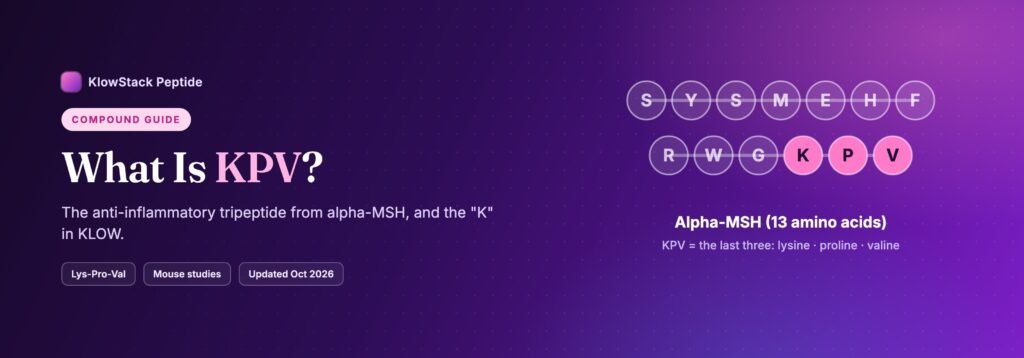
KPV is the C-terminal tripeptide of alpha-melanocyte-stimulating hormone (α-MSH): its last three amino acids, lysine, proline and valine. Researchers found that this small fragment keeps much of α-MSH’s anti-inflammatory activity without the skin-darkening effects linked to the full hormone, which made it attractive as a research tool.
Alpha-MSH is a 13-amino-acid hormone made in the pituitary gland and also in skin and immune cells. It wears several hats. It tells pigment cells to make melanin (that’s the tanning part), it plays a role in appetite, and it calms inflammation.
Scientists wanted the calming part without the rest. Picture keeping a car’s brakes and leaving the paint job behind: KPV is the piece of α-MSH that still slows inflammation, minus the pigment signal. A 2008 review in Endocrine Reviews by Brzoska’s group at Germany’s University of Münster described KPV as a promising alternative for anti-inflammatory research for exactly that reason. They also pointed out its other selling points: it’s small, stable and expected to be cheap to produce.
What Does KPV Stand For?
KPV isn’t an acronym in the usual sense. Each letter is the standard one-letter code for an amino acid: K for lysine, P for proline and V for valine. Scientists write peptide sequences this way all the time, so “KPV” is simply the peptide’s full recipe, spelled out in three letters. The same naming logic is why KLOW puts a “K” at the front.
Is KPV a Hormone or a Drug?
KPV is neither an approved drug nor a hormone in its own right. It’s a fragment of a hormone, made synthetically for research. Its parent hormone’s family has produced real medicines, though. Afamelanotide (Scenesse) and bremelanotide (Vyleesi) are FDA-approved drugs that act on melanocortin receptors, which shows the pathway can be turned into treatments. KPV itself hasn’t taken that path. No country has approved it as a medicine, and in the US it’s sold as a research chemical, with a pending FDA compounding review described in the legal section below.
How Does KPV Work?
KPV appears to calm inflammation from inside cells. In lab studies it enters intestinal and immune cells, partly through a transporter called PepT1, and dampens NF-κB and MAP-kinase signaling, the switches that turn on inflammatory cytokines. The full picture comes from cells and mice, so its action in people is still unconfirmed.
Here’s the chain of events scientists have mapped so far:
- PepT1 uptake (lab and mouse): PepT1 is a transporter on gut-lining cells whose day job is absorbing small protein fragments from food. KPV is the right size to ride it in. PepT1 is barely present in a healthy colon and becomes much more active when the colon is inflamed, according to the Dalmasso study in Gastroenterology.
- Quieter inflammation switches (lab): inside the cell, KPV lowers NF-κB and MAP-kinase activity. Those pathways act like master switches for inflammation.
- Fewer inflammatory messengers (lab and mouse): with the switches turned down, cells release less IL-6, IL-8 and TNF-α, three cytokines that drive inflammation.
- Melanocortin receptors (mixed evidence): the parent hormone works through melanocortin receptors such as MC1R. KPV may use them too, but a 2008 mouse study by Kannengiesser and colleagues found KPV still reduced colitis in mice whose MC1R didn’t work, so at least some of its effect seems receptor-independent.
PepT1 isn’t only a food transporter, either. Drug designers already rely on it: some common antibiotics and the antiviral valacyclovir get absorbed partly by hitching a ride on PepT1. That track record is part of why scientists take the idea of oral KPV seriously.
You’ll often see KPV described as “calming inflammation without shutting down the immune system.” That’s the hope, based on how its pathways work. It hasn’t been shown in humans. Inflammation is also part of how the body fights infection and starts healing, so any compound that dampens it raises the question of how much quieting is helpful, which only careful human studies could answer.
A side note on a common question: does KPV make you tired? No study has measured fatigue or energy with KPV, in animals or people, so there’s no evidence either way. Online reports of tiredness are personal accounts, and many people posting them are also dealing with gut conditions or other compounds that could explain how they feel.
What Is KPV Used For?
KPV is studied mainly for inflammatory bowel conditions like colitis, plus skin inflammation and wound healing. In mice it reduced colitis severity; it has not been tested in human trials, so any use in people is unproven. What is KPV used for in practice? Mostly as a lab tool for studying gut inflammation.
Gut Inflammation: Colitis and IBD
This is KPV’s home turf. In the 2008 Gastroenterology study (published online in late 2007, which is why you’ll see both years), Dalmasso and colleagues at Emory University ran KPV through two mouse colitis models, called DSS and TNBS, which mimic different features of human inflammatory bowel disease. Mice given KPV in their drinking water had less colon inflammation and lower inflammatory cytokine levels.
The German team behind the Kannengiesser study reported similar results in two other colitis models, with faster weight recovery and less immune-cell buildup in the colon.
Then came a clever delivery idea. In a 2017 study in Molecular Therapy, Xiao and colleagues at Georgia State University packed KPV into tiny hyaluronic acid-coated nanoparticles designed to target inflamed colon cells. Given by mouth to mice with ulcerative colitis, the particles sped up healing of the gut lining and reduced inflammation.
Many of these papers come from one research family, led by gut biologist Didier Merlin, first at Emory and later at Georgia State. That’s both a strength (deep, consistent expertise) and a reason to want independent labs to repeat the work.
One point often gets mixed up online. At the FDA’s July 2026 advisory meeting, ulcerative colitis was the indication reviewed for BPC-157, not KPV. KPV was reviewed for wound healing and inflammatory conditions. Our guide to KPV for gut health covers the colitis studies in more depth.
Skin Inflammation and Wound Healing
Because α-MSH is active in skin, researchers have tested it and KPV in skin cells (keratinocytes) and in animal models of skin inflammation and wounds. The Brzoska review lists anti-inflammatory effects of α-MSH across models of contact dermatitis, vasculitis and fibrosis, with KPV positioned as the non-tanning version. Wound healing and inflammation were also the indications the FDA panel considered for KPV.
Other Areas People Ask About
Reddit threads tie KPV to mast-cell activation syndrome (MCAS), long-COVID gut problems and joint pain. There are no published studies on any of these, so they’re personal reports only.
Does KPV help with weight loss? There’s no evidence it does. Alpha-MSH plays a role in appetite, but that effect works through brain receptors and hasn’t been shown for KPV.
KPV and Cancer
People search “KPV peptide cancer” for two different reasons, so it helps to be precise. In a 2016 mouse study by Viennois and colleagues, KPV given to mice prevented the development of colitis-associated tumors, a kind of colon cancer linked to long-term inflammation. The effect disappeared in mice lacking PepT1, which suggests KPV has to get into cells through that transporter to work.
That’s an intriguing animal result. There’s no evidence that KPV treats or prevents cancer in people, and nobody has tested it. Our KPV benefits page tracks each claimed benefit by evidence level.
How Strong Is the Evidence for KPV?
Weak in humans. KPV has a solid base of cell and mouse studies, mostly on gut inflammation, but no published randomized human trials. Claims about healing gut issues, MCAS or long COVID come from anecdotes, so the human evidence for KPV today rests on personal reports.
| Research area | Evidence level | Best study | Biggest gap |
|---|---|---|---|
| Colitis | Mouse | Dalmasso 2008; Kannengiesser 2008; Xiao 2017 | No human trials |
| Skin and wounds | Cell and animal | α-MSH and KPV models summarized by Brzoska 2008 | No human trials |
| Systemic inflammation | Cell | NF-κB studies in cultured cells | No whole-body data |
| MCAS and long COVID | Anecdote only | None | No studies at all |
| Weight loss | None | None | No studies at all |
We searched ClinicalTrials.gov on October 5, 2026 and found no registered human trials of KPV. That’s an unusual gap for a compound that just went through an FDA advisory review, and it’s worth keeping in mind whenever you see benefit language on a product page.
The mouse work is consistent across several models and labs, which counts for something. Mice and people differ a lot in how their guts work, from the bacteria they carry to how fast food moves through, and many treatments that look great in mouse colitis never make it through human trials. What would a first human study look like? Usually a small phase 1 trial in healthy volunteers, checking safety and how the body handles the peptide, followed by a trial in people with a condition like ulcerative colitis, compared against a placebo. Neither step has been registered for KPV. Our Editorial Policy lays out the evidence labels we use.
Oral vs Injectable KPV: Does Oral KPV Work?
Oral KPV has more scientific logic than most oral peptides, because the gut transporter PepT1 can carry small peptides like KPV into intestinal cells. That’s why capsules are common. But oral effectiveness in people hasn’t been tested, and capsule quality varies widely between sellers.
Most peptides get chopped up by digestive enzymes long before they can do anything, which is why insulin is still injected. Even oral semaglutide, sold as Rybelsus, needs a special absorption enhancer and strict instructions about taking it on an empty stomach to get through. KPV is different on paper. It’s already the size of the protein fragments PepT1 was built to absorb from your dinner, and two of the main mouse studies gave it by mouth, in drinking water or nanoparticles, and still saw results.
| Form | How it’s sold | Rationale | Evidence | Main risk |
|---|---|---|---|---|
| Capsules | Online sellers, some clinics | PepT1 uptake in the gut | Oral mouse studies only | Unverified contents and amounts |
| Injectable vial | Research suppliers, some clinics | Reaches the bloodstream directly | No human data | Contamination, injection-site problems |
| Topical | Some skincare and clinic products | α-MSH activity in skin | Cell and animal skin models | Unknown penetration and strength |
The catch is that mouse guts aren’t human guts, and capsules sold online are often labeled as supplements without a lab-tested certificate of analysis. People also ask whether KPV should be taken in the morning or at night. There’s no research-based guidance on timing, and we don’t publish dosing or schedules for any research compound. Our oral vs injectable KPV page covers each route’s animal data.
Is KPV Safe? Side Effects and Who Should Avoid It
KPV’s safety in humans is largely unknown. Animal studies haven’t flagged major toxicity, but there are no human safety trials. Most reported issues are anecdotal, such as digestive upset or injection-site reactions, and product purity is a major risk with research-grade vials of the KPV peptide.
Here’s what we know and don’t know:
- Unknowns: no long-term data, no drug-interaction data, and no information on how KPV behaves in people with other health conditions.
- Online self-reports: people describe mild stomach upset, headaches or skin reactions. No study has measured any of them.
- Product quality: research-use-only vials and capsules may be underfilled, mislabeled, or contaminated with bacterial toxins or solvent residue.
- Immune questions: because KPV dampens inflammatory signaling, researchers would want to know how it interacts with infections or with medicines that suppress the immune system. Nobody has studied that.
Is KPV the Safest Peptide?
“Safest” can’t be claimed for any compound without human safety data, and KPV has none. Its natural origin and tiny size are often used as reassurance, but natural and small don’t equal safe. Plenty of natural substances are harmful in the wrong amount or context, and the absence of reported problems in a handful of mouse studies isn’t the same as proof of safety.
Who Shouldn’t Take KPV?
Several groups should be especially careful: anyone pregnant or breastfeeding, people with autoimmune disease or taking immunosuppressants (since KPV acts on immune signaling), children and teenagers, and competitive athletes. Anyone in these groups, or with any chronic condition, should talk to a licensed clinician before considering an unapproved compound.
Do You Need to Cycle Off KPV?
There’s no research basis for cycling advice, because no study has tested KPV over time in people. The on-and-off schedules you’ll find online trace back to vendors and forum posts; KlowStack doesn’t publish protocols. Our KPV side effects page goes into each risk in more detail.
Is KPV Legal?
KPV is not FDA-approved. On 23 July 2026, the FDA’s Pharmacy Compounding Advisory Committee voted 8–6 to recommend adding KPV, with BPC-157 and TB-500, to the list of substances compounding pharmacies can use. The FDA still has to complete rulemaking, so it isn’t legal for compounding yet.
Two terms help make sense of this:
- The 503A list is the FDA’s list of bulk ingredients that compounding pharmacies are allowed to mix into individualized prescriptions.
- Category 2 is a separate FDA list of ingredients flagged for safety concerns. KPV came off Category 2 in April 2026, along with BPC-157 and TB-500, after the nominations behind those listings were withdrawn.
According to the FDA’s meeting page, the panel reviewed KPV for wound healing and inflammatory conditions. AJMC reported that the panel narrowly backed it, and that the FDA must still publish a draft rule, collect public comments and issue a final version before anything changes.
Why doesn’t “the panel voted yes” mean “legal now”? Think back to Schoolhouse Rock’s “I’m Just a Bill.” A bill clearing a committee isn’t a law yet, and an advisory vote isn’t a rule yet. Some social posts in July blurred that line, and the difference is real for anyone reading clinic marketing. FDA rulemaking often takes many months, and the agency isn’t obliged to follow its advisers at all.
Is KPV peptide legal to purchase? It’s sold widely as a “research use only” chemical, a label meaning it’s intended for laboratory study and not approved for use in people.
For athletes, KPV isn’t named on the WADA Prohibited List, but WADA’s S0 category covers any pharmacological substance without government approval for human therapeutic use. Athletes should treat it as off-limits and check with their anti-doping body. Status checked October 5, 2026. The broader rules are covered in our peptide legality guide.
Is KPV in KLOW? KPV in Peptide Blends
Yes. KPV is one of the four peptides in the KLOW blend, alongside GHK-Cu, BPC-157 and TB-500. In the standard 80 mg vial it’s 10 mg, or 12.5%. It’s the “K” that separates KLOW from the GLOW blend, which has no KPV.
| Blend | Contains KPV? | KPV per vial |
|---|---|---|
| KLOW (standard 80 mg) | Yes | 10 mg (12.5%) |
| GLOW (standard 70 mg) | No | None |
| Wolverine | No | None |
KPV’s job in KLOW is to add an inflammation and gut angle to GLOW’s skin and repair ingredients. Even in the less common 30/20/20 KLOW recipe, KPV usually stays at 10 mg, so its share of the vial is the same. Since KPV was part of the July 2026 vote, it’s one of three KLOW ingredients with a pending compounding recommendation; GHK-Cu, the largest, wasn’t reviewed.
There’s also a popular Reddit objection that GHK-Cu’s copper “wipes out” the other peptides sharing the KLOW vial. No published stability data exist for the mixed blend, so that claim can’t be confirmed or ruled out yet. Our KLOW stack guide covers the question in more detail.
For the rest of the family, see GLOW and our KLOW vs GLOW comparison, plus the other KLOW ingredients: BPC-157, GHK-Cu and TB-500.
KPV vs BPC-157: What’s the Difference?
Both are studied for gut inflammation, but they’re different molecules. KPV is a 3-amino-acid α-MSH fragment that targets inflammatory signaling, while BPC-157 is a 15-amino-acid peptide studied mostly for tissue repair and blood-vessel growth. Neither has human trial data, and both were part of the same July 2026 vote.
| KPV | BPC-157 | |
|---|---|---|
| Size | 3 amino acids | 15 amino acids |
| Origin | Tail of the hormone α-MSH | Protein in human gastric juice |
| Main research | Calming inflammatory signaling, colitis | Tendon repair, blood-vessel growth, gut lining |
| July 2026 indication reviewed | Wound healing and inflammation | Ulcerative colitis |
A simple way to remember it: KPV is studied for turning down the alarm, and BPC-157 for sending in the repair crew. That’s why some researchers see them as complementary and others call one redundant. Our BPC-157 guide explains its side of the story, and the peptide blends hub shows where both fit.
Frequently Asked Questions
What is KPV peptide good for?
KPV is studied mainly for calming gut inflammation, with mouse colitis studies as its strongest evidence. It’s also researched for skin inflammation and wounds. None of these uses has been tested in human trials.
Is KPV peptide legal to purchase?
KPV is sold as a research-use-only chemical and isn’t FDA-approved. A July 2026 FDA advisory panel recommended it for compounding, but rulemaking isn’t finished, so pharmacies can’t legally compound it yet.
What are the side effects of KPV?
No human study has measured KPV’s side effects. Online self-reports mention mild stomach upset, headaches or skin reactions. Product quality problems, like contamination, are a bigger documented risk.
Who shouldn’t take KPV peptide?
Pregnant or breastfeeding people, anyone with autoimmune disease or on immunosuppressants, children and competitive athletes have extra reasons for caution. Anyone with a health condition should talk to a clinician first.
Is KPV the safest peptide?
No peptide can be called “safest” without human safety data, and KPV has none. Its natural origin and small size don’t prove safety on their own.
How long does KPV take to work?
Nobody knows, because no human study has followed KPV over time. Timelines online come from personal reports and marketing, which can’t separate KPV’s effect from other changes.
Does KPV help with weight loss?
There’s no evidence KPV helps with weight loss. Its parent hormone, α-MSH, affects appetite through brain receptors, but that effect hasn’t been shown for KPV.
Does KPV make you tired?
No study has measured fatigue with KPV, in animals or people. Reports of tiredness online are personal accounts, and there’s no research to confirm or rule them out.
Does oral KPV work?
Oral KPV has a real scientific rationale, since the gut transporter PepT1 can absorb it, and it worked orally in mice. It hasn’t been tested in people.
Is KPV in KLOW?
Yes. KPV is one of KLOW’s four peptides, at 10 mg in the standard 80 mg vial. It’s the ingredient that separates KLOW from GLOW.
Is KPV the same as alpha-MSH?
No. KPV is only the last three amino acids of alpha-MSH, a 13-amino-acid hormone. It keeps much of the anti-inflammatory activity and lacks the pigment effect, which is why it doesn’t cause tanning the way full alpha-MSH or related drugs can.
Sources
Studies and reviews
- Dalmasso G, et al. 2008. PepT1-Mediated Tripeptide KPV Uptake Reduces Intestinal Inflammation. Gastroenterology 134(1):166-178 (published online 2007). doi:10.1053/j.gastro.2007.10.026
- Kannengiesser K, et al. 2008. Melanocortin-derived tripeptide KPV has anti-inflammatory potential in murine models of inflammatory bowel disease. Inflammatory Bowel Diseases. doi:10.1002/ibd.20334
- Brzoska T, et al. 2008. Alpha-melanocyte-stimulating hormone and related tripeptides. Endocrine Reviews. doi:10.1210/er.2007-0027
- Xiao B, et al. 2017. Orally Targeted Delivery of Tripeptide KPV via Hyaluronic Acid-Functionalized Nanoparticles Efficiently Alleviates Ulcerative Colitis. Molecular Therapy. doi:10.1016/j.ymthe.2016.11.020
- Viennois E, et al. 2016. Critical role of PepT1 in promoting colitis-associated cancer and therapeutic benefits of the anti-inflammatory PepT1-mediated tripeptide KPV in a murine model. Cellular and Molecular Gastroenterology and Hepatology. doi:10.1016/j.jcmgh.2016.01.006
Regulatory and trials
- FDA: July 23-24, 2026 Meeting of the Pharmacy Compounding Advisory Committee
- AJMC: FDA Panel Backs 6 Peptides for Compounding
- WADA Prohibited List
- ClinicalTrials.gov search for KPV (no registered trials found, checked October 5, 2026)
Disclaimer: KPV is sold for research use only and isn’t approved for human use. This guide is for education and doesn’t give medical advice. Read our Medical Disclaimer and Editorial Policy.