
Regulatory Watch · Reviewed by Thomas Okafor, PhD · Published October 23, 2026
Asked on “The Will Cain Show” about the FDA’s pending peptide policy, Kennedy didn’t argue that these compounds are ready for prime time. His case was more practical. “Americans are going to be buying these anyway,” he said, according to Reuters, so the goal is a market where products are what they claim to be and factories get inspected [1]. Reuters noted that the peptides under consideration haven’t been approved by the FDA as safe or effective [1]. The remarks came five days after HHS and FDA sent the White House an “Interim Access Policy for Compounding Using Certain Peptides,” which we covered last week. Its text still isn’t public.
What a “regulated market” would mean, based on what’s known
The clearest description so far comes from an October 16 client alert by Holland & Knight health care attorneys Sarah Starling Crossan and Shalyn Watkins [2]. Their reading of the policy as reported:
- It would use enforcement discretion. That means FDA choosing not to pursue certain actions against pharmacies in particular circumstances, as opposed to approving anything.
- It would not approve any product. None of the peptides would become an FDA-approved drug.
- It would not cover every channel. In the attorneys’ words, it “would not cover research-use-only, supplement or 503B outsourcing facility channels” [2].
- It could be reversed quickly. Enforcement discretion “could be put in place quickly but reversed just as quickly by a future administration,” they wrote [2].
In plain terms, the “regulated market” Kennedy describes would run through licensed compounding pharmacies filling prescriptions. That’s a different lane from the research-chemical market, where peptides are sold for laboratory use with no prescription involved.
Where the research-use-only market fits
The same analysis notes that FDA has “stepped up enforcement against research-use-only peptide sellers and high-volume compounders” since August 2026 [2]. That includes the five warning letters sent to online peptide vendors on August 24, which we reported at the time. So two tracks are moving at once. One would open a supervised pharmacy route for some peptides. The other is tightening scrutiny of sellers whose labels say “research use only” while their marketing suggests otherwise. Nothing announced this month changes how research-use-only products are classified.
The timeline so far
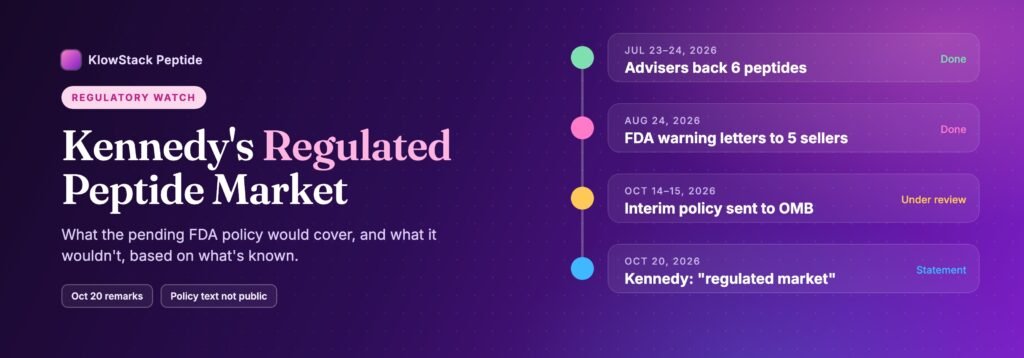
| Date | Step |
|---|---|
| July 23–24, 2026 | FDA’s outside advisers recommended loosening restrictions on six of seven peptides reviewed, including BPC-157, against FDA staff advice [1] |
| August 24, 2026 | FDA sent warning letters to five online peptide vendors [2] |
| October 14–15, 2026 | HHS and FDA sent the interim access policy to the White House budget office [2] |
| October 20, 2026 | Kennedy called for a regulated peptide market on Fox News [1] |
What hasn’t changed
FDA’s 503A Bulks List, the roster of substances pharmacies may use in compounding, still includes none of these peptides, and the July votes “are recommendations only” [2]. The interim policy remains under review, so pharmacies have no new permissions yet. And the peptides discussed, including BPC-157, are still unapproved drugs.
What to watch next
- The policy text. Publication would show which peptides, routes and conditions are included.
- A second advisory meeting. Holland & Knight expects one “before the end of February 2027,” with no date set [2].
- A permanent pathway. The attorneys write that a clear federal path out of the gray market “is unlikely before 2027 and may not be finalized until 2028” [2].
Background: our report on the interim access policy reaching the White House, the August warning letters, and our KLOW legal status page.
This piece covers a pending federal policy and isn’t legal advice. We’ll update it when the policy text is released.
Sources
- Reuters via KSL, “Kennedy says Trump administration aims for regulated market for peptides,” October 20, 2026. https://www.ksl.com/article/51638881/kennedy-says-trump-administration-aims-for-regulated-market-for-peptides
- Crossan SS, Watkins S. “Peptides at a Crossroads: What Wellness Providers Need to Know About HHS and FDA Actions,” Holland & Knight, October 16, 2026. https://www.hklaw.com/en/insights/publications/2026/10/peptides-at-a-crossroads-what-wellness-providers-need-to-know