Reviewed by Thomas Okafor, Peptide Chemist · Last updated October 14, 2026
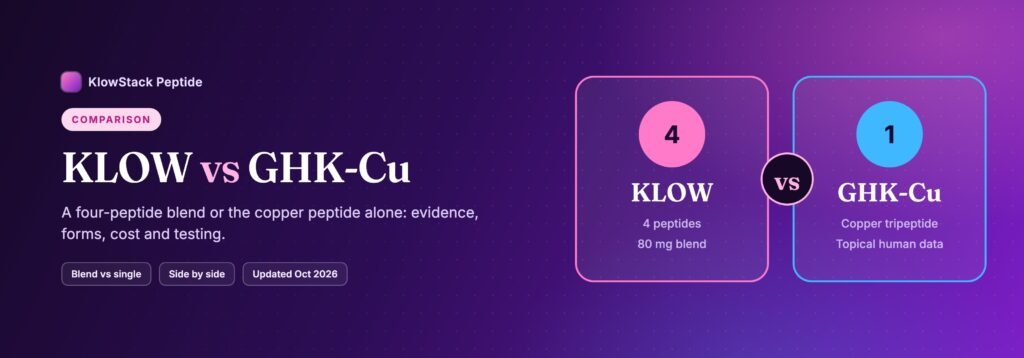
GHK-Cu is a single compound, a copper-binding tripeptide. KLOW contains GHK-Cu too, 50 of its 80 mg, plus BPC-157, TB-500 and KPV. So the comparison isn’t really copper peptide versus something unrelated. It’s one compound versus that same compound with three partners, and a large research record versus a blend that’s never been studied as a blend.
That distinction shapes everything else on this page: what each one has been researched for, what a lab report needs to show, what you’re paying for per milligram, and how regulators treat them. Both are discussed here as research materials. KLOW and research-grade GHK-Cu are sold for laboratory use only and aren’t intended for human consumption.
Quick Comparison: KLOW vs GHK-Cu (vs GLOW)
GHK-Cu is one peptide with decades of lab research and small human cream studies. GLOW pairs the copper peptide with BPC-157 and TB-500, and KLOW goes one further with KPV. Neither blend has been studied as a combination, so their research rests on the individual ingredients.
| GHK-Cu | GLOW | KLOW | |
|---|---|---|---|
| Compounds | 1 | 3 | 4 |
| Typical mg per vial | 50 mg (research vials vary) | 70 mg (50/10/10) | 80 mg (50/10/10/10) |
| Research areas | Collagen, skin remodeling, wound models, gene activity | Adds tendon, tissue and cell-migration research | Adds inflammation signaling research |
| Main study types | Lab; animal; small human topical studies | Lab and animal, plus GHK-Cu’s topical studies | Same as GLOW, plus KPV cell and mouse studies |
| Human data | Small cosmetic cream studies | None for the blend | None for the blend |
| Forms | Cosmetic creams and serums; lyophilized research powder | Lyophilized research powder | Lyophilized research powder |
| FDA status | Not approved as a drug; cosmetic ingredient | Not approved | Not approved |
| GHK-Cu cost per mg (US listings, fall 2026) | About 1.28–2.14 | Not separable | Not separable |
Our GLOW guide and KLOW vs GLOW comparison cover the middle column in detail.
What Is GHK-Cu?
GHK-Cu is a tripeptide of glycine, histidine and lysine that binds a copper ion. Loren Pickart, working with human blood plasma in the early 1970s, was the first to isolate it. It’s studied mainly for collagen production, skin remodeling and wound repair, and for its broad effects on gene activity in cell-line data.
🧪 Lab: Skin fibroblasts in culture ramp up collagen and elastin output in response to GHK-Cu, as a 2018 review by Pickart and Margolina details, and gene-database analyses suggest GHK shifts the activity of about 31% of human genes by half or more.
🐭 Animal: Wound studies in rats and rabbits linked GHK to faster wound contraction and more collagen in new tissue.
👤 Human: Small cosmetic studies tested GHK-Cu creams for 8 to 12 weeks, measuring skin density, thickness and wrinkle depth. All used topical products.
Reported blood levels drop by more than half across adulthood, from roughly 200 ng/mL in a 20-year-old to roughly 80 ng/mL at 60, which helped draw skin researchers’ interest. Our GHK-Cu guide and GHK-Cu benefits page cover the evidence by study type.
What Is KLOW?
Inside KLOW’s 80 mg are four peptides: the same 50 mg of GHK-Cu found in a typical single vial, plus 10 mg apiece of BPC-157, TB-500 and KPV. It’s GLOW with KPV added. Each ingredient brings its own research area, and the formula as a whole hasn’t been studied.
| Ingredient | mg | Studied mainly for |
|---|---|---|
| GHK-Cu | 50 | Collagen and skin remodeling |
| BPC-157 | 10 | Tendon, ligament and gut injury models in rats |
| TB-500 | 10 | Cell migration (research mostly on full thymosin beta-4) |
| KPV | 10 | Inflammatory signaling in cell lines and mice |
KLOW comes as a premixed blend vial or as four separate vials. Both formats, and the thinking behind the 5:1:1:1 recipe, are explained in our KLOW stack overview.
Key Differences in Research
The biggest research difference is design. A single compound can be studied so that any effect traces back to it. A blend can’t, unless researchers also test each part alone and in combination, which nobody has done for KLOW. Beyond that, the skin evidence is shared, while KLOW adds tissue and inflammation research.
Single compound vs multi-compound research design
A study of GHK-Cu alone can tie what researchers measure to GHK-Cu. Add three more peptides and that clarity disappears. If a KLOW study ever reported a change, it would take extra arms, each ingredient alone and in pairs, to know which part caused it or whether the ingredients interact. That kind of factorial design is expensive and rare in peptide research, and it’s why every “KLOW does X” claim online is really a claim about one of its parts.
Interactions are a genuine open question. Ingredients might add up, cancel out, or simply coexist. Copper chemistry adds a wrinkle: GHK-Cu is a copper complex, and nobody has published how it behaves alongside three other peptides in one solution.
Skin and collagen research
🧪👤 Skin and collagen research is where the two overlap almost completely, because GHK-Cu is the only ingredient with human skin studies. KLOW’s three other peptides add rodent wound and burn models and skin-inflammation lab work. For deeper dives, see GHK-Cu and skin and KLOW skin research.
Tissue and inflammation research
🐭🧪 This is what KLOW’s other 30 mg brings. BPC-157 has rat tendon, ligament and muscle studies, TB-500’s parent protein has cell-migration and wound research, and KPV contributes inflammation studies done in human colon cells and mice. GHK-Cu alone covers none of these in depth. Our KLOW gut and inflammation research page covers KPV’s role.
Hair research
🧪 GHK-Cu’s hair evidence is thin. Reviews list larger follicles and hair growth among its reported effects with little detailed data, and the hair study most often quoted online tested a related copper peptide, AHK-Cu. 👤 Eighteen volunteers in a 2026 split-face study showed favorable eyebrow changes with a GHK-Cu product, according to an August 2026 review in Pharmaceutics. No hair research exists for KLOW.
Is the Blend “Stronger” Than GHK-Cu Alone?
No study has compared KLOW with GHK-Cu, so there’s no evidence that the blend is stronger, weaker or different. A larger total milligram count doesn’t mean greater potency, and combining compounds hasn’t been shown to make them work better together.
The “stronger” idea usually rests on simple addition: four research areas must beat one. That logic skips how pharmacology works. Each peptide acts on different targets, and adding BPC-157 to a vial doesn’t make GHK-Cu do more of what GHK-Cu does. The milligram comparison misleads too, because both formulas hold the same 50 mg of GHK-Cu. The extra 30 mg in KLOW is three different molecules.
Research tells us what each compound did in its own model, at its own concentration, in its own experiment. It says nothing yet about the combination. Our comparison hub lists other head-to-head guides built on the same principle.
Forms: Topical GHK-Cu vs Lyophilized Research Powders
GHK-Cu comes in two very different forms: cosmetic creams and serums sold in stores, often listed as copper tripeptide-1, and lyophilized (freeze-dried) research powder sold to laboratories. KLOW exists only as lyophilized research powder.
| Form | GHK-Cu | KLOW |
|---|---|---|
| Cosmetic topical (cream, serum) | Yes, widely sold | No |
| Lyophilized research powder | Yes | Yes |
| Where human studies fit | Topical creams only | None |
Keep the form in mind when reading research. Every human GHK-Cu study tested a cream or serum applied to skin. Those results describe that form, and they don’t transfer automatically to a research powder or to a four-peptide formula.
Cost per mg Compared
Research-grade GHK-Cu typically costs about $1.28 to $2.14 per mg in 50 mg vials, based on US-facing listings in fall 2026. KLOW listings ran about $90 to $180 for 80 mg, or roughly $1.13 to $2.25 per total mg, with the extra 30 mg made up of BPC-157, TB-500 and KPV.
Here’s a worked example using the middle of each range. A 50 mg GHK-Cu vial at about $85 works out to $1.70 per mg. A KLOW vial at about $135 holds the same 50 mg of GHK-Cu plus 30 mg of other peptides, or about $1.69 per total mg. In other words, KLOW’s price premium over plain GHK-Cu, about $50 in this example, buys the three added peptides.
GLOW, the three-peptide version, ran about $48 to $158 for 70 mg in the same period. Prices vary widely between sellers, and testing quality explains part of the gap, so a low price per mg says nothing about what’s actually in the vial.
Regulatory Status of Each
GHK-Cu turns up in cosmetics, and the FDA has never approved it as a drug. Its compounding nomination for injectable routes was withdrawn in April 2026, and its turn before FDA advisers is expected by late February 2027. KLOW is a research-use-only blend with no FDA approval.
Store-bought copper peptide creams need no FDA sign-off, provided they steer clear of treatment claims. Research-grade GHK-Cu and KLOW are laboratory chemicals. On the agency’s risk listing dated April 22, 2026, injectable GHK-Cu shows up under withdrawn nominations, noting “limited data in humans.” Our guide on research peptide legality covers the wider rules.
Purity and Testing: Single vs Blend COAs
A single-compound GHK-Cu vial needs one identity check and one purity and content result. A KLOW vial asks for four times the work: identity and quantity for every peptide, plus proof the recipe matches the label.
That makes blend testing harder and easier to cut corners on. One rosy blended purity number can coexist with an ingredient that never made it into the vial. GHK and KPV also weigh almost the same, so a good lab separates them by how they behave on the HPLC column as well as by mass. For reference values, see the KLOW COA guide, and the general COA checklist works for either product.
FAQs
Is GHK-Cu the main ingredient in KLOW?
Yes. GHK-Cu makes up 50 of KLOW’s 80 mg, or 62.5% by weight. The other three peptides, BPC-157, TB-500 and KPV, are 10 mg each. GHK-Cu is also why dissolved KLOW looks blue, since copper complexes absorb red light.
What’s the difference between KLOW, GLOW and GHK-Cu?
GHK-Cu is one copper peptide. GLOW blends the copper peptide (50 mg) with BPC-157 and TB-500 at 10 mg each, and KLOW tops that up with 10 mg of KPV. Only GHK-Cu has its own human studies, all of them on topical creams.
What have studies examined for GHK-Cu and skin?
Lab studies examined collagen, elastin and matrix-enzyme production by human skin fibroblasts. Small human cosmetic studies tested GHK-Cu creams for 8 to 12 weeks, measuring skin density, thickness and wrinkle depth. No study has examined KLOW and skin.
What compounds are studied alongside GHK-Cu?
In combinations like GLOW and KLOW, GHK-Cu is paired with BPC-157 and TB-500, and in KLOW also KPV. In cosmetic research, it’s often compared with retinoids, vitamin C and signal peptides such as Matrixyl. No combination study has been published.
What adverse findings are reported in GHK-Cu research?
Published topical studies report few adverse findings, with irritation mentioned most often. The FDA notes limited human data for injectable routes. The safety of GHK-Cu in combination with other peptides hasn’t been studied.
Is KLOW more expensive than GHK-Cu?
Per vial, usually yes, because KLOW adds 30 mg of three other peptides to the same 50 mg of GHK-Cu. Per total milligram, US listings in fall 2026 put both in a similar range, roughly $1.10 to $2.25.
Conclusion
GHK-Cu and KLOW share a backbone: the same 50 mg of copper peptide. GHK-Cu offers a clearer research picture, and KLOW adds three compounds with their own preclinical records and an untested combination on top.
Sources
- [Review: in vitro, animal, human topical] Pickart L, Margolina A. 2018. Regenerative and protective actions of the GHK-Cu peptide in the light of the new gene data. International Journal of Molecular Sciences. doi:10.3390/ijms19071987
- [Review: in vitro, animal, human topical] Pickart L, Vasquez-Soltero JM, Margolina A. 2015. GHK peptide as a natural modulator of multiple cellular pathways in skin regeneration. BioMed Research International. doi:10.1155/2015/648108
- [Review] Mateescu DM, et al. 2026. GHK-Cu as a bioactive metallopeptide and drug-delivery cargo. Pharmaceutics. PubMed
- [Regulatory] Certain Bulk Drug Substances for Use in Compounding that May Present Significant Safety Risks, FDA, current as of April 22, 2026
- [Regulatory] Is It a Cosmetic, a Drug, or Both?, FDA