
Reviewed by Thomas Okafor, Peptide Chemist · Updated October 2026
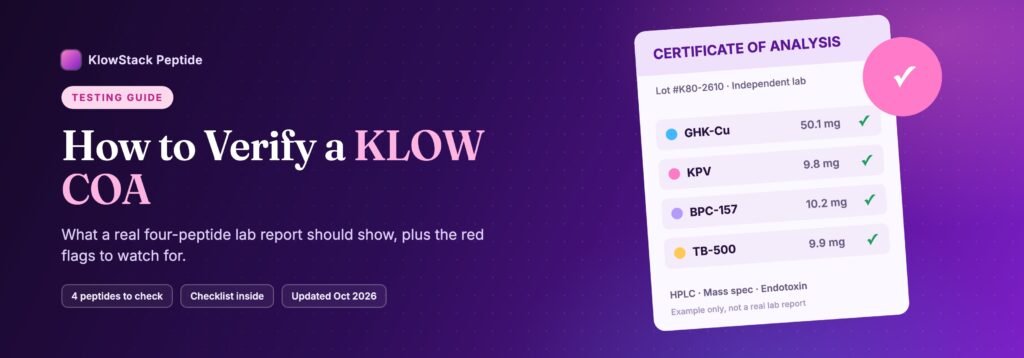
A KLOW COA (certificate of analysis) is a lab report that should confirm the identity and amount of all four peptides in the vial (GHK-Cu, BPC-157, TB-500 and KPV), plus purity and contamination tests. A single “99% purity” figure isn’t enough for a blend.
Search “klow coa” and almost every result is a seller showing off its own paperwork, often with one big purity number at the top. That number looks reassuring, and for a single peptide it can mean a lot. For a four-peptide blend, it answers only part of the question. This guide is the KLOW-specific worked example: the values a real report should show for each ingredient, how to read every section, the red flags unique to this blend, and how to confirm a report came from the lab it names. The general theory of blend testing is covered in our peptide blend COA guide.
A COA checks a product’s quality. It doesn’t make KLOW safe or legal for human use, and KLOW is sold for research use only. See KLOW side effects and our guide to whether research peptides are legal.
What Is a KLOW COA?
A COA is a document from a testing lab showing results for a specific production batch (lot). For KLOW, it should show four separate identity and quantity results, one per peptide, because a blend can be “99% pure” and still be missing an ingredient or be wrongly formulated.
Think of it like the nutrition label on a box of cereal, except that it’s issued by an outside inspector and tied to one production run. The label is only as good as who wrote it and which box they tested.
Who issues it. Some COAs come from the manufacturer’s own lab (in-house). Others come from an independent lab with no stake in the sale (third-party). In-house testing isn’t automatically wrong, but the seller is grading its own homework. Our guide to third-party vs in-house testing covers the tradeoffs.
Lot-specific vs “sample” COAs. A lot-specific COA lists the batch number printed on your vial. A “sample” or “representative” COA is a report from some earlier batch, posted to show what testing looks like. It tells you about that batch, and nothing about yours.
Why blends are harder. Testing one peptide means finding one compound and measuring it. Testing KLOW means separating four compounds of very different sizes, confirming each one’s identity, and measuring each amount. That’s more work, and more room for a lab report to quietly leave something out.
Is KLOW third-party tested? That depends entirely on the specific product and lot. A vendor’s statement that its KLOW is “third-party tested” is a claim. The way to check it is to get the lot-specific report, find the lab on your own, and confirm the report with them, as shown in the step-by-step section below.
What Should Be in a KLOW Vial? Expected Values
A standard KLOW blend vial contains 80 mg: 50 mg GHK-Cu, 10 mg BPC-157, 10 mg TB-500 and 10 mg KPV. In a KLOW stack, the same amounts come in four separate vials, each with its own COA. A valid COA should report each amount close to these figures, along with identity results matching each peptide’s expected molecular weight.
Molecular weight is measured in daltons (Da), and it works like a fingerprint for identity testing. A mass spectrometer weighs molecules, and if the weight it finds matches the expected one, that’s strong evidence the right compound is present. The figures below come from PubChem, the National Institutes of Health’s chemistry database.
| Peptide | Amount | Share of vial | Sequence or formula | Expected molecular weight | Identity test should confirm |
|---|---|---|---|---|---|
| GHK-Cu | 50 mg | 62.5% | Gly-His-Lys + copper(II) | GHK about 340.4 Da; copper complex about 401 to 403 Da depending on form | The GHK peptide, plus copper bound to it |
| BPC-157 | 10 mg | 12.5% | 15 amino acids (C62H98N16O22) | About 1,419.5 Da | The full 15-amino-acid chain |
| TB-500 | 10 mg | 12.5% | Ac-LKKTETQ, 7 amino acids (C38H68N10O14) | About 889.0 Da | The acetylated 7-amino-acid fragment |
| KPV | 10 mg | 12.5% | Lys-Pro-Val (C16H30N4O4) | About 342.4 Da | The three-amino-acid peptide |
Two quirks are worth knowing before you look at a real report. First, GHK and KPV weigh almost the same, about 340 and 342 daltons. A good lab separates them by how they behave in the HPLC column as well as by mass, so the report should show them as two distinct results. Second, GHK-Cu can appear in more than one way. Some labs report the bare GHK peptide mass, since copper can come loose during analysis, while others report the copper complex. Either can be fine, as long as the report says which it measured.
On ingredients, this table is also the short answer to “what’s in KLOW?”: four peptides, in a 5:1:1:1 ratio by weight, with GHK-Cu making up most of the powder. Our guide to what the KLOW stack is explains why it’s built that way.
Other KLOW sizes
Not every KLOW is 80 mg. Some sellers offer a 90 mg version or change the ratio between ingredients. That’s not a problem in itself. The rule is simple: the COA should match whatever the label on your vial claims, ingredient by ingredient. A 90 mg vial with an 80 mg COA, or a label that lists different amounts than the report, is a mismatch worth questioning.
How to Read Each Section of a KLOW COA
Read a KLOW COA in this order: header details (lab, date, lot), identity (mass spec for each peptide), quantity (mg of each), purity (HPLC), then safety tests (endotoxin, sterility, heavy metals). If any section is missing, the COA can’t confirm what’s in your vial.
Header and lot details
Start at the top. You should see the lab’s name and address, a report or sample ID, the test date, the lot number, the client’s name (usually the seller), and a sample description such as “KLOW blend, 80 mg, lyophilized powder.” If the lot number doesn’t match your vial, stop there. Nothing below it describes your product.
Identity: mass spectrometry
Identity answers the most basic question: is each peptide actually there? Mass spectrometry (MS) measures the weight of molecules in the sample, and the report should list an observed mass for each of the four peptides next to the expected value from the table above. Small differences are normal. A missing peptide, or a mass that’s nowhere close, is a problem.
TB-500 needs extra attention. The name gets used loosely, and a vial sold as TB-500 may hold the whole parent protein, thymosin beta-4, a 43-amino-acid protein weighing about 4,963 daltons, or something else entirely. Unless your label says thymosin beta-4, the identity result should match the 7-amino-acid fragment at about 889 daltons, the molecule chemists characterized in 2012. Our TB-500 guide explains the difference.
Quantity or content
Quantity tells you how much of each peptide is in the vial, in milligrams. For KLOW, you want four numbers that land close to 50, 10, 10 and 10. Some reports also give a total, which should land near 80 mg (or whatever your label says).
What counts as close? There’s no single universal tolerance for research peptides, and you’ll see different figures quoted online. The useful move is to ask the lab what tolerance it applies, or check whether the report states one. A result that’s slightly under is common. One peptide coming in at half its labeled amount is a different story.
KLOW purity: HPLC
HPLC (high-performance liquid chromatography) pushes the sample through a column that separates compounds, then draws each one as a peak on a chart. Purity is usually reported as the main peak’s share of the total area, as a percentage.
For a single peptide, “99% pure” means the target compound makes up about 99% of what the instrument saw. For KLOW, it gets murky. A single blend figure might mean all four target peaks together make up 99% of the chart, which says nothing about whether each one is present in the right amount. A strong KLOW COA labels each peptide’s peak and gives a purity figure for each. If you see one number with no breakdown, ask what it represents.
Safety tests
Many KLOW COAs stop at identity and purity, and that’s where some of the most important tests go missing.
- Endotoxin: Usually measured with the LAL test and reported in endotoxin units per milligram (EU/mg). The method is described in USP chapter <85>. Endotoxins are bacterial fragments that can cause fever and flu-like reactions, and a high purity score doesn’t rule them out.
- Sterility: Checks for living microorganisms, following USP chapter <71>. It’s rare on research peptide reports.
- Heavy metals: Copper is expected, because GHK-Cu is a copper complex. Seeing copper isn’t a red flag. Lead, arsenic, mercury or cadmium would be.
If these tests are absent, the COA can confirm what’s in the vial. It can’t say much about whether the contents are clean.
Red Flags on a KLOW COA
Warning signs include a single purity number with no per-peptide results, missing peptides, no lot number or one that doesn’t match your vial, no lab name or report ID, edited or blurry documents, identical results across different lots, and test dates older than the product.
| Red flag | Why it’s a problem | What to do |
|---|---|---|
| One combined purity number | Can’t show whether all four peptides are present in the right amounts | Ask for per-peptide identity and quantity |
| Only three peptides identified | One ingredient may be missing or below detection | Ask why, or treat the vial as unverified |
| TB-500 mass doesn’t match 889 Da | It may be full thymosin beta-4 or a different compound | Compare with the label; ask the lab |
| Amounts don’t add up (an “80 mg” vial with results totaling 65 mg) | Underfilling, or a test of a different product | Ask for the lot-specific report |
| The same COA shown for several products or lots | A reused document describes none of them reliably | Request the report for your lot |
| Only the vendor’s own lab | No independent check | Look for third-party results |
| No endotoxin test | Contamination goes unmeasured | Ask whether one was run |
| Blurry text, mismatched fonts, odd spacing | Possible editing | Verify with the lab directly |
| The lab can’t be found | Possibly a made-up lab | Treat the report as unverified |
| Test date earlier than the lot was made | The report can’t describe this lot | Ask for a current report |
A pattern runs through this table. Most red flags come down to the same issue: the document can’t be tied to your specific vial, or it doesn’t test all four ingredients. If you remember one idea, it’s that a KLOW COA has to cover both your lot and all four peptides.
Can a COA be faked?
Yes. The most common tricks are editing a real PDF (changing a lot number, a date or a purity figure), reusing an old report for new batches, and inventing a lab with a professional-looking letterhead. Editing software makes this easy, and a fake can look perfectly convincing on a phone screen. That’s why the next section beats any visual inspection: the only reliable check is confirming the report with the lab that supposedly issued it.
How to Verify a KLOW COA Is Real: Step by Step
To verify a KLOW COA: match the lot number to your vial, find the testing lab independently (not through the vendor’s link), use the lab’s report lookup or contact it with the report ID, and confirm that the results, date and client match the document you were given.
- Photograph your vial’s lot number. Do it before you misplace the box. Everything else hangs on this one detail.
- Get the lot-specific COA. Ask the seller for the report that matches your lot. A “sample” COA doesn’t count.
- Find the lab yourself. Search for the lab’s name in a fresh browser tab. Look for a real address, contact details and a history. If it claims ISO/IEC 17025 accreditation, the international standard for testing-lab competence, check the accrediting body’s listing.
- Use the lab’s verification tool or email it. Many peptide testing labs offer an online lookup or will confirm a report ID by email. Use the contact details you found on your own, and skip any printed on the PDF.
- Compare every value. Check the lab’s version against your copy, then check both against the expected-values table: four identities, four amounts, purity and any safety tests.
- Keep a copy. Save the PDF and the lab’s confirmation together with your vial photo.
This is the same habit most of us already use with suspicious emails from “your bank”: you don’t click the link in the message, you go to the bank’s site yourself. A KLOW lab test works the same way.
Independent testing labs
Related searches show people looking up Janoshik and other labs that test research peptides. Janoshik reports, for example, carry a task number and a unique key that can be checked on the lab’s own site. Some buyers also send samples to a testing lab themselves, which removes the seller from the process entirely. We don’t rank or recommend labs. Whatever lab you see on a KLOW COA, the same verification steps apply. Our guide to third-party peptide testing explains what independent testing does and doesn’t cover.
What a KLOW COA Can’t Tell You
Even a genuine COA only describes the sample the lab tested, on the test date. It doesn’t guarantee your specific vial is sterile, that it was stored correctly after testing, that the peptides stay stable once mixed, or that KLOW is safe or effective for human use.
A COA is a snapshot, a bit like a home inspection report. It’s valuable, and it describes the house on inspection day. It can’t promise the roof survives next winter.
- Sample vs batch: The lab tested one or a few vials. Others in the same lot are probably similar, but that’s an assumption.
- Shipping and storage: Heat, light and moisture after testing can degrade peptides. Our guide to lyophilized vs pre-mixed peptides covers why the powder form is more stable.
- Stability once mixed: No published data shows how the four peptides hold up together after reconstitution.
- Safety and effectiveness: A perfect COA says nothing about what KLOW does in a body. See KLOW benefits and KLOW side effects.
Researchers who analyzed thousands of independent peptide test results in a 2026 preprint made a similar point: consumer-directed testing improves transparency but covers only a small part of the safety picture.
Is KLOW supposed to be blue?
Yes. The copper in GHK-Cu gives dissolved KLOW a blue tint, the same reason copper sulfate solutions look blue. Color confirms copper is present. It can’t confirm the other three peptides or the amounts.
How long does KLOW last?
Check the COA for a retest or expiry date, if one is given. Stability data for the blend itself haven’t been published, so any shelf-life claim is the seller’s estimate.
KLOW Blend vs KLOW Stack: Which Is Easier to Verify?
A KLOW stack, with each peptide in its own vial, is simpler to verify because each vial has its own single-peptide COA. A KLOW blend, premixed in one vial, needs a blend COA covering all four peptides, which is harder to test and easier to cut corners on.
With a stack, each report has one job: confirm one compound, one amount, one purity. Labs do that kind of testing all the time, and it’s easy to read. A blend report has to do four jobs at once, and a thin report can look complete while skipping one. Stacks come with tradeoffs of their own, including four lot numbers to track and four reports to verify. There’s also a reading advantage. On a single-peptide report, a 99% purity figure means what it says, so the red flag about combined purity numbers mostly disappears. With a blend, you’re relying on the lab to separate four peaks cleanly, including GHK and KPV, which weigh almost the same. Our comparisons of single vial vs kit and KLOW vs buying the peptides separately cover the rest.
Frequently Asked Questions
What should a KLOW COA include?
A KLOW COA should include the lot number, the lab’s name and report ID, mass spec identity for all four peptides, an amount in mg for each, HPLC purity, and ideally endotoxin, sterility and heavy-metal results.
Is KLOW third-party tested?
It depends on the product and lot. Ask for the lot-specific report, find the named lab independently, and confirm the report with them. A seller’s claim alone doesn’t verify third-party testing.
Is “99% purity” good for KLOW?
It’s incomplete. For a four-peptide blend, a single purity number can’t show whether each peptide is present in the right amount. Look for separate results per peptide.
How do I know if a KLOW COA is fake?
Signs include a lot number that doesn’t match, a lab you can’t find, edited-looking text, and identical results across batches. The surest check is confirming the report ID with the lab directly.
What should the molecular weights be?
Roughly 340 Da for GHK (about 401 to 403 with copper), 1,419.5 Da for BPC-157, 889 Da for TB-500 and 342.4 Da for KPV, based on PubChem data.
Why does my KLOW COA show copper?
Because GHK-Cu, KLOW’s largest ingredient, is a copper complex. Copper is expected. Other heavy metals, such as lead or arsenic, would be a concern.
Does a COA prove KLOW is safe?
No. A COA describes a sample’s contents on the test date. It says nothing about safety or effectiveness in humans, and KLOW isn’t approved for human use.
Can I get KLOW tested myself?
Yes. Some buyers send a sample directly to an independent testing lab. Ask the lab whether it can test all four peptides individually, and whether it runs endotoxin tests.
Is KLOW supposed to be blue?
Yes. The copper in GHK-Cu makes it blue. The color doesn’t confirm the other peptides or the amounts.
What’s the difference between an in-house and a third-party COA?
An in-house COA comes from the seller’s own lab. A third-party COA comes from an independent lab with no stake in the sale, which makes it more trustworthy when you can verify it.
Sources
Molecular data (PubChem)
- PubChem: Glycyl-L-histidyl-L-lysine (GHK), CID 73587
- PubChem: GHK-Cu copper complex, CID 139035031
- PubChem: BPC-157, CID 9941957
- PubChem: TB-500 (CAS 885340-08-9), CID 62707662
- PubChem: Lysyl-prolyl-valine (KPV), CID 125672
- PubChem: Thymosin beta-4, CID 45382195
Studies
- Esposito S, et al. 2012. Synthesis and characterization of the N-terminal acetylated 17-23 fragment of thymosin beta 4 identified in TB-500. Drug Testing and Analysis. doi:10.1002/dta.1402
- Mendias CL, Awan TM. 2026. Evaluation of Research Grade Peptides Marketed Directly to Consumers Reveals Extensive Variability in Purity and Measured Abundance. Preprints (not peer-reviewed). doi:10.20944/preprints202604.1748.v1
Testing standards
- United States Pharmacopeia, General Chapter <85> Bacterial Endotoxins Test
- United States Pharmacopeia, General Chapter <71> Sterility Tests
- ISO/IEC 17025: General requirements for the competence of testing and calibration laboratories
Disclaimer: KLOW and its ingredients are sold for research use only and aren’t approved for human use. This guide explains how to read lab documents; it doesn’t recommend any vendor or lab and isn’t medical advice. Read our Medical Disclaimer and Editorial Policy.