
Reviewed by Thomas Okafor, Peptide Chemist · Updated October 2026
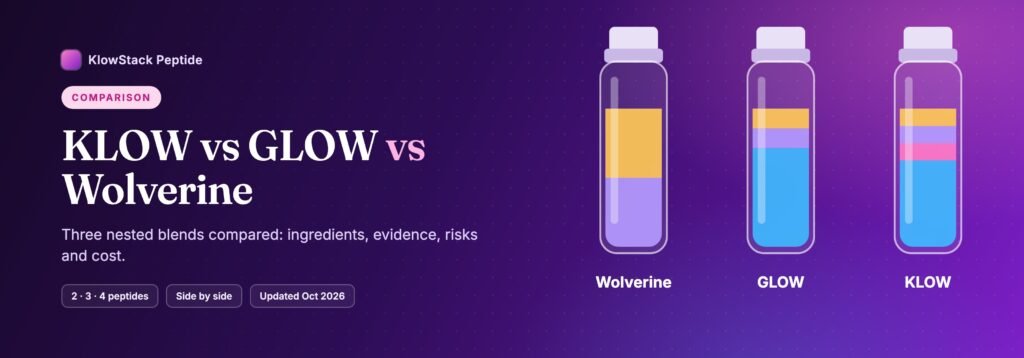
Wolverine, GLOW and KLOW are nested peptide blends. Wolverine is BPC-157 + TB-500; GLOW adds GHK-Cu; KLOW adds KPV on top of GLOW. Each extra peptide targets a different research area (skin and collagen for GHK-Cu, inflammation for KPV), but none of the three blends has been tested in humans.
If you’ve searched glow vs klow vs wolverine, you’ve probably noticed that almost every result is written by someone selling one of them. This comparison is the opposite: no vendor, no “best blend,” just what’s in each vial, what each ingredient has been studied for, and what the evidence can and can’t tell you. Think of it like a burger menu. Wolverine is the hamburger, GLOW is the cheeseburger, and KLOW is the bacon cheeseburger. Same patty in all three. The question is whether the extra toppings are relevant to what you’re studying, and that’s what the sections below sort out, ingredient by ingredient and with the evidence level of each.
No blend is proven better than another. This comparison is for education only, and every blend here carries a research-use-only label, explained in our Medical Disclaimer.
What’s the Difference Between KLOW, GLOW and Wolverine?
The difference is which peptides each one contains. All three share the BPC-157 + TB-500 core. GLOW adds 50 mg of GHK-Cu, a copper peptide studied for collagen and skin. KLOW adds 10 mg of KPV, an alpha-MSH fragment studied for inflammation. Everything else follows from those additions.
That shared core is the important part to grasp. BPC-157 is a 15-amino-acid peptide based on a stomach protein, studied in rats for tendon, ligament and gut repair. TB-500 is a short, seven-unit piece of thymosin beta-4, researched for getting repair cells to an injury. Every claim about “recovery” for any of these three blends traces back to those two ingredients.
That’s also why the three blends share most of their risks and most of their legal story. Change the core and you’d have a different product; change the add-ons and you mostly change the marketing angle and the research areas attached to it.
The additions change the pitch more than the core. GHK-Cu turns a recovery blend into a skin-and-recovery blend, and it’s so dominant by weight that GLOW and KLOW look blue while Wolverine looks like plain white powder. KPV adds an inflammation and gut angle without changing the color or much of the weight.
It helps to picture the three as rungs on one ladder. Each step up keeps everything from the step below and adds exactly one new peptide. Nothing is ever taken away, so KLOW contains every ingredient Wolverine does, plus two more.
Is GLOW the Same as Wolverine?
No. GLOW is Wolverine plus GHK-Cu. The standard GLOW vial holds 50 mg GHK-Cu, 10 mg BPC-157 and 10 mg TB-500, for 70 mg in total. Wolverine has the same two repair peptides and no copper peptide, so its powder is white.
Is KLOW the Same as Wolverine?
No. KLOW is Wolverine plus GHK-Cu and KPV. A standard KLOW blend vial holds 50 mg GHK-Cu and 10 mg each of BPC-157, TB-500 and KPV, for 80 mg. So klow vs wolverine comes down to two extra ingredients and two extra research areas. It also comes down to four times the price at the top end, as the cost section shows.
Side-by-Side Comparison Table
Here’s how the three blends compare on ingredients, typical vial size, research focus, evidence and complexity. Every row is about the blend as sold in October 2026; sizes and prices vary by seller, so check the label and certificate of analysis on the day you compare.
| Wolverine | GLOW | KLOW | |
|---|---|---|---|
| Peptides | 2 | 3 | 4 |
| Typical premixed vial | Commonly 10 + 10 = 20 mg (also 5 + 5 mg) | 70 mg | 80 mg |
| BPC-157 | Usually 10 mg | 10 mg | 10 mg |
| TB-500 | Usually 10 mg | 10 mg | 10 mg |
| GHK-Cu | None | 50 mg | 50 mg |
| KPV | None | None | 10 mg |
| Research focus | Tendon, ligament, muscle repair | Repair plus skin, collagen, hair | Repair, skin, plus inflammation and gut |
| Strongest human evidence of any ingredient | Thymosin beta-4 eye and wound trials (full protein) | Same, plus topical GHK-Cu skin studies | Same as GLOW |
| Human data on the blend | None | None | None |
| Color | Clear or white | Blue | Blue |
| July 2026 FDA panel | Both ingredients recommended | GHK-Cu not reviewed | KPV recommended; GHK-Cu not reviewed |
| WADA | BPC-157 (S0) and TB-500 (S2) banned | Same two banned; GHK-Cu not named | Same two banned; GHK-Cu and KPV not named |
| COA complexity | 2 identities to confirm | 3 | 4 |
| Typical US price (October 2026) | From about $30 to $50 for small vials | About $48 to $158 | About $90 to $180 |
Two rows deserve a closer look. The “strongest human evidence” row shows that the best human data in the whole family belong to full thymosin beta-4 eye drops and topical GHK-Cu creams, neither of which is what’s inside these vials. And the “COA complexity” row shows the hidden cost of more ingredients: every added peptide is one more identity, purity and amount to confirm.
The July 2026 row is worth a second look too. Wolverine is the only one of the three whose ingredients were all reviewed and recommended by the FDA panel. GLOW and KLOW both carry GHK-Cu, which follows a separate, slower path.
What Each Added Peptide Brings
Moving from Wolverine to GLOW adds GHK-Cu, the only ingredient with human skin data (topical). Moving from GLOW to KLOW adds KPV, which has mouse data for gut and skin inflammation. Neither addition has been shown to improve the other peptides’ effects, so each step adds a research area, not proven extra benefit.
The Wolverine Core: BPC-157 + TB-500
The two-peptide core carries the recovery story for all three blends. BPC-157’s research comes mostly from one group in Croatia, with dozens of rat studies on tendons, ligaments, muscle and the gut, and when Case Western researchers systematically reviewed it in 2025, all but one of the 36 qualifying studies were preclinical. TB-500’s evidence is borrowed largely from its parent protein, thymosin beta-4, which has animal wound and heart studies and human eye-drop trials. Because both are WADA-banned and both were part of the July 2026 FDA vote, the core also sets the sporting and legal limits for every blend that contains it. Our Wolverine stack, BPC-157 and TB-500 guides go deeper, and the BPC-157 vs TB-500 comparison sets them side by side.
+ GHK-Cu (GLOW)
The copper-carrying tripeptide GHK-Cu is what gives GLOW its skin and hair marketing. Cream studies in small groups of women reported denser skin and softer lines after about three months of use, as collected in Pickart and Margolina’s 2018 review. That evidence is for creams on skin. Injected GHK-Cu has no trials. In NPR’s September 2026 reporting, a physician described self-injecting patients whose blood copper and liver enzymes climbed. Our GHK-Cu guide covers both sides.
+ KPV (KLOW)
KPV is a three-unit tail clipped from alpha-MSH, a hormone with anti-inflammatory effects. The gut’s PepT1 transporter can carry it into cells, and in mice with colitis, KPV reduced inflammation in studies like Dalmasso and colleagues’ 2008 Gastroenterology paper. There are no published human trials. Our KPV guide walks through each study.
Does Adding More Peptides Mean Better Results?
There’s no evidence it does. No study has compared the three blends, or tested whether the extra ingredients help the core work better. More ingredients means more research areas and also more unknowns. In medicine, combination products are usually approved only after the combination itself is tested, because two compounds can interact in ways neither shows alone.
Which Blend Fits Which Research Question?
Since no blend has head-to-head data, match the question to the ingredient research. Musculoskeletal repair research centers on BPC-157 and TB-500 (Wolverine). Skin and collagen questions add GHK-Cu (GLOW). Inflammation and gut-lining questions add KPV (KLOW).
| Research focus | Relevant ingredients | Blends that contain them | Evidence level |
|---|---|---|---|
| Tendon and ligament | BPC-157, TB-500 | All three | Animal |
| Muscle | BPC-157, TB-500 | All three | Animal |
| Skin | GHK-Cu | GLOW, KLOW | Small topical human studies |
| Hair | GHK-Cu (and Tβ4 in rodents) | GLOW, KLOW | Lab and animal |
| Gut and inflammation | KPV (plus BPC-157 gut work) | KLOW (partly all three) | Mouse |
| General recovery | BPC-157, TB-500 | All three | Animal |
This table is a map of the research and isn’t a recommendation to use any of these products. Anyone thinking about a health problem should talk to a licensed clinician. Proven options such as physical therapy for tendons, or approved treatments for skin and gut conditions, have far more evidence behind them than any of these blends.
Is glow or wolverine peptide better? For repair-focused questions, they carry the same two repair peptides, so neither has an edge on paper. Is KLOW better than GLOW? Only if inflammation or gut research is part of the question; our KLOW vs GLOW comparison covers that in detail. And which peptide is the most effective? Nobody can rank them, because they’ve never been compared in people.
The vendor pages that rank for this search usually answer by goal: Wolverine for injury, GLOW for skin, KLOW for inflammation. That’s a reasonable summary of where each blend’s ingredients point, as long as it’s read as research areas and not as promised results.
Is GLOW Better Than Wolverine for Tendons?
A popular Reddit thread asks this, pointing out that tendons are made mostly of collagen. It’s a smart question. Tendons are built largely from type I collagen, and GHK-Cu is studied for collagen. The catch is that GHK-Cu’s collagen data come from skin, mostly from creams. Nobody has tested whether it does anything for tendons, so there’s no evidence GLOW beats Wolverine there. Tendon collagen also turns over far more slowly than skin collagen, which is part of why tendon injuries take so long to heal.
Evidence Compared: What’s Proven for Each Blend?
None of the three blends has been studied in humans. Evidence exists only for individual ingredients, mostly in animals. Adding peptides doesn’t add proof: KLOW has more ingredients with some research, but it isn’t better-studied as a product than Wolverine.
| Ingredient | Best evidence | Label (our Editorial Policy) |
|---|---|---|
| BPC-157 | Rat tendon, gut and blood-vessel studies; 3 tiny human pilots | Animal |
| TB-500 | Thymosin beta-4 animal studies; Tβ4 eye-drop trials in people (full protein) | Animal (fragment) |
| GHK-Cu | Small topical human skin studies | Early human (topical only) |
| KPV | Mouse colitis studies; cell work | Animal |
It’s tempting to think a blend with four researched ingredients must be better supported than one with two. Vendors sometimes lean on that impression with phrases like “the most complete blend.” That’s like assuming a recipe is tested because each ingredient is. The ingredients have research; the recipes don’t. There’s also a quality difference hidden in that table. BPC-157’s research comes mainly from one lab group, KPV’s mostly from one US research family, and GHK-Cu’s human data mostly from cosmetic studies. Independent replication is thin across the board. Our Editorial Policy defines each label.
Side Effects and Risks Compared
Every blend carries the shared unknowns of BPC-157 and TB-500 (no human safety data, angiogenesis and cancer questions, product purity). GLOW adds copper-load questions from GHK-Cu. KLOW adds KPV’s unknowns. More ingredients means more to verify and more variables if a reaction occurs.
| Blend | Added risk | Verification burden |
|---|---|---|
| Wolverine | Shared core unknowns: blood-vessel growth and the cancer question, no human safety data | 2 peptides to confirm |
| GLOW | Copper load from 50 mg of GHK-Cu | 3 peptides to confirm |
| KLOW | KPV’s unknown human safety, on top of GLOW’s | 4 peptides to confirm |
Two more issues apply to the copper blends. A widely shared Reddit claim says GHK-Cu degrades BPC-157 and TB-500 once the powder is dissolved. No published stability study has tested it, either way, so it’s an open question. And sterility is the same concern for all three: any vial made outside pharmaceutical conditions carries an infection risk.
When something goes wrong, more ingredients also make it harder to know why, for the person and for any doctor they see. If a reaction happens with Wolverine, there are two suspects. With KLOW, there are four. Online self-reports of side effects for all three include injection-site redness, fatigue and headaches, none of them measured in a study.
Some groups have reasons for extra caution with any of the three: people who are pregnant or nursing, anyone with a cancer history, athletes in tested sports, minors, and, for GLOW and KLOW, anyone with a copper-handling disorder such as Wilson’s disease.
Cost Compared: Premixed vs Separate Vials
In October 2026, US research-vendor prices run roughly 30–50 for a Wolverine vial, 48–158 for 70 mg GLOW and similar or higher for 80 mg KLOW. Compare cost per milligram of each peptide, not per vial, and check that the COA covers every ingredient.
| Blend | Price range (US listings, October 2026) | Total mg | Approximate cost per mg of powder |
|---|---|---|---|
| Wolverine | From about $30 to $50 | Varies (5 + 5 or 10 + 10 mg) | Depends on size; often the highest per mg |
| GLOW | About $48 to $158 | 70 mg | About $0.70 to $2.25 |
| KLOW | About $90 to $180 | 80 mg | About $1.10 to $2.25 |
Per milligram of powder, the copper blends can look cheap, but most of that powder is GHK-Cu. If the research question is about the repair core, the more useful number is what you pay per milligram of BPC-157 and TB-500. In a standard GLOW or KLOW vial, those two make up only 20 mg of the 70 or 80. A 20 mg Wolverine vial holds the same 20 mg of repair peptides with nothing else, which is why its price per milligram looks high but its price per milligram of BPC-157 and TB-500 can be competitive.
Kits and multi-vial bundles add another layer, since a KLOW stack of four separate vials can cost more than a premixed KLOW blend while giving four separate COAs.
Premixed blends and separate-vial stacks each have a trade-off. A premixed vial is convenient, with one label and one lot number, though its single COA has to work harder to prove every ingredient is there. Separate vials cost more and take more handling, and each comes with its own COA, which makes every ingredient easier to verify. One vendor claims a premixed GLOW saves about 20% over buying the three separately, a figure worth checking against current prices. Those numbers are worked through on our KLOW vs buying separately page. For reading the reports themselves, use our guide on how to verify a peptide COA.
Legal Status of Each Blend
None of the blends is FDA-approved. In July 2026 the FDA’s compounding panel voted for BPC-157, TB-500 and KPV, but GHK-Cu wasn’t reviewed. So Wolverine’s ingredients are furthest along, while GLOW and KLOW include an unreviewed injectable ingredient. BPC-157 and TB-500 are banned by WADA in all three.
| Ingredient | FDA (October 2026) | July 2026 panel | WADA |
|---|---|---|---|
| BPC-157 | Not approved; off Category 2 since April 2026 | Recommended (8–6) | Banned, S0 |
| TB-500 | Not approved; off Category 2 since April 2026 | Recommended (8–6) | Banned, S2 |
| GHK-Cu | Not approved as a drug; injectable nomination withdrawn; FDA review planned by February 2027 | Not on the agenda | Not named |
| KPV | Not approved; off Category 2 since April 2026 | Recommended (8–6) | Not named; S0 covers unapproved substances |
The peptides under review are named on the FDA’s agenda for its July 2026 meeting, and AJMC reported that the votes are advisory, with rulemaking still to come. GHK-Cu’s status comes from the FDA’s bulk-substances list updated May 14, 2026.
Neither GHK-Cu nor KPV appears by name on the WADA Prohibited List, though WADA’s S0 class catches substances without government approval for human use. For a tested athlete, the named BPC-157 and TB-500 bans settle it for every blend. A compounded version wouldn’t change that either; WADA rules apply regardless of how a product is made or prescribed. Status checked October 5, 2026. Broader US rules are in our peptide legality guide.
Frequently Asked Questions
Is GLOW the same as Wolverine?
No. GLOW is Wolverine (BPC-157 and TB-500) plus 50 mg of GHK-Cu, a copper peptide studied for skin. GLOW is blue and 70 mg; Wolverine is usually clear.
Is KLOW the same as Wolverine?
No. KLOW is Wolverine plus GHK-Cu and KPV, for four peptides and 80 mg in a standard vial. It adds skin and inflammation research areas to the repair core.
Is GLOW or Wolverine better?
Neither has human data, so neither is proven better. Both carry the same BPC-157 and TB-500, usually 10 mg of each. GLOW adds GHK-Cu, whose evidence is for skin, mostly from topical creams.
Is KLOW better than GLOW?
Not on evidence. KLOW is GLOW plus 10 mg of KPV, studied in mice for gut inflammation, and it usually costs about $30 to $50 more. If inflammation research isn’t part of the question, the two are otherwise identical.
What does the Wolverine peptide do?
In animal studies, BPC-157 supports blood supply and tissue repair, and thymosin beta-4, TB-500’s parent protein, helps cells move into injuries. What the pair does in people hasn’t been tested.
Does KLOW give you energy?
There’s no evidence it does. None of KLOW’s four ingredients has been studied for energy, and no human study of the blend exists. Online reports of more energy are personal accounts.
Which blend is cheapest per peptide?
Per milligram of powder, GLOW and KLOW often look cheapest, but most of their weight is GHK-Cu. Per milligram of BPC-157 and TB-500, the answer depends on each seller’s prices.
Can GHK-Cu damage BPC-157 and TB-500 in a blend?
Nobody knows. The claim is popular on Reddit, but stability in a dissolved copper blend has never been measured in a published study.
Which blend is the most studied?
No blend in the family has its own study. KLOW has the most researched ingredients, but that doesn’t make the KLOW product better studied than Wolverine.
Are any of these blends legal in 2026?
None is FDA-approved. BPC-157, TB-500 and KPV won a July 2026 advisory vote, and GHK-Cu wasn’t reviewed. All three blends are sold as research use only while rulemaking continues.
Sources
Studies and reviews
- Vasireddi N, et al. 2025. Emerging Use of BPC-157 in Orthopaedic Sports Medicine: A Systematic Review. HSS Journal. doi:10.1177/15563316251355551
- Goldstein AL, et al. 2012. Thymosin β4: a multi-functional regenerative peptide. Expert Opinion on Biological Therapy. doi:10.1517/14712598.2012.634793
- Pickart L, Margolina A. 2018. Regenerative and Protective Actions of the GHK-Cu Peptide in the Light of the New Gene Data. International Journal of Molecular Sciences. doi:10.3390/ijms19071987
- Dalmasso G, et al. 2008. PepT1-Mediated Tripeptide KPV Uptake Reduces Intestinal Inflammation. Gastroenterology. doi:10.1053/j.gastro.2007.10.026
Regulatory
- FDA: July 23-24, 2026 Meeting of the Pharmacy Compounding Advisory Committee
- FDA: Bulk Drug Substances Nominated for Use in Compounding Under Section 503A (updated May 14, 2026)
- AJMC: FDA Panel Backs 6 Peptides for Compounding
- WADA Prohibited List
Price listings: US research-vendor listings, October 2026 (from the brief’s October 4–5 check).
Disclaimer: Wolverine, GLOW, KLOW and their ingredients carry a research-use-only label and aren’t approved for human use. This comparison is educational and doesn’t give medical advice. Read our Medical Disclaimer and Editorial Policy.