Reviewed by Thomas Okafor, Peptide Chemist · Updated October 2026
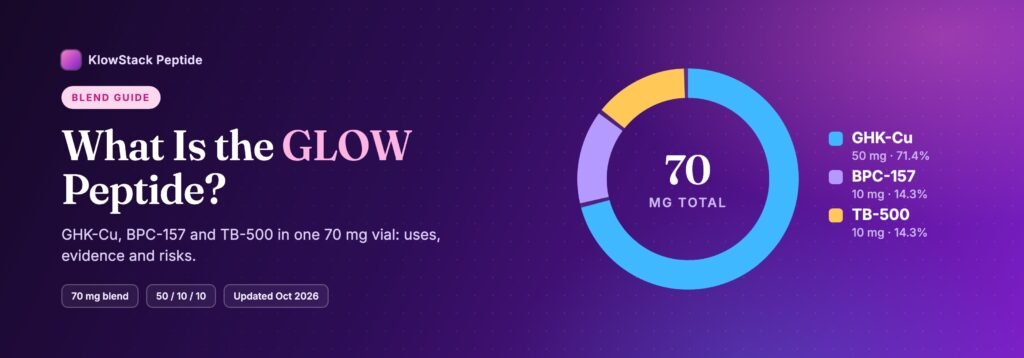
GLOW is a three-peptide blend (GHK-Cu, BPC-157 and TB-500) sold in one vial, usually 70 mg (50 mg GHK-Cu, 10 mg BPC-157, 10 mg TB-500). It’s marketed for skin, collagen and recovery, but the combination itself has never been studied in humans. Everything known about it is built from separate studies of each ingredient.
Search “glow peptide” and you’ll find a peptide brand, a Sephora moisturizer, clinic menus and dozens of vials priced anywhere from about $48 to $158. It’s a lot of noise for one small vial of blue powder. Here we untangle what the GLOW peptide blend actually contains, why it’s built the way it is, what each ingredient has been tested for, the real risks, and how its legal status looks in late 2026.
None of this is medical advice. GLOW is sold for research use only, a label our Medical Disclaimer explains.
What Is the GLOW Peptide Blend?
GLOW combines three peptides that are each studied for repair: GHK-Cu (a copper peptide linked to collagen), BPC-157 (studied for tissue and gut repair) and TB-500 (a thymosin beta-4 fragment linked to cell migration). It’s usually sold premixed as a freeze-dried powder in a single vial, the GLOW blend. Bought as three separate vials in one bundle, it’s called the glow stack or glow peptide stack.
The name is pure marketing, and pretty good marketing at that. “Glow” is the word the beauty industry uses for healthy-looking skin, and the blend leans hard on the copper peptide’s skincare reputation. So what is the GLOW peptide in practice? A repair blend dressed up for the skincare crowd.
GLOW grew out of the clinic and biohacker habit of “stacking” peptides, which took off around 2024 and 2025. People could skip buying BPC-157, TB-500 and GHK-Cu as three products and get one premixed vial, and sellers gave the mix a catchy name. It has since become one of the most searched peptide blends in the US. The convenience is real: one vial, one label and, ideally, one certificate of analysis covering everything inside.
You’ll notice the powder is blue. That’s the copper in GHK-Cu, which makes up most of the vial. The color is a quick visual tell that copper is present, and nothing more.
GLOW Peptide vs “Glow Peptides” vs Glow Skincare
Three different things share the name, which can make shopping confusing. The GLOW blend is a recipe that many suppliers sell, so it isn’t one brand, even though a company called Glow Peptides ranks first for the search. It’s also unrelated to Glow Recipe, the skincare line at Sephora, and to topical serums that advertise a “peptide glow.”
When people ask “what is the peptide that makes you glow?”, they usually mean GHK-Cu, the copper peptide found in many serums. It’s the ingredient doing most of the “glow” work in the blend too.
What’s in the GLOW Peptide?
A standard GLOW vial holds 70 mg: 50 mg GHK-Cu (about 71%), 10 mg BPC-157 (about 14%) and 10 mg TB-500 (about 14%). GHK-Cu dominates because the blend is built around skin and collagen; BPC-157 and TB-500 are added for repair and recovery, the same pair that makes up the Wolverine blend.
| Peptide | mg per vial | Share | What it’s studied for | Evidence level | Our guide |
|---|---|---|---|---|---|
| GHK-Cu | 50 mg | 71% | Skin, collagen, wound healing | Small topical human studies; otherwise preclinical | GHK-Cu |
| BPC-157 | 10 mg | 14% | Tendon, tissue and gut repair | Animal, plus 3 tiny human pilots | BPC-157 |
| TB-500 | 10 mg | 14% | Cell migration | Animal; its parent protein has some human trials | TB-500 |
Why is GLOW mostly GHK-Cu? No published study set the 50/10/10 ratio. It appears to have spread from early sellers and stuck, and it fits the blend’s skin-first marketing. The heavy copper-peptide share is also what makes GLOW look so blue next to a Wolverine vial, which is clear.
GHK-Cu: The “Glow” Part
GHK-Cu is a three-amino-acid peptide that carries copper, and your body makes it naturally. Small human studies of GHK-Cu creams found firmer skin, better density and softer fine lines over 8 to 12 weeks, as Pickart and Margolina summarized in 2018. That’s the evidence behind GLOW’s skin marketing, and it comes from creams.
BPC-157: The Repair Part
BPC-157 is a lab-made chain of 15 amino acids, modeled on a stomach protein. It’s studied mostly in rats for tendon, ligament and gut repair, with a strong focus on new blood-vessel growth. A 2025 HSS Journal systematic review found 35 of 36 qualifying studies were preclinical.
TB-500: The Recovery Part
TB-500 is a seven-amino-acid fragment of thymosin beta-4, a protein that guides cells toward injuries. Its parent protein has animal wound and heart studies plus human eye-drop trials. The fragment itself, as identified by Esposito and colleagues in 2012, hasn’t been tested in people. Some vials sold as TB-500 actually contain the full 43-amino-acid protein, which is one more reason a GLOW COA should confirm each ingredient’s identity by mass.
Other GLOW Versions
Not every vial labeled GLOW follows the 50/10/10 recipe. Some sellers use 30 mg GHK-Cu with 20 mg each of BPC-157 and TB-500, and others sell different total sizes. Always read the label’s per-peptide amounts and check the COA, since the name alone doesn’t tell you the recipe.
What does the glow peptide mix do, then? On paper, it combines one ingredient studied for skin with two studied for repair. What the three do together in people is still an open question.
What Is the GLOW Peptide Used For?
GLOW is marketed for skin quality (firmness, fine lines, texture), hair, and faster recovery from workouts or injuries. Those claims are borrowed from research on each peptide alone. Only GHK-Cu has human skin data, and that’s for topical use, not injection.
Skin and Collagen
This is GLOW’s headline use. The human evidence comes from topical GHK-Cu: 12-week cream studies in women with sun-damaged skin, plus a randomized 8-week wrinkle study comparing GHK-Cu with Matrixyl 3000. Those results are real and modest.
What’s missing is any study of GHK-Cu given by injection, alone or in a blend. Skin cells reached by a cream and by a needle under the skin aren’t in the same place, and the amount of copper involved is very different. The topical studies are laid out in our GHK-Cu for skin guide.
Recovery and Tissue Repair
BPC-157 and TB-500 bring the recovery story. Both have plenty of animal work on tendons, ligaments, muscle and wounds, and none of it has been confirmed by controlled trials in people. The 2026 American Journal of Sports Medicine primer by USC orthopedic surgeons summed up the state of play: encouraging preclinical results, with human orthopedic data still lacking. The Wolverine stack page covers this pair on its own.
Hair
GLOW gets mentioned in hair-loss forums because two of its ingredients have hair research. GHK-Cu appears in many hair serums based on lab and early follicle studies, and full thymosin beta-4 stimulated hair growth in rodents. Neither has human evidence for hair as an injected blend. Forum posts about hair often involve people using several products at once, such as minoxidil or finasteride alongside GLOW, which makes it impossible to credit any single one.
What GLOW Hasn’t Been Shown to Do
GLOW hasn’t been shown to “reset” aging, produce a whole-body glow, burn fat or speed up recovery in people. Those claims take findings from creams, rats and lab dishes and apply them to a blend nobody has tested. Some aesthetic clinics also offer GLOW after cosmetic procedures, pitching it as a recovery aid. That use rests on the same borrowed ingredient research, with no study of the blend after any procedure. Our GLOW benefits page sorts each claim by evidence level.
Does the GLOW Peptide Actually Work?
No one knows yet. There are no published human studies of GLOW as a blend, and no data showing the three peptides work better together than alone. Positive reports come from users and clinics, which can’t separate real effects from placebo, other treatments or natural healing.
| Claim | Best evidence | Level |
|---|---|---|
| Better skin | Topical GHK-Cu cream studies | Small human studies, topical only |
| Faster recovery | BPC-157 and TB-500 animal studies | Preclinical |
| Hair growth | GHK-Cu lab work; thymosin beta-4 rodent studies | Early and preclinical |
| The blend as a whole | None | No studies |
Does the glow stack really work? For the premixed GLOW blend, the question has a second layer that most pages skip: stability. A popular Reddit claim says GHK-Cu’s copper degrades the other two peptides once the powder is dissolved. Copper is chemically reactive with certain amino acids, which makes the worry plausible. No published stability study has tested it, in either direction, so the claim stays unproven.
What would a real answer look like? A placebo-controlled trial, with people randomly assigned to GLOW or a dummy injection, skin measured by imaging instruments, and neither the participants nor the assessors knowing who got which. That kind of study is what separates a product that works from one that just feels like it works.
About “Before and After” Photos
You’ll see dramatic before-and-after shots on social media and clinic pages. Anyone who’s spent five minutes on Instagram knows how much lighting, angle, makeup, hydration and filters can change a face. Photos also can’t separate the blend from a new skincare routine, a better night’s sleep or a few months of time. KlowStack doesn’t publish result photos for that reason. Our GLOW before and after page explains what research-grade evidence would look like instead.
How Long Does the GLOW Peptide Take to Work?
There’s no research-based timeline for GLOW. Topical GHK-Cu studies measured skin changes at 8–12 weeks, but injected blends haven’t been studied, so claims of results in 2 or 4 weeks are anecdotal. Skin also renews itself slowly, which makes quick results unlikely to mean much.
People also ask how often GLOW peptides are injected. We don’t publish dosing, injection frequency or protocols for any research compound, and no human study exists to base one on. The schedules circulating online come from vendors and forums. For topical GHK-Cu products, follow the product’s own directions.
It helps to know the skin’s own clock. The outer layer of skin turns over roughly every month, and collagen changes deeper down take longer, which is why the cream studies ran for two to three months. Any change someone notices in the first week or two is more likely to come from hydration, a new routine or simple expectation than from collagen remodeling.
GLOW Peptide Side Effects and Risks
GLOW’s safety as a blend is unknown. Each peptide lacks long-term human safety data. Reported issues include injection-site reactions, redness, fatigue and headaches, plus serious risks from contaminated or mislabeled research products. Each ingredient also brings its own open questions.
Here’s how the risks break down by ingredient:
- GHK-Cu and copper: GLOW’s biggest ingredient carries copper, and too much copper builds up in the liver. In NPR’s September 2026 reporting, a physician described patients who self-injected copper peptides and developed high copper levels and raised liver enzymes.
- BPC-157 and TB-500 and growth signals: both are studied for new blood-vessel growth and cell movement. That’s helpful for healing and a theoretical concern for anyone with a tumor, since cancers also need blood vessels.
- Product quality: research vials may be underdosed, mislabeled, contaminated with bacterial toxins or missing an ingredient. A three-peptide vial has three chances for an error.
- Sterility: injecting anything that wasn’t made under pharmaceutical conditions risks infection.
- Unknown interactions: nobody has studied how the three peptides behave together in the body, or alongside common medicines.
Online self-reports also mention redness and itching where people injected, tiredness and headaches. A psoriasis support group asked whether GLOW triggered an inflammation flare. There’s no data either way. Since BPC-157 and GHK-Cu are both studied for calming inflammation in animals, a flare would be surprising, and it still can’t be ruled out without a study.
Cons of Glow Peptides
- No human study of the blend exists.
- Products are unregulated and often unverified.
- Vials and clinic programs aren’t cheap.
- The legal status is a gray area that’s still shifting.
- Two ingredients are banned in sport: BPC-157 under WADA’s S0 and TB-500 under S2.
Who Should Avoid GLOW
People with extra reasons to avoid GLOW include those who are pregnant or nursing, people with current or past cancer, people with copper-metabolism disorders such as Wilson’s disease, competitive athletes subject to testing, and anyone under 18. Check with a doctor who knows your history before anything else. More detail on each risk is on our GLOW side effects page.
Is the GLOW Peptide Legal?
GLOW isn’t FDA-approved and is sold as “research use only”. In 2026 its parts stand differently: BPC-157 and TB-500 left Category 2 in April and got a favorable advisory vote on 23 July. GHK-Cu wasn’t on that agenda, and topical GHK-Cu creams are legal cosmetics.
| Ingredient | FDA status (October 2026) | July 2026 advisory vote | WADA |
|---|---|---|---|
| GHK-Cu | Not approved as a drug; injectable nomination withdrawn; non-injectable under evaluation | Not on the agenda | Not named |
| BPC-157 | Not approved; off Category 2 since April 2026 | Recommended, 8–6 | Banned (S0) |
| TB-500 | Not approved; off Category 2 since April 2026 | Recommended, 8–6 | Banned (S2) |
BPC-157 and TB-500 appear on the agenda of the FDA’s July 2026 advisory meeting; GHK-Cu doesn’t. According to the FDA’s May 2026 bulk-substances list, the agency intends to bring GHK-Cu before its compounding advisers by February 2027. AJMC reported that the July votes are advisory and rulemaking still has to follow.
There’s an extra wrinkle for a premixed blend. Compounding rules apply ingredient by ingredient, so a compounded GLOW would need every one of its three ingredients to be eligible. Even if BPC-157 and TB-500 clear rulemaking, GHK-Cu’s injectable status would still hold the blend back. Topical GHK-Cu, meanwhile, is sold legally in cosmetics, a point some clinic doctors make when they say it’s “already legal in cream form.” Status checked October 5, 2026. The wider rules are in our peptide legality guide.
GLOW vs KLOW: What’s the Difference?
KLOW is GLOW plus a fourth peptide, KPV, which is studied for inflammation. A standard KLOW blend vial is 80 mg (50 / 10 / 10 / 10); GLOW is 70 mg. GLOW is pitched more for skin, KLOW for skin plus inflammation and gut. Everything else in the two vials is identical.
| GLOW | KLOW | |
|---|---|---|
| Peptides | GHK-Cu, BPC-157, TB-500 | GHK-Cu, BPC-157, TB-500, KPV |
| Standard vial | 70 mg (50 / 10 / 10) | 80 mg (50 / 10 / 10 / 10) |
| Pitch | Skin, hair, recovery | Skin, recovery, plus inflammation and gut |
| Price range (US, October 2026) | About $48 to $158 | About $90 to $180 |
| Evidence | Ingredient studies only | Ingredient studies only, plus KPV mouse work |
KPV, a tiny piece of the hormone alpha-MSH, is studied in mice for calming gut inflammation. It was also part of the July 2026 FDA vote, which GHK-Cu wasn’t. If those research areas aren’t part of the question, GLOW covers the same ground for less. The cost gap between the two usually runs about $30 to $50 per vial at the same seller, almost all of it for KPV.
One practical difference is the paperwork. A KLOW certificate has four ingredients to verify against GLOW’s three, so a complete KLOW report is longer and, done properly, costs the seller more to produce.
Our KLOW stack guide, the full KLOW vs GLOW comparison and the KPV guide go deeper.
GLOW vs Other Options: NAD+, GHK-Cu Alone and Topical Serums
NAD+ is a coenzyme involved in cell energy, not a peptide, and it’s promoted for different reasons. GHK-Cu alone gives the main “glow” ingredient without BPC-157 and TB-500. Topical copper-peptide serums are the only option with human skin data and legal cosmetic status.
| Option | What it is | Evidence | Legal status |
|---|---|---|---|
| GLOW blend | Three-peptide research vial | Ingredient studies only | Research use only |
| NAD+ | Coenzyme used in cell energy, often given as an IV drip | Studied for aging and metabolism; mixed human data | Sold as a supplement or through clinics |
| GHK-Cu alone | The copper peptide by itself | Topical human studies; no injection trials | Cosmetic in creams; research vials otherwise |
| Copper peptide serum | Topical skincare with copper tripeptide-1 | Small human skin studies | Legal cosmetic |
NAD+ shows up in this conversation because it’s the other big “wellness” injection trend, the drip you may have seen celebrities post about. It works on a completely different system from GLOW, supporting the chemical reactions cells use to make energy. Comparing the two is a bit like comparing a car’s fuel with its body shop work: both relate to how the car runs, in very different ways.
GHK-Cu on its own is the simpler choice for skin-focused research. It removes two ingredients, two sets of COA results and both WADA-banned compounds, while keeping the one ingredient with human skin data.
Topical serums go one step further. They’re the only option in this table with both human skin studies and clear legal status, and they cost far less than a research vial. The trade-off is reach: a cream acts on the skin it touches, which is exactly where the skin research was done. Our GHK-Cu guide and our injectable vs topical GHK-Cu page explain why the serum route has the strongest evidence.
How Much Does GLOW Cost, and How Do You Check Quality?
In October 2026, US listings for a 70 mg GLOW vial range from about $48 to $158, and clinic programs cost far more. Price says little about quality: look for a recent third-party COA showing all three peptides’ identity and amounts, plus endotoxin and sterility testing.
A solid GLOW certificate of analysis should show:
- ☐ HPLC purity and mass spec identity for each of the three peptides
- ☐ Measured amounts that match the label’s 50 / 10 / 10 (or whatever recipe is listed)
- ☐ A batch number that matches your vial
- ☐ The testing lab’s name and a test date
- ☐ Endotoxin and sterility results
Some sellers also offer a “GLOW pen,” a pre-filled pen version of the blend. It’s a different package, and it isn’t more regulated, tested or approved than a vial. The same COA questions apply.
Price tends to track three things: how much testing a seller pays for, whether the product is a single premixed vial (a blend) or a set of separate vials (a stack), and whether a clinic visit is bundled in. A very cheap vial isn’t automatically bad, and a pricey one isn’t automatically good; the COA is what tells them apart.
We don’t recommend vendors, and we don’t publish dosing. Line-by-line help is in our guide on how to verify a peptide COA, and our peptide blends hub places GLOW within the wider family.
Frequently Asked Questions
Do glow peptides actually work?
Nobody knows, because the GLOW blend has never been studied in people. Its ingredients have promising lab, animal and topical skin research, and that’s where the claims come from. A blend trial would be needed to answer the question.
What does the glow peptide mix do?
On paper, GLOW combines a copper peptide studied for skin and collagen with two peptides studied for tissue repair. What the three do together in people hasn’t been tested.
What’s in GLOW peptide?
A standard GLOW vial holds 70 mg: 50 mg GHK-Cu, 10 mg BPC-157 and 10 mg TB-500. Some sellers use a 30/20/20 recipe, so the label and COA deserve a close read.
What are the cons of glow peptides?
There’s no human data on the blend, products are unregulated, costs add up, the legal status is unsettled, and two ingredients are banned in sport. Quality also varies widely, since many vials ship without a full per-peptide COA.
How long does it take for GLOW to work?
There’s no research-based timeline. Topical GHK-Cu studies measured skin changes at 8 to 12 weeks; injected GLOW hasn’t been studied, so faster claims are anecdotal.
What’s the difference between GLOW and KLOW?
KLOW is GLOW plus 10 mg of KPV, a peptide studied for inflammation. GLOW is 70 mg with three peptides; KLOW is 80 mg with four. For skin, hair or tendon research questions, the two are effectively the same blend.
What’s the difference between NAD+ and GLOW?
NAD+ is a coenzyme involved in cell energy, often sold as an IV drip. GLOW is a blend of three repair peptides. They work on different systems and have different evidence, so one isn’t a substitute for the other.
What is the peptide that makes you glow?
People usually mean GHK-Cu, the copper peptide in many serums. It has small human studies for firmness and fine lines when applied to skin.
Is GLOW peptide legal?
GLOW isn’t FDA-approved and is sold as research use only. Two ingredients got a favorable FDA panel vote in July 2026; GHK-Cu wasn’t reviewed, so the blend’s status is unsettled. Topical GHK-Cu creams are legal cosmetics.
Why is GLOW peptide blue?
The blue tint comes from copper, carried by GHK-Cu, the biggest ingredient in the vial. It confirms copper is there and tells you nothing about purity.
Is a GLOW pen different from a vial?
A GLOW pen is a pre-filled package of the same blend. It isn’t more regulated or tested than a vial, so the same COA checks apply, including identity, purity and amount for each of the three peptides.
Can you use GLOW topically?
GLOW research vials aren’t made for skin. Topical copper peptide serums, which contain GHK-Cu as copper tripeptide-1, are the products designed and studied for skin, and they’re sold legally as cosmetics.
Sources
Studies and reviews
- Pickart L, Margolina A. 2018. Regenerative and Protective Actions of the GHK-Cu Peptide in the Light of the New Gene Data. International Journal of Molecular Sciences. doi:10.3390/ijms19071987
- Vasireddi N, et al. 2025. Emerging Use of BPC-157 in Orthopaedic Sports Medicine: A Systematic Review. HSS Journal. doi:10.1177/15563316251355551
- Esposito S, et al. 2012. Synthesis and characterization of the N-terminal acetylated 17-23 fragment of thymosin beta 4 identified in TB-500. Drug Testing and Analysis. doi:10.1002/dta.1402
- Goldstein AL, et al. 2012. Thymosin β4: a multi-functional regenerative peptide. Expert Opinion on Biological Therapy. doi:10.1517/14712598.2012.634793
- Mayfield CK, et al. 2026. Injectable Peptide Therapy: A Primer for Orthopaedic and Sports Medicine Physicians. American Journal of Sports Medicine. doi:10.1177/03635465251357593
News
Regulatory
Disclaimer: GLOW and its ingredients are sold for research use only and aren’t approved for human use. This guide is educational and doesn’t give medical advice. Read our Medical Disclaimer and Editorial Policy.