
Reviewed by Thomas Okafor, Peptide Chemist · Updated October 2026
The Wolverine stack is a nickname for using two experimental peptides together, BPC-157 and TB-500, to try to speed up injury recovery. It takes its name from the Marvel hero with a near-instant healing power. Neither peptide is FDA-approved, and the combination has never been tested in a human trial.
The nickname has gone mainstream in 2026. In September, Reuters reported on a study of more than 15 million US medical records that found documented use of BPC-157, the stack’s best-known half, had risen 33-fold since 2020. Below, we explain what’s actually in the Wolverine stack, what each peptide has been tested for, what the evidence says about the pair, the risks, and the legal picture as of October 2026.
Nothing here is medical advice. Both peptides carry a research-use-only label, which our Medical Disclaimer explains.
What Is the Wolverine Stack?
The Wolverine stack is not a product or a medical protocol. It’s a marketing name for combining BPC-157 and TB-500, two lab-made peptides each studied in animals for tissue repair. The idea started in horse racing and bodybuilding and spread through biohacking and clinics in the 2020s.
The name is a nod to the X-Men’s Wolverine, whose superpower is healing from almost anything. That tells you how the stack is pitched: as a shortcut back from injury. McGill University’s Office for Science and Society, which explains science to the public, has written about the trend and noted that the two peptides are usually bought on a “gray” market, often from overseas producers.
The path to popularity runs through some unexpected places. TB-500 was first sold for racehorses, BPC-157 picked up a following among bodybuilders, and wellness clinics and social media did the rest. Podcasts and short videos turned the pairing into one of the most talked-about wolverine peptide combinations in the US. Today you’ll find it sold three ways: as research vials, as clinic “healing protocols” with monthly fees, and as capsules marketed online, each with very different oversight.
What no regulator, pharmacopoeia or medical society has done is define it. There’s no official recipe, no approved product and no standard amount, which is unusual for something so widely discussed. That means the “Wolverine stack” can mean slightly different things depending on who’s selling it.
What Is in a Wolverine Stack?
The standard Wolverine stack is BPC-157 plus TB-500, usually in equal amounts. Some sellers offer two separate vials, often 5 mg each; others combine 10 mg of each in a single 20 mg vial.
Variations exist. One clinic defines its version as four peptides, adding the growth-hormone secretagogues CJC-1295 and Ipamorelin. Add GHK-Cu to the original pair and you’ve made GLOW instead. Because the name isn’t standardized, the label and certificate of analysis are the only reliable guide to what’s inside.
What Do BPC-157 and TB-500 Each Do?
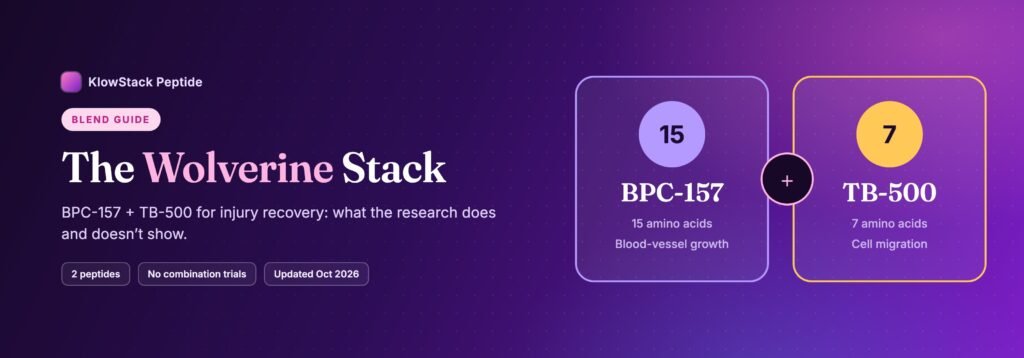
BPC-157 is a 15-amino-acid peptide based on a protein in stomach juice, studied in animals for tendon, ligament, muscle and gut repair, largely through blood-vessel growth. TB-500 is a 7-amino-acid fragment of thymosin beta-4, studied for helping cells migrate into injured tissue. These wolverine peptides come from completely different families.
BPC-157: The Local Repair Half
BPC-157 was first described in 1993 by Predrag Sikirić’s group in Croatia, which has produced most of its research since. In rats, it’s been studied for torn tendons and ligaments, muscle injuries and stomach ulcers. Many of its effects trace back to growing new blood vessels, which bring oxygen and nutrients to damaged tissue.
The animal record is large and consistent. A 2025 systematic review led by Vasireddi in the HSS Journal found 36 qualifying studies, 35 of them preclinical. Only three tiny human pilot studies exist, none with a control group: a knee-pain chart review, a bladder-pain study and a two-person IV safety test. All three were led by the same Florida physician. Our BPC-157 guide covers each one.
TB-500: The Cell-Migration Half
TB-500 is a synthetic seven-amino-acid piece (Ac-LKKTETQ) of thymosin beta-4, a repair protein present in most of the body’s cells. That stretch is the part of thymosin beta-4 that binds actin, a protein cells rely on to change shape and travel. An anti-doping paper by Esposito and colleagues confirmed in 2012 that this fragment is what products sold as TB-500 contain.
Here’s the catch: most research people cite for TB-500 actually used full thymosin beta-4. That includes animal heart and wound studies and human eye-drop trials. The fragment itself has no published human trials. Some vials sold as TB-500 even contain the full protein instead, which is why identity testing by mass carries so much weight for this half of the stack. Our TB-500 guide explains the difference.
| BPC-157 | TB-500 | |
|---|---|---|
| Size | 15 amino acids | 7 amino acids |
| Origin | A protein in human gastric juice | A fragment of thymosin beta-4 |
| Proposed role | Blood supply and local tissue repair | Moving repair cells into the injury |
| Best evidence | Rat tendon, ligament and gut studies | Thymosin beta-4 animal studies; Tβ4 eye-drop trials in people |
| WADA class | S0 (non-approved substances) | S2 (peptide hormones and growth factors) |
Put side by side, the two peptides don’t have much in common beyond the repair theme. They come from different proteins, differ in size, act on different steps of healing and even fall under different WADA classes. Our BPC-157 vs TB-500 comparison goes deeper on each difference.
Why Are BPC-157 and TB-500 Stacked Together?
The theory is that the two work in complementary ways: BPC-157 promotes blood supply and repair at the injury site, while TB-500 helps repair cells move into the area. That “synergy” is a hypothesis; no study has shown the combination works better than either peptide alone, in animals or in people.
Clinics usually describe the BPC-157 and TB-500 stack as “local plus systemic”: BPC-157 working where it’s needed, TB-500 circulating more widely. It’s a tidy story, pieced together from research on each peptide in isolation. Nobody has measured how the two behave together in a body.
What would it take to prove synergy? A proper trial would need four groups: one getting BPC-157 alone, one getting TB-500 alone, one getting both, and one getting a placebo, all with the same injury and the same outcome measure, such as healing seen on imaging. Only that design can show whether the pair beats each half. That trial hasn’t been done.
There’s also a biological reason to be careful with the synergy idea. Two compounds that both encourage blood-vessel growth might add together, cancel out or simply overlap. Medicine has plenty of examples of drug pairs that looked complementary on paper and did nothing extra in practice. The only way to know is to test.
You may have seen a LinkedIn post claiming the stack was “finally put to the test” in July 2026. We searched for the study and couldn’t find any published paper, so we don’t treat it as evidence.
Does the Wolverine Stack Work? What the Research Says
There’s no human clinical trial of the Wolverine stack. Evidence for each half comes mostly from rodent studies; the strongest human data belong to full thymosin beta-4 in eye and wound trials, not TB-500. User reports of faster healing can’t rule out placebo, natural recovery or physical therapy.
| Claim | BPC-157 evidence | TB-500 / Tβ4 evidence | Combination evidence |
|---|---|---|---|
| Tendon and ligament healing | Rat studies | Thymosin beta-4 animal studies | None |
| Muscle recovery | Rat studies | Limited animal data | None |
| Post-surgery healing | None in people | None in people | None |
| Joint pain | One uncontrolled knee case series | None | None |
Experts who study this area are cautious. A 2026 primer in the American Journal of Sports Medicine, written by orthopedic surgeons at USC, concluded that both peptides show promise in preclinical models while human orthopedic data are lacking. At Johns Hopkins, physician-scientist Christopher Robinson, who specializes in chronic pain and regenerative medicine, told the university’s news service he understands the appeal and is seeking federal funding to study peptides in his own lab. That’s the kind of research that could eventually settle the question.
McGill’s Office for Science and Society made a similar point in plain terms: the two peptides aren’t approved by Health Canada or the FDA, and buyers can’t verify purity when products come from unregulated producers.
The data that exist on everyday use are about how many people take these peptides, not whether they work. In the nference study reported by Reuters, researchers found 1,039 patients whose doctors had written down BPC-157 use in clinical notes. As Healthline reported, the share of those new users who were male rose from 57% in 2020 to 70% in 2026, and users were getting younger each year. Pain relief was the benefit doctors most often wrote down, noted for 183 patients, but those are notes about what patients reported, not measured outcomes.
What About the Reddit Success Stories?
Threads about the stack on forums like r/Kneesovertoes run to dozens of comments, including meniscus and knee stories. They’re sincere, and they rank at the bottom of the evidence ladder, because every story lacks a matched person who skipped the peptides. Interestingly, the top comment in one popular thread suggested trying well-studied options like collagen and rehab first. That’s a fair reminder that physical therapy, progressive loading and time have far more evidence behind them for tendon problems than any peptide does today.
How Long Does the Wolverine Stack Take to Work?
Nobody has a research-based timeline for the Wolverine stack, since no trial in people has tracked it. Clinic pages claiming results in “6–12 weeks” aren’t backed by trials. Most soft-tissue injuries also improve over a similar stretch on their own, which makes any timeline hard to interpret. How long people should take it is likewise unstudied, and we don’t publish protocols. Clinic timelines often line up with how long an injury takes to heal anyway, which makes them easy to believe and hard to test.
Wolverine Stack Side Effects and Risks
The combination has no human safety data. Reported side effects, mostly anecdotal, include injection-site reactions, fatigue, headaches, nausea and dizziness. The larger risks are contaminated or mislabeled research products and unanswered questions about blood-vessel growth and cancer.
The risks fall into four buckets:
- Product quality: research vials can be underdosed, mislabeled or contaminated. A “TB-500” vial may hold the fragment, the full protein or something else, and fake vials circulate.
- Sterility: injecting anything not made under pharmaceutical conditions carries an infection risk.
- The cancer question: both peptides are studied for encouraging new blood vessels and cell movement. That’s useful for healing and a theoretical concern for anyone with a tumor, since cancers rely on blood vessels too. Some tumor studies also find higher thymosin beta-4 levels in cancer tissue.
- Unknown interactions: nobody has studied how the two peptides behave together, or with common medicines.
Groups with extra reasons to stay away include people who are pregnant or nursing, those with a cancer history, athletes in tested sports, teenagers and children. People on blood thinners or with bleeding problems also have a specific reason for caution, given the blood-vessel effects. A conversation with your own doctor should come before anything else.
Is BPC-157 Hard on Your Liver?
There’s no human data showing BPC-157 harms the liver, and none proving it’s safe for the liver either. A tiny 2025 safety pilot in two adults saw liver blood tests stay normal after IV BPC-157, and rat studies suggest it protects the liver from some kinds of damage. That’s too little to say anything firm about people.
Are There Oral or Capsule Versions?
Oral BPC-157 has been tested in animals, where it was given in drinking water, and it holds up better in stomach acid than most peptides do. There’s no evidence for oral TB-500. Capsule products sold online usually lack independent testing, so their contents are unverified. The Department of Defense’s supplement-safety program has also said BPC-157 can’t legally be sold as a dietary supplement. Our BPC-157 side effects and TB-500 side effects pages go further.
Is the Wolverine Stack Legal?
Neither peptide is FDA-approved. In April 2026 the FDA removed BPC-157 and TB-500 from Category 2, and on 23 July 2026 its compounding advisory committee voted 8–6 to recommend allowing both. Until the FDA finalizes that, licensed pharmacies can’t compound them, so most products are sold as “research use only”.
Here’s what each step means. Category 2 was the FDA’s list of compounding ingredients flagged for safety concerns. Both had been placed there in 2023, which pushed many clinics toward gray-market research vials. Coming off it in April left both peptides uncategorized, which isn’t approval. In July, the Pharmacy Compounding Advisory Committee reviewed BPC-157 for ulcerative colitis and TB-500 for wound healing and recommended both for the 503A list. AJMC made the same point: the vote carries no legal force until the agency drafts a rule, opens it to public comment and finalizes it.
The federal stance is unusual. According to Reuters, Health Secretary Robert F. Kennedy Jr. encouraged the July vote, and Time reported that the committee voted in favor despite the agency’s own scientists opposing it. That’s why you’ll see confident social posts saying the stack is “legal now.” The vote moved the process forward; it didn’t finish it. Analysts quoted by Reuters estimated that a legitimized peptide market could be worth $2 billion to $3 billion, which helps explain the commercial pressure behind the headlines.
Sports: the WADA Prohibited List bans BPC-157 in class S0 and TB-500 in class S2, at all times. Either peptide alone would fail a test, so the stack doubles the problem for tested athletes. Anti-doping labs have reference methods for both, and “I didn’t know” isn’t a defense under WADA’s strict-liability rules.
Other countries: New Zealand’s Medsafe classifies thymosin beta-4 and TB-500 as prescription medicines, and Health Canada hasn’t approved either peptide. FDA and WADA status confirmed on October 5, 2026. More on the US rules is in our peptide legality guide.
Wolverine Stack vs GLOW vs KLOW
They’re nested blends. The Wolverine stack is BPC-157 + TB-500. GLOW adds 50 mg of GHK-Cu (70 mg total), aimed at skin as well as recovery. KLOW adds KPV on top of GLOW (80 mg total) for inflammation. Think of them as the same core recipe with one extra ingredient at each step.
| Blend | Peptides | Typical mg | Pitch | Evidence |
|---|---|---|---|---|
| Wolverine | BPC-157, TB-500 | Varies (often 20 mg) | Injury recovery | Animal studies of each peptide |
| GLOW | GHK-Cu, BPC-157, TB-500 | 70 mg | Skin plus recovery | Same, plus topical GHK-Cu human studies |
| KLOW | GHK-Cu, KPV, BPC-157, TB-500 | 80 mg | Skin, recovery, inflammation and gut | Same, plus KPV mouse studies |
No human trial exists for any of these three mixes. The extra ingredients in GLOW and KLOW add research areas, and they also add things to verify on a certificate of analysis. GHK-Cu brings copper, the blue color and its own legal path, since it wasn’t part of the July vote. That makes the plain Wolverine pair the only member of the family whose ingredients were both recommended by the panel.
If the research question is purely about tendon or muscle repair, Wolverine is the leanest option in the family; GLOW and KLOW only add ingredients aimed at skin and inflammation. Each blend has a full guide: GLOW and the KLOW stack. The added ingredients are covered in our GHK-Cu and KPV guides, and the peptide blends hub lays out the full lineup.
How Much Does the Wolverine Stack Cost?
In October 2026, US research-vendor listings start around 30–50 for small premixed or paired vials, while clinic “Wolverine” programs typically cost much more and often bundle consultations and lab work. Price doesn’t indicate quality: check for a third-party COA for both peptides.
The format affects how easy it is to check quality:
- Separate vials: two COAs, one per peptide, which makes each ingredient easy to verify on its own.
- Premixed blend: one COA that must report both peptides separately. A single purity number for the whole vial doesn’t show whether both are present in the right amounts.
Separate vials usually cost a little more overall, and they’re easier to audit. Premixed vials are simpler to store and track, with one lot number to match. Clinic programs land in a different price bracket entirely, because they bundle visits, lab tests and markup into a monthly fee.
Whichever format, look for each peptide’s identity (confirmed two ways, by HPLC and by mass), its purity, its measured amount next to the label claim, endotoxin results, and a lot number printed on both the report and the vial. We don’t recommend vendors. Walk through any report line by line with our guide on how to verify a peptide COA.
Which Peptide Does Joe Rogan Take?
Joe Rogan has frequently endorsed BPC-157 on his podcast as a way to heal soft-tissue injuries and joint issues, as a June 2026 University of Colorado Anschutz article noted. A celebrity’s personal experience is a story, and it isn’t evidence that a compound is safe or effective. It’s one person, with no comparison, and often alongside other treatments like physical therapy, rest or other peptides. Rogan’s endorsement is a big reason so many people search for BPC-157 at all.
Frequently Asked Questions
What is in a Wolverine stack?
A Wolverine stack is BPC-157 plus TB-500, usually in equal amounts, sold as two separate vials or one premixed vial. Some clinics add other peptides, so the label and COA show what’s inside.
What do wolverine peptides do?
In animal studies, BPC-157 supports blood supply and tissue repair, and thymosin beta-4, TB-500’s parent protein, helps cells move into injuries. What the pair does in people hasn’t been tested.
Does the Wolverine stack work?
Nobody knows yet. No human trial has tested the combination, and no study has compared it with either peptide on its own. Each peptide has animal research, and user reports can’t separate the stack from rest, rehab or natural healing.
How long does it take to work?
There’s no research-based timeline. Clinic claims like “6 to 12 weeks” aren’t backed by trials, and most soft-tissue injuries improve over a similar period on their own.
What are the side effects?
No study has measured the stack’s side effects. Online self-reports mention injection-site reactions, fatigue, headaches, nausea and dizziness. Product contamination and the cancer question are bigger concerns.
Is BPC-157 hard on your liver?
There’s no human evidence either way. Liver tests stayed normal in a two-adult IV pilot, and rat work hints at liver protection, which is far too little to judge liver safety in people.
Is the Wolverine stack legal in 2026?
Neither peptide is FDA-approved. Both left Category 2 in April 2026 and won a July advisory vote, but rulemaking isn’t finished, so pharmacies can’t legally compound them yet.
How much does it cost?
In October 2026, US research listings started around $30 to $50 for small vials. Clinic programs cost much more, often bundling visits and lab work. Price doesn’t reflect quality, so the COA for both peptides is the thing to check.
Is there an oral Wolverine stack?
Some sellers offer capsules. Oral BPC-157 has animal data; oral TB-500 has none, and most peptides break down during digestion. Capsule contents are usually unverified by independent labs.
What’s the difference between Wolverine and KLOW?
Wolverine is BPC-157 and TB-500. KLOW adds GHK-Cu (50 mg) and KPV (10 mg) for an 80 mg, four-peptide blend aimed at skin and inflammation as well as recovery.
Is the Wolverine stack banned in sports?
Yes. WADA bans BPC-157 under S0 and TB-500 under S2, at all times, so the stack would fail a drug test. Leagues like the UFC and NFL also prohibit BPC-157.
Sources
Studies and reviews
- Vasireddi N, et al. 2025. Emerging Use of BPC-157 in Orthopaedic Sports Medicine: A Systematic Review. HSS Journal. doi:10.1177/15563316251355551
- Esposito S, et al. 2012. Synthesis and characterization of the N-terminal acetylated 17-23 fragment of thymosin beta 4 identified in TB-500. Drug Testing and Analysis. doi:10.1002/dta.1402
- Goldstein AL, et al. 2012. Thymosin β4: a multi-functional regenerative peptide. Expert Opinion on Biological Therapy. doi:10.1517/14712598.2012.634793
- Mayfield CK, et al. 2026. Injectable Peptide Therapy: A Primer for Orthopaedic and Sports Medicine Physicians. American Journal of Sports Medicine. doi:10.1177/03635465251357593
News and expert commentary
- Reuters via U.S. News: Use of Untested “Wolverine” Peptide on the Rise, Study Finds (September 15, 2026)
- Healthline: “Wolverine” Peptide (October 2026)
- Johns Hopkins, via Medical Xpress: The compounding problem of peptides (September 2026)
- McGill Office for Science and Society: Biohackers are Reaching for Wolverine Peptides
- CU Anschutz: Influencers Love Peptides, But Are They Safe and Effective? (June 2026)
Regulatory and anti-doping
Disclaimer: BPC-157 and TB-500 are sold for research use only and aren’t approved for human use. This guide is educational and doesn’t give medical advice. Read our Medical Disclaimer and Editorial Policy.