
Reviewed by Thomas Okafor, Peptide Chemist · Updated October 2026
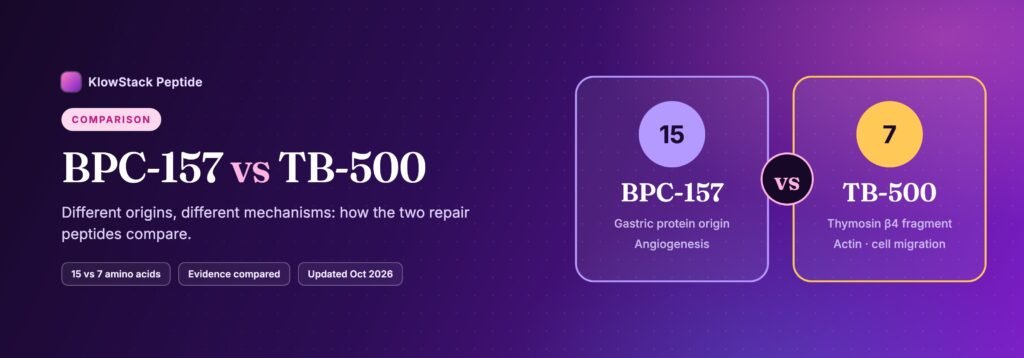
BPC-157 and TB-500 are both lab-made peptides studied for tissue repair, but they come from different sources and work differently. BPC-157 is a 15-amino-acid fragment from a stomach protein, linked to blood-vessel growth. TB-500 is a 7-amino-acid piece of thymosin beta-4, linked to cell migration. Neither has been proven in human trials.
People usually meet these two as a pair, in the same vial or the same forum thread, so it’s easy to assume they’re interchangeable. They’re closer to a plumber and an electrician: both show up for the same renovation, and they do very different jobs. This BPC-157 vs TB-500 guide compares where each comes from, how each is thought to work, how strong the evidence really is, and how their safety and legal status differ.
Education only, with no medical advice here. Both are research-use-only chemicals, as the Medical Disclaimer spells out.
What’s the Difference Between BPC-157 and TB-500?
The main differences are origin, size and proposed mechanism. BPC-157 comes from “body protection compound” in human gastric juice and is thought to work mainly by promoting blood-vessel growth and nitric-oxide signaling. TB-500 comes from thymosin beta-4 and is thought to work by binding actin so repair cells can move.
BPC-157 is a 15-unit synthetic peptide that dates to 1993, when Predrag Sikirić’s Zagreb team first described it. It was modeled on a protective protein in stomach juice, which is why so much of its early research involved ulcers. Since then, the same group has tested it on tendons, ligaments, muscle, nerves and organs, mostly in rats. Our BPC-157 guide covers the full story.
TB-500 is a synthetic seven-amino-acid fragment (Ac-LKKTETQ) of thymosin beta-4, a 43-unit protein that organizes the actin inside cells. It started as a racehorse recovery product, and Esposito and colleagues confirmed its identity in 2012 for anti-doping labs. Most research quoted for TB-500 actually used the full parent protein. Our TB-500 guide explains that difference.
Why do people mix them up? They’re both sold for “recovery,” they share WADA bans and a July 2026 FDA vote, and they’re often sold in one vial as the Wolverine stack. On a shop page, they look like two flavors of the same thing, often at similar prices and with near-identical product descriptions. In the lab, they’re unrelated molecules from unrelated proteins, and the difference between BPC-157 and TB-500 is bigger than the marketing suggests.
Side-by-Side Comparison Table
Here’s how BPC-157 and TB-500 compare on structure, research and status, using the most recent sources we could verify as of October 2026. The table shows where the two genuinely differ, and the rows that look similar, like the FDA and price rows, are similar mostly because the market treats them as a pair.
| BPC-157 | TB-500 | |
|---|---|---|
| Amino acids | 15 | 7 (Ac-LKKTETQ) |
| Source | A protein in human gastric juice | Thymosin beta-4 (43 amino acids) |
| Proposed mechanism | Blood-vessel growth (VEGFR2), nitric-oxide signaling, tissue protection | Actin binding, helping cells migrate; less scarring (in Tβ4 studies) |
| Main research areas | Tendon, ligament, muscle, gut, nerve | Wound, heart, cornea, hair (mostly full Tβ4) |
| Main research source | Largely one group (Sikirić, Zagreb) | Many labs, but mostly on full Tβ4 |
| Human data | Three small pilot reports, no control groups | None for TB-500; Tβ4 eye and wound trials |
| Oral data | Animal studies | None |
| Stability | Described as stable in gastric juice | Not established |
| FDA (October 2026) | Off Category 2 in April 2026; recommended by PCAC in July | Same |
| WADA | S0 (non-approved substances) | S2 (peptide hormones and growth factors) |
| Typical research-vial price (US, October 2026) | About $25 to $80 | Varies widely by seller and by fragment vs full protein |
Two rows tell most of the story, and they’re the rows that vendor comparison pages usually skip. The “main research source” row shows that BPC-157’s evidence leans heavily on one lab, while TB-500’s leans on a different molecule. And the “oral data” row is the one real practical difference: only BPC-157 has been studied by mouth, and only in animals.
How Do BPC-157 and TB-500 Work Differently?
In animal and cell studies, BPC-157 mainly boosts blood supply to damaged tissue (angiogenesis via VEGF and nitric-oxide pathways) and protects tissue, while TB-500 and thymosin beta-4 mainly regulate actin, helping cells migrate into wounds and reducing scarring. Put simply, tb-500 vs bpc-157 is cell movement vs blood supply.
BPC-157’s Proposed Mechanism
University of Utah physicians led by Flynn McGuire pulled BPC-157’s pathways together in a 2025 review. In rats and cell cultures, BPC-157 activates VEGFR2, a receptor that tells blood vessels to grow, and boosts nitric oxide through the Akt-eNOS pathway. It also makes tendon cells carry more growth-hormone receptors and quiets inflammatory signals.
A Reddit user once summed up the pair this way: “BPC is the project manager, TB is the crew.” It’s a fun line, and the first half fits the research well. BPC-157’s effects look like site preparation: more blood flow, better-protected tissue, a better environment for repair. It’s also studied heavily in the gut, its original home.
TB-500’s Proposed Mechanism
Thymosin beta-4 grabs loose actin, the protein strands that give cells their shape, and helps control when cells use it. That lets cells change shape and crawl toward an injury. In animal studies summarized in Goldstein and colleagues’ 2012 review, Tβ4 also encouraged new blood vessels, calmed inflammation and reduced scar-forming cells.
TB-500 contains the stretch of Tβ4 (positions 17 to 23) that does the actin binding. That makes cell movement the likeliest job the fragment keeps. Whether TB-500 also carries Tβ4’s anti-scarring and heart effects is unknown, because those may depend on other parts of the full protein.
Is the “Local vs Systemic” Idea Real?
Clinic pages often say BPC-157 works “locally” and TB-500 works “systemically,” stated as fact. That idea grew out of animal-study designs and marketing, and no human study has tested it. Some BPC-157 rat studies injected near the injury, and Tβ4 is a protein that circulates widely in the body, so the labels stuck. No human study has measured where either peptide goes or acts after it’s given.
This affects the marketing more than the science. If someone says TB-500 is the right pick because “it’s systemic,” they’re repeating a hypothesis as if it were a test result. In reality, where either peptide travels in the human body is unknown.
Which Has Better Evidence?
Neither has strong human evidence. BPC-157 has many rodent studies, mostly from one research group, plus a few small human pilot reports. TB-500 itself has no human trials; the stronger human data (eye and wound trials) used full thymosin beta-4, which isn’t the same molecule.
| Area | BPC-157 | TB-500 / Tβ4 | Evidence label |
|---|---|---|---|
| Tendon and ligament | Many rat studies | Few direct tendon studies | Animal |
| Muscle | Rat studies | Limited animal data | Animal |
| Gut | Many rat studies; registered IBD trials as PL 14736 with unpublished outcomes | Little | Animal |
| Wounds and skin | Rat studies | Tβ4 animal studies; Tβ4 wound-gel trials | Animal; early human for Tβ4 |
| Eye | Little | Tβ4 eye-drop Phase 2 and 3 trials | Human, for Tβ4 only |
| Human pilot data | Three tiny reports | None for TB-500 | Case series |
When a Case Western team searched the BPC-157 literature for a 2025 HSS Journal review, they found 544 articles, kept 36 and counted only one clinical study among them. Their verdict was hopeful but measured: promising for musculoskeletal recovery, built on low-level evidence. The 2026 AJSM primer from USC orthopedic surgeons reached a similar view of both peptides: encouraging preclinical results, missing human orthopedic data.
The single-lab concern is fair, so here it is in plain terms. Science gets stronger when other teams repeat a result. Much of BPC-157’s literature comes from one group, which has published consistently positive findings. That doesn’t make the findings wrong; it means independent replication is the missing piece.
The three small human reports, all led by Florida physician Edwin Lee, include a 2021 knee-pain chart review, a 2024 interstitial cystitis pilot and a 2025 two-person IV safety test. None had a control group.
Is BPC or TB500 better? On evidence, “better” can’t be established for either. BPC-157 has more studies on the actual molecule; TB-500’s parent protein has better human data, on a different molecule.
If you picture an evidence scorecard, BPC-157 wins on volume and TB-500’s family wins on human trial quality, and neither scores a point for its own controlled trial in people. That’s a tie at a low level, which is why “better” is the wrong question to ask of either one today.
BPC-157 vs TB-500 for Specific Uses
Animal research points BPC-157 toward tendon, ligament, muscle and gut injury models, and TB-500/thymosin beta-4 toward wound, heart and eye repair. For tendons specifically, BPC-157 has more direct animal studies; neither has human tendon trials. Everything below is a map of research, not a recommendation.
Tendons and Ligaments
This is the most searched comparison: bpc-157 vs tb-500 for tendon repair. BPC-157 has the more direct record here. In Chang’s 2011 tendon-explant experiments, cells from rat Achilles tendons grew out, survived stress and migrated better with BPC-157, and further rat work examined complete tendon and ligament tears. Thymosin beta-4 has fewer tendon-specific studies, though its cell-migration role is relevant to any repair. Neither has a human tendon trial, and physical therapy remains the best-studied approach for tendon injuries.
There’s also a timing issue. Tendon healing takes months, and the rat studies usually measure results within weeks, in young animals with fresh, surgically made injuries. Chronic human tendon problems, like a long-running case of tennis elbow or Achilles pain, are a different situation that neither peptide has been tested in.
Muscle Injuries
Rat experiments on damaged muscle reported quicker structural recovery with BPC-157. Tβ4 has less direct muscle work. No human study has compared either for muscle strains.
Gut
This is BPC-157’s home turf, with years of rat studies on ulcers and intestinal injury. A drug company even tested it, under the code PL 14736, for inflammatory bowel disease in the 2000s, though full results were never published. TB-500 has almost no gut research. If gut inflammation is the research question, KPV is the other peptide that comes up, through its mouse colitis studies; our KPV guide covers it.
Post-Surgery Recovery
Some clinics market both peptides for recovery after surgery. Post-surgical healing hasn’t been studied in people for either peptide, and most surgeons want patients off any unapproved compound before an operation, since nobody knows how these affect bleeding or wound closure.
Skin, Wounds and Hair
Here the edge goes to thymosin beta-4: rat wound studies, mouse and rat hair-growth studies, and human wound-gel trials for venous and pressure ulcers. BPC-157 has its own rat skin-wound and burn studies, reviewed by the Zagreb group, but no human skin data. Again, that’s the full protein, not TB-500. For skin specifically, the ingredient with human data is the copper peptide GHK-Cu, covered in our GHK-Cu guide.
Oral vs Injectable: A Key Difference
BPC-157 is unusual because animal studies used it orally as well as by injection; it’s described as stable in gastric juice. TB-500 has no oral research. Oral BPC-157 capsules are sold, but human absorption and effectiveness haven’t been tested, and capsules are often sold without independent testing.
| Form | BPC-157 | TB-500 |
|---|---|---|
| Injectable research vial | Common; rat studies used injection | Common; no human data |
| Oral capsule or drops | Sold; rat studies gave it in drinking water | Sold by some vendors; no research |
| Topical | Some rat wound studies | Tβ4 wound gels studied in people (full protein) |
The Zagreb group describes BPC-157 as a “stable gastric pentadecapeptide” in its paper titles, including a 2021 review in Frontiers in Pharmacology by Seiwerth and colleagues. That review reports similar effects across routes of application in animal models. Most peptides fall apart in the stomach, so this is a genuine point of difference. For comparison, even approved oral semaglutide needs a special absorption enhancer to survive the trip.
The caution is that rats aren’t people. How much oral BPC-157 reaches human blood has never been measured. Operation Supplement Safety, the Pentagon’s supplement program, also says BPC-157 doesn’t qualify as a legal dietary ingredient, which puts most capsule listings on shaky ground.
Safety and Side Effects Compared
Both lack human safety data. Reported side effects for both, mostly anecdotal, include injection-site reactions, fatigue, headaches and dizziness. Both raise theoretical cancer questions because they promote blood-vessel growth or cell migration, and research-grade products carry purity and sterility risks.
| BPC-157 | TB-500 | |
|---|---|---|
| Animal safety testing | No toxicity found in mice, rats, rabbits and dogs (Xu 2020) | Little published for the fragment |
| Cancer signal | Theoretical, via blood-vessel growth | Theoretical, plus higher Tβ4 levels found in some tumors |
| Product-specific concern | Supplement-style capsules with unverified contents | Vials may contain the fragment or the full protein |
| Human safety data | Three tiny pilots, no adverse events reported | None |
The most tangible danger for both is the product itself. Research vials can be underfilled, wrongly labeled or tainted with bacterial endotoxins, and anything made outside sterile manufacturing can introduce infection. Pregnancy or nursing, a past or current cancer, competitive sport and being under 18 are all reasons for extra caution with either peptide. Each peptide also has its own side effects page with more detail.
Can BPC-157 Cause Liver Damage?
Human data can’t answer this yet. In a two-adult IV pilot, the liver panel didn’t change, and rat studies suggest BPC-157 protects the liver, but neither tells us what happens in people over time.
Does BPC-157 Mess With Testosterone?
There’s no evidence BPC-157 affects testosterone, and the same goes for TB-500. No study has checked testosterone levels after either, and neither acts as a hormone.
Can You Take Them Every Day?
No research-based schedule exists for either peptide, because neither has been tested over time in people. We don’t publish dosing or protocols.
Should BPC-157 and TB-500 Be Taken Together?
They’re often combined as the “Wolverine stack,” but no study has tested the combination in people or shown it works better than either alone. Whether BPC-157 “works without TB-500” is also unknown, since neither has proven effects in humans. The pairing rests on theory and marketing.
The case for combining them is that each targets a different step of healing. The case for caution is that both are studied for promoting blood-vessel growth or cell movement, two processes that tumors also exploit, and two untested compounds bring twice the unknowns. Our Wolverine stack guide covers the pairing in depth, and KLOW vs GLOW vs Wolverine places it within the larger GLOW and KLOW blends.
And the Joe Rogan question? He’s frequently endorsed BPC-157, as covered in our Wolverine stack guide, which is a personal story and not evidence.
If the question is whether one of the two might be enough on its own, the research can’t answer it either way. A trial with four groups, each peptide alone, both together and a placebo, is the only design that could, and nobody has run it.
Legal Status: BPC-157 vs TB-500
Neither is FDA-approved. Both were removed from Category 2 in April 2026 and got a favorable vote from the FDA’s compounding panel on 23 July 2026, but final rulemaking is pending. In sport, BPC-157 is banned under WADA S0 and TB-500 under S2, so both would fail a test.
There’s one detail worth knowing: the FDA’s July 2026 meeting reviewed them for different uses. Colitis was the indication on the table for BPC-157, and wound healing for TB-500. Both votes were 8–6, and AJMC reported that the FDA still needs to write and finalize a rule before pharmacies can compound either.
Abroad, New Zealand’s Medsafe classifies TB-500 as a prescription medicine, and neither peptide is approved by Health Canada. The WADA Prohibited List names BPC-157 in S0 and thymosin beta-4 derivatives, including TB-500, in S2. Status checked October 5, 2026. The wider rules are explained in our peptide legality guide.
Frequently Asked Questions
What’s the difference between BPC-157 and TB-500?
BPC-157 is a 15-amino-acid peptide from a stomach protein, studied for blood-vessel growth and tissue repair. TB-500 is a 7-amino-acid thymosin beta-4 fragment, researched for steering cells toward injuries.
Is BPC-157 or TB-500 better?
There’s no winner, because neither one has a controlled human trial. BPC-157 has more studies on the molecule itself; TB-500 borrows most of its evidence from full thymosin beta-4.
Which is better for tendons?
BPC-157 has more direct animal tendon studies, mostly in rats, including tendon-to-bone healing models. Neither has a human tendon trial, and physical therapy is still the best-studied approach for tendon injuries.
Should you take TB-500 with BPC-157?
No study has tested the pair in people or shown it beats either alone. The “Wolverine stack” is a marketing combination, and we don’t give use recommendations or dosing.
Is BPC-157 good without TB-500?
Nobody knows, because neither peptide has proven effects in humans. BPC-157’s animal research was done mostly on BPC-157 alone, without TB-500.
Can BPC-157 cause liver damage?
Human data can’t settle it. Liver tests were normal in a two-adult IV pilot, and rat studies suggest liver protection, which isn’t enough to judge safety in people.
Does BPC-157 affect testosterone?
No evidence says it does. Testosterone simply hasn’t been measured after BPC-157 or TB-500 in any study.
Can you take BPC-157 orally? What about TB-500?
BPC-157 has been given orally in animal studies and is described as stable in stomach acid; human absorption is untested. TB-500 has no oral research at all, and most peptides its size break down in the gut.
Are BPC-157 and TB-500 legal in 2026?
Neither is FDA-approved. Both came off the FDA’s Category 2 list in April 2026 and were recommended by advisers in July; the final rule hasn’t been written, so compounding pharmacies still can’t use them.
Are both banned in sports?
Yes. WADA prohibits both at all times, BPC-157 under S0 and TB-500 under S2. Pro leagues such as the NFL and UFC prohibit BPC-157 as well.
Sources
Studies and reviews
- Vasireddi N, et al. 2025. Emerging Use of BPC-157 in Orthopaedic Sports Medicine: A Systematic Review. HSS Journal. doi:10.1177/15563316251355551
- McGuire FP, et al. 2025. Regeneration or Risk? A Narrative Review of BPC-157 for Musculoskeletal Healing. Current Reviews in Musculoskeletal Medicine. doi:10.1007/s12178-025-09990-7
- Seiwerth S, et al. 2021. Stable Gastric Pentadecapeptide BPC 157 and Wound Healing. Frontiers in Pharmacology. doi:10.3389/fphar.2021.627533
- Chang CH, et al. 2011. The promoting effect of pentadecapeptide BPC 157 on tendon healing. Journal of Applied Physiology. doi:10.1152/japplphysiol.00945.2010
- Lee E, Padgett B. 2021. Intra-Articular Injection of BPC 157 for Multiple Types of Knee Pain. Alternative Therapies in Health and Medicine. PMID 34324435
- Lee E, Walker C, Ayadi B. 2024. Effect of BPC-157 on Symptoms in Patients with Interstitial Cystitis: A Pilot Study. Alternative Therapies in Health and Medicine. PMID 39325560
- Esposito S, et al. 2012. Synthesis and characterization of the N-terminal acetylated 17-23 fragment of thymosin beta 4 identified in TB-500. Drug Testing and Analysis. doi:10.1002/dta.1402
- Goldstein AL, et al. 2012. Thymosin β4: a multi-functional regenerative peptide. Expert Opinion on Biological Therapy. doi:10.1517/14712598.2012.634793
- Mayfield CK, et al. 2026. Injectable Peptide Therapy: A Primer for Orthopaedic and Sports Medicine Physicians. American Journal of Sports Medicine. doi:10.1177/03635465251357593
Regulatory and anti-doping
Disclaimer: BPC-157 and TB-500 are sold for research use only and aren’t approved for human use. This comparison is educational and doesn’t give medical advice. Read our Medical Disclaimer and Editorial Policy.