
Reviewed by Thomas Okafor, Peptide Chemist · Updated October 2026
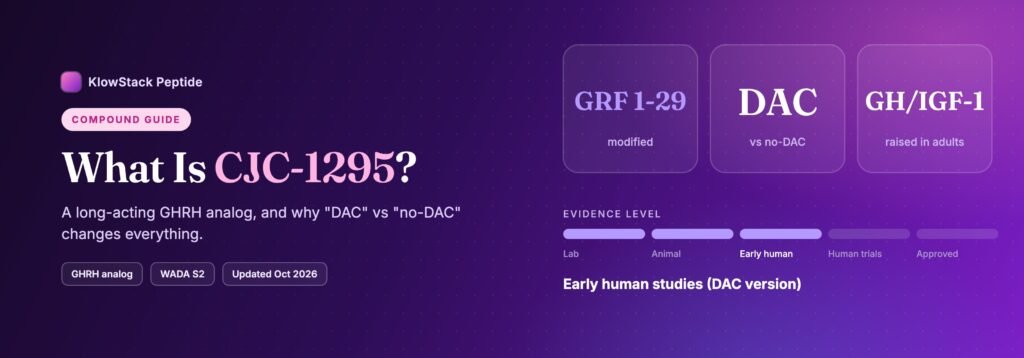
CJC-1295 is a synthetic version of the first 29 amino acids of growth hormone-releasing hormone (GHRH), modified so it lasts far longer in the body. It signals the pituitary to release more of its own growth hormone, and it’s studied mainly for raising growth hormone and IGF-1 levels.
Two small studies in healthy adults, both from 2006, showed it raises growth hormone and IGF-1 for days after one injection. A Phase 2 trial in people with HIV-related belly fat was stopped that same year after a participant died, and the drug was never approved. One more wrinkle is easy to miss: almost all the human data come from the “with DAC” version, and the “no DAC” version sold online has essentially no published human trials.
CJC-1295 is sold for research use only. This guide is educational and isn’t medical advice; see our Medical Disclaimer.
What Is CJC-1295?
CJC-1295 is a lab-made growth hormone-releasing peptide developed by the Montreal company ConjuChem in the early 2000s. It was built from GHRH(1-29), the shortest piece of natural GHRH that still works, then modified so it would resist breakdown and, in its original form, latch onto albumin in the blood for about a week.
Natural GHRH is fragile. Enzymes chop it within minutes, which is why the older drug sermorelin, essentially the same 29-amino-acid fragment, needs frequent dosing. ConjuChem made two kinds of changes, described in its 2005 Endocrinology paper:
- Four amino acid swaps at positions 2, 8, 15 and 27. These protect the chain from the enzyme DPP-4 and from other weak spots. A version with only these swaps is called “tetrasubstituted GRF(1-29)” or, in online shops, “Mod GRF 1-29.”
- The DAC tag. DAC stands for Drug Affinity Complex. It’s a chemical hook (a maleimide group on an extra lysine) that grabs a specific spot on albumin, the most common protein in blood, after injection. Riding on albumin, the peptide is shielded from the kidneys and enzymes.
In rats, the DAC version raised growth hormone four times more than plain GRF(1-29) over two hours. In healthy adults, its half-life was 5.8 to 8.1 days. Picture the difference between a message written on a sticky note and one taped to a delivery truck: same message, very different travel time.
The history. ConjuChem published two healthy-volunteer studies in 2006 and began a Phase 2 trial in HIV-associated visceral fat. In July 2006 it stopped that trial after a participant died, then ended development. Since then, CJC-1295 has appeared mainly in doping cases and research-chemical shops.
Also known as: CJC-1295 with DAC vs without DAC (Mod GRF 1-29)
This is the biggest source of confusion. CJC-1295 with DAC is the long-acting compound ConjuChem tested in people. CJC-1295 without DAC, also sold as Mod GRF 1-29, keeps the four swaps but drops the albumin hook, so it lasts minutes to an hour. The FDA’s 2024 review found that the first published reference to the no-DAC version came in 2010, when Norwegian anti-doping scientists identified it in a seized preparation. Many products labeled “CJC-1295” are actually the no-DAC version, so the name alone doesn’t tell you which molecule is in the vial.
How Does CJC-1295 Work?
CJC-1295 binds the GHRH receptor on growth hormone-making cells in the pituitary, the same receptor natural GHRH uses. That boosts growth hormone release, and the liver responds by making more IGF-1. With DAC, the signal stays switched on for days after a single dose.
What’s known about each step, and from what kind of study:
- GHRH receptor activation (lab and animal): in rat pituitary cells and live rats, the albumin-bound peptide activated the GHRH receptor and released growth hormone.
- Days-long growth hormone rise (human): one injection in healthy adults raised average growth hormone 2- to 10-fold for six days or more, depending on the dose.
- IGF-1 rise (human): average IGF-1 rose 1.5- to 3-fold for 9 to 11 days after one injection, and stayed above baseline for up to 28 days with repeated doses.
- Pulses kept, baseline raised (human): a follow-up study sampled blood every 20 minutes overnight. Growth hormone still came in natural pulses, but the “floor” between pulses rose 7.5-fold.
- Normal growth in deficient mice (animal): in mice lacking their own GHRH, daily CJC-1295 normalized growth.
What does CJC-1295 do, then? It holds the GHRH “door” open for days, so the pituitary releases more growth hormone overall while keeping its natural rhythm. Whether that higher baseline is good or bad over months is unknown, since no long-term human study exists.
Almost all of this applies to the DAC version. For no-DAC Mod GRF 1-29, the mechanism should be the same at the receptor, but its short life means a brief pulse, and published human data are essentially absent.
What Is CJC-1295 Used For / Studied For?
CJC-1295 has been studied for raising growth hormone and IGF-1 (human, healthy adults), for growth in growth hormone-deficient animals, and briefly for belly fat in people with HIV. Only the first has published human results. Claims about muscle, fat loss, sleep and recovery haven’t been tested in any published trial.
Growth hormone and IGF-1 levels
What was studied: Teichman and colleagues ran two randomized, placebo-controlled studies in healthy adults aged 21 to 61, lasting 28 and 49 days, with single or repeated injections.
What it found: dose-dependent increases in growth hormone for six days or more and in IGF-1 for up to 11 days after one dose, with no serious adverse reactions reported.
What it doesn’t show: any change in body composition, strength, sleep or health. The studies measured hormone levels only, in a few dozen people, for weeks.
Growth hormone deficiency (animal)
What was studied: Johns Hopkins researchers gave CJC-1295 to mice bred without GHRH, a model of one type of childhood growth hormone deficiency.
What it found: daily injections normalized body weight and length; less frequent doses helped partly.
What it doesn’t show: benefit in children. ConjuChem’s program ended before pediatric trials.
Belly fat in HIV lipodystrophy (human, stopped)
What was studied: a Phase 2 trial (NCT00267527) of CJC-1295 vs placebo for 12 weeks in people with HIV and excess visceral fat. It had enrolled 192 participants across North and South America.
What it found: no results were ever published. Aidsmap reported in July 2006 that ConjuChem stopped the study after a participant at a site in Argentina died. The attending physician thought undiagnosed heart disease was the likely cause, but the trial was terminated.
What it doesn’t show: whether CJC-1295 reduces visceral fat. A different GHRH drug, tesamorelin, later won FDA approval for that exact use.
What CJC-1295 hasn’t been shown to do
It hasn’t been shown to build muscle, burn fat, deepen sleep, speed healing or slow aging in people. These claims assume more growth hormone automatically means those results, an assumption no CJC-1295 study has tested. Growth hormone does rise during deep sleep, but no trial has measured sleep on CJC-1295.
What Does the Human Research Show?
Human research on CJC-1295 consists of two small, short studies in healthy adults, both showing large and long-lasting rises in growth hormone and IGF-1, plus one Phase 2 patient trial stopped in 2006 with no published results. Nothing has been published in people since.
| Study | Year | Design | Participants | Result | Limitation |
|---|---|---|---|---|---|
| Teichman et al. | 2006 | Two randomized, placebo-controlled, ascending-dose studies | Healthy adults aged 21–61 | GH up 2–10x for 6+ days; IGF-1 up 1.5–3x for 9–11 days; half-life 5.8–8.1 days | 28–49 days; hormone levels only |
| Ionescu & Frohman | 2006 | Before-and-after sampling study | Healthy men aged 20–40 | GH pulses kept; trough GH up 7.5x; IGF-1 up 45% | Single dose, small group |
| ConjuChem Phase 2 (NCT00267527) | 2005–2006 | Phase 2, randomized, placebo-controlled | 192 adults with HIV and visceral fat | Terminated after a participant died; no results posted | No efficacy or safety data published |
PubMed (36 records) and ClinicalTrials.gov (1 registered trial) searched October 5, 2026.
Why was CJC-1295 discontinued? ConjuChem halted the Phase 2 trial in July 2006 after the death, investigated, and then ended the study and its development of the compound. The FDA’s 2024 review describes it as withdrawn from clinical trials after that death. No company has picked it back up.
Every human result above used CJC-1295 with DAC. That’s worth repeating, because most people asking about CJC-1295 today are looking at no-DAC products, for which there’s no comparable human data. Our Editorial Policy explains how we label this kind of gap.
CJC-1295 Side Effects and Safety
In the healthy-volunteer studies, nearly everyone on CJC-1295 had side effects, mostly injection-site reactions, headache, flushing and diarrhea. No serious reactions were reported in those studies. The bigger unknowns are long-term effects of a constantly raised growth hormone floor and product quality.
Reported in human studies: the FDA’s 2024 briefing document summarized the Teichman data. In the first study, 94% of people on CJC-1295 had adverse events, against 29% on placebo. About 70% had injection-site reactions (redness, hardness, pain or itching), and nearly 30% had brief hives at the site. Headache affected 63% versus 14% on placebo. Flushing, warmth and brief drops in blood pressure occurred in about 30%, and diarrhea in 43%. Most effects were more common at higher doses.
Expected from the mechanism: people prescribed growth hormone itself often deal with puffiness from fluid, achy joints, tingling hands similar to carpal tunnel, and rising blood sugar. A drug that keeps growth hormone elevated for days could plausibly do the same, though no long-term CJC-1295 study has checked.
Anecdotal only: users online describe tiredness after doses, vivid dreams, hunger changes and numb hands. None has been measured in a controlled study.
Product quality: the FDA’s review found CJC-1295 products weren’t well characterized, partly because of inconsistent naming between DAC and no-DAC forms. A vial’s label may not tell you which one you have. Our peptide COA guide explains how identity testing by mass can tell them apart.
Who should avoid CJC-1295
Because IGF-1 is a growth signal, a past or current cancer diagnosis is the most serious red flag. The list also includes pregnancy and nursing, diabetes or blood sugar problems, known pituitary or heart disease, teenagers and children, and anyone subject to drug testing in sport. The death in the Phase 2 trial, even if unrelated, is a reminder that people with hidden heart disease were part of the only patient study.
Is CJC-1295 the same as HGH?
No. HGH is growth hormone itself, a 191-amino-acid protein. CJC-1295 is a much smaller peptide that tells the pituitary to release more of the body’s own growth hormone. The effect on blood levels can overlap, which is why both are banned in sport, but the molecules and their regulation are completely different.
Does CJC-1295 affect testosterone?
There’s no published evidence that it does. The human studies measured growth hormone and IGF-1, not testosterone, LH or FSH. Growth hormone and sex hormones interact, so an effect isn’t impossible, but no CJC-1295 study has looked.
CJC-1295 vs Ipamorelin
CJC-1295 and ipamorelin raise growth hormone through different pituitary receptors: CJC-1295 through the GHRH receptor, ipamorelin through the ghrelin receptor. They’re often paired because pressing both “doors” at once releases more growth hormone than either alone. Neither is approved.
| CJC-1295 (with DAC) | Ipamorelin | |
|---|---|---|
| Mechanism | GHRH receptor agonist | Ghrelin receptor (GHS-R1a) agonist |
| Half-life | 5.8–8.1 days | About 2 hours |
| Evidence | Two healthy-volunteer studies; Phase 2 stopped | Healthy-volunteer study; Phase 2 missed goals |
| Status | Not approved; research use only | Not approved; research use only |
The pairing, including the popular combined vials, is covered in CJC-1295 vs Ipamorelin, and our ipamorelin guide covers the other half.
Is CJC-1295 Legal? Why Is It Banned in Sports?
CJC-1295 isn’t FDA-approved for any use and is sold in the US only as a “research use only” chemical. FDA advisers voted against allowing pharmacies to compound it in December 2024, and WADA bans it in sport at all times.
FDA and compounding. CJC-1295 was nominated for the 503A bulks list, which would let pharmacies compound it with a prescription. The FDA placed it in Category 2 over safety concerns, and after the nominations were withdrawn it came off that list. The FDA still brought it to its Pharmacy Compounding Advisory Committee on December 4, 2024. According to the final meeting minutes, the committee voted 13–0 against including CJC-1295 (free base) and both DAC forms, and 12–1 against the acetate form. The FDA’s own review had concluded that the substance wasn’t well characterized and lacked evidence of safety and effectiveness. It wasn’t part of the July 2026 advisory meeting.
Research use only. Vials labeled “not for human consumption” can be sold for lab work, but nobody checks them like medicines. Clinics offering “CJC-1295” injections are in a legal gray area at best. Our guide to whether research peptides are legal covers the wider picture.
Sport. The 2026 WADA Prohibited List names CJC-1295 under S2.2.4, growth hormone-releasing factors, prohibited in and out of competition. Doping labs have methods to detect it, and it has turned up in seized products since at least 2009.
FDA and WADA status checked October 5, 2026.
Where CJC-1295 Fits: Needs & Symptoms
CJC-1295 appears in three research areas: Sleep & Energy (in the CJC-1295/Ipamorelin card, because growth hormone peaks in deep sleep), Muscle & Performance, and Weight & Metabolism. In all three, the link runs through growth hormone in general; CJC-1295 itself hasn’t been tested for sleep, muscle or fat in published trials.
For related compounds on those pages, see ipamorelin, sermorelin, tesamorelin and IGF-1 LR3. The CJC-1295 and ipamorelin pairing has its own page, CJC-1295 vs Ipamorelin.
Frequently Asked Questions
What exactly does CJC-1295 do?
CJC-1295 activates the GHRH receptor on the pituitary, raising growth hormone and IGF-1. With DAC, one injection raised them for about a week in healthy adults. Effects on health or body composition weren’t measured.
What’s the difference between CJC-1295 with DAC and without DAC?
With DAC, it binds albumin in the blood and lasts about a week. Without DAC (Mod GRF 1-29), it lasts minutes to an hour. The published human studies used the DAC version.
What are the downsides of CJC-1295?
In studies, most people had injection-site reactions, and many had headaches, flushing or diarrhea. It’s unapproved, its long-term effects are unknown, and research vials are poorly characterized.
Is CJC-1295 safe?
Its safety hasn’t been established. Short studies found frequent mild side effects and no serious reactions, but its only patient trial stopped after a death, and there’s no long-term data.
Is CJC-1295 legal?
It isn’t FDA-approved and is sold only as a research chemical. FDA advisers voted against letting pharmacies compound it in December 2024.
Is CJC-1295 banned in sports?
Yes. WADA lists CJC-1295 under S2.2.4 as a growth hormone-releasing factor, banned in and out of competition.
Is CJC-1295 a steroid or a peptide?
It’s a peptide, a chain of amino acids modeled on a brain hormone. Steroids are a different chemical class built on a ring structure, like testosterone.
Does CJC-1295 affect testosterone?
No study has measured testosterone with CJC-1295. The human research tracked only growth hormone and IGF-1.
Has CJC-1295 been tested in humans?
Yes, in two small 2006 studies in healthy adults and one Phase 2 trial in people with HIV that was stopped early. No human results have been published since.
How much CJC-1295 should be used?
There’s no research-based dosing for non-approved use, and we don’t publish dosing for any compound. See our Medical Disclaimer.
Sources
Primary studies
- Jetté L, et al. 2005. Human growth hormone-releasing factor (hGRF)1-29-albumin bioconjugates activate the GRF receptor on the anterior pituitary in rats: identification of CJC-1295 as a long-lasting GRF analog. Endocrinology. doi:10.1210/en.2004-1286
- Teichman SL, et al. 2006. Prolonged stimulation of growth hormone (GH) and insulin-like growth factor I secretion by CJC-1295, a long-acting analog of GH-releasing hormone, in healthy adults. Journal of Clinical Endocrinology & Metabolism. doi:10.1210/jc.2005-1536
- Ionescu M, Frohman LA. 2006. Pulsatile secretion of growth hormone (GH) persists during continuous stimulation by CJC-1295, a long-acting GH-releasing hormone analog. Journal of Clinical Endocrinology & Metabolism. doi:10.1210/jc.2006-1702
- Alba M, et al. 2006. Once-daily administration of CJC-1295, a long-acting growth hormone-releasing hormone (GHRH) analog, normalizes growth in the GHRH knockout mouse. American Journal of Physiology: Endocrinology and Metabolism. doi:10.1152/ajpendo.00201.2006
- Henninge J, et al. 2010. Identification of CJC-1295, a growth-hormone-releasing peptide, in an unknown pharmaceutical preparation. Drug Testing and Analysis. doi:10.1002/dta.233
Regulatory and trials
- FDA: Briefing Document, Pharmacy Compounding Advisory Committee, CJC-1295 (December 4, 2024)
- FDA: Final Summary Minutes, Pharmacy Compounding Advisory Committee (December 4, 2024)
- WADA: 2026 Prohibited List
- ClinicalTrials.gov: NCT00267527
News
Disclaimer: CJC-1295 is sold for research use only and isn’t approved for human use. This guide is educational and doesn’t give medical advice. Read our Medical Disclaimer and Editorial Policy.