
Reviewed by Thomas Okafor, Peptide Chemist · Updated October 2026
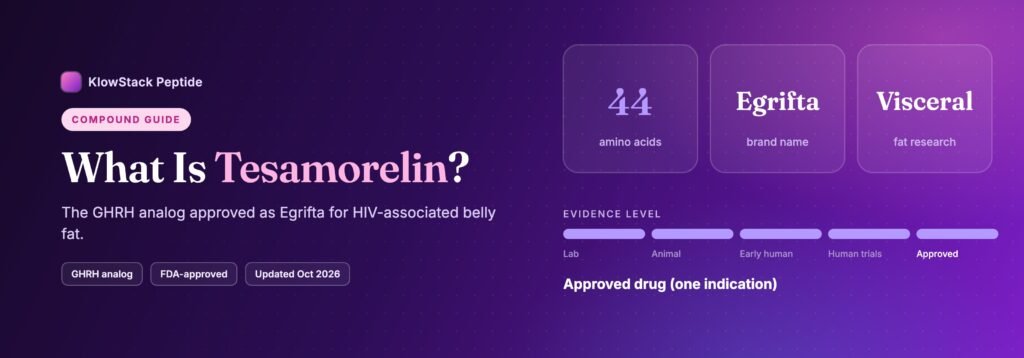
Tesamorelin is a stabilized, full-length version of growth hormone-releasing hormone (GHRH) that prompts the pituitary to release more of its own growth hormone. It’s studied mainly for reducing visceral fat, the deep fat around abdominal organs, and for fatty liver in people with HIV.
Tesamorelin is an FDA-approved prescription drug, sold as Egrifta, for one specific use: reducing excess belly fat in adults with HIV who have lipodystrophy. That approval rests on two Phase 3 trials. Online, it’s often marketed for general fat loss, muscle or anti-aging, uses it isn’t approved for and that have much thinner evidence.
Prescription tesamorelin should only be used under a licensed clinician’s care. Research-grade tesamorelin isn’t approved for human use. This guide is educational; see our Medical Disclaimer.
What Is Tesamorelin?
Tesamorelin is a lab-made GHRH analog developed by Theratechnologies, a Montreal company, under the code TH9507. It keeps all 44 amino acids of natural GHRH and adds a small fatty group to the front end, which protects it from rapid breakdown. The FDA approved it as Egrifta in November 2010.
Why the full chain? The older drug sermorelin uses only the first 29 amino acids, the shortest working piece. Theratechnologies kept the whole 44-amino-acid hormone and attached a trans-3-hexenoyl group, a short fatty chain, to the first amino acid. That cap shields the front of the molecule from DPP-4, the enzyme that chews up natural GHRH within minutes. The result lasts long enough to work with one daily injection, while still producing natural-looking growth hormone pulses.
Why HIV? In the late 1990s and 2000s, many people treated with older HIV medicines developed lipodystrophy: fat loss in the face and limbs, and fat buildup deep in the belly. That visceral fat was linked to heart and metabolic risk, and growth hormone was known to shrink it. Growth hormone itself, though, often caused high blood sugar and swelling. Tesamorelin was developed to reduce visceral fat by nudging the body’s own system, without flooding it with growth hormone.
The history. Two Phase 3 trials published in 2007 and 2010 led to the 2010 approval. Newer formulations followed, including Egrifta SV and, in March 2025, Egrifta WR, a version that’s mixed less often. The approved use has stayed the same.
Also known as: TH9507, Egrifta and “tesa”
Early trials used the code TH9507. Egrifta is the brand; Egrifta SV and Egrifta WR are later formulations of the same molecule. Online, “tesa” or “tesamorelin peptide” usually refers to research-grade powder, which isn’t the approved product.
How Does Tesamorelin Work?
Tesamorelin binds the GHRH receptor on growth hormone-making cells in the pituitary, raising growth hormone release. The liver responds by producing more IGF-1. Growth hormone breaks down stored fat, especially visceral fat, which is why tesamorelin shrinks belly fat more than fat under the skin.
What’s known about each step:
- GHRH receptor activation (human): tesamorelin raised IGF-1 by 81% in the first Phase 3 trial, a direct sign the growth hormone axis was switched on.
- Pulses preserved (human): studies at Massachusetts General Hospital found tesamorelin increased the size of growth hormone pulses while keeping their natural rhythm.
- Visceral fat breakdown (human): CT scans showed visceral fat fell by about 15% over 26 weeks, while fat under the skin of the belly and limbs barely changed.
- Liver fat (human): in later trials, liver fat dropped, and some genes linked to liver inflammation and scarring were turned down, based on liver tissue samples.
- Blood sugar (human): fasting glucose rose slightly early in treatment in some studies, then mostly settled.
What does tesamorelin do? It turns up the body’s own growth hormone signal, and growth hormone preferentially burns the deep belly fat that’s most closely tied to metabolic risk. It’s targeted at one kind of fat, which is why it isn’t a general weight-loss drug: weight often barely moves.
Why single out visceral fat? It’s the fat packed around the liver, intestines and other organs, and it behaves differently from the pinchable fat under the skin. It releases fatty acids and inflammatory signals straight into the blood that flows to the liver, which helps explain its links to fatty liver, insulin resistance and heart disease. Two people can weigh the same and carry very different amounts of it, which is why researchers measure it with CT or MRI scans, not a bathroom scale.
What Is Tesamorelin Used For / Studied For?
Tesamorelin is approved to reduce visceral belly fat in adults with HIV-associated lipodystrophy. Researchers have also tested it for fatty liver in HIV, for cognition in older adults, for belly fat in people without HIV, and for muscle quality. Only the first is approved; the rest have Phase 2 or smaller trials.
Visceral fat in HIV lipodystrophy
What was studied: the first Phase 3 trial, published in the New England Journal of Medicine in 2007, randomized 412 adults with HIV and excess belly fat to daily tesamorelin or placebo for 26 weeks. A second Phase 3 trial followed.
What it found: visceral fat fell 15.2% with tesamorelin and rose 5.0% with placebo. Triglycerides and cholesterol ratios improved. In the second trial, visceral fat dropped about 11% at six months and about 18% in those who continued for a year, and patients reported less distress about how their belly looked.
What it doesn’t show: lasting effects after stopping. People switched to placebo quickly regained the visceral fat.
Fatty liver in HIV
What was studied: a 2014 JAMA trial of 50 adults with HIV and excess belly fat, and a 2019 Lancet HIV trial of 61 adults with HIV and fatty liver disease, both using liver imaging.
What it found: in the 2019 trial, liver fat fell by 37% relative to baseline over a year, and 35% of the tesamorelin group reached normal liver fat levels, against 4% on placebo. Fewer people had their liver scarring progress.
What it doesn’t show: whether it prevents cirrhosis, or whether it helps people without HIV. Larger trials are under way.
Cognition in older adults
What was studied: the SMART trial gave tesamorelin or placebo for 20 weeks to 152 adults aged 55 to 87, some healthy and some with mild cognitive impairment.
What it found: executive function improved with tesamorelin, by a similar amount in both groups. IGF-1 rose 117%, and body fat fell 7.4%.
What it doesn’t show: whether the benefit lasts, or whether it slows dementia. It was short, with modest effects.
Thinking and memory in HIV
What was studied: a 2025 Phase 2 trial randomized 73 adults with well-controlled HIV, belly fat and mild thinking problems to tesamorelin or usual care for six months.
What it found: waist size shrank more with tesamorelin, but thinking scores didn’t improve more than with usual care.
What it doesn’t show: a cognitive benefit in this group. The study was small and had no placebo, so the authors called it inconclusive.
Belly fat without HIV, and muscle
What was studied: smaller trials tested tesamorelin in adults with obesity and low growth hormone and looked at muscle in people with HIV.
What it found: visceral fat decreased in the obesity trial, and in HIV, a 2019 analysis found less fat inside muscle and more muscle area.
What it doesn’t show: benefit in healthy adults trying to lose weight or build muscle. Tesamorelin isn’t approved for either.
What tesamorelin hasn’t been shown to do
It hasn’t been shown to cause meaningful weight loss on the scale, build muscle in healthy people, or slow aging. Some clinics present it as a fat-loss drug for anyone, but its trials focused on one fat compartment in specific groups, and body weight often didn’t change.
What Does the Human Research Show?
Tesamorelin has solid human evidence for its approved use: two randomized, placebo-controlled Phase 3 trials with more than 800 adults combined, plus long-term extensions. Evidence for other uses, including fatty liver and cognition, comes from smaller Phase 2 trials. No trial has tested it in healthy people seeking fat loss.
| Study | Year | Design | Participants | Result | Limitation |
|---|---|---|---|---|---|
| Falutz et al. | 2007 | Phase 3 RCT | 412 adults with HIV and excess belly fat | Visceral fat −15.2% vs +5.0%; IGF-1 +81% | 26 weeks; HIV only |
| Falutz et al. | 2010 | Phase 3 RCT with extension | Adults with HIV and excess belly fat | Visceral fat −10.9% vs −0.6% at 6 months; about −18% at 12 | Fat returned after stopping |
| Baker et al. (SMART) | 2012 | Phase 2 RCT | 152 older adults, with or without MCI | Better executive function | 20 weeks |
| Stanley et al. | 2014 | RCT | 50 adults with HIV | Less visceral and liver fat | Six months |
| Stanley et al. | 2019 | Phase 2 RCT | 61 adults with HIV and fatty liver | Liver fat −37% relative; less fibrosis progression | One year, HIV only |
PubMed (121 records) and ClinicalTrials.gov searched October 5, 2026.
The approved product’s data come from Theratechnologies’ manufactured drug. Our Editorial Policy explains why we don’t assume those results carry over to research-grade powder.
Tesamorelin Side Effects and Safety
In trials, the most common tesamorelin side effects were joint pain, injection-site redness and itching, muscle aches, swelling in the hands or feet, and pain in the arms or legs. It can raise blood sugar and IGF-1, so the label calls for monitoring. People with active cancer or pituitary problems shouldn’t use it.
Reported in human studies: across the Phase 3 trials, adverse events overall were similar to placebo, but more people on tesamorelin dropped out because of side effects. Injection-site reactions, joint and muscle pain and fluid-related swelling were the most frequent. Some participants developed antibodies to tesamorelin, and allergic-type reactions such as rash or hives were reported.
Expected from the mechanism: growth hormone counteracts insulin, so blood sugar can climb, especially in people already at risk for diabetes. IGF-1 can rise above normal, which is why the FDA label recommends checking it. A rarer concern is worsening diabetic eye disease, which Theratechnologies studied after approval.
Anecdotal only: online self-reports mention numb or tingling hands, water weight, better sleep and changes in hunger. These haven’t been measured as tesamorelin effects in trials.
Product quality: this risk applies to research-grade tesamorelin, which isn’t made under drug manufacturing rules. Our peptide COA guide covers what a lab report should include.
Does tesamorelin raise blood sugar?
It can, a little. In the 2014 JAMA trial, fasting glucose rose about 9 mg/dL in the first two weeks, then the difference from placebo faded by six months. In a 12-week trial in people with type 2 diabetes, sponsored by the manufacturer, blood sugar control and HbA1c didn’t worsen against placebo. The label still advises checking glucose, because growth hormone works against insulin.
Who should not take tesamorelin
According to the Egrifta label, it shouldn’t be used by people with a disrupted hypothalamic-pituitary axis (from surgery, radiation, tumors or head injury), active cancer, known allergy to tesamorelin, or during pregnancy. People with diabetes need careful blood sugar monitoring, and those with a cancer history need discussion with their doctor first.
Will tesamorelin get rid of belly fat?
In people with HIV-associated lipodystrophy, it reduced deep visceral belly fat by roughly 15% to 18%, measured by CT scans. It doesn’t target fat under the skin, and the fat came back after stopping. It hasn’t been tested or approved for belly fat in healthy people.
Tesamorelin vs Semaglutide
Tesamorelin and semaglutide both reduce belly fat in a sense, but they work completely differently. Tesamorelin raises growth hormone, which targets visceral fat with little weight loss. Semaglutide, a GLP-1 drug, reduces appetite and produces large overall weight loss.
| Tesamorelin | Semaglutide | |
|---|---|---|
| Mechanism | GHRH analog (raises growth hormone) | GLP-1 receptor agonist (lowers appetite) |
| Half-life | About half an hour | About 1 week |
| Evidence | Two Phase 3 trials in HIV lipodystrophy | Many Phase 3 trials in diabetes, obesity, heart, kidney, liver |
| Status | Approved (Egrifta) for one HIV-related use | Approved (Ozempic, Wegovy, Rybelsus) |
So, is tesamorelin similar to Ozempic? Only in the broadest sense that both are injectable peptides with metabolic effects. Our semaglutide guide covers the GLP-1 side. Within the growth hormone family, tesamorelin’s closest relatives are sermorelin and CJC-1295.
Is Tesamorelin Legal? Prescriptions, Compounding and Sport
Tesamorelin is legal in the US as a prescription drug, Egrifta, approved for reducing excess abdominal fat in adults with HIV-associated lipodystrophy. Doctors can prescribe it for other uses off-label, but those uses aren’t approved. Research-grade tesamorelin isn’t approved for human use, and WADA bans tesamorelin in sport.
Approved drug. Egrifta was approved in November 2010, and Egrifta WR in March 2025. The FDA label states it isn’t indicated for weight loss, and that its long-term heart benefits haven’t been established.
Compounding. Because Egrifta is commercially available, pharmacies generally can’t compound routine copies of it under federal law, apart from narrow, documented individual needs. Compounded “tesamorelin” offered for general weight loss falls outside the approved label and outside FDA quality checks.
Off-label prescribing. Doctors are legally allowed to prescribe an approved drug for uses not on its label, which is how some clinics offer Egrifta for belly fat in people without HIV. Insurers rarely cover that, and the evidence for such uses is limited to the smaller studies described above. Off-label prescribing is a medical decision between a patient and a clinician; it doesn’t extend the FDA’s approval.
Research use only. Online vials labeled “research use only” aren’t Egrifta and have no quality guarantee. Our guide to whether research peptides are legal explains the rules.
Sport. The 2026 WADA Prohibited List names tesamorelin under S2.2.4, growth hormone-releasing factors, banned in and out of competition. Athletes with an approved medical need can apply for a therapeutic use exemption.
FDA, compounding and WADA status checked October 5, 2026.
Where Tesamorelin Fits: Needs & Symptoms
Tesamorelin belongs in Weight & Metabolism, where it’s one of three approved drugs on the page, alongside semaglutide and tirzepatide. Its niche is narrower than theirs: deep belly fat in one population, with little effect on body weight.
On the same page, AOD-9604 is a growth hormone fragment marketed for fat loss whose trials failed, and CJC-1295 is an unapproved GHRH analog. Comparing the three shows how much evidence separates an approved GHRH drug from research peptides that use similar language. See also tirzepatide for the incretin approach.
Frequently Asked Questions
What are the benefits of tesamorelin?
In trials, tesamorelin reduced visceral belly fat by about 15% to 18% and improved triglycerides in adults with HIV-associated lipodystrophy. Smaller trials found less liver fat and better executive function.
Is tesamorelin similar to Ozempic?
Not really. Tesamorelin raises growth hormone to shrink deep belly fat; Ozempic (semaglutide) is a GLP-1 drug that lowers appetite and blood sugar. They’re approved for different uses.
Who should not take tesamorelin?
According to the label: people with pituitary or hypothalamic disruption, active cancer, allergy to tesamorelin, or who are pregnant. People with diabetes need close monitoring.
Will tesamorelin get rid of belly fat?
It reduced visceral fat in people with HIV lipodystrophy, but not fat under the skin, and the effect faded after stopping. It isn’t approved for general belly-fat loss.
Is tesamorelin safe?
As an approved drug, its benefits and risks for its approved use are documented. Main concerns are blood sugar, raised IGF-1 and injection reactions. Research-grade tesamorelin has no safety record.
Is tesamorelin legal?
Yes, by prescription as Egrifta. Research-grade vials aren’t approved for human use.
Is tesamorelin banned in sports?
Yes. WADA lists it under S2.2.4 as a growth hormone-releasing factor, banned at all times.
Has tesamorelin been tested in humans?
Yes. Two Phase 3 trials with more than 800 adults led to its approval, and Phase 2 trials tested it for fatty liver and cognition.
Does tesamorelin help with weight loss?
Not much on the scale. Its trials found reductions in visceral fat with little change in body weight. Egrifta’s label states it isn’t indicated for weight loss.
What dose of tesamorelin is used?
Approved dosing is on the Egrifta label and set by a prescriber. We don’t publish dosing; see our Medical Disclaimer.
Sources
Primary studies
- Falutz J, et al. 2007. Metabolic effects of a growth hormone-releasing factor in patients with HIV. New England Journal of Medicine. doi:10.1056/NEJMoa072375
- Falutz J, et al. 2010. Effects of tesamorelin, a growth hormone-releasing factor, in HIV-infected patients with abdominal fat accumulation: a randomized placebo-controlled trial with a safety extension. Journal of Acquired Immune Deficiency Syndromes. doi:10.1097/QAI.0b013e3181cbdaff
- Baker LD, et al. 2012. Effects of growth hormone-releasing hormone on cognitive function in adults with mild cognitive impairment and healthy older adults (SMART). Archives of Neurology. doi:10.1001/archneurol.2012.1970
- Makimura H, et al. 2012. Metabolic effects of a growth hormone-releasing factor in obese subjects with reduced growth hormone secretion. Journal of Clinical Endocrinology & Metabolism. doi:10.1210/jc.2012-2794
- Stanley TL, et al. 2014. Effect of tesamorelin on visceral fat and liver fat in HIV-infected patients with abdominal fat accumulation. JAMA. doi:10.1001/jama.2014.8334
- Stanley TL, et al. 2019. Effects of tesamorelin on non-alcoholic fatty liver disease in HIV. Lancet HIV. doi:10.1016/S2352-3018(19)30338-8
- Adrian S, et al. 2019. The growth hormone releasing hormone analogue, tesamorelin, decreases muscle fat and increases muscle area in adults with HIV. Journal of Frailty & Aging. doi:10.14283/jfa.2018.45
- Clemmons DR, et al. 2017. Safety and metabolic effects of tesamorelin, a growth hormone-releasing factor analogue, in patients with type 2 diabetes. PLoS One. doi:10.1371/journal.pone.0179538
- Ellis RJ, et al. 2025. Effects of tesamorelin on neurocognitive impairment in persons with HIV and abdominal obesity. Journal of Infectious Diseases. doi:10.1093/infdis/jiaf012
Regulatory
Disclaimer: Egrifta (tesamorelin) should be used only under a licensed clinician’s care for its approved use. Research-grade tesamorelin is sold for research use only and isn’t approved for human use. This guide is educational and isn’t medical advice. Read our Medical Disclaimer and Editorial Policy.