
Reviewed by Thomas Okafor, Peptide Chemist · Updated October 2026
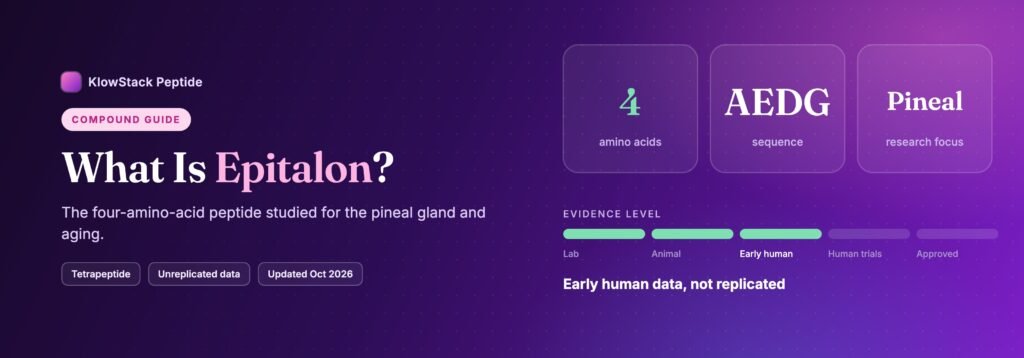
Epitalon is a synthetic four-amino-acid peptide (Ala-Glu-Asp-Gly) modeled on an extract of the pineal gland, the small brain gland that makes melatonin. In cell studies it switches on telomerase, the enzyme that rebuilds the protective caps on chromosomes. It’s studied mainly for aging and for sleep and circadian rhythms.
Most epitalon research comes from one group in St. Petersburg, Russia, and much of it is in cells and animals. The human studies people cite mostly used Epithalamin, the older pineal extract, which isn’t the same thing as the synthetic peptide sold today. An independent 2025 lab study confirmed the telomere effect in human cells, with a twist that’s worth knowing about.
Epitalon is sold for research use only. This guide is educational and isn’t medical advice; see our Medical Disclaimer.
What Is Epitalon?
Epitalon is a lab-made peptide of just four amino acids, developed in the late 1980s and 1990s by Vladimir Khavinson and colleagues at the St. Petersburg Institute of Bioregulation and Gerontology. They analyzed Epithalamin, a peptide extract from cattle pineal glands, and designed epitalon as a short synthetic version of what they believed was its active part.
Some background on the pineal gland. The pineal gland is a pea-sized structure deep in the brain that makes melatonin, the hormone that rises in the evening and helps signal “time to sleep.” Melatonin output tends to fall with age, which is one reason the pineal gland has long interested aging researchers. Khavinson’s group spent decades testing pineal and thymus extracts, which they call “peptide bioregulators,” on the idea that short peptides can fine-tune how genes behave in specific tissues.
The chemistry. Epitalon’s sequence is alanine, glutamic acid, aspartic acid and glycine, written Ala-Glu-Asp-Gly or AEDG. At about 390 daltons, it’s one of the smallest peptides in our library, far smaller than a typical protein. Small size makes it cheap to make, but also quickly broken down.
The history. Most of the early work, including human studies of Epithalamin in older adults, was published in Russian journals and English-language journals edited in the same circle. In 2025, a team at Brunel University London published an independent cell study, one of the first outside replications. In July 2026, the FDA reviewed epitalon at an advisory meeting for possible compounding.
Also known as: Epitalon vs Epithalon vs Epithalamin
Epitalon, Epithalon and Epithalone are spellings of the same synthetic tetrapeptide. Epithalamin is different: a natural mixture of peptides extracted from animal pineal glands. Many “human study” claims online cite Epithalamin trials as if they tested epitalon. They didn’t, and results from an extract don’t automatically carry over to a single synthetic peptide.
How Does Epitalon Work?
In human cells grown in the lab, epitalon raises the activity of telomerase, the enzyme that adds length back to telomeres, the protective tips of chromosomes that shorten each time a cell divides. Some studies also suggest it influences how the pineal gland produces melatonin, though that evidence comes mostly from the related extract.
Telomeres are often compared to the plastic tips on shoelaces. Every time a cell divides, the tips wear a little shorter, and when they’re too short, the cell stops dividing. Telomerase is the repair crew that can rebuild them. Most adult cells keep telomerase mostly switched off, a built-in limit on how many times they can divide.
What’s known about each part:
- Telomerase switched on (lab): in human fetal lung fibroblasts, epitalon raised telomerase activity and lengthened telomeres, and the cells made 10 extra divisions past their usual limit.
- Independent confirmation (lab): the 2025 Brunel study found dose-dependent telomere lengthening in normal human epithelial cells and fibroblasts, through more hTERT (the telomerase gene) and higher telomerase activity.
- Cancer cells too (lab): in the same study, breast cancer cell lines also lengthened their telomeres, through a different route called ALT.
- Melatonin (early human, for the extract): in older adults with low melatonin, Epithalamin raised nighttime melatonin levels, while in those with normal levels it didn’t push them higher.
- Gene regulation (lab): Khavinson’s group proposes that short peptides bind DNA and change gene activity. This idea isn’t widely tested outside their labs.
What does epitalon do, then? In a dish, it helps cells rebuild their telomeres. Whether that happens in a living person, whether it’s good or bad there, and whether it changes how fast anyone ages are all untested.
What Is Epitalon Used For / Studied For?
Epitalon has been studied for telomeres and cell aging (lab), lifespan and tumors in rodents (animal), and sleep and melatonin rhythms (mostly human studies of the Epithalamin extract). It has also been tested in small Russian studies for eye disease. None of these areas has a modern, independent human trial of epitalon itself.
Telomeres and cellular aging
What was studied: human cells in culture, in Russian studies from the early 2000s and in the 2025 Brunel study.
What it found: telomeres lengthened and normal cells kept dividing longer.
What it doesn’t show: that this happens in the body. Cells in a dish don’t have an immune system, blood supply or the many controls that limit telomerase in tissues.
Lifespan and tumors in mice
What was studied: in a 2003 Biogerontology study, 54 female mice got monthly courses of epitalon from three months of age until death, against 54 controls.
What it found: average lifespan didn’t change. The longest-lived 10% of mice lived 13.3% longer, maximum lifespan was 12.3% longer, chromosome damage in bone marrow dropped by 17%, and leukemia was less common. Total tumor rates didn’t change.
What it doesn’t show: a longer life for the typical animal, or anything about people. It’s a single strain of mouse in a single lab.
Sleep, melatonin and circadian rhythm
What was studied: older adults given courses of Epithalamin, the pineal extract, with melatonin measured over 24 hours.
What it found: a 2004 study found Epithalamin normalized melatonin in people whose levels were low, raising nighttime melatonin without overshooting in those with normal levels.
What it doesn’t show: that synthetic epitalon improves sleep, which is the use the FDA reviewed in 2026. Sleep quality wasn’t measured as a clinical outcome in a controlled trial.
What epitalon hasn’t been shown to do
Epitalon hasn’t been shown to reverse aging, lengthen telomeres in living people, extend human life or treat insomnia. The common online claim that it “adds years to your life” leans on extract studies and a mouse study where average lifespan didn’t change.
What Does the Human Research Show?
Human research on epitalon itself is minimal. The human studies usually cited used Epithalamin, a pineal extract, in older adults in Russia and Ukraine, mostly published by the developers’ own group. They report fewer deaths and better health markers, but lack the independent replication and trial registration that would make them persuasive.
| Study | Year | Design | Participants | Result | Limitation |
|---|---|---|---|---|---|
| Khavinson & Morozov | 2003 | Long-term observational comparison | 266 older adults (Epithalamin or Thymalin) | Lower mortality and illness reported vs controls | Extract, not epitalon; same research group |
| Korkushko et al. | 2004 | Before-and-after study | Healthy older adults | Melatonin rhythm normalized | Extract; small; no placebo reported |
| Korkushko et al. | 2006 | Described as a 12-year randomized study | Older adults with heart disease | 28% fewer deaths vs control | Extract; details limited; not independently replicated |
PubMed (236 records, most from the developers’ institutes) and ClinicalTrials.gov (no registered trials) searched October 5, 2026.
These results, if they held up, would be remarkable, and that’s exactly why they need independent confirmation. No Western regulator has reviewed the original trial data, and no trial of synthetic epitalon is registered on ClinicalTrials.gov. FDA staff reviewing it in 2026 recommended against adding it to the compounding list. Our Editorial Policy explains how we weigh studies from a single research group.
Epitalon Side Effects and Safety
There’s no modern clinical safety data for synthetic epitalon. Russian extract studies reported few side effects, and the long-term mouse study found no rise in tumors overall. The biggest theoretical concern comes from its main mechanism: switching on telomerase, which cancer cells use to keep dividing.
Reported in human studies: the Epithalamin studies didn’t report serious adverse effects, but they weren’t designed or reported to modern safety standards.
Expected from the mechanism: telomerase is active in most cancers, where it lets tumor cells divide endlessly. The 2025 Brunel study found epitalon lengthened telomeres in breast cancer cells as well as normal cells. That doesn’t mean epitalon causes cancer, but it’s a reason for real caution in anyone with a cancer history. Effects on melatonin could also change sleep timing.
Anecdotal only: online self-reports mention vivid dreams, changes in sleep, mild headaches and injection-site irritation. These haven’t been studied.
Product quality: research vials aren’t held to drug standards, and a four-amino-acid peptide is easy to mislabel or underdose. Our peptide COA guide explains how identity and purity testing works.
Who should avoid epitalon
Anyone with active or past cancer has the strongest reason to stay away, given the telomerase effect in cancer cells. Pregnancy, breastfeeding, being under 18, autoimmune conditions and use of sleep or psychiatric medications are further reasons for caution.
Does epitalon really lengthen telomeres?
In human cells in a lab dish, yes: the Russian studies and an independent 2025 UK study both found longer telomeres. In living people, no study has measured telomere length before and after epitalon. Telomere length in blood also varies a lot from test to test, so any future study would need careful design.
Epitalon vs Melatonin
Epitalon and melatonin are both linked to the pineal gland, but they’re very different. Melatonin is the hormone the pineal gland makes, sold over the counter in the US as a supplement. Epitalon is a synthetic peptide studied for influencing the pineal gland and telomeres, with no approved use.
| Epitalon | Melatonin | |
|---|---|---|
| Mechanism | Telomerase activation (lab); pineal regulation (extract studies) | Binds melatonin receptors that signal night to the body clock |
| Half-life | Not established in humans | About 30 to 60 minutes |
| Evidence | Lab, animal, Russian extract studies | Many human trials for sleep timing and jet lag |
| Status | Research use only | US dietary supplement |
If your interest is the body clock, melatonin has far more human research. Our DSIP guide covers another peptide linked to sleep.
Is Epitalon Legal?
No US approval exists for epitalon. What you can buy online is labeled for laboratory research. In July 2026, a federal advisory panel narrowly backed it as a possible compounding ingredient for insomnia, against the advice of FDA reviewers, but that vote hasn’t become a rule, so pharmacies still can’t legally use it.
FDA and compounding. Epitalon was in the FDA’s Category 2 list of compounding substances with safety concerns until its nomination was withdrawn in 2026. On July 24, 2026, the FDA’s Pharmacy Compounding Advisory Committee reviewed it for insomnia. AJMC reported that it passed by a tight margin. The FDA still has to propose and finalize a rule, and as of October 2026 none of the reviewed peptides had been added.
Research use only. The “research use only” label is a sales category, and products sold under it skip the testing that pharmacy drugs go through. Our guide to whether research peptides are legal covers the details.
Other countries. Epitalon and Epithalamin have been used in Russia, where Khavinson’s group developed them. That history doesn’t carry over to US approval.
Sport. Epitalon isn’t named on the 2026 WADA Prohibited List. WADA’s S0 class, however, bans any pharmacological substance not approved for human use by a government health authority, which can apply to unapproved peptides like epitalon. Athletes should check with their anti-doping organization.
FDA and WADA status checked October 5, 2026.
Where Epitalon Fits: Needs & Symptoms
Epitalon is listed in two research areas: Sleep & Energy, for its links to the pineal gland and melatonin, and Longevity & Cellular Health, for its telomerase effects in cells. In both, the evidence is mostly lab, animal and extract-based.
Related guides on those pages include DSIP and sermorelin for sleep, and MOTS-c, SS-31 and thymosin alpha-1 for longevity research.
Frequently Asked Questions
What does epitalon do?
In human cells in the lab, epitalon raises telomerase activity and lengthens telomeres. Studies of the related pineal extract suggest it can normalize melatonin rhythms in older adults. Effects in living people are untested.
Is epitalon safe?
Its safety in people hasn’t been studied in modern trials. Because it switches on telomerase, which cancer cells also use, people with a cancer history face the biggest open question.
Is epitalon the same as epithalamin?
No. Epitalon is a synthetic four-amino-acid peptide. Epithalamin is a natural extract from animal pineal glands. Most human studies used Epithalamin.
Does epitalon help you sleep?
There’s no controlled trial showing epitalon improves sleep. Studies of Epithalamin found it normalized melatonin levels in some older adults. The FDA panel reviewed epitalon for insomnia in 2026 despite limited data.
Is epitalon legal?
There’s no approved epitalon product in the US, only research-labeled vials. A narrow advisory vote in July 2026 favored it for compounding, but pharmacies can’t use it unless the FDA finalizes a rule.
Is epitalon banned in sports?
It isn’t named on the WADA list, but WADA’s S0 class covers unapproved substances, which can include it. Tested athletes should check before use.
Has epitalon been tested in humans?
Not in modern registered trials. Human data mostly come from Russian studies of the pineal extract Epithalamin.
Does epitalon extend lifespan?
In one mouse study, average lifespan didn’t change, though the longest-lived mice lived about 12% to 13% longer. No human study has measured lifespan with synthetic epitalon.
How much epitalon should be used?
There’s no research-based dosing for human use, and we don’t publish dosing for any compound. See our Medical Disclaimer.
Sources
Primary studies
- Anisimov VN, et al. 2003. Effect of Epitalon on biomarkers of aging, life span and spontaneous tumor incidence in female Swiss-derived SHR mice. Biogerontology. doi:10.1023/A:1025114230714
- Khavinson VKh, Morozov VG. 2003. Peptides of pineal gland and thymus prolong human life. Neuro Endocrinology Letters. PMID 14523363
- Khavinson VKh, et al. 2004. Peptide promotes overcoming of the division limit in human somatic cell. Bulletin of Experimental Biology and Medicine. doi:10.1023/b:bebm.0000038164.49947.8c
- Korkushko OV, et al. 2004. Effect of peptide preparation epithalamin on circadian rhythm of epiphyseal melatonin-producing function in elderly people. Bulletin of Experimental Biology and Medicine. doi:10.1023/b:bebm.0000035139.31138.bf
- Korkushko OV, et al. 2006. Geroprotective effect of epithalamine (pineal gland peptide preparation) in elderly subjects with accelerated aging. Bulletin of Experimental Biology and Medicine. doi:10.1007/s10517-006-0365-z
- Al-Dulaimi S, et al. 2025. Epitalon increases telomere length in human cell lines through telomerase upregulation or ALT activity. Biogerontology. doi:10.1007/s10522-025-10315-x
Reviews
- Araj SK, et al. 2025. Overview of Epitalon: highly bioactive pineal tetrapeptide with promising properties. International Journal of Molecular Sciences. doi:10.3390/ijms26062691
Regulatory
Disclaimer: Epitalon is sold for research use only and isn’t approved for human use. This guide is educational and doesn’t give medical advice. Read our Medical Disclaimer and Editorial Policy.