
Reviewed by Thomas Okafor, Peptide Chemist · Updated October 2026
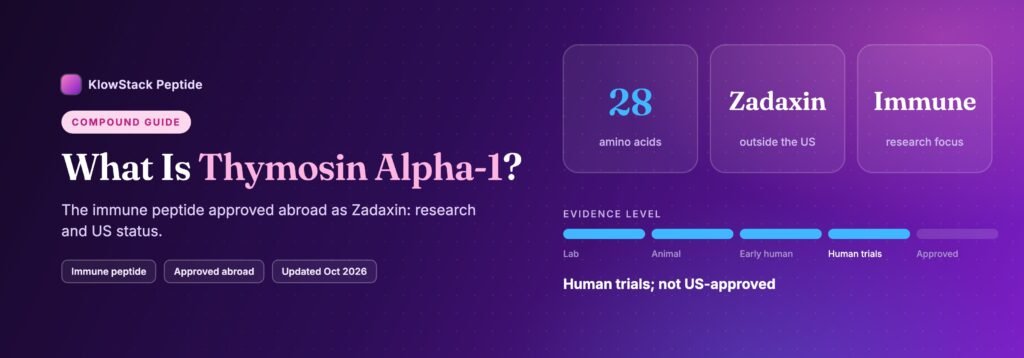
Thymosin alpha-1 (Tα1) is a 28-amino-acid peptide first isolated from the thymus, the small gland behind the breastbone where immune T-cells mature. It’s thought to tune immune responses by acting on immune sensors called toll-like receptors and by supporting T-cell function. It’s studied mainly for hepatitis B and C, as a vaccine booster, and in cancer, sepsis and COVID-19.
Thymosin alpha-1 is in an unusual position. It’s an approved medicine, sold as Zadaxin, in dozens of countries across Asia, Latin America, Eastern Europe and the Middle East, but it has never been approved in the US. Its human trial record is large but uneven: a big 2025 sepsis trial found no survival benefit, and a 2026 Cochrane review rated the hepatitis B evidence as very low certainty.
Thymosin alpha-1 isn’t approved for any use in the US. Research-grade Tα1 is sold for research use only. This guide is educational; see our Medical Disclaimer.
What Is Thymosin Alpha-1?
Thymosin alpha-1 is a peptide discovered in 1977 by Allan Goldstein and colleagues, who purified it from “thymosin fraction 5,” a mix of thymus proteins from calves. It’s made of 28 amino acids with an acetyl cap at the front end. The drug company SciClone Pharmaceuticals developed a synthetic version, thymalfasin, under the brand Zadaxin.
What the thymus does. The thymus is where T-cells, the immune system’s coordinators and assassins, go to school. Young T-cells mature there and learn to tell your own body’s cells from invaders. The thymus is biggest in childhood and gradually shrinks and fills with fat with age, so by late middle age much of it is gone, which is one reason scientists have long wondered whether thymus-derived peptides could support immune function in older or sick people.
The chemistry. Tα1 is an acetylated 28-amino-acid chain that’s cut, in the body, from a larger protein called prothymosin alpha. The acetyl group on the first amino acid makes the synthetic version a closer match to the natural one. It doesn’t dissolve easily in water, which the FDA flagged as a practical problem for some compounded forms.
The history. Tα1 was tested in the US for hepatitis B and C in the 1990s, without winning FDA approval. Meanwhile, Zadaxin was approved in many other countries, mainly for hepatitis B and as an immune booster with vaccines, and in some for hepatitis C or as an add-on to cancer chemotherapy. Italy approved it as a booster for flu vaccines in people with weak immune systems, and India for chronic hepatitis B. The European Medicines Agency granted it orphan designation for liver cancer.
Also known as: thymosin alpha-1, thymalfasin, Zadaxin and thymosin beta-4
Tα1 and thymalfasin are the same molecule; thymalfasin is the official name of the synthetic peptide. Zadaxin is the finished drug product sold abroad. Don’t confuse Tα1 with thymosin beta-4: despite the shared “thymosin” name, Tβ4 is an unrelated 43-amino-acid protein involved in cell movement and wound repair, and it’s the parent of TB-500.
How Does Thymosin Alpha-1 Work?
Thymosin alpha-1 is thought to work mainly by activating toll-like receptors, especially TLR9 and TLR2, on dendritic cells, the immune system’s scouts. That triggers immune signaling and supports T-cell maturation and activity. It’s described as an immune modulator, because it seems to boost weak responses and temper some excessive ones.
What’s known, and from what kind of research:
- Toll-like receptor activation (lab and animal): in a 2004 Blood study, Tα1 activated dendritic cells through toll-like receptor signaling and helped mice resist a fungal infection.
- T-cell maturation (lab and animal): it promotes maturation of T-cells and increases signaling molecules such as interferon-gamma and interleukin-2.
- T-cell counts in severe illness (human, observational): in a 2020 study of severe COVID-19, Tα1-treated patients had higher T-cell counts and less T-cell “exhaustion.”
- Vaccine response (human): some trials reported better antibody responses to flu and hepatitis B vaccines in people with weak immune systems.
- Balancing role (lab): some studies suggest it can dampen overactive inflammation as well, which is why it’s called a modulator, a step beyond a simple booster.
What does thymosin alpha-1 do, in plain terms? Think of it as a coach shouting instructions to the immune system’s defensive line: it doesn’t fight the infection itself, but it helps the players get organized. How much that coaching changes the final score has turned out to be hard to prove.
What Is Thymosin Alpha-1 Used For / Studied For?
Thymosin alpha-1 has been studied for chronic hepatitis B and C, as a vaccine adjuvant, as an add-on in cancer treatment, in sepsis and in COVID-19. It’s approved abroad mainly for hepatitis B and vaccine response. The best-controlled recent trials, in sepsis and hepatitis B, found little or uncertain benefit.
Chronic hepatitis B
What was studied: dozens of trials since the 1990s, mostly in Asia, alone or with antiviral drugs. A 2026 Cochrane review pooled the randomized evidence.
What it found: the Cochrane authors rated the evidence “very low” certainty for nearly every outcome, including death and liver-related illness, and said they couldn’t be sure whether Tα1 helps. The FDA’s 2024 review also found inconsistent results.
What it doesn’t show: a clear benefit over modern antiviral drugs, which have transformed hepatitis B care since the 1990s.
Sepsis
What was studied: the TESTS trial, a Phase 3, double-blind, placebo-controlled study across many Chinese hospitals, randomized 1,106 adults with sepsis to Tα1 or placebo.
What it found: 28-day death rates were 23.4% with Tα1 and 24.1% with placebo, essentially identical. No secondary or safety outcome differed. A subgroup analysis hinted at benefit in older adults and those with diabetes, but that needs its own trial.
What it doesn’t show: a survival benefit in sepsis, despite smaller earlier studies that suggested one.
COVID-19
What was studied: a 2020 retrospective study from China compared 76 patients with severe COVID-19 who did or didn’t receive Tα1.
What it found: death rates were 11.1% with Tα1 and 30.0% without.
What it doesn’t show: cause and effect. Patients weren’t randomized, so the groups may have differed in ways that explain the gap.
Cancer and vaccines
What was studied: small trials of Tα1 as an add-on to chemotherapy in lung cancer, liver cancer and melanoma, and as a booster with flu and hepatitis B vaccines in people with weak immune systems.
What it found: some improvements in immune markers and, in certain studies, survival or vaccine response.
What it doesn’t show: consistent, large-trial confirmation. The FDA noted that many of these settings now have approved treatments with stronger evidence.
What thymosin alpha-1 hasn’t been shown to do
It hasn’t been shown to slow aging, prevent infections in healthy people, cure Lyme disease or treat chronic fatigue. “Immune support” marketing borrows from trials in very sick patients and from its foreign approvals, which cover specific diseases.
What Does the Human Research Show?
Thymosin alpha-1 has a large human research base, with hundreds of trials and studies over 40 years, mostly in Asia and Italy. The quality varies a lot. The most rigorous recent evidence, a 1,106-person sepsis trial and a 2026 Cochrane review for hepatitis B, didn’t find clear benefits.
| Study | Year | Design | Participants | Result | Limitation |
|---|---|---|---|---|---|
| Liu et al. | 2020 | Retrospective cohort | 76 adults with severe COVID-19 | Deaths 11.1% vs 30.0% | Not randomized |
| Wu et al. (TESTS) | 2025 | Phase 3 RCT | 1,106 adults with sepsis | 28-day deaths 23.4% vs 24.1% | Chinese hospitals only |
| Naing et al. (Cochrane) | 2026 | Systematic review of RCTs | Chronic hepatitis B trials | Very low-certainty evidence; benefit unclear | Mostly small, older trials |
PubMed (875 records) and ClinicalTrials.gov (60 registered studies) searched October 5, 2026.
Why isn’t it approved in the US? US trials in hepatitis in the 1990s didn’t produce results strong enough for approval, and as antiviral drugs improved, the case weakened further. The FDA’s 2024 review concluded that the available studies didn’t establish safety and effectiveness for the proposed uses, and that FDA-approved treatments exist for many of them. Our Editorial Policy explains how we weigh a drug approved abroad but not in the US.
How can a drug be approved in dozens of countries and not in the US? Approval standards differ, and many of Zadaxin’s approvals date from the 1990s and 2000s, when hepatitis B had few good treatments and smaller trials were accepted. The FDA generally expects large, well-controlled trials showing a clear benefit over existing options. Since then, antiviral drugs that suppress hepatitis B in most patients have raised that bar considerably.
Thymosin Alpha-1 Side Effects and Safety
In clinical trials, thymosin alpha-1 has been generally well tolerated. The most common side effect is irritation or discomfort at the injection site. In the 1,106-person sepsis trial, no safety outcome differed from placebo. The FDA’s concerns center on product quality and immune reactions from impurities in compounded or research forms.
Reported in human studies: injection-site reactions were the most frequent complaint across trials. The TESTS trial found no differences in safety outcomes between Tα1 and placebo.
Expected from the mechanism: because Tα1 stimulates the immune system, people with autoimmune diseases or organ transplants face theoretical risks of flares or rejection. Its effects on immune-based cancer drugs aren’t well understood.
Anecdotal only: online self-reports mention fewer colds, more energy and mild flu-like feelings after injections. None of these has been tested in a controlled study of healthy people.
Product quality: the FDA found that critical quality data for Tα1 sold for compounding, including impurities, aggregates and bacterial endotoxins, weren’t available, and raised concerns about immune reactions with injectable forms. Research vials carry the same unknowns. Our peptide COA guide explains what a credible lab report shows.
Who should avoid thymosin alpha-1
People with autoimmune conditions, organ transplant recipients on anti-rejection drugs, people who are pregnant or breastfeeding, and anyone under 18 have the most reason for caution. Anyone receiving cancer immunotherapy should talk with their oncologist before any immune-active product.
Is thymosin alpha-1 safe long-term?
Long-term safety data come mostly from patients with hepatitis B or cancer treated for months under medical supervision, where serious problems attributed to Tα1 were uncommon. There’s little data on healthy people using it for months or years, and none on research-grade products, whose quality the FDA couldn’t confirm.
Does thymosin alpha-1 boost the immune system?
In lab studies and in some patient studies, it raised T-cell activity and immune signaling. Whether that translates into fewer infections or better survival is less clear: the largest recent trial, in sepsis, found no difference in deaths. There’s no evidence it improves immunity in healthy people.
Thymosin Alpha-1 vs Thymosin Beta-4
Thymosin alpha-1 and thymosin beta-4 share a name and a historical origin in thymus extracts, but they’re unrelated molecules. Tα1 is a 28-amino-acid immune modulator; Tβ4 is a 43-amino-acid actin-binding protein studied for wound healing and tissue repair, and the parent of TB-500.
| Thymosin alpha-1 | Thymosin beta-4 | |
|---|---|---|
| Mechanism | Toll-like receptors; T-cell support | Binds actin; cell migration and repair |
| Half-life | About 2 hours | Short in blood |
| Evidence | Many human trials; approved abroad | Phase 2 and 3 eye and wound trials |
| Status | Not FDA-approved; Zadaxin abroad | Not FDA-approved |
Our thymosin beta-4 guide and TB-500 guide cover that side of the family.
Is Thymosin Alpha-1 Legal?
Thymosin alpha-1 isn’t FDA-approved, so there’s no legal US prescription product. In December 2024, FDA advisers voted 17–4 against adding it to the list of substances pharmacies may compound. Zadaxin is legal in many other countries, and research-grade Tα1 is sold in the US under a research-only label.
FDA and compounding. Tα1 was previously in Category 2 of the FDA’s compounding safety list, then removed after its nominations were withdrawn. The FDA still reviewed it at its Pharmacy Compounding Advisory Committee on December 4, 2024, and the final minutes record votes of 17–4 against both the free base and the acetate form. Members voting no cited “no compelling evidence demonstrating clinical effectiveness and safety,” while those voting yes said it should be accessible to patients as an option.
Approved abroad. Zadaxin is approved in countries across the Asia-Pacific, Latin America, Eastern Europe and the Middle East, according to its developer, though the FDA noted it couldn’t independently verify every claimed approval. Approval in another country doesn’t permit sale as a drug in the US.
Research use only. Research vials aren’t checked like medicines, and the FDA flagged missing quality data. Our guide to whether research peptides are legal explains the rules.
Sport. Tα1 isn’t named on the 2026 WADA Prohibited List. Because it’s approved in some countries, WADA’s S0 catch-all for unapproved substances may not apply, but athletes should still check with their anti-doping organization.
FDA and WADA status checked October 5, 2026.
Where Thymosin Alpha-1 Fits: Needs & Symptoms
Thymosin alpha-1 appears in Longevity & Cellular Health, for interest in immune aging, and Anti-Inflammatory Signaling, for its immune-modulating effects. It’s one of the few compounds on either page with large human trials, even if those trials were mostly in seriously ill patients.
Related guides on those pages include LL-37 and VIP for immune and inflammation research, KPV for inflammatory signaling, and epitalon and MOTS-c for aging research.
Frequently Asked Questions
What does thymosin alpha-1 do?
It acts on toll-like receptors on immune cells, supporting T-cell maturation and immune signaling. It’s approved abroad for hepatitis B and vaccine response, but not in the US.
Is thymosin alpha-1 FDA-approved?
No. It’s approved as Zadaxin in many other countries, but not by the FDA, and FDA advisers voted against compounding it in 2024.
Is thymosin alpha-1 safe?
In trials, it was generally well tolerated, with injection-site reactions most common. The FDA raised concerns about impurities and immune reactions in compounded and research forms.
Does thymosin alpha-1 work for sepsis?
A 1,106-person Phase 3 trial published in 2025 found no difference in 28-day survival between Tα1 and placebo.
Does thymosin alpha-1 help with hepatitis B?
A 2026 Cochrane review rated the evidence very low certainty and couldn’t confirm a benefit. Modern antiviral drugs are the standard treatment.
Is thymosin alpha-1 legal?
There’s no FDA-approved product, and compounding isn’t permitted after the 2024 advisory vote. Research vials are sold labeled for lab use only.
Is thymosin alpha-1 banned in sports?
It isn’t named on the 2026 WADA list. Athletes should still confirm with their anti-doping organization.
Is thymosin alpha-1 the same as thymosin beta-4?
No. They’re unrelated peptides that share a name. Tα1 modulates immunity; Tβ4 is involved in cell movement and tissue repair.
Has thymosin alpha-1 been tested in humans?
Yes, extensively, in hepatitis, sepsis, cancer, vaccine and COVID-19 studies. Results have been mixed, and the most rigorous recent trials found little benefit.
How much thymosin alpha-1 should be used?
There’s no research-based dosing for non-approved use, and we don’t publish dosing for any compound. See our Medical Disclaimer.
Sources
Primary studies
- Liu Y, et al. 2020. Thymosin alpha 1 reduces the mortality of severe coronavirus disease 2019 by restoration of lymphocytopenia and reversion of exhausted T cells. Clinical Infectious Diseases. doi:10.1093/cid/ciaa630
- Wu J, et al. 2025. The efficacy and safety of thymosin α1 for sepsis (TESTS): multicentre, double blinded, randomised, placebo controlled, phase 3 trial. BMJ. doi:10.1136/bmj-2024-082583
- Romani L, et al. 2004. Thymosin α1 activates dendritic cells for antifungal Th1 resistance through toll-like receptor signaling. Blood. doi:10.1182/blood-2003-11-4036
Reviews
- Naing C, et al. 2026. Thymosin-α1 for people with chronic hepatitis B. Cochrane Database of Systematic Reviews. doi:10.1002/14651858.CD014610.pub2
Regulatory
Disclaimer: Thymosin alpha-1 isn’t approved for any use in the US, and research-grade Tα1 is sold for research use only. This guide is educational and doesn’t give medical advice. Read our Medical Disclaimer and Editorial Policy.