
Reviewed by Thomas Okafor, Peptide Chemist · Updated October 2026
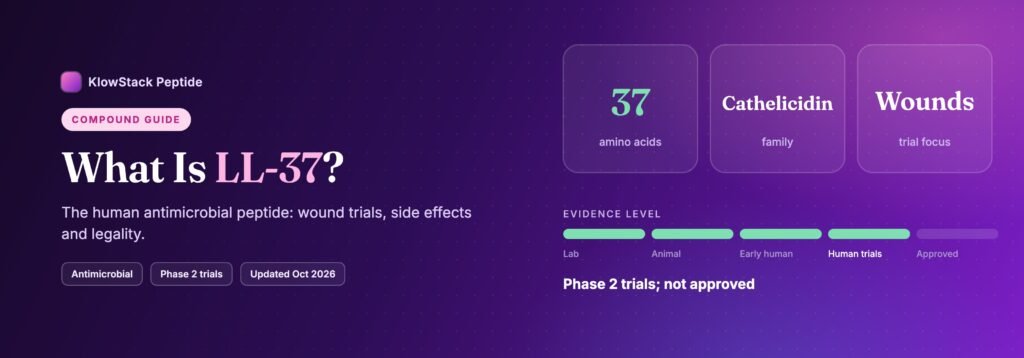
LL-37 is the only cathelicidin antimicrobial peptide humans make: a 37-amino-acid molecule released by white blood cells and skin cells that can punch holes in bacteria and also directs the immune response. It’s studied for chronic wounds, infections and cancer, and also for its role in inflammatory skin diseases like psoriasis and rosacea.
LL-37 is a good example of a molecule with two faces. In the right amount it helps defend and heal tissue; in excess, lab and patient studies tie it to inflammation and autoimmunity. Topical LL-37 has reached Phase 2 wound trials, with mixed results, and it isn’t approved for any medical use as of October 2026.
LL-37 isn’t approved for any use, and research-grade LL-37 is sold for research use only. This guide is educational; see our Medical Disclaimer.
What Is LL-37?
LL-37 is a natural human peptide named for its first two amino acids (two leucines) and its length of 37. It’s part of the innate immune system, the body’s first line of defense, and it’s found in white blood cells, skin, the lining of the lungs and gut, sweat, saliva and breast milk.
Where it comes from. Cells make LL-37 as part of a bigger, inactive protein called hCAP18. When neutrophils, the white blood cells that rush to infections, get activated, an enzyme snips off the active 37-amino-acid tail. Skin cells ramp up production when skin is cut or infected.
How it was found. Researchers at the Karolinska Institute in Stockholm identified the human cathelicidin gene in 1995, and the active peptide was soon named LL-37. Animals have their own cathelicidins (cows, pigs and mice have several), but humans have only this one.
The vitamin D link. In 2006, a UCLA study in Science showed that immune cells use vitamin D to switch on cathelicidin and kill tuberculosis bacteria. That’s part of why researchers think vitamin D status may affect infection risk, and why many studies measure LL-37 levels after vitamin D supplements.
Also known as: LL37, cathelicidin and hCAP18
LL-37 and LL37 are interchangeable. “Cathelicidin” is the family name; in people it refers to LL-37 and its precursor hCAP18. CAMP is the gene’s name, and FALL-39 was a 39-amino-acid version described before the true active form was pinned down. Shorter lab-made fragments, such as KR-12 and FK-16, are separate molecules with their own data.
How Does LL-37 Work?
LL-37 works in two ways. It directly kills microbes by binding and disrupting their outer membranes, and it acts as an immune signal that attracts white blood cells, neutralizes bacterial toxins, and helps skin cells and blood vessels rebuild wounds. Most of this comes from lab and animal research.
What’s known, and from what kind of research:
- Membrane attack (lab): LL-37 is positively charged and spiral shaped, so it sticks to the negatively charged surfaces of bacteria, fungi and some viruses and breaks them open.
- Toxin neutralizing (lab and animal): it binds lipopolysaccharide, a toxin from bacterial walls that drives septic shock, and lowered inflammation in animal sepsis models.
- Wound repair (lab and animal): it encourages skin cells to migrate and new blood vessels to form, and chronic ulcers have been found to contain unusually low LL-37.
- Immune alarm (lab and human tissue): a 2007 Nature study found LL-37 binds the body’s own DNA and makes it look foreign to immune cells, a trigger for psoriasis inflammation.
- Rosacea (human tissue and animal): a 2007 Nature Medicine study from UC San Diego found people with rosacea have abnormally high and abnormally processed cathelicidin in facial skin.
What does LL-37 do? Think of a home security system with both a lock and an alarm. LL-37 can lock out intruders directly and also call the police. That’s helpful during a break-in, but an alarm that keeps going off when no one’s there is its own problem, and in some skin diseases that’s what LL-37 seems to do.
What Is LL-37 Used For / Studied For?
LL-37 has been studied as a topical treatment for chronic venous leg ulcers and diabetic foot ulcers (human Phase 1 to 2b), as an injection into melanoma skin tumors (human Phase 1), and widely in the lab for infections, biofilms, sepsis and inflammatory diseases. Lab-made fragments are being developed as new antibiotics.
Venous leg ulcers
What was studied: a 2014 first-in-human trial of 34 people with hard-to-heal leg ulcers, comparing three strengths of topical LL-37 with placebo for four weeks, and the larger HEAL LL-37 Phase 2b trial of 148 patients in Poland and Sweden, published in 2021.
What it found: in the first trial, the two lower strengths healed ulcers several times faster than placebo, though the highest strength did no better than placebo. In the Phase 2b trial, LL-37 didn’t improve healing compared with placebo across the whole group. An after-the-fact analysis suggested a benefit in people with large wounds.
What it doesn’t show: a confirmed benefit. Post hoc subgroup findings need a new trial to test them.
Diabetic foot ulcers
What was studied: a randomized double-blind trial in Jakarta, run from 2020 to 2021 and registered for 40 participants, comparing LL-37 cream with placebo cream on mildly infected diabetic foot ulcers for four weeks.
What it found: healthy new wound tissue (granulation) increased more in the LL-37 group at every check. Levels of two inflammation markers and bacterial counts didn’t differ clearly between groups.
What it doesn’t show: better infection control or complete healing rates; it was short and small.
Melanoma
What was studied: an MD Anderson Phase 1 trial injected LL-37 directly into melanoma skin metastases, aiming to rouse the immune system against the tumor. It enrolled four patients.
What it found: one published case from the trial reported shrinking of injected tumors but also many wart-like skin growths and blisters, which cleared within two months of stopping.
What it doesn’t show: whether LL-37 helps treat melanoma. Lab work also cuts the other way: a 2023 Japanese study linked higher LL-37 in melanoma tissue to deeper tumor invasion.
What LL-37 hasn’t been shown to do
It hasn’t been shown to treat Lyme disease, chronic infections, mold illness, gut problems or autoimmune disease in people, or to work as a general immune booster. Those uses are common online, but they rest on lab findings.
What Does the Human Research Show?
LL-37 itself has been given to people in only a few small trials: two leg-ulcer trials with 182 participants combined, one diabetic foot ulcer trial and a four-person cancer study. It was well tolerated on wounds. The largest trial missed its main goal, and none has led to approval.
| Study | Year | Design | Participants | Result | Limitation |
|---|---|---|---|---|---|
| Grönberg et al. | 2014 | Phase 1/2 RCT, 4 weeks | 34 adults, leg ulcers | Faster healing at two lower strengths | Small; highest strength no effect |
| MD Anderson (NCT02225366) | 2015 start | Phase 1, open-label | 4 adults, melanoma | Skin growths in one case; no efficacy data published | Tiny |
| Mahlapuu et al. (HEAL LL-37) | 2021 | Phase 2b RCT | 148 adults, leg ulcers | Missed primary goal; subgroup signal | Post hoc subgroup only |
| Miranda et al. | 2023 | Double-blind RCT, 4 weeks | About 40 adults, diabetic foot ulcers | More granulation tissue | Short; small |
PubMed (5,305 records for LL-37 or cathelicidin, mostly lab and biomarker work) and ClinicalTrials.gov searched October 5, 2026. Many registered “LL-37” studies only measure the body’s own levels.
Why it stalled. The Swedish developer, Promore Pharma, didn’t publish a move to Phase 3 after HEAL LL-37 missed its main goal. Trials that only measure natural LL-37, such as vitamin D studies, don’t test LL-37 as a treatment. Our Editorial Policy explains how we separate those.
LL-37 Side Effects and Safety
Topical LL-37 on chronic ulcers raised no safety concerns in trials enrolling more than 200 people. Injected into tumors, it caused widespread skin growths in one reported case. The broader concern comes from biology: too much LL-37 drives inflammation in psoriasis and rosacea, and it’s been tied to autoimmune disease.
Reported in human studies: no local or body-wide safety concerns in the 2014 leg ulcer trial, and good tolerability in HEAL LL-37. In the melanoma study, one woman developed many wart-like skin growths and blisters that resolved after LL-37 was stopped.
Expected from the mechanism:
- Inflammation and autoimmunity. LL-37 makes the body’s own DNA visible to immune cells, which is linked to psoriasis and studied in lupus. Raising LL-37 levels could plausibly flare these conditions.
- Rosacea. Excess cathelicidin fragments cause redness and inflammation in mouse skin, matching what’s seen in people with rosacea.
- Cell damage. In lab studies at high concentrations, LL-37 can damage human cells, including red blood cells, as well as microbes.
- Cancer signals. LL-37 appears to promote growth of some tumors in lab studies (including ovarian, breast and melanoma models) and to slow others (such as colon and stomach cancers).
Anecdotal only: people using research-grade LL-37 online describe injection-site redness, itching, flu-like feelings and fatigue. These reports haven’t been studied.
Product quality: at 37 amino acids, LL-37 is long enough that incomplete or wrong sequences can sneak into synthesis. Our peptide COA guide explains how mass testing confirms the right molecule.
Who should avoid LL-37
People with psoriasis, rosacea, lupus or other autoimmune conditions have the clearest reason to avoid it, given LL-37’s role in those diseases. So do people with a cancer history, anyone pregnant or breastfeeding, anyone under 18 and athletes in tested sport.
Does LL-37 cause autoimmune flares?
That hasn’t been tested directly in people taking LL-37. The concern comes from the 2007 Nature study and later work showing LL-37 helps trigger immune attacks on self-DNA in psoriasis and lupus, so it’s a theoretical but well-grounded worry.
LL-37 vs Thymosin Alpha-1
LL-37 and thymosin alpha-1 are both immune peptides, but they work at different levels. LL-37 is a frontline defender that kills microbes directly and sounds the alarm; thymosin alpha-1 is more of a coach for T cells and dendritic cells. Thymosin alpha-1 has the bigger human trial record.
| LL-37 | Thymosin alpha-1 | |
|---|---|---|
| Mechanism | Kills microbes directly; immune alarm signal | Trains and activates immune cells |
| Half-life | Short; broken down quickly in tissue | About 2 hours under the skin |
| Evidence | Phase 1 to 2b wound trials | Large sepsis and hepatitis trials |
| Status | Not approved; research use only | Approved abroad; not in the US |
See our thymosin alpha-1 guide for its trials.
Is LL-37 Legal?
LL-37 isn’t FDA-approved for any use. The FDA previously listed it in Category 2, compounding substances with potential safety risks, until the nomination was withdrawn, so pharmacies can’t compound it. It wasn’t part of the FDA’s July 2026 peptide review. Research suppliers sell it labeled “research use only.”
FDA. Topical LL-37 was studied as an investigational drug in Europe and Asia but has no US approval. After its 503A nomination was withdrawn, LL-37 isn’t on any list of substances pharmacies may use. The July 2026 Pharmacy Compounding Advisory Committee reviewed other peptides, including KPV and BPC-157; LL-37 wasn’t among them.
Vitamin D isn’t LL-37. Vitamin D supplements raise the body’s own LL-37 production and are sold legally as supplements. That’s a separate question from taking synthetic LL-37.
Research use only. This label means the product hasn’t been checked for human use. Our guide to whether research peptides are legal explains the details.
Sport. LL-37 isn’t named on the 2026 WADA Prohibited List. WADA’s S0 class bans pharmacological substances without government approval for human therapeutic use, which would appear to cover it, so athletes should check with their anti-doping agency.
FDA and WADA status checked October 5, 2026.
Where LL-37 Fits: Needs & Symptoms
LL-37 appears in Anti-Inflammatory Signaling, described as an antimicrobial peptide studied for its dual role in immune defense and inflammatory signaling regulation. That “dual role” description fits: it can calm inflammation in some settings and drive it in others.
Other guides in that category include thymosin alpha-1, an immune-coaching peptide with sepsis and hepatitis trials, and VIP, a gut and lung signaling peptide studied for inflammatory bowel conditions.
Frequently Asked Questions
What is LL-37?
LL-37 is the only human cathelicidin, a 37-amino-acid antimicrobial peptide made by white blood cells and skin. It kills microbes and signals the immune system.
What are the side effects of LL-37?
Topical use on ulcers was well tolerated in trials. Injected into tumors, it caused skin growths in one case. In theory, it could worsen psoriasis, rosacea or autoimmune disease.
What diseases are linked to LL-37?
Too much LL-37 is linked to psoriasis, rosacea and lupus. Too little has been seen in chronic wounds and some infections. Its role in cancer varies by tumor type.
How long does it take for LL-37 to work?
In the wound trials, healing was measured over four weeks. There’s no human data on timing for other uses, because those haven’t been tested.
Does vitamin D increase LL-37?
Yes. Immune and skin cells use active vitamin D to switch on the cathelicidin gene. That’s how vitamin D supports this part of the immune system.
Is LL-37 an antibiotic?
It works like a natural antibiotic in lab dishes, but it hasn’t been approved as one. Shorter lab-made versions are being studied as possible antibiotics.
Does LL-37 help with cancer?
Not proven. A tiny melanoma trial injected it into tumors, and lab studies show it can promote some cancers and slow others.
Is LL-37 legal?
It isn’t FDA-approved, and its compounding nomination was withdrawn. It’s sold in the US only as a research chemical.
How much LL-37 should be used?
There’s no research-based dosing for non-approved use, and we don’t publish dosing for any compound. See our Medical Disclaimer.
Sources
Primary studies
- Liu PT, et al. 2006. Toll-like receptor triggering of a vitamin D-mediated human antimicrobial response. Science. doi:10.1126/science.1123933
- Lande R, et al. 2007. Plasmacytoid dendritic cells sense self-DNA coupled with antimicrobial peptide. Nature. doi:10.1038/nature06116
- Yamasaki K, et al. 2007. Increased serine protease activity and cathelicidin promotes skin inflammation in rosacea. Nature Medicine. doi:10.1038/nm1616
- Grönberg A, et al. 2014. Treatment with LL-37 is safe and effective in enhancing healing of hard-to-heal venous leg ulcers: a randomized, placebo-controlled clinical trial. Wound Repair and Regeneration. doi:10.1111/wrr.12211
- Dolkar T, et al. 2018. Dermatologic toxicity from novel therapy using antimicrobial peptide LL-37 in melanoma. Journal of Cutaneous Pathology. doi:10.1111/cup.13262
- Mahlapuu M, et al. 2021. Evaluation of LL-37 in healing of hard-to-heal venous leg ulcers: a multicentric prospective randomized placebo-controlled clinical trial. Wound Repair and Regeneration. doi:10.1111/wrr.12977
- Ohuchi K, et al. 2023. LL-37 might promote local invasion of melanoma by activating melanoma cells and tumor-associated macrophages. Cancers. doi:10.3390/cancers15061678
- Miranda E, et al. 2023. Efficacy of LL-37 cream in enhancing healing of diabetic foot ulcer: a randomized double-blind controlled trial. Archives of Dermatological Research. doi:10.1007/s00403-023-02657-8
Regulatory and trials
Disclaimer: LL-37 isn’t approved for any use, and research-grade LL-37 is sold for research use only. This guide is educational and doesn’t give medical advice. Read our Medical Disclaimer and Editorial Policy.