
Reviewed by Thomas Okafor, Peptide Chemist · Updated October 2026
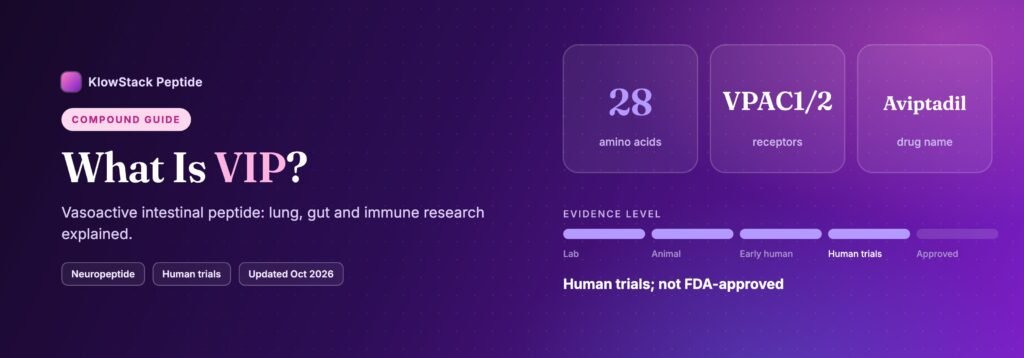
Vasoactive intestinal peptide (VIP) is a 28-amino-acid messenger made by nerve and immune cells throughout the gut, lungs, brain and blood vessels. It relaxes smooth muscle, widens blood vessels, tells the gut to release water and calms several kinds of immune cells, which is why it’s studied for lung disease, inflammatory bowel conditions and sepsis-like inflammation.
VIP has more human research than most peptides on this site. As the drug aviptadil, it’s been tested in COVID-19 respiratory failure (including a 471-person NIH trial), sarcoidosis and pulmonary hypertension, and combined with phentolamine for erectile dysfunction in Europe. It isn’t FDA-approved for any use, though pharmacies can currently compound it under an FDA interim policy.
VIP isn’t FDA-approved for any use, and research-grade VIP is sold for research use only. This guide is educational; see our Medical Disclaimer.
What Is VIP (Vasoactive Intestinal Peptide)?
VIP is a neuropeptide, a small protein that nerve cells release as a signal. It was found in 1970 by Sami Said and Viktor Mutt in Stockholm, who isolated it from pig intestine and named it for its effect on blood vessels (“vasoactive”). It turned out to be made all over the body, especially in the gut and lungs.
What it does in the body. In the gut, VIP relaxes the muscle wall and tells the lining to release water and salt into the intestine, which keeps things moving. In the lungs, it relaxes airways and blood vessels. In the brain, it helps set the body’s 24-hour clock. On immune cells, it generally turns down inflammation.
A natural experiment. The clearest proof of VIP’s power comes from VIPomas, rare tumors that pump out huge amounts of it. People with these tumors get severe watery diarrhea, low potassium and flushing, a pattern sometimes called “pancreatic cholera.” That shows both what VIP does and what too much of it can cause.
The drug version. Synthetic VIP is called aviptadil. Researchers in Austria and Germany tested inhaled forms for pulmonary hypertension and sarcoidosis in the 2000s. In 2020 and 2021, US company NRx Pharmaceuticals tested intravenous aviptadil, branded ZYESAMI, for critical COVID-19.
Also known as: aviptadil, vasoactive intestinal polypeptide and VIP
“Vasoactive intestinal polypeptide” is the older full name. Aviptadil is the official drug name, ZYESAMI was NRx’s brand in COVID-19 trials, and Invicorp is a European injection that pairs VIP with phentolamine for erectile dysfunction. Don’t confuse VIP with PACAP, a related peptide that shares its receptors.
How Does VIP Work?
VIP works by binding two receptors, VPAC1 and VPAC2, found on smooth muscle, blood vessel walls, gut lining and immune cells. Switching them on raises a messenger called cyclic AMP inside the cell, which relaxes muscle, widens vessels and dampens the release of inflammatory signals like TNF-alpha and IL-6.
What’s known, and from what kind of research:
- Blood vessels and airways (human): VIP widens blood vessels and relaxes airway muscle, effects measured directly in people.
- Gut water and motility (human): VIP drives fluid into the intestine; VIPoma patients show what happens at very high levels.
- Immune calming (lab and animal): VIP lowers TNF-alpha and other inflammatory signals from immune cells and increases regulatory T cells, the immune system’s peacekeepers.
- Colitis (animal): VIP protected mice in several colitis models, though one 2015 study found mice lacking VIP had milder colitis, which complicates the story.
- Lungs (animal and human): VIP is found at low levels in the lungs of people with pulmonary hypertension, and it protects lung cells in animal injury models.
What does VIP do? Picture a home’s thermostat and plumbing on one control panel. VIP turns down the heat (inflammation), opens the pipes (blood vessels and airways) and runs the water (gut fluid). That’s useful in the right place, but it’s hard to turn on one function without the others.
What Is VIP Used For / Studied For?
VIP has been studied in people for COVID-19 respiratory failure, sarcoidosis, pulmonary hypertension and erectile dysfunction, and in animals for inflammatory bowel disease, arthritis and sepsis. It’s also prescribed off-label in some US clinics as a compounded nasal spray, a use that lacks controlled trials.
COVID-19 respiratory failure
What was studied: a 2022 NRx-funded trial of 196 patients at 10 US hospitals, and the NIH-funded TESICO trial of 471 patients at 28 US sites, both using three-day IV infusions of aviptadil versus placebo.
What it found: the NRx trial missed its main goal (alive and free of respiratory failure at day 60), though the authors reported better survival in an additional analysis. TESICO found no improvement at day 90: 38% died on aviptadil versus 36% on placebo.
What it doesn’t show: a benefit in COVID-19. The larger, independent trial was clearly negative.
Sarcoidosis
What was studied: a 2010 open-label Phase 2 study in Germany gave inhaled VIP for four weeks to 20 people with active lung sarcoidosis, a disease where clumps of immune cells form in the lungs.
What it found: inhaled VIP was safe and well tolerated, lowered TNF-alpha production by lung immune cells and increased regulatory T cells.
What it doesn’t show: improved breathing or disease course; there was no placebo group, and the measures were lab markers.
Pulmonary hypertension
What was studied: a 2003 Vienna study of inhaled VIP in eight people with pulmonary hypertension, and a 2008 Munich study giving a single inhaled dose to 20 patients during heart catheterization.
What it found: the Vienna study reported lower lung artery pressure and better heart output. The Munich study found the effect was small and short-lived, though it didn’t lower body-wide blood pressure.
What it doesn’t show: long-term benefit; the drug wasn’t developed further for this use.
Inflammatory bowel disease and mold-related illness
What was studied: IBD research is almost all in animals. Separately, some US physicians prescribe compounded VIP nasal spray for “chronic inflammatory response syndrome” (CIRS) blamed on mold exposure, based on a 2013 open-label study by the clinician who developed the protocol.
What it found: VIP reduced inflammation in many mouse colitis models. The CIRS study reported symptom and lab improvements.
What it doesn’t show: any human IBD benefit, and the CIRS study had no control group and isn’t indexed in PubMed. CIRS isn’t a widely recognized diagnosis.
What VIP hasn’t been shown to do
It hasn’t been shown to treat Crohn’s disease or ulcerative colitis in people, cure long COVID, help autism, improve athletic performance or build muscle. Many online claims extend animal findings to humans.
What Does the Human Research Show?
VIP’s human research is broader than most peptides’, with two US COVID-19 trials enrolling nearly 670 people and several small lung studies. It was generally safe, but the large trials didn’t show benefit, and the positive findings come from small, uncontrolled or single-dose studies.
| Study | Year | Design | Participants | Result | Limitation |
|---|---|---|---|---|---|
| Petkov et al. | 2003 | Open-label | 8 adults, pulmonary hypertension | Lower lung artery pressure | Tiny; no control |
| Leuchte et al. | 2008 | Single dose, open-label | 20 adults, pulmonary hypertension | Small, short-lived vessel widening | One dose |
| Prasse et al. | 2010 | Open-label Phase 2 | 20 adults, sarcoidosis | Less TNF-alpha; more regulatory T cells | Lab markers only |
| Youssef et al. | 2022 | Phase 2b/3 RCT | 196 adults, critical COVID-19 | Missed primary goal | Sponsor-run |
| TESICO (Brown et al.) | 2023 | Phase 3 RCT, NIH | 471 adults, COVID-19 respiratory failure | No benefit at 90 days | Narrow population |
PubMed (1,006 records for aviptadil or VIP treatment studies) and ClinicalTrials.gov (9 aviptadil studies) searched October 5, 2026.
Why it stalled. NRx Pharmaceuticals sought emergency use authorization for ZYESAMI in COVID-19, which the FDA didn’t grant, and the independent TESICO trial later found no benefit. Several inhaled COVID-19 trials ended early for sponsor decisions or slow recruitment. Our Editorial Policy explains why we weight independent trials more than sponsor-run ones.
VIP Side Effects and Safety
In human studies, VIP’s side effects match what it does: flushing, low blood pressure, faster heartbeat and diarrhea. Inhaled VIP was well tolerated in small lung studies. In the TESICO trial, serious safety events were somewhat more common on aviptadil (63%) than placebo (56%), a difference that wasn’t statistically clear.
Reported in human studies: in TESICO, the main safety measure (death, serious adverse events, organ failure, serious infection or severe side effects by day 5) occurred in 63% on aviptadil and 56% on placebo. Smaller inhaled studies reported no notable side effects.
Expected from the mechanism:
- Low blood pressure and flushing. VIP widens blood vessels, so dizziness, warmth and a racing heart are predictable, especially with IV use.
- Watery diarrhea. VIPoma tumors show that high VIP levels cause severe diarrhea and potassium loss.
- Erections. VIP relaxes penile blood vessels, which is the basis for Invicorp; unwanted erections are possible.
Anecdotal only: people using compounded or research-grade nasal VIP describe nasal irritation, headaches, loose stools and lightheadedness. These reports haven’t been formally studied.
Product quality: VIP breaks down fast in blood and in poorly stored solutions. Our peptide COA guide explains how purity testing works, but a COA can’t show how a nasal spray was stored after mixing.
Who should avoid VIP
People with low blood pressure, heart rhythm problems or a history of chronic diarrhea have the clearest reasons to avoid it. So do people who are pregnant or breastfeeding, anyone under 18, and anyone taking blood pressure or erectile dysfunction medicines, which may add to VIP’s effects.
Can VIP cause dangerously low blood pressure?
It can lower blood pressure, especially by IV. That’s why COVID-19 trials used slow 12-hour infusions in hospital settings with close monitoring. Inhaled VIP in the 2008 Munich study didn’t affect body-wide blood pressure.
VIP vs KPV
VIP and KPV both calm gut inflammation in animal studies, but they’re very different molecules. VIP is a 28-amino-acid natural messenger with human trials in lung disease. KPV is a three-amino-acid fragment of alpha-MSH with mostly animal data, and it got a favorable FDA advisory vote in July 2026.
| VIP | KPV | |
|---|---|---|
| Mechanism | VPAC1 and VPAC2 receptors; vessel, muscle and immune effects | Enters cells and blocks NF-κB inflammation signaling |
| Half-life | About 1 to 2 minutes in blood | Not established in humans |
| Evidence | Human Phase 2 and 3 trials (lungs, COVID-19) | Mostly animal colitis studies |
| Status | 503A Category 1; not approved | Favorable PCAC vote (July 2026); not approved |
Our KPV guide covers its gut research in more depth.
Is VIP Legal?
VIP isn’t FDA-approved for any use. It’s in the FDA’s 503A Category 1, a holding list of bulk substances under evaluation, which means licensed compounding pharmacies can currently prepare it for individual patients with a prescription. Research-grade VIP is sold separately with a “research use only” label.
FDA and compounding. Category 1 is different from approval. Under an FDA interim policy, the agency generally doesn’t act against pharmacies compounding with Category 1 substances while it reviews them, as long as other rules are met. That’s why prescribed VIP nasal sprays are available. The FDA could later add VIP to its approved bulk list or reject it.
Aviptadil. Aviptadil has no FDA approval for COVID-19 or anything else. Invicorp (VIP with phentolamine) has been licensed for erectile dysfunction in some European countries, but not in the US.
Research use only. Products with this label haven’t been reviewed for human use and aren’t the same as pharmacy-compounded prescriptions. Our guide to whether research peptides are legal explains the difference.
Sport. VIP isn’t named on the 2026 WADA Prohibited List. Athletes should still check with their anti-doping agency before using any unapproved product.
FDA and WADA status checked October 5, 2026.
Where VIP Fits: Needs & Symptoms
VIP appears in Anti-Inflammatory Signaling, described as studied for its broad immunomodulatory effects, including research into inflammatory bowel conditions. That gut research is promising in animals, while VIP’s human trials have focused on the lungs.
Other compounds in that category include LL-37, an antimicrobial peptide that can both calm and drive inflammation, and thymosin alpha-1, an immune-coaching peptide with sepsis and hepatitis trials.
Frequently Asked Questions
What is VIP peptide used for?
In research, VIP has been tested for COVID-19 respiratory failure, sarcoidosis, pulmonary hypertension and erectile dysfunction. Animal studies focus on gut inflammation. It isn’t FDA-approved for any use.
Is VIP a good peptide?
It has stronger human research than many peptides, but the largest trial, TESICO, found no benefit in COVID-19. Its value outside small lung studies is still unproven.
How long does it take for VIP to work?
In lung studies, blood vessel effects appeared within minutes and faded quickly. VIP lasts only a minute or two in blood. Longer-term effects haven’t been measured in controlled trials.
Who should not take VIP?
People with low blood pressure, heart rhythm problems, chronic diarrhea, pregnancy or breastfeeding have the clearest reasons to avoid it, along with anyone on blood pressure medicines.
Is VIP nasal spray legal?
Pharmacies can currently compound VIP with a prescription because it’s in FDA Category 1. That isn’t FDA approval, and research-grade products are a different category.
Does VIP help inflammatory bowel disease?
It reduced colitis in many mouse studies, but there are no published human IBD trials. One mouse study even found that lacking VIP made colitis milder.
Is aviptadil the same as VIP?
Yes. Aviptadil is the drug name for synthetic VIP. ZYESAMI and Invicorp are brand names for specific aviptadil products tested in COVID-19 and erectile dysfunction.
What happens if you have too much VIP?
VIPoma tumors show the answer: severe watery diarrhea, low potassium, flushing and low blood pressure. This is why VIP’s gut effects get careful attention.
How much VIP should be used?
There’s no research-based dosing for non-approved use, and we don’t publish dosing for any compound. See our Medical Disclaimer.
Sources
Primary studies
- Said SI, Mutt V. 1970. Polypeptide with broad biological activity: isolation from small intestine. Science. doi:10.1126/science.169.3951.1217
- Petkov V, et al. 2003. Vasoactive intestinal peptide as a new drug for treatment of primary pulmonary hypertension. Journal of Clinical Investigation. doi:10.1172/JCI17500
- Leuchte HH, et al. 2008. Inhalation of vasoactive intestinal peptide in pulmonary hypertension. European Respiratory Journal. doi:10.1183/09031936.00050008
- Prasse A, et al. 2010. Inhaled vasoactive intestinal peptide exerts immunoregulatory effects in sarcoidosis. American Journal of Respiratory and Critical Care Medicine. doi:10.1164/rccm.200909-1451OC
- Abad C, et al. 2015. Vasoactive intestinal peptide-deficient mice exhibit reduced pathology in trinitrobenzene sulfonic acid-induced colitis. Neuroimmunomodulation. doi:10.1159/000364912
- Youssef JG, et al. 2022. The use of IV vasoactive intestinal peptide (aviptadil) in patients with critical COVID-19 respiratory failure: results of a 60-day randomized controlled trial. Critical Care Medicine. doi:10.1097/CCM.0000000000005660
- Brown SM, et al. 2023. Intravenous aviptadil and remdesivir for treatment of COVID-19-associated hypoxaemic respiratory failure in the USA (TESICO): a randomised, placebo-controlled trial. Lancet Respiratory Medicine. doi:10.1016/S2213-2600(23)00147-9
- Shoemaker RC, et al. 2013. Vasoactive intestinal polypeptide (VIP) corrects chronic inflammatory response syndrome (CIRS) acquired following exposure to water-damaged buildings. Health. doi:10.4236/health.2013.53053
Regulatory and trials
Disclaimer: VIP isn’t FDA-approved for any use, and research-grade VIP is sold for research use only. This guide is educational and doesn’t give medical advice. Read our Medical Disclaimer and Editorial Policy.