
Reviewed by Thomas Okafor, Peptide Chemist · Updated October 2026
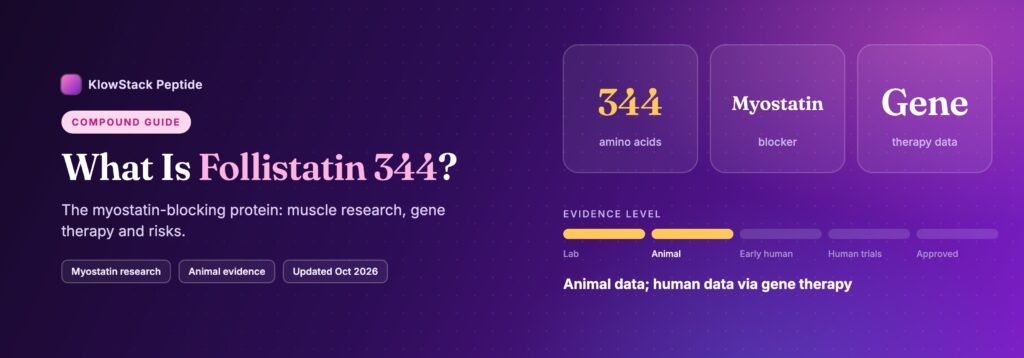
Follistatin 344 (FS344) is the longest form of follistatin, a natural protein that binds and neutralizes myostatin, the body’s main brake on muscle growth. It also binds activin, a hormone involved in reproduction and inflammation. Follistatin is studied for muscle-wasting diseases, mostly through gene therapy that gets muscle to produce extra follistatin on its own.
That distinction drives this guide. The published human studies of FS344 used a virus to deliver the follistatin gene into the leg muscles of people with rare muscle diseases. Nobody has published a trial of injecting follistatin protein, the form sold in research vials. No follistatin product is FDA-approved as of October 2026.
Follistatin 344 isn’t approved for any use, and research-grade follistatin is sold for research use only. This guide is educational; see our Medical Disclaimer.
What Is Follistatin 344?
Follistatin 344 is the full-length starting form of follistatin, a protein made in the ovaries, muscle, liver and many other tissues. The number is its length in amino acids. Cells trim FS344 into FS315, the main form circulating in blood, and a shorter version called FS288 clings to cell surfaces and works close to home.
Where the name comes from. Researchers first described follistatin in the 1980s in ovarian fluid, where it blocked the release of follicle-stimulating hormone. The muscle connection came later, after myostatin was discovered in 1997 as the protein that holds muscle size in check.
The link to muscle. A 2001 PNAS study from Se-Jin Lee’s lab at Johns Hopkins showed follistatin blocks myostatin from reaching its receptor, and that mice engineered to make extra follistatin grew dramatically more muscle. That result is the origin of nearly every follistatin claim you’ll read online.
Why FS344 specifically. When researchers built a gene therapy, they chose the FS344 version because it avoids binding to unintended targets elsewhere in the body, which they considered a safety advantage over other forms.
Also known as: FS344, FS315 and FS288
FS344 is the gene’s full product. FS315 is the circulating form, and FS288 is the cell-surface form. Research vials labeled “follistatin 344” usually contain a lab-made protein meant to match FS344. Follistatin-like 3 (FSTL3) and follistatin-like 1 are different proteins despite the similar names.
How Does Follistatin 344 Work?
Follistatin works as a trap. Myostatin normally docks onto activin type II receptors on muscle cells and signals them to limit growth. Follistatin wraps around myostatin so it can’t dock, which lifts that limit. It does the same to activin, which is why its effects reach beyond muscle.
What’s known, and from what kind of research:
- Myostatin trapping (lab): purified follistatin blocked myostatin from binding activin type II receptors in the 2001 Johns Hopkins experiments.
- Muscle growth (animal): mice engineered to produce extra follistatin gained far more muscle than normal mice, more than blocking myostatin alone would predict.
- Beyond myostatin (lab and animal): because follistatin also traps activin and several related growth factors, its muscle effect appears larger than a pure myostatin blocker’s.
- Less fibrosis (human tissue): muscle biopsies from the gene therapy trials showed reduced scar tissue after treatment.
- Reproductive signaling (lab): follistatin suppresses follicle-stimulating hormone release, its originally described job.
What does follistatin do? Picture a car with the parking brake partly engaged. Myostatin is that brake. Follistatin releases it, and in animals the muscle grows noticeably. Whether an injected protein can reach muscle tissue and do the same in a person is a separate question nobody has answered in a published trial.
What Is Follistatin 344 Used For / Studied For?
Follistatin 344 has been studied in people only as gene therapy for two muscle diseases: Becker muscular dystrophy and sporadic inclusion body myositis. Animal work covers muscle growth, muscular dystrophy and age-related muscle loss. Online, it’s promoted for muscle building, which no published human study supports.
Becker muscular dystrophy
What was studied: a Phase 1/2a trial at Nationwide Children’s Hospital in Ohio injected an AAV1 virus carrying the FS344 gene directly into both quadriceps muscles of six men with Becker muscular dystrophy, at two dose levels.
What it found: four of six walked meaningfully farther on a six-minute walking test, with gains from 29 to 125 meters. Two showed no change. Biopsies showed bigger muscle fibers and less scar tissue.
What it doesn’t show: benefit beyond the injected muscles, or durability. This was an open-label trial with no placebo group.
Sporadic inclusion body myositis
What was studied: a 2017 trial from the same team gave the FS344 gene therapy to the quadriceps of six people with inclusion body myositis, an inflammatory muscle disease, alongside an exercise program.
What it found: treated participants improved by about 56 meters per year on the walking test, while eight untreated comparison patients declined by about 26 meters per year.
What it doesn’t show: a true placebo comparison. The comparison group was matched, not randomly assigned, and everyone treated also exercised.
Muscle growth in healthy people
What was studied: nothing published. Research is in mice and in cell cultures.
What it found: animals making extra follistatin build substantially more muscle.
What it doesn’t show: that injecting follistatin protein increases muscle in healthy people. The gene therapy results came from muscle cells manufacturing follistatin continuously, which is a different thing entirely.
What follistatin 344 hasn’t been shown to do
It hasn’t been shown to build muscle in healthy people, burn fat, extend lifespan or treat sarcopenia. A clinic offering follistatin gene therapy for longevity has registered a small early-phase safety study, which hasn’t published results.
What Does the Human Research Show?
Human research on FS344 consists of two small gene therapy trials with twelve participants total, both from one Ohio research group, both open-label. Results were encouraging for walking distance. Neither tested the injectable protein form, and neither has led to an approved therapy.
| Study | Year | Design | Participants | Result | Limitation |
|---|---|---|---|---|---|
| Mendell et al. | 2015 | Phase 1/2a gene therapy, open-label | 6 men, Becker muscular dystrophy | 4 of 6 walked farther (29–125 m) | No placebo; one site |
| Mendell et al. | 2017 | Gene therapy, matched comparison | 6 adults, inclusion body myositis | +56 m/year vs −26 m/year untreated | Matched, not randomized; exercise included |
PubMed and ClinicalTrials.gov searched October 5, 2026. No registered trial of injected follistatin protein has published results.
What this means for research vials. A virus that permanently instructs muscle cells to produce follistatin is a different intervention from an injected protein, and the trial results don’t transfer. Our Editorial Policy explains how we handle this kind of gap.
Follistatin 344 Side Effects and Safety
The gene therapy trials reported no serious treatment-related adverse events in twelve participants, though those involved local muscle injections at one site. The safety of injected follistatin protein is unknown. The theoretical concerns come from what follistatin does outside muscle: it affects reproductive hormones, and activin signaling plays a role in several cancers.
Reported in human studies: no serious adverse events attributed to the gene therapy in either trial. The injections were local, and follistatin levels outside the treated muscles weren’t substantially raised.
Expected from the mechanism:
- Reproductive hormones. Follistatin suppresses follicle-stimulating hormone, so body-wide exposure could plausibly affect menstrual cycles or sperm production.
- Cancer signaling. Activin acts as a tumor suppressor in several tissues, and follistatin blocks activin. Higher follistatin levels have been linked to worse outcomes in some cancers, though that’s an association in tumor tissue, which isn’t evidence that follistatin causes cancer.
- Heart muscle. Myostatin also regulates heart muscle, and the long-term effects of blocking it in people aren’t known.
Anecdotal only: people using research-grade follistatin online report injection-site reactions and joint discomfort, and many say they can’t tell whether it did anything. These reports haven’t been studied.
Product quality: follistatin is a large glycoprotein, far bigger and more complex than the short peptides most research suppliers handle. Making it correctly requires mammalian cell systems, and standard purity testing can’t confirm the protein folded properly. Our peptide COA guide explains what these certificates do and don’t cover.
Who should avoid follistatin 344
Anyone with a personal or family cancer history has the clearest reason to avoid it, given the activin connection. So do people trying to conceive, anyone pregnant or breastfeeding, anyone under 18, people with heart conditions, and athletes in tested sport, where it’s explicitly banned.
Follistatin 344 vs Myostatin Inhibitor Drugs
Follistatin and pharmaceutical myostatin inhibitors aim at the same brake from different angles. Drug companies have spent two decades testing antibodies and decoy receptors against muscular dystrophy and age-related muscle loss. Most added muscle size without clearly improving strength or function, and several programs stopped.
| Follistatin 344 | Myostatin inhibitor drugs | |
|---|---|---|
| Mechanism | Traps myostatin plus activin and related factors | Target myostatin or its receptor specifically |
| Delivery studied | Gene therapy into muscle | Injections and infusions |
| Evidence | 12 people, gene therapy only | Multiple Phase 2 and 3 trials |
| Status | Not approved | None approved for muscle wasting |
The broader lesson from that field is worth carrying over: bigger muscles on a scan haven’t reliably meant stronger or more capable patients.
Is Follistatin 344 Legal?
Follistatin 344 isn’t FDA-approved for any use and isn’t on the FDA’s compounding nomination lists, so pharmacies can’t prepare it. Research suppliers sell it labeled “research use only.” WADA bans it in sport at all times, naming follistatin directly.
FDA. The gene therapy versions are investigational products studied under clinical trial rules; neither is approved. Follistatin protein doesn’t appear on the FDA’s 503A nomination lists and wasn’t part of the July 2026 peptide advisory review.
Research use only. This label means nobody has reviewed the product for human use. Our guide to whether research peptides are legal covers how that works.
Sport. The 2026 WADA Prohibited List bans myostatin inhibitors under section S4, listing myostatin-binding proteins such as follistatin by name. That ban applies in and out of competition.
FDA and WADA status checked October 5, 2026.
Where Follistatin 344 Fits: Needs & Symptoms
Follistatin 344 appears in two categories. In Muscle & Performance and in Recovery & Tissue Repair, it’s described as researched for its myostatin-inhibiting properties.
Among compounds in those categories, follistatin is unusual in having real human trial data, with the catch that the data come from gene therapy and not from an injected protein. Related guides include PEG-MGF and IGF-1 LR3, both studied for muscle signaling, and TB-500 for tissue repair.
Frequently Asked Questions
What is follistatin 344?
Follistatin 344 is the full-length form of follistatin, a natural protein that binds and neutralizes myostatin, the protein that limits muscle growth. It also binds activin.
Does follistatin build muscle?
In mice engineered to produce extra follistatin, yes, substantially. In people, the only published studies used gene therapy in muscle disease, and no trial has tested injected follistatin in healthy adults.
What’s the difference between follistatin 344 and 315?
FS344 is the starting form the gene produces. Cells trim it into FS315, which circulates in blood. FS288 is a third form that stays attached to cell surfaces.
Is follistatin banned in sports?
Yes. WADA’s 2026 list bans myostatin-binding proteins including follistatin under section S4, in and out of competition.
Is follistatin 344 safe?
The gene therapy trials reported no serious treatment-related events in twelve people. Injected follistatin protein hasn’t been studied in people, so its safety is unknown.
Does follistatin cause cancer?
There’s no evidence it causes cancer. The concern is theoretical: follistatin blocks activin, which suppresses tumors in some tissues, and some tumors show high follistatin.
Is follistatin 344 legal?
It isn’t FDA-approved or nominated for compounding, so it’s sold in the US only as a research chemical.
How much follistatin 344 should be used?
There’s no research-based dosing for non-approved use, and we don’t publish dosing for any compound. See our Medical Disclaimer.
Sources
Primary studies
- Lee SJ, McPherron AC. 2001. Regulation of myostatin activity and muscle growth. PNAS. PMID 11459935
- Mendell JR, et al. 2015. A phase 1/2a follistatin gene therapy trial for Becker muscular dystrophy. Molecular Therapy. doi:10.1038/mt.2014.200
- Mendell JR, et al. 2017. Follistatin gene therapy for sporadic inclusion body myositis improves functional outcomes. Molecular Therapy. doi:10.1016/j.ymthe.2017.02.015
Regulatory
Disclaimer: Follistatin 344 isn’t approved for any use, and research-grade follistatin is sold for research use only. This guide is educational and doesn’t give medical advice. Read our Medical Disclaimer and Editorial Policy.