
Reviewed by Thomas Okafor, PhD · Last reviewed October 21, 2026
Key Takeaways
- KPV is Lys-Pro-Val, the last three amino acids of the hormone alpha-MSH, studied for calming inflammatory signals inside gut and immune cells.
- BPC-157 is a 15-unit peptide cut from a larger stomach-juice protein, studied for protecting and repairing the gut lining.
- Both rely on rodent and cell studies. KPV’s gut work is mostly mouse colitis, and BPC-157’s is mostly rat lesion and colitis models.
- Human gut data: none for KPV, and none published for BPC-157.
Both peptides are research reagents for laboratory work only. The full statement is in our Medical Disclaimer.
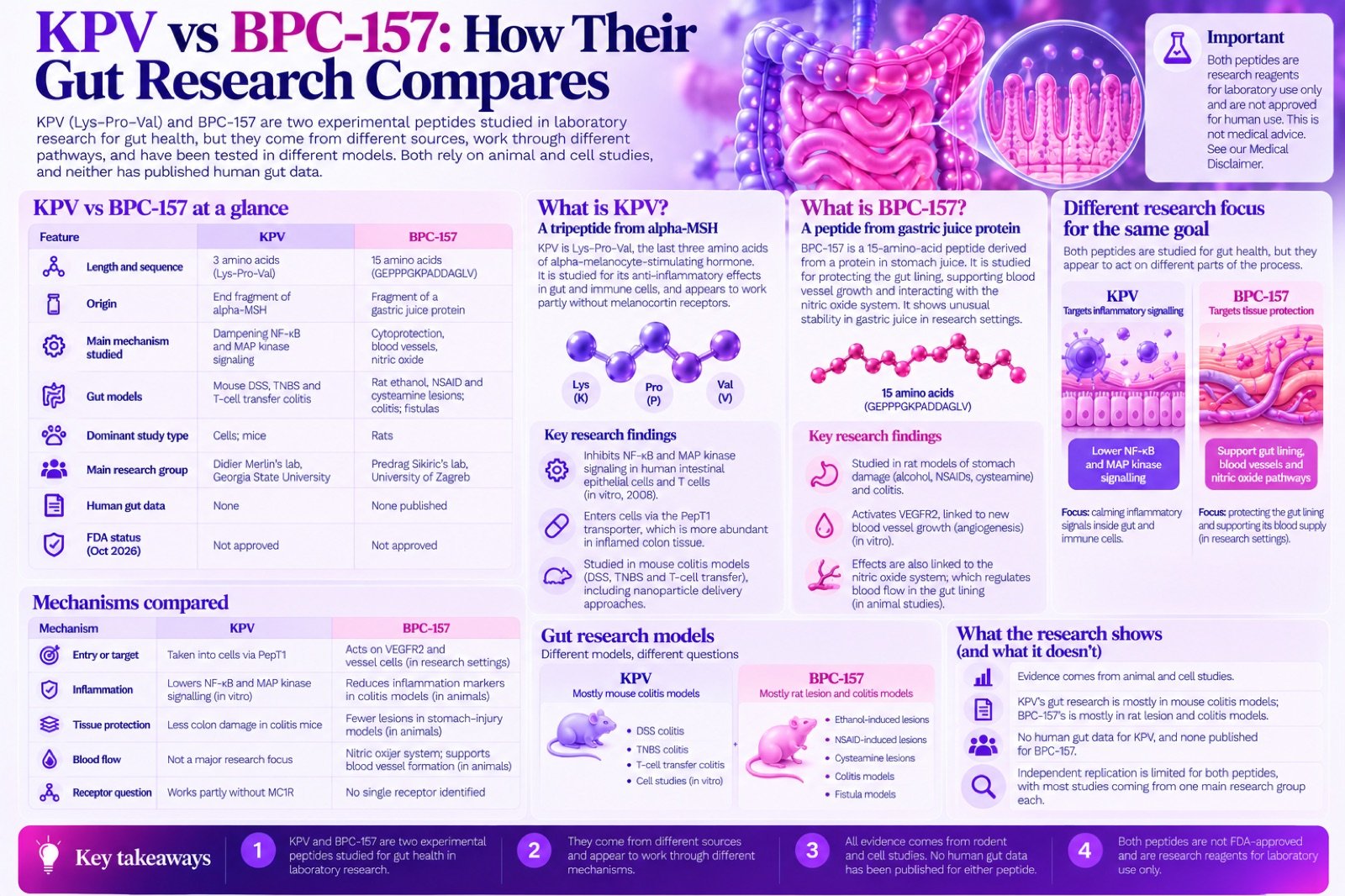
KPV vs BPC-157 at a Glance
KPV and BPC-157 come from different hormones and organs, work through different pathways, and were studied in different gut models. KPV research focuses on inflammation inside cells, while BPC-157 research focuses on the gut lining and its blood supply. Neither has published human gut data.
| KPV | BPC-157 | |
|---|---|---|
| Length and sequence | 3 amino acids (Lys-Pro-Val) | 15 amino acids (GEPPPGKPADDAGLV) |
| Origin | End fragment of alpha-MSH | Fragment of a gastric juice protein |
| Main mechanism studied | Dampening NF-κB and MAP kinase signaling | Cytoprotection, blood vessels, nitric oxide |
| Gut models | Mouse DSS, TNBS and T-cell transfer colitis | Rat ethanol, NSAID and cysteamine lesions; colitis; fistulas |
| Dominant study type | 🧪 Cells; 🐭 mice | 🐭 Rats |
| Main research group | Didier Merlin’s lab, Georgia State University | Predrag Sikiric’s lab, University of Zagreb |
| Human gut data | None | None published |
| FDA status (Oct 2026) | Not approved | Not approved |
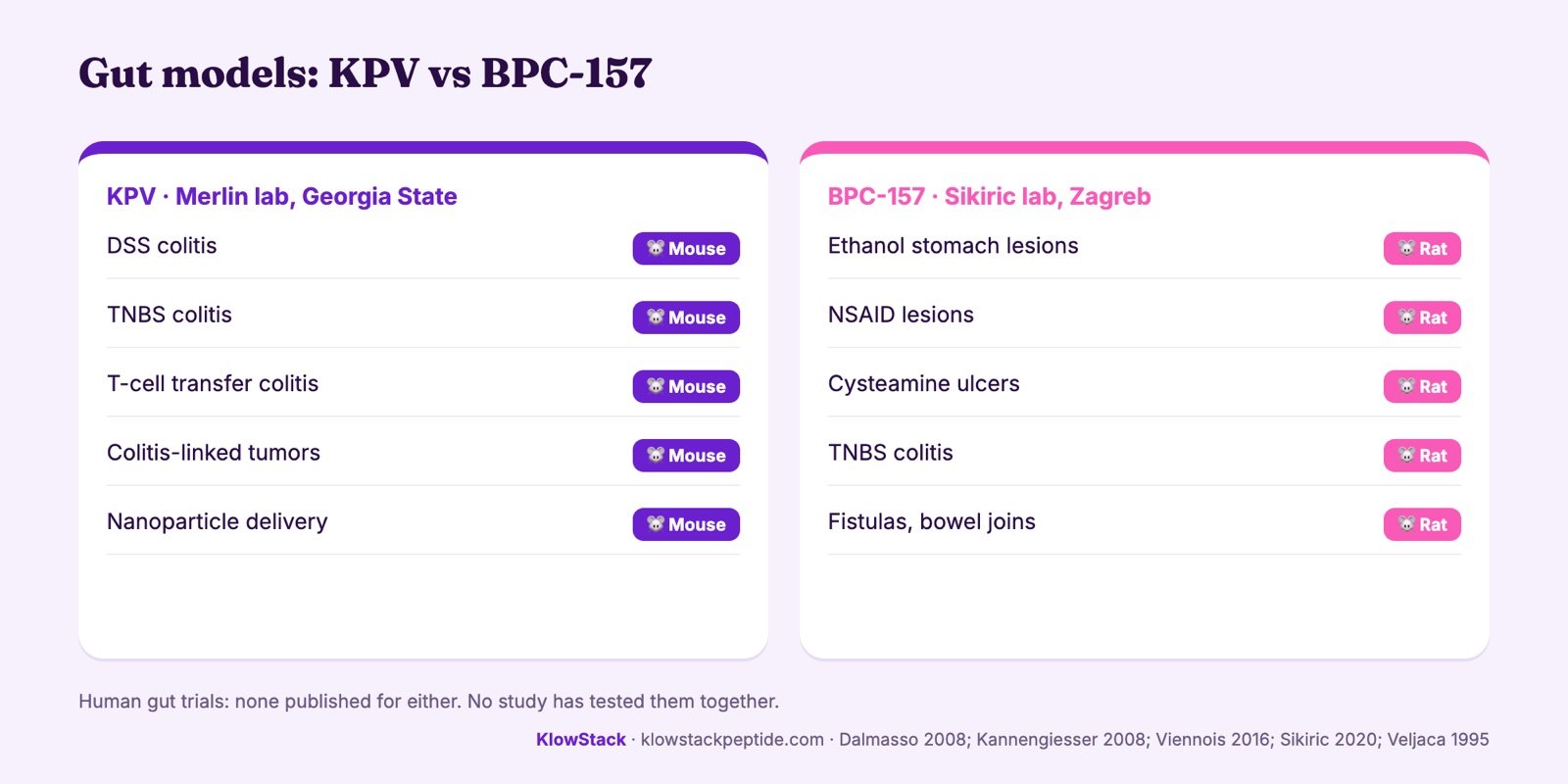
The “main research group” row explains a lot. It also hints at a practical point for readers: when one lab produces most of a compound’s papers, independent replication is the next thing to look for, and for both peptides it’s limited. Each compound’s gut story was largely written by one lab, which shapes both the models used and the questions asked.
What Is KPV?
KPV is a tripeptide matching positions 11 to 13 of alpha-melanocyte-stimulating hormone, a hormone known for pigmentation and anti-inflammatory effects. Researchers study KPV because it keeps anti-inflammatory activity in lab models despite its tiny size. Our KPV hub covers its background. Alpha-MSH acts on melanocortin receptors around the body, and KPV appears to work partly without them. More on the peptide is in our What Is KPV? guide.
NF-κB and Cytokine Signaling Findings
🧪 In a 2008 Gastroenterology study, Dalmasso and colleagues in Merlin’s lab found nanomolar concentrations of KPV inhibited NF-κB and MAP kinase signaling in human intestinal epithelial cells and T cells, lowering inflammatory cytokine release.
PepT1 Transporter Uptake and Nanoparticle Delivery in Colitis Models
🧪 The same study showed KPV enters cells through PepT1, a transporter for small peptides from digested food that becomes more abundant in inflamed colon tissue. 🐭 Researchers later packed KPV into hyaluronic acid-coated nanoparticles, about 272 nanometers across, and delivered them by mouth in colitis mice, aiming the peptide at colon and immune cells.
What Is BPC-157?
Croatian scientists identified BPC-157 in the early 1990s as a 15-amino-acid piece of a larger gastric juice protein. They report it holds up in stomach acid, and its gut research began with shielding the stomach lining in rats. Our BPC-157 hub covers its full story. Unlike most peptides, BPC-157 shows “unusual stability in gastric juice,” according to a May 2026 review in Pharmaceutics. See our What Is BPC-157? guide.
Mucosal and Lesion Models
🐭 Rat studies tested BPC-157 against stomach damage from alcohol, anti-inflammatory drugs such as indomethacin, and cysteamine, a chemical that causes duodenal ulcers. A 2020 review in Gut and Liver by Sikiric, Hahm and colleagues summarizes those models.
Angiogenesis and Nitric-Oxide Pathway Findings
🧪 BPC-157 activates VEGFR2, a receptor for new blood vessel growth, according to Hsieh and colleagues. 🐭 Sikiric’s rat studies also tie its effects to the nitric oxide system, which regulates blood flow in the gut lining.
Mechanisms Compared
KPV research describes a peptide that enters gut and immune cells and turns down inflammatory switches inside them. BPC-157 research describes a peptide that protects the gut lining, supports its blood vessels and interacts with nitric oxide signaling. One targets the inflammatory response, the other the tissue.
| Mechanism | KPV | BPC-157 |
|---|---|---|
| Entry or target | 🧪 Taken into cells by PepT1 | 🧪 Acts on VEGFR2 and vessel cells |
| Inflammation | 🧪 Lowers NF-κB and MAP kinase signaling | 🐭 Reduces inflammation markers in colitis models |
| Tissue protection | 🐭 Less colon damage in colitis mice | 🐭 Fewer lesions in stomach-injury models |
| Blood flow | Not a major research focus | 🐭 Nitric oxide system; bypass vessel formation |
| Receptor question | 🐭 Works partly without MC1R | No single receptor identified |
🐭 The MC1R point comes from Kannengiesser and colleagues, who found KPV still reduced colitis in mice lacking a working MC1R, alpha-MSH’s main receptor. That makes KPV a signaling molecule with its own route into cells, separate from its parent hormone. An analogy helps. In a flooded room, KPV research looks like turning off the alarm system that keeps calling in more crews, while BPC-157 research looks like patching the walls and pipes. Both are repair strategies, aimed at different parts of the problem.
Gut Research Compared by Study Type
Every result below comes from rodents or cells. Colitis in a mouse is a model of human disease, and results don’t transfer automatically. Our pages on KPV gut research and BPC-157 gut research go deeper.
KPV in Colitis Models
🐭 In Dalmasso’s study, KPV given in drinking water reduced inflammation in mice with DSS and TNBS colitis, two chemical models. Kannengiesser’s group reported faster weight regain and fewer inflammatory cells in DSS and T-cell transfer colitis. 🐭 A 2016 study by Viennois and colleagues found KPV prevented colitis-associated tumors in normal mice but not in mice lacking PepT1.
BPC-157 in Gut-Injury Models
🐭 Beyond the stomach lesion work, BPC-157 has been tested in rat colitis, colon-to-bladder fistulas and surgical bowel joins. An independent 1995 study from Warner-Lambert found that abdominal injection reduced chemical colon damage in rats, while delivery into the colon at the single tested amount didn’t. An enema formulation reportedly reached phase 2 ulcerative colitis trials in the 2000s, but full results were never published. There’s also a difference in what each model mimics. Chemical colitis models like DSS damage the colon lining directly, while T-cell transfer colitis is driven by the immune system, closer to how inflammatory bowel disease develops in people. KPV has data in both kinds. BPC-157’s gut data lean toward acute chemical injury in the stomach and colon.
What No Study Has Tested Yet
No study has compared KPV and BPC-157 in the same gut model. No human gut trial exists for either. And no one has measured how much of either peptide reaches colon tissue after oral delivery in people.
Have KPV and BPC-157 Been Studied Together?
No. When we searched PubMed on October 21, 2026, no experiment combining the two turned up. Both appear in the KLOW research blend, alongside GHK-Cu and TB-500, where KPV is the ingredient that separates KLOW from the three-peptide GLOW. KLOW itself hasn’t been tested as a blend. The KLOW stack guide lays out the formula, while our KLOW gut inflammation research page covers each component’s gut data.
Safety Data Compared
KPV has no human safety data and no formal toxicology studies. Lab and mouse studies reported no toxicity at tested amounts. BPC-157’s record adds a four-species animal toxicology screen and a trio of tiny human reports, none recording adverse events. Neither has long-term data. KPV. 🧪 Cell studies and nanoparticle work reported no toxicity to intestinal cells. 🐭 Mouse studies, designed to measure benefits, described no adverse effects. Our KPV side effects page lists what was and wasn’t measured. BPC-157. 🐭 Xu’s 2020 toxicology work screened BPC-157 in four animal species without finding meaningful toxicity. Liver results point the same way in rats, where Sikiric’s 1993 study reported protection against chemical liver injury. In people, the two-volunteer infusion pilot saw liver blood tests stay stable. See our BPC-157 side effects page.
Regulatory Status
Neither peptide has FDA approval, as of October 21, 2026. Key 2026 developments, each sourced:
- April. Both left FDA’s Category 2 compounding list when their nominations were withdrawn, shown on the FDA’s compounding safety-risk page (updated April 22, 2026). Our April Category 2 report covers it.
- July. FDA’s compounding advisers recommended both for the compounding bulks list, as our July advisory vote report describes. FDA hasn’t acted on the recommendation.
- October 15. HHS and FDA sent an interim compounding-access policy to the White House, reportedly covering BPC-157, per our interim access policy report.
Each category is explained in our peptide legality guide.
Research FAQ
What is the main difference between KPV and BPC-157?
KPV is a three-amino-acid fragment of alpha-MSH studied for dampening inflammatory signaling inside cells. BPC-157, a 15-amino-acid stomach-protein fragment, is studied for protecting the gut lining and its blood supply.
Have KPV and BPC-157 been studied together?
No published study has combined them, as of October 21, 2026. They appear together only in research blends such as KLOW, which hasn’t been tested.
What safety data exists for KPV?
Only lab and mouse studies, which reported no toxicity at tested amounts. No human safety study or formal toxicology program exists.
What do animal studies report about BPC-157 and the liver?
Rat liver work from 1993 reported protection in three chemical and surgical injury models, and the 2020 four-species toxicology screen flagged no liver problems.
How does oral delivery research differ for each?
KPV was given in drinking water and as hyaluronic acid nanoparticles to colitis mice, entering cells through PepT1. BPC-157 was given by stomach tube or drinking water to rats, relying on its reported gastric stability. Neither has human oral data.
Are KPV or BPC-157 FDA-approved?
No. The FDA hasn’t approved either one, as of October 21, 2026. FDA advisers recommended both for compounding in July 2026, and FDA hasn’t added them to the 503A Bulks List. Our peptide comparisons hub and BPC-157 vs TB-500 comparison cover related pairs.
Sources
- [In vitro + animal] Dalmasso G, et al. 2008. PepT1-mediated tripeptide KPV uptake reduces intestinal inflammation. Gastroenterology. PMC2431115
- [Animal] Kannengiesser K, et al. 2008. Melanocortin-derived tripeptide KPV has anti-inflammatory potential in murine models of inflammatory bowel disease. Inflammatory Bowel Diseases. doi:10.1002/ibd.20334
- [Animal] Xiao B, et al. 2017. Orally targeted delivery of tripeptide KPV via hyaluronic acid-functionalized nanoparticles. Molecular Therapy. PMC5498804
- [Animal] Viennois E, et al. 2016. Critical role of PepT1 in promoting colitis-associated cancer and therapeutic benefits of the anti-inflammatory PepT1-mediated tripeptide KPV in a murine model. Cellular and Molecular Gastroenterology and Hepatology. PMC4957955
- [Review] Mateescu DM, et al. 2026. BPC-157 as an investigational peptide therapeutic. Pharmaceutics. doi:10.3390/pharmaceutics18050625
- [Review: animal] Sikiric P, Hahm KB, et al. 2020. Stable gastric pentadecapeptide BPC 157, Robert’s stomach cytoprotection/adaptive cytoprotection/organoprotection, and Selye’s stress coping response. Gut and Liver. doi:10.5009/gnl18490
- [In vitro + animal] Hsieh MJ, et al. 2017. Therapeutic potential of pro-angiogenic BPC157 is associated with VEGFR2 activation and up-regulation. Journal of Molecular Medicine. doi:10.1007/s00109-016-1488-y
- [Animal] Veljaca M, et al. 1995. BPC-15 reduces trinitrobenzene sulfonic acid-induced colonic damage in rats. Journal of Pharmacology and Experimental Therapeutics. PubMed
- [Animal toxicology] Xu C, et al. 2020. Preclinical safety evaluation of body protective compound-157. Regulatory Toxicology and Pharmacology. doi:10.1016/j.yrtph.2020.104665
- [Animal] Sikiric P, et al. 1993. Hepatoprotective effect of BPC 157 on liver lesions in rats. Life Sciences. doi:10.1016/0024-3205(93)90589-u
- [Regulatory] Certain Bulk Drug Substances for Use in Compounding that May Present Significant Safety Risks, FDA, current as of April 22, 2026