
Reviewed by Thomas Okafor, PhD · Last reviewed October 22, 2026
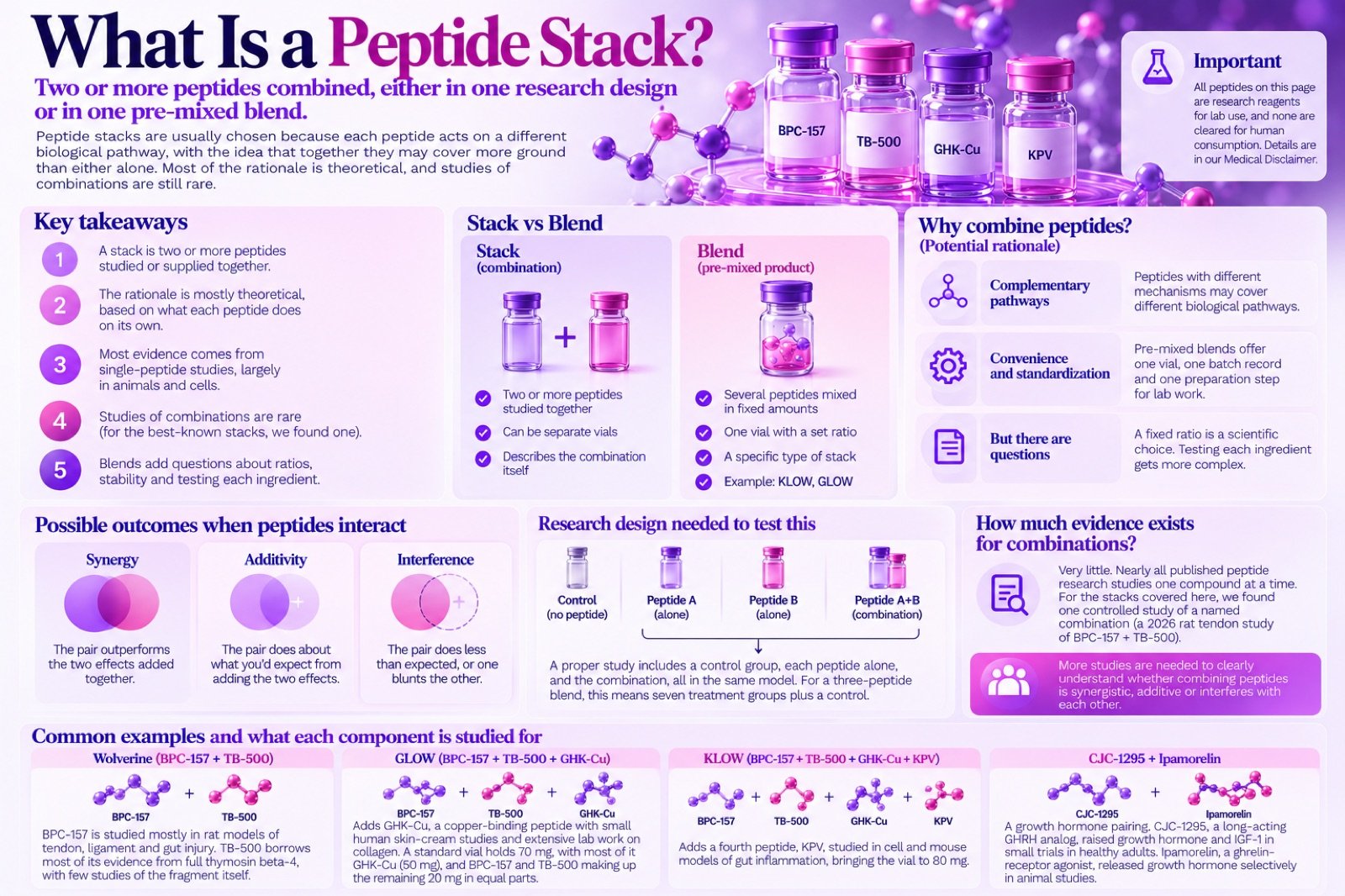
A peptide stack is two or more peptides combined, either in one research design or in one pre-mixed blend. They’re usually chosen because each acts on a different biological pathway, on the idea that together they’ll cover more ground than either alone. That idea is easy to state and surprisingly hard to test. Here’s the short version before the detail:
- The rationale is mostly theoretical. Stacks are built from what each peptide does on its own.
- Most evidence comes from single-peptide studies, largely in animals and cells.
- Studies of combinations are rare. For the best-known stacks, we found one.
- Blends add their own questions, about ratios, stability and testing each ingredient.
Every peptide on this page is a research reagent for lab use, and none is cleared for human consumption; details are in our Medical Disclaimer.
What a Peptide Stack Means
In research, a “stack” means two or more peptides studied or supplied together. A “blend” is a specific kind of stack: several peptides mixed in fixed amounts in one vial, such as KLOW or GLOW. Online, “stacking” often also implies a personal protocol, which KlowStack doesn’t cover. The word comes from fitness and supplement culture, where “stacking” long meant combining products. In the scientific literature, the same idea goes by plainer names: combination studies, co-administration, or factorial designs. You’ll rarely find “stack” in a journal title. Two distinctions keep things clear:
- Stack describes the combination itself. Two separate vials studied together count.
- Blend describes a physical product, with every peptide pre-mixed at a set ratio.
KLOW, GLOW and the Wolverine stack can exist either way: as a single blended vial or as separate vials. Labels deserve a close look. A blend’s headline number is usually the total, such as “70 mg,” which says nothing about how much of each peptide is inside unless the per-ingredient amounts are listed too. Our peptide blends guide explains how blends are made and labeled.
Why Researchers Combine Peptides
Complementary Pathways
The usual argument is that peptides with different mechanisms might add up. 🧪 BPC-157, for example, activated VEGFR2, a receptor for new blood vessel growth, in a 2017 lab study. 🧪 Thymosin beta-4, the parent protein of TB-500, is best known for managing actin, the protein cells use to move. One pathway feeds tissue with blood supply and the other moves cells into place, so pairing them sounds logical. The physiology of growth hormone offers a stronger example. 👤 In a 2009 study of 47 men, Mayo Clinic researcher Johannes Veldhuis and Cyril Bowers infused GHRH together with GHRP-2, two signals acting on different pituitary receptors, and found that delivering both at once produced a growth hormone response well beyond either signal alone.
Testing Interactions: Synergy, Additivity or Interference
When two peptides meet, three things can happen:
- Synergy: the pair outperforms the two effects added together.
- Additivity: the pair does about what you’d expect from adding the two effects.
- Interference: the pair does less than expected, or one blunts the other.
Only a study with separate arms can tell these apart. A proper design includes a control group, each peptide alone, and the combination, all in the same model. For a three-peptide blend like GLOW, testing every single peptide and every pair means seven treatment groups plus a control. Without the single-peptide arms, a combination result can’t show which ingredient did what, or whether combining helped at all. That design is also why combination studies are rare. Each extra arm needs more animals, more peptide and more funding, and the number of groups climbs quickly as ingredients are added. For compounds without a drug company behind them, few research groups have the budget to run all those arms properly.
Convenience and Standardization
For lab work, pre-mixed blends offer one vial, one batch record and one preparation step. That convenience is real. It also locks in one ratio, which is a scientific choice in its own right, covered below. Testing gets harder too. Once several peptides share a vial, the lab analysis has to separate and measure each one, which takes more careful HPLC work than checking a single compound, and a weak method can blur one peptide into another.
Common Examples and What Each Component Is Studied For
Wolverine (BPC-157 + TB-500)
🐭 BPC-157 is studied mostly in rat models of tendon, ligament and gut injury. 🐭 TB-500 borrows most of its evidence from full thymosin beta-4, with few studies of the fragment itself. Our Wolverine stack guide covers the pairing, and our BPC-157 vs TB-500 comparison contrasts the two.
GLOW (BPC-157 + TB-500 + GHK-Cu)
GLOW adds GHK-Cu, a copper-binding peptide with 👤 small human skin-cream studies and 🧪 extensive lab work on collagen. A standard vial holds 70 mg, most of it GHK-Cu (50 mg), with BPC-157 and TB-500 making up the remaining 20 mg in equal parts. See our GLOW peptide guide.
KLOW (BPC-157 + TB-500 + GHK-Cu + KPV)
KLOW adds a fourth peptide, KPV, studied in 🧪 cell and 🐭 mouse models of gut inflammation, bringing the vial to 80 mg. Our KLOW stack guide and KLOW vs GLOW comparison explain the difference.
CJC-1295 + Ipamorelin
A growth hormone pairing. 👤 CJC-1295, a long-acting GHRH analog, raised growth hormone and IGF-1 in small trials in healthy adults. 🐭 Ipamorelin, a ghrelin-receptor agonist, released growth hormone selectively in animal studies. Our CJC-1295 vs ipamorelin comparison covers both.
How Much Evidence Exists for Combinations?
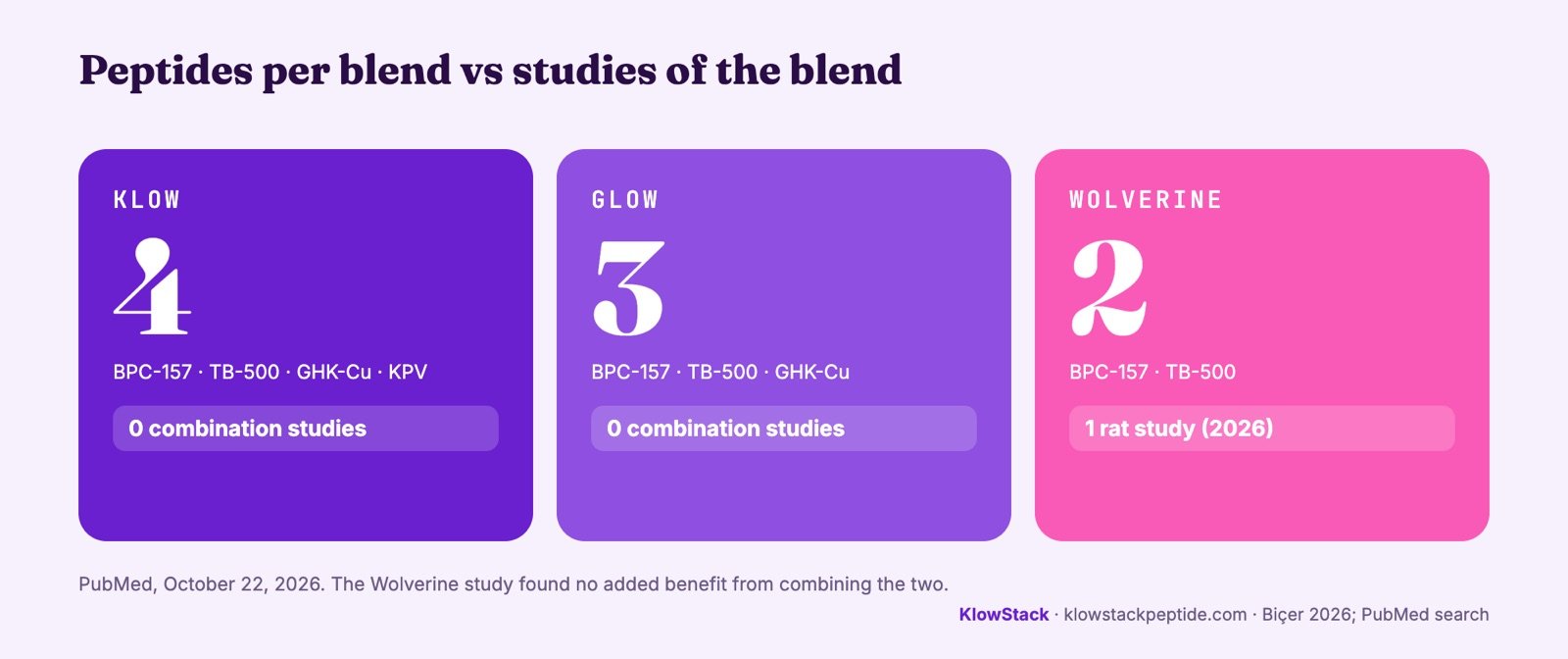
Very little. Nearly all published peptide research studies one compound at a time. For the stacks above, our October 22, 2026 PubMed search turned up one controlled study of a named combination: a 2026 rat tendon study of BPC-157 and TB-500, which found the pair did no better than either alone. 🐭 That study, by Biçer, Adanir and colleagues in Istanbul, is a good model of how combination research should work. It used four groups of rats: control, BPC-157 alone, TB-500 alone and both together. TB-500 alone produced the strongest tendons, and the combination “did not confer additional benefits compared to either agent alone.” The authors suggested the two peptides may converge on shared downstream pathways, the opposite of the complementary-pathway theory. For GLOW, KLOW and CJC-1295 with ipamorelin, we found no published combination studies at all. Even the stronger growth hormone evidence comes with a caveat. In the Veldhuis study, the size of the GHRH and GHRP-2 effect varied a lot from man to man, tracking age and abdominal fat, so a pairing that works on average can work very differently across individuals. Why can’t single-peptide results simply be added together? Because each study used its own species, injury model, delivery route, amount and timeline. A rat Achilles result for one peptide and a mouse colitis result for another describe different experiments. Stacking the conclusions doesn’t stack the evidence. A useful way to judge any claim is an evidence ladder: 🧪 cells in a dish at the bottom, then 🐭 animal studies, then 👤 small human studies, with randomized controlled trials at the top. Most stack claims rest on the bottom two rungs, for ingredients studied separately. Each rung answers a different question: cell studies show a mechanism is possible, animal studies show it can happen in a living body, and only controlled human trials show what happens in people. A stack that skips the combination step on every rung is still at the starting line.
Research and Quality Limits of Stacks
Combining peptides multiplies the questions a single vial raises:
- Ratios. Why 50:10:10 for GLOW? No published study compared ratios, so blend recipes reflect convention more than data.
- Identity and purity of each ingredient. A blend’s certificate of analysis needs separate results for every peptide. A single purity figure can hide one missing component. Our guide to verifying a peptide COA shows what to look for.
- Stability together. Copper can drive oxidation of histidine in peptides, forming cross-links, according to a 2025 Journal of the American Chemical Society study of histatin peptides. BPC-157, TB-500 and KPV contain no histidine, which eases one concern for blends that include GHK-Cu, though no stability study of KLOW or GLOW has been published.
- Product variability. University of Michigan researchers Christopher Mendias and Tariq Awan reported “extensive variability in purity and measured abundance” in consumer research peptides, in a 2026 preprint.
- Interactions. Unknown for every named blend.
Health systems have flagged the trend too. A January 2026 Henry Ford Health article described peptide stacking as an unregulated and under-researched area.
Stacks vs Single Peptides vs Cosmetic Peptide Formulations
Blend vs separate vials. A blend fixes the ratio and ties every ingredient to one batch. Separate vials let researchers test each peptide alone and in combination, which is how interactions get measured. Our page on KLOW vs the four peptides separately sets out the trade-offs. Cosmetic peptide formulations. Skincare often combines several peptides with other actives in one cream, such as palmitoyl peptides alongside copper peptides and retinoids. Those are topical cosmetic products, designed and regulated for skin appearance. Research peptide stacks are powders sold for lab work. The two share a word and little else. Even in skincare, combinations often go untested as combinations; we found no published study testing copper peptides together with retinoids, for example. Our Matrixyl guide covers one common cosmetic peptide.
Regulatory Status at a Glance
The FDA hasn’t approved any of the stack ingredients above, as of October 22, 2026. Its compounding safety-risk list (April 22, 2026 update) shows BPC-157, TB-500, KPV, GHK-Cu and CJC-1295 with withdrawn Category 2 nominations, while ipamorelin stays on the Category 2 list for outsourcing facilities. In sport, BPC-157 is named under section S0 of the WADA Prohibited List, and thymosin beta-4 derivatives such as TB-500 fall under section S2. Each category is explained in our peptide legality guide. Approved medicines face a stricter bar for combinations. FDA rules for fixed-combination prescription drugs allow two or more drugs in one product only “when each component makes a contribution to the claimed effects,” under 21 CFR 300.50. No research blend has been through that kind of test.
FAQ
What is a peptide stack?
A peptide stack is two or more peptides combined in one research design or one pre-mixed blend, usually chosen because each acts on a different pathway. Examples include the Wolverine stack (BPC-157 and TB-500) and the KLOW and GLOW blends.
What does peptide stacking mean?
Peptide stacking means combining peptides. In research it describes studying them together, ideally alongside each peptide alone. Online, the term often implies personal use, which KlowStack doesn’t cover. In journals, the same idea is called combination or co-administration research.
Why are peptides combined in research?
Mainly to test whether peptides with different mechanisms work better together. For example, one may be studied for blood vessel growth and another for cell movement. Blends also offer lab convenience, with one vial and one batch record.
Which peptide combinations are most discussed in research?
BPC-157 with TB-500 (the Wolverine stack), the GLOW and KLOW blends, and CJC-1295 with ipamorelin. Discussion far outpaces data: only the BPC-157 and TB-500 pair has a published controlled combination study, in rats.
Have peptide stacks been tested as combinations in studies?
Rarely. As of October 22, 2026, the only published controlled study of a named stack we found is a 2026 rat tendon study of BPC-157 and TB-500, which found no added benefit from combining them. GLOW, KLOW and CJC-1295 with ipamorelin have no combination studies. Our research guide explains how to read study designs.
Closing Note
A peptide stack is a hypothesis in a vial: each ingredient has its own research record, and the combination usually has none. The one stack tested as a stack didn’t show the synergy its pairing promised, which is exactly why combination studies are the missing piece.
Sources
- [Lab + animal] Hsieh MJ, et al. 2017. Therapeutic potential of pro-angiogenic BPC157 is associated with VEGFR2 activation and up-regulation. Journal of Molecular Medicine. doi:10.1007/s00109-016-1488-y
- [Human physiology] Veldhuis JD, Bowers CY. 2009. Determinants of GH-releasing hormone and GH-releasing peptide synergy in men. American Journal of Physiology: Endocrinology and Metabolism. doi:10.1152/ajpendo.91001.2008
- [Animal] Biçer O, Adanir O, et al. 2026. Effects of BPC-157 and TB-500 on Achilles tendon healing in rats. Joint Diseases and Related Surgery. doi:10.52312/jdrs.2026.2951
- [Chemistry] Bontreger LG, et al. 2025. Intramolecular histidine cross-links formed via copper-catalyzed oxidation of histatin peptides. Journal of the American Chemical Society. doi:10.1021/jacs.5c01363
- [Preprint] Mendias CL, Awan TM. 2026. Evaluation of research grade peptides marketed directly to consumers reveals extensive variability in purity and measured abundance. Preprints (not peer-reviewed). doi:10.20944/preprints202604.1748.v1
- [Health system] Peptide Stacking, Henry Ford Health, January 2026
- [Regulatory] Certain Bulk Drug Substances for Use in Compounding that May Present Significant Safety Risks, FDA, current as of April 22, 2026
- [Regulatory] The Prohibited List, World Anti-Doping Agency