
Reviewed by Thomas Okafor, Peptide Chemist · Last updated October 14, 2026
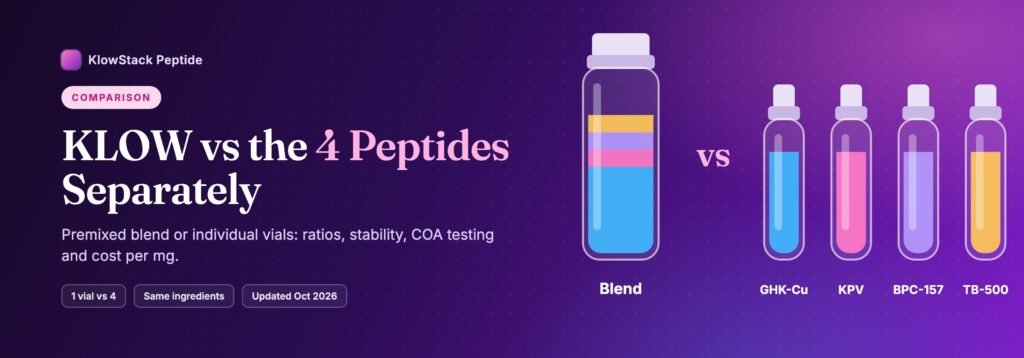
KLOW’s four peptides, GHK-Cu, KPV, BPC-157 and TB-500, reach buyers in two shapes: mixed together in one vial totaling 80 mg, or kept apart in four. The molecules don’t change between them. What changes is who controls the ratio, how stable the mixture is, how it gets tested and what it costs.
Every one of the four has a research file built from dish and rodent experiments. Researchers haven’t tested the combination in either packaging. This page compares the two formats on the points that can actually be checked, from ratio math to lab reports, and explains the reasoning behind combining peptides in the first place. Both are laboratory products; our Medical Disclaimer has the details.
| Premixed blend (one vial) | Separate vials (four) | |
|---|---|---|
| Vials | 1 | 4 |
| Ratio | Fixed by the manufacturer | Each amount labeled and measured on its own |
| COA | One report covering four peptides | Four single-peptide reports |
| Stability questions | Four peptides and copper share one vial | Each peptide stored on its own |
| Attribution in a study | Can only describe the mixture | Each peptide can be tested alone |
| Cost | About 90–180 per 80 mg vial | About 290–400 for a four-vial kit |
| Label risk | One blended figure can hide a short ingredient | Each vial’s contents checked separately |
What “KLOW Blend” and “KLOW Stack” Mean
A KLOW blend is the four peptides premixed and freeze-dried together in one vial. A KLOW stack is the same four peptides in four separate vials, sold as a bundle. Buying each peptide individually gives you the stack format without the bundle.
The terms get mixed up constantly online, partly because “stack” became a casual word for any peptide combination, and partly because some sellers call a single premixed vial a “KLOW stack.” Strictly, “stack” means separate vials and “blend” means premixed. Product photos help too. A single vial with a four-ingredient label is a blend. Four vials, each printed with one compound name and its own lot number, is a stack. When a listing is still unclear, the vial count and the certificate of analysis settle it: one report covering four peptides means a blend, four reports means a stack.
Our KLOW stack guide and our explainer on how peptide blends work go deeper on the terminology.
Why Combine Peptides at All? The Reasoning Behind KLOW
KLOW’s logic rests on coverage: collagen work from one peptide, cell movement from another, vessel growth from a third, inflammation from a fourth. Putting them together is an untested idea. Research on peptide mixtures of any kind is scarce, and KLOW’s own mixture has none.
The closest published example of peptide “synergy” involves entirely different molecules. In a 2021 in vitro study in the International Journal of Cosmetic Science, Flagler and colleagues tested cosmetic peptides (Ac-PPYL and Pal-KTTKS, with niacinamide) on lab-grown human skin cells and reported gene-activity changes larger than the sum of each ingredient alone. 🧪 That’s a cell-culture result, on peptides that aren’t in KLOW, from a study partly funded by a consumer-products company.
Scientists use three words for what can happen when compounds meet. Additive means the combined effect equals the sum of the parts. Synergistic means it’s larger. Antagonistic means one compound weakens another. Telling them apart takes careful experiments with each compound alone and together, at several amounts.
The Flagler study shows that synergy can happen in a dish. It says nothing about whether KLOW’s four peptides behave that way, which no one has tested. Our upcoming guide on what a peptide stack is will cover the idea of combining compounds more broadly.
Peptide Blends vs Single Peptides: The General Trade-offs
A peptide blend means two or more peptides mixed in one product. A single peptide has a defined identity: one sequence, one molecular weight, one registry number. A blend has none of those as a whole, so it’s harder to characterize, harder to test and impossible to attribute effects within.
- Identity. BPC-157 has one sequence and one expected mass. “KLOW” has four of each, plus a ratio.
- Attribution. With four peptides in play, a study can’t say which one caused a measured change.
- Convenience vs control. A blend means one vial and one label. Separate vials mean more pieces, and full control over each amount.
- Traceability. With single vials, a problem in one batch affects one peptide. With a blend, one bad ingredient compromises the whole vial.
- Matching the literature. Published studies tested each peptide alone, so single-peptide vials line up more closely with the research record.
Ratios: What 50/10/10/10 Means and Why It Varies
In the usual KLOW recipe, the copper peptide supplies 62.5% of the vial’s weight at 50 mg, and KPV, BPC-157 and TB-500 supply 12.5% each at 10 mg. Some sellers use different recipes, and with separate vials each amount is labeled and tested on its own.
The math is simple: 50 + 10 + 10 + 10 = 80 mg, and 50 divided by 80 is 62.5%. Change one number and every share shifts. Cut GHK-Cu back to 25 mg, which a few listings do, makes the vial 55 mg in total, and GHK-Cu falls to about 45% while each other peptide rises to about 18%.
In a premixed vial, the manufacturer decides the ratio and the buyer relies on the COA to confirm it. With separate vials, each peptide’s amount appears on its own label and its own report. In both cases, every number on the label needs a matching number on the lab report.
Here’s a simple mismatch to watch for. A label promises 50/10/10/10 mg, and the report shows 48, 9.6, 10.2 and 4.1 mg. Three values look normal for filling tolerances. The fourth, at about 40% of its claim, means one ingredient is badly short, and a single blended purity figure would never reveal it.
Stability: Can Four Peptides Share One Vial?
Researchers haven’t published how this particular quartet holds up when stored together. The main chemical questions are copper from GHK-Cu, the pH that suits each peptide, and how freeze-drying protects the mix. Keeping the peptides in their own vials sidesteps every one of those questions.
Copper. GHK-Cu is a copper complex. Copper ions can catalyze oxidation of nearby peptides, and chemistry studies show the most vulnerable targets are histidine and methionine residues, according to a 2025 study in the Journal of the American Chemical Society by Bontreger and colleagues. KLOW’s other three peptides contain neither amino acid in their sequences, which is reassuring on paper. Nobody has tested it in an actual KLOW vial.
pH. Each peptide has a pH range where it’s most stable, and in a shared vial they all share one. Suppliers commonly describe GHK-Cu as stable in mildly acidic to neutral conditions and prone to breaking down in alkaline ones.
What a proper stability study would involve. A manufacturer would store sealed blend vials at several temperatures, then measure each peptide’s purity and amount at set intervals, often over many months, alongside single-peptide controls. Faster breakdown of any one peptide in the mixture than on its own would point to an interaction. Nothing like that has been published for KLOW.
Freeze-drying. Lyophilization removes water, which slows most degradation reactions, so dry powder generally holds up better than any solution. The shelf life of a four-peptide freeze-dried mixture hasn’t been published, so any expiry date on a blend is the seller’s estimate.
Testing and COAs: One Report for Four Peptides vs Four Reports
A blend’s certificate of analysis has to separate four peptides in a single analysis, identify each by mass spectrometry, measure each amount and account for GHK-Cu’s copper. Four separate vials each need a simpler single-peptide report, which is easier for a lab to produce and for a buyer to read.
A blend report earns trust when its chromatogram shows four clean, labeled peaks, a challenge because the two smallest peptides, GHK and KPV, have near-identical masses. It should also give a measured molecular mass per peptide, four amounts that track the label, and a line explaining how the copper in GHK-Cu was treated.
For separate vials, each report should confirm one identity, one purity and one amount, with a lot number matching that specific vial. Four reports means four lot numbers to track. Expected values for each peptide are listed on our KLOW lab report page, and our COA verification walkthrough shows how to get the testing lab itself to vouch for a document.
Cost per mg: Blend vs Separate Vials
Premixed KLOW vials listed for about $90 to $180 per 80 mg in fall 2026, while four-vial kits of the same peptides ran roughly $290 to $400. The four-vial route usually costs more overall, since each vial carries its own filling, packaging and testing bill.
Per milligram, the blend looks cheap: about $1.10 to $2.25 for each mg of total peptide. The copper peptide drags that average down, being both the cheapest ingredient per milligram and five-eighths of the weight. Comparing the price of the specific peptide you’re interested in gives a fairer view than averaging across all 80 mg. Expect big swings between sellers, partly tracking how much testing each one pays for.
A rough worked example shows why. If a premixed vial sells for $135 and a four-vial kit for $340, the kit costs about $205 more for the same nominal 80 mg. Part of that premium buys independent single-peptide reports and the freedom to set each amount separately. Whether the extra cost makes sense depends entirely on what a researcher needs to measure.
What the Research Covers: Each Peptide vs the Blend
All the research behind KLOW was done on its peptides one at a time. GHK-Cu has lab, animal and small topical human studies, KPV has cell and mouse work, BPC-157 has mostly rat studies plus small human pilots, and TB-500’s record rests largely on its parent protein. The KLOW blend has no published studies.
| Peptide | Lab | Animal | Human |
|---|---|---|---|
| GHK-Cu | Yes | Yes | Small topical cream studies |
| KPV | Yes | Yes, mice | None |
| BPC-157 | Yes | Yes, mostly rats | 3 small uncontrolled studies |
| TB-500 | Yes | Yes, mostly full thymosin beta-4 | None for TB-500 |
| KLOW blend | None | None | None |
How do KLOW and KPV differ? KPV is a single component of the formula, a three-amino-acid peptide studied for inflammatory signaling in colon cells and mice. KLOW is the full formula, with KPV making up 10 of its 80 mg. The compound guides for GHK-Cu, KPV, BPC-157 and TB-500 cover each in detail, and our KLOW stack benefits page summarizes them together.
Which Format Fits Which Research Question?
In study design terms, separate vials let researchers isolate one peptide, vary amounts independently, and run proper comparison arms. A premixed blend tests one fixed combination as a single unit, which answers a narrower question about that exact mixture.
A researcher asking “what does KPV do in this model?” needs KPV alone. One asking “does this specific four-peptide formula do anything different from its parts?” needs both: the blend and each peptide separately, in the same experiment. Neither question has been studied for KLOW.
Separate vials also make dose-response work possible, where researchers test several amounts of one peptide to see whether a measured effect grows as the amount rises. A fixed blend locks every ratio, so changing the amount of one ingredient changes all four. That limitation is built into the format. None of this is advice to use either format; it’s about how experiments get built.
Is the Legal Status Different for a Blend?
Mixing doesn’t change the law. Whichever format a buyer sees, nothing in it carries FDA approval, the blend inherits the status of its four parts, and in mid-October 2026 none of those parts had reached the 503A Bulks List. Both are marketed as laboratory reagents.
The FDA’s April 2026 compounding risk listing puts each ingredient in its withdrawn table, which is how all four left Category 2. GHK-Cu’s listing covers injectable routes. In July 2026, FDA advisers recommended BPC-157, KPV and TB-500 for the 503A Bulks List, a recommendation that still needs FDA rulemaking. Packaging makes no difference in sport, where anti-doping rules ban two of the four ingredients in any form. Our KLOW legal status page has the full table.
FAQs
What does peptide blend mean?
A peptide blend is a product containing two or more peptides mixed together, usually freeze-dried in one vial. KLOW’s premixed version is a blend of four peptides. The opposite is a single peptide, or several peptides kept in separate vials.
Is there evidence for blending peptides?
Very little. KLOW’s quartet has no combination research at all. The closest published example is a 2021 lab study showing combined effects of different cosmetic peptides on skin cells, which doesn’t apply directly to KLOW.
Are separate vials the same as the KLOW stack?
Yes, in format. The stack packages the four peptides in their own vials as one purchase, and buying them one by one ends up the same way. A premixed single vial is a KLOW blend.
What’s the difference between KLOW and KPV?
KPV is a single three-amino-acid peptide studied for inflammatory signaling. KLOW is a four-peptide formula that includes 10 mg of KPV alongside GHK-Cu, BPC-157 and TB-500, for 80 mg total.
Is GHK-Cu alone different from KLOW?
Yes. GHK-Cu is a single copper peptide, while KLOW wraps that same compound together with BPC-157, TB-500 and KPV. Our KLOW vs GHK-Cu comparison covers the differences in research, testing and cost.
How can you tell whether a blend’s ratio matches its label?
A lab report has to quantify every peptide on its own to answer that. Check for four identity confirmations, four milligram readings consistent with the label, and a batch code identical to the one on the vial.
Conclusion
Premixed or separate, KLOW’s four peptides are the same molecules. The separate format gives clearer testing, independent ratios and fewer chemistry questions, and the blend gives one vial. Neither has been studied as a combination.
Sources
- [In vitro, different peptides] Flagler MJ, Tamura M, Laughlin T, et al. 2021. Combinations of peptides synergistically activate the regenerative capacity of skin cells in vitro. International Journal of Cosmetic Science. PMC9291327
- [Chemistry] Bontreger LN, Gallo AA, et al. 2025. Intramolecular histidine cross-links formed via copper-catalyzed oxidation of histatin peptides. Journal of the American Chemical Society. doi:10.1021/jacs.5c01363
- [Review] Pickart L, Margolina A. 2018. Regenerative and protective actions of the GHK-Cu peptide in the light of the new gene data. International Journal of Molecular Sciences. doi:10.3390/ijms19071987
- [In vitro + animal] Dalmasso G, et al. 2008. PepT1-mediated tripeptide KPV uptake reduces intestinal inflammation. Gastroenterology. PMC2431115
- [Review] Vasireddi N, et al. 2025. Emerging use of BPC-157 in orthopaedic sports medicine: a systematic review. HSS Journal. doi:10.1177/15563316251355551
- [Regulatory] Certain Bulk Drug Substances for Use in Compounding that May Present Significant Safety Risks, FDA, April 22, 2026