
Reviewed by Thomas Okafor, Peptide Chemist · Last reviewed October 15, 2026
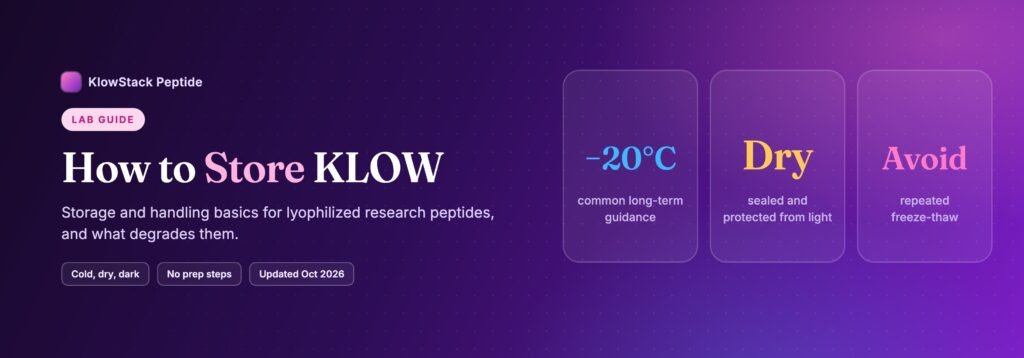
Lyophilized KLOW keeps best sealed, cold, dry and in the dark, with repeated freeze-thaw cycles avoided. Peptide manufacturers commonly recommend -20 °C or colder for long-term storage of freeze-dried peptides. No published stability study covers this particular four-peptide blend, so the guidance here comes from general peptide-handling sources.
That caveat shapes the whole page. Where a manufacturer has published guidance, we cite it. Where a figure comes only from a seller’s own marketing, we say so. Where nobody has published anything, the table says “no data.” KLOW is a laboratory reagent, sold for research use only and not for human consumption; see our Medical Disclaimer.
Why Storage Counts for a Four-Peptide Blend
Peptides break down through moisture, oxidation, light and heat, and each of KLOW’s four peptides has its own weak points. When a peptide degrades, the vial no longer matches what its certificate of analysis described, so storage conditions decide how long that report stays meaningful.
The common breakdown routes are well described in peptide chemistry. Water drives hydrolysis, which cuts peptide bonds, and deamidation, which alters asparagine and glutamine residues. Oxygen attacks sensitive amino acids such as methionine, cysteine and tryptophan. Heat speeds up all of it. Light can trigger photochemical reactions in some molecules.
KLOW combines four peptides with different profiles:
- GHK-Cu carries a copper ion bound to a histidine-containing peptide. Sellers commonly describe it as light-sensitive, though we found no primary stability study quantifying that.
- TB-500 (Ac-LKKTETQ) contains glutamine, a residue that Sigma-Aldrich flags as unstable when peptides are kept in solution.
- BPC-157 and KPV contain none of the residues manufacturers single out as oxidation-prone.
The copper in GHK-Cu raises one blend-specific question. Copper ions can catalyze oxidation, and chemistry studies show histidine and methionine residues are the main targets, according to a 2025 study in the Journal of the American Chemical Society. KLOW’s other three peptides contain neither, which is reassuring on paper, though nobody has tested how the four behave together over months of storage.
A certificate of analysis describes the vial on its test date. Every week of poor storage after that widens the distance between the paperwork and the contents.
Storing Lyophilized (Powder) KLOW
Store lyophilized KLOW sealed, at -20 °C or colder for long-term keeping, in a dark, dry place. Peptide manufacturers advise letting a cold vial reach room temperature, ideally in a desiccator, before opening it, so moisture from the air doesn’t condense on the powder.
Temperature
Bachem, one of the largest peptide manufacturers, recommends keeping freeze-dried peptides in a tightly closed container below -15 °C for longer storage, with lower temperatures preferred, according to its handling and storage guidelines. Sigma-Aldrich (MilliporeSigma) gives -20 °C or -80 °C for lyophilized peptides in its peptide stability guidance. JPT Peptide Technologies describes -20 to -80 °C with the vial kept dry, in its researcher storage guide.
Lab freezers hold their set temperature more steadily than household units, which cycle and open often. A thermometer or temperature logger in the storage space shows whether the freezer actually holds -20 °C. For short periods, such as transit, freeze-dried peptides generally tolerate ambient temperatures better than solutions do.
Temperature records are worth keeping for another reason too. If a vial later tests below its original purity, a log showing the freezer held steady helps rule out storage as the cause and points attention back to the batch itself.
Light and moisture
Opaque or amber containers, or simply keeping vials inside a closed box, limit light exposure. Moisture is the bigger day-to-day risk. Freeze-dried peptides are often hygroscopic, meaning they pull water from the air. Bachem advises warming cold peptide samples to room temperature in a desiccator before opening, because absorbed water can lower stability and the effective peptide content.
A sealed container with a desiccant pack helps between uses, and frost-free freezers, which cycle temperature, are best avoided for long-term storage.
Shelf life claims
| Claim | Source type | What it means |
|---|---|---|
| 24+ months for sealed lyophilized KLOW | Seller marketing | No published data behind it |
| Stable when kept below -15 °C, colder preferred | Manufacturer guidance (general peptides) | Not specific to KLOW |
| Retest or expiry date on a COA | Lab or seller document | Applies to that batch only |
Treat any long shelf-life figure as an estimate unless the seller can show stability data for the blend.
KLOW in Solution: What the Stability Sources Say
Published guidance treats peptides in solution as far less stable than dry powder. Sigma-Aldrich describes solutions as generally stable for up to about a week at 4 °C and advises frozen single-use aliquots for longer storage. Seller guidance on KLOW in solution conflicts, and no study covers this blend.
Here’s how the sources line up, as data only:
- Manufacturer guidance (general peptides): Bachem advises against long-term storage in solution and recommends frozen aliquots below -15 °C. Sigma-Aldrich gives about a week at 4 °C and recommends freezing individual aliquots, ideally in a mildly acidic buffer around pH 5 to 6.
- Seller claims (KLOW): One seller allows refrigerated storage for up to about four weeks, or frozen aliquots for 3 to 6 months. Another says refrigerated storage for three to four weeks and never freezing. Neither cites a study.
pH plays a small role for dry powder and a large one for solutions. Sigma-Aldrich advises avoiding prolonged exposure to pH above 8, where several breakdown reactions speed up.
Why does freeze-thaw get singled out? Each cycle forms ice crystals that concentrate the peptide and any salts into small pockets, changes local pH, and can push peptides to clump. Both Bachem and Sigma-Aldrich advise avoiding repeated freeze-thaw cycles, which is the reason behind single-use aliquots.
Lab procedures for preparing solutions are covered separately in our upcoming guides to bacteriostatic water and peptide reconstitution. This page doesn’t give preparation steps.
KLOW Stability at a Glance
Every storage figure for KLOW comes from either general peptide-manufacturer guidance or seller claims. No KLOW-specific stability study has been published, so confidence is moderate for dry, cold storage, which manufacturers agree on, and low for anything involving solutions.
| Condition | What sources state | Source type | Confidence |
|---|---|---|---|
| Lyophilized, long-term | Below -15 °C, or -20 to -80 °C, sealed and dry | Manufacturer guidance (Bachem, Sigma-Aldrich, JPT) | Moderate (general peptides) |
| Lyophilized, short-term or transit | Tolerates ambient temperatures briefly | Manufacturer guidance (general) | Moderate |
| Lyophilized, shelf life | 24+ months | Seller marketing | Low |
| Light exposure | GHK-Cu described as light-sensitive | Seller descriptions | Low (no primary data found) |
| In solution, refrigerated | About 1 week (Sigma-Aldrich); 3–4 weeks (sellers) | Manufacturer guidance vs seller claims | Low, sources conflict |
| In solution, frozen | Single-use aliquots advised (manufacturers); “never freeze” (one seller) | Conflicting | Low |
| Repeated freeze-thaw | Avoid | Manufacturer guidance | Moderate |
| Four-peptide blend specifically | Not studied | No data | None |
Receiving and Logging a KLOW Shipment
When a KLOW shipment arrives, check the packaging and seal, confirm the vial’s lot number matches its certificate of analysis, record the date received, and log where and at what temperature it’s stored. A simple log makes it possible to trace any later problem back to a specific vial.
Receipt checklist
- Packaging intact, with any cold packs noted
- Vial seal unbroken and cap secure
- No visible moisture inside the vial
- Lot number on the vial matches the lot on the certificate of analysis (see our KLOW COA guide)
- Date received recorded
- Moved to its storage location promptly
Storage log template
| Lot number | Date received | Storage location | Temperature | Opened (yes/no) | Notes |
|---|---|---|---|---|---|
| KL-0000 | 2026-10-15 | Freezer B, shelf 2 | -20 °C | No | Seal intact |
If a shipment arrives warm, or after a long delay, note it in the log rather than discarding the vial straight away. Freeze-dried peptides generally tolerate short warm periods, but a vial with a compromised seal, visible moisture or an unusual appearance is a candidate for retesting before use in research.
For a four-vial kit, log each vial on its own line, since each carries its own lot. Our guide on checking a peptide COA explains how to confirm the report with the issuing lab.
Signs a Vial May Have Degraded
Warning signs in lyophilized KLOW include powder that has clumped, shrunk or turned sticky, a color clearly different from the usual pale blue, a broken or loose seal, and visible moisture inside the vial. Any of these is a reason to retest the vial or exclude it from research.
- Clumping or collapse. A dry cake that has shrunk, melted or turned gummy has usually taken on water.
- Discoloration. KLOW is normally pale blue from its copper. Green, brown or patchy color is a reason for caution.
- Broken seal. A loose cap or punctured stopper breaks the sterile, dry environment.
- Moisture. Droplets or fog inside the vial suggest condensation or a failed seal.
Visual checks catch only obvious problems. Net peptide content can fall, and impurities can rise, with no visible change at all. A vial that looks fine can still have degraded. When in doubt, a fresh lab analysis is the only way to confirm what’s inside, and excluding a questionable vial protects the rest of the data.
FAQs
Does lyophilized KLOW need to be refrigerated or frozen?
For long-term storage, peptide manufacturers recommend freezing freeze-dried peptides at -20 °C or colder, sealed and dry. Short periods at room temperature, such as transit, are generally tolerated. No KLOW-specific study defines exact limits.
How long is KLOW powder stable?
No published study has measured KLOW’s shelf life. Sellers often claim 24 months or more for sealed, frozen powder, without data. Manufacturer guidance for general peptides supports long-term frozen storage. A retest date on a batch certificate applies to that batch only.
Can KLOW go through freeze-thaw cycles?
Repeated cycles are best avoided. Both Bachem and Sigma-Aldrich advise against repeated freezing and thawing of peptides, which is why single-use aliquots are recommended for solutions. Each cycle can concentrate the peptide, change local pH and promote clumping.
Why is KLOW sensitive to light?
Sellers often describe GHK-Cu, KLOW’s copper peptide, as light-sensitive, which is why opaque storage is commonly advised. We didn’t find a primary study quantifying KLOW’s light sensitivity, so treat it as a precaution.
Is a frost-free freezer suitable for KLOW?
For long-term storage, a manual-defrost freezer is the better choice. Frost-free freezers warm up briefly during defrost cycles, and repeated small temperature swings are what manufacturers advise avoiding for peptides.
Where can I read about reconstitution?
Our upcoming peptide reconstitution guide will cover laboratory procedures. This page covers storage and stability data only.
Conclusion
Cold, dry, dark and sealed is the consensus for freeze-dried peptides, and it’s the best available guide for KLOW until someone publishes stability data on the blend itself.
Sources
- [Manufacturer guidance] Handling and Storage Guidelines for Peptides, Bachem
- [Manufacturer guidance] Peptide Stability, Sigma-Aldrich (MilliporeSigma)
- [Manufacturer guidance] How to Store Peptides: Best Practices for Researchers, JPT Peptide Technologies