
Reviewed by Thomas Okafor, Peptide Chemist · Last reviewed October 15, 2026
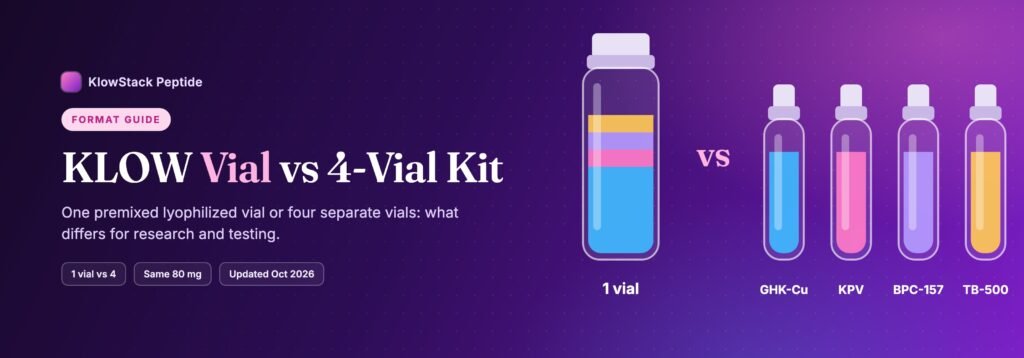
A KLOW vial is a single freeze-dried vial holding all four peptides in a fixed recipe: 50 mg of GHK-Cu plus a 10 mg portion each of BPC-157, TB-500 and KPV, totaling 80 mg. A KLOW kit is a different object, four separate vials, each carrying one peptide on its own label.
Both are sold as research reagents for laboratory work. Neither is approved for use in people, as our Medical Disclaimer explains. This page sticks to the physical side of the comparison: what’s in each format, what the paperwork should show, and how freeze-dried powder differs from pre-mixed liquid. The research and cost reasons for choosing a blend or separate peptides are covered in our KLOW vs individual peptides guide.
What’s Inside a Single KLOW Vial?
A standard KLOW vial contains 80 mg of freeze-dried peptide powder made of four compounds: GHK-Cu at 50 mg, and BPC-157, TB-500 and KPV at 10 mg each. The powder usually looks pale blue, a tint that comes from the copper bound to GHK.
The 80 mg fill
| Peptide | Labeled amount | Share by weight | Approximate molecular weight |
|---|---|---|---|
| GHK-Cu | 50 mg | 62.5% | About 340 Da (peptide); about 400 Da with copper |
| BPC-157 | 10 mg | 12.5% | About 1,419 Da |
| TB-500 | 10 mg | 12.5% | About 889 Da |
| KPV | 10 mg | 12.5% | About 342 Da |
The 5:1:1:1 split describes weight, and molecule counts look quite different. Because BPC-157 is roughly four times heavier per molecule than GHK, 10 mg of it holds far fewer molecules than 10 mg of a small tripeptide. In molecule terms, the two tiny peptides, GHK-Cu and KPV, vastly outnumber BPC-157 in the vial. That’s a useful reminder that “equal milligrams” and “equal amounts” mean different things to a chemist.
One more detail changes how a label reads. Freeze-dried peptide powder is never 100% peptide. According to Bachem’s handling guidelines, the peptide content of a lyophilized solid typically ranges from 70 to 90%, because the powder also holds counter-ions such as acetate or trifluoroacetate and some residual moisture. A label that says “80 mg” may describe the powder’s weight or the peptide content, and a good certificate of analysis states which.
Any specific vial’s contents should be checked against its batch certificate of analysis, since some sellers use other recipes.
Why the powder looks blue
Copper(II) complexes absorb red and orange light, so they reflect blue. GHK-Cu holds a copper ion tightly, and since it makes up most of the vial’s weight, the dried cake usually has a pale blue or blue-violet tint. The color confirms copper is present. It says nothing about the other three peptides or their amounts.
What Is a 4-Vial KLOW Kit?
A 4-vial KLOW kit is a bundle of four freeze-dried vials, one for each peptide: GHK-Cu, BPC-157, TB-500 and KPV. Kits differ between sellers, so the milligrams in each vial and whether each one comes with its own certificate of analysis need checking.
Some kits mirror the standard 50/10/10/10 recipe. Others ship each peptide in its catalog size, which can make the totals quite different from a premixed vial. A kit described as “KLOW” with 10 mg of every peptide, for example, holds a very different ratio from the standard blend.
Vial sizes and fill dates can differ inside one kit, too. Each peptide may come from a different production batch, made weeks or months apart, so the four lot numbers and test dates rarely match. That’s normal for a kit, and it’s one more thing to record.
The paperwork is the other difference. A well-documented kit includes four lab reports, one per vial, each with its own lot number. A kit shipped with a single combined report, or with reports for only some vials, is harder to verify.
Single Vial vs 4-Vial Kit at a Glance
A single KLOW vial locks the four peptides into one fixed ratio with one lot number and one lab report. A 4-vial kit keeps each peptide separate, which means four labels, four reports and amounts that can be measured, tracked and adjusted one peptide at a time.
| Single KLOW vial | 4-vial kit | |
|---|---|---|
| Ratio | Fixed by the manufacturer | Set by each vial’s contents |
| Lab reports to check | 1, covering four peptides | 4, one per peptide |
| Identity testing | All four in one analysis | Each peptide tested on its own |
| Storage footprint | One vial | Four vials |
| Labels and lots | One lot to log | Four lots to log |
| Cost per mg | Usually lower per vial; see our cost comparison | Usually higher in total |
| Research design | Studies the combination as sold | Can isolate one compound or vary ratios |
The trade-off comes down to simplicity against control. A single vial is also easier to keep cold and dark, since there’s only one item to store and one cap to keep sealed. One vial means fewer items to track. Four vials mean each peptide’s identity, amount and lot can be confirmed and recorded separately, which is how most published research on these compounds was done.
Lyophilized vs Pre-Mixed KLOW
Lyophilized KLOW is freeze-dried powder, the standard format for research peptides because removing water slows most of the chemistry that breaks peptides down. Pre-mixed KLOW is already in liquid, and far less published stability data exists for a four-peptide solution.
Lyophilization works in three stages. The peptide solution is frozen, the pressure is lowered so ice turns straight into vapor, and a final drying step removes most remaining moisture. The result is a dry cake that peptide manufacturers such as Bachem recommend storing sealed and cold, below -15 °C for longer periods, according to Bachem’s handling and storage guidelines.
The cake’s look can vary between batches. A freeze-dried cake may be fluffy, compact or slightly shrunken depending on the process, which doesn’t by itself signal a problem. A cake that has melted into a sticky film usually has taken on moisture.
Water speeds up several breakdown reactions, so peptides in solution generally have a much shorter shelf life than dry powder. Sigma-Aldrich notes that peptide solutions are generally stable for only about a week at refrigerator temperature. For a four-peptide liquid, most stability claims come from the sellers themselves, and we found no published study of KLOW in solution.
Our upcoming guides to lyophilized vs pre-mixed peptides and to KLOW storage cover both topics in depth.
What a KLOW Vial Label and COA Should Show
A KLOW vial’s label and certificate of analysis should agree on the lot number, total fill and each peptide’s amount, and the report should show HPLC purity and mass spectrometry identity for all four peptides, plus a test date, lab name and research-use-only labeling.
- Lot number on the vial that matches the lot on the report.
- Total fill (80 mg in the standard formula) and the amount of each peptide.
- HPLC purity for each peptide, shown as separate peaks, with a single blended figure as the weaker alternative.
- Mass spectrometry identity for GHK, BPC-157, TB-500 and KPV, each with a measured mass next to the expected value.
- Test date and lab name, ideally an independent lab you can contact.
- “Research use only” printed on the vial or box.
- Net peptide content, where reported, so it’s clear whether the milligrams describe peptide or total powder.
- Appearance noted by the lab, for example “blue lyophilized powder,” which should match what’s in the vial.
For a kit, the same list applies to each of the four vials and their four reports. Our KLOW COA guide walks through each field with expected values, and our general peptide COA verification guide shows how to check a document with its testing lab.
Which Format Fits Which Research Setup?
A fixed-ratio KLOW vial suits studies of the combination exactly as sold, since every vial holds the same mixture. Separate vials suit studies that need to isolate one compound, compare compounds, or test different ratios, because each peptide can be handled and measured on its own.
Consider two simple lab questions. “Does this commercial four-peptide product behave consistently from batch to batch?” calls for the single vial, tested as a unit. “Which of these four compounds produces a given effect in a cell model?” calls for separate vials, so each peptide can be tested alone and in combination.
There’s also a practical documentation angle. Separate vials make it easier to trace a problem to one batch of one peptide. A single vial ties all four to one lot, so a fault in any ingredient affects the whole vial. This section describes research setups only.
FAQs
How much does a KLOW vial contain?
A standard KLOW vial contains 80 mg of freeze-dried powder, with GHK-Cu at 50 mg and the other three peptides at 10 mg apiece. Some sellers use different recipes, so check the lab report for any individual vial.
Is KLOW sold as one vial or four?
Both. The premixed format is a single 80 mg vial with all four peptides. A kit is four separate vials, one per peptide. Kit contents vary between sellers, so check each vial’s label and report.
What does “lyophilized” mean on a KLOW label?
It means freeze-dried. The peptide solution was frozen and the water removed under low pressure, leaving a dry powder or cake. Dry peptides break down much more slowly than peptides in solution, which is why research peptides usually ship this way.
Why is KLOW powder blue?
The copper in GHK-Cu, KLOW’s largest ingredient, absorbs red and orange light, giving the powder a pale blue tint. The color confirms copper is present. It can’t confirm the other three peptides or the amounts.
How do I check a KLOW vial is genuine?
Match the vial’s lot number to the certificate of analysis, look for identity and amount results for all four peptides, and confirm the report with the testing lab directly. Our KLOW COA guide walks through each step.
Conclusion
One vial or four, the molecules inside are the same. The formats differ in how much you can see, measure and trace, which is what a lab report is there to confirm.
Sources
- [Manufacturer guidance] Handling and Storage Guidelines for Peptides, Bachem
- [Manufacturer guidance] Peptide Stability, Sigma-Aldrich (MilliporeSigma)
- [Database] PubChem, National Library of Medicine