Reviewed by Thomas Okafor, Peptide Chemist · Updated October 2026
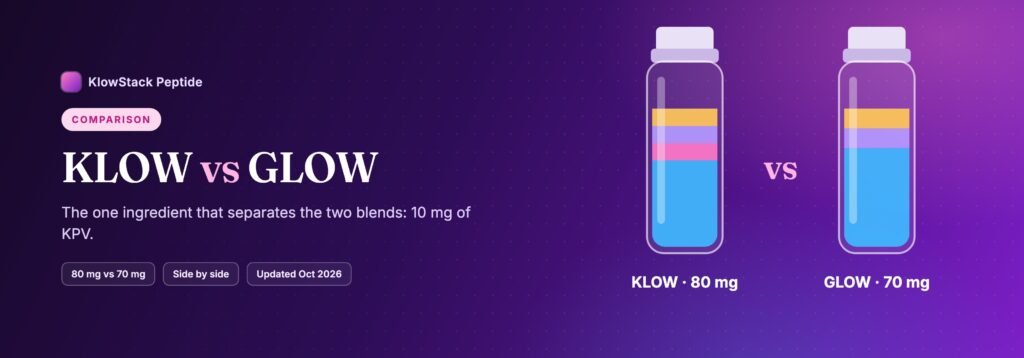
KLOW and GLOW are near-identical peptide blends. Both contain GHK-Cu, BPC-157 and TB-500; KLOW adds 10 mg of KPV, a small anti-inflammatory peptide, taking the vial from 70 mg to 80 mg. That one ingredient is the only difference. Neither blend has been tested in a human trial, so “better” depends on the research question being asked.
Think of GLOW as the base model of a car and KLOW as the same car with one extra option package. The engine, the seats and most of the price are shared. So the KLOW vs GLOW question really comes down to one thing: what does that extra package, KPV, bring? This guide answers it ingredient by ingredient, with the studies linked, so you can weigh the glow vs klow choice on facts. You’ll also see why two vials with the same name can hold different recipes, and what a good certificate of analysis should show for each one.
Educational content only, with no medical advice. Both blends are sold for research use only, as our Medical Disclaimer explains.
What’s the Difference Between KLOW and GLOW?
The only ingredient difference is KPV: KLOW contains it, GLOW doesn’t. Everything else, GHK-Cu, BPC-157 and TB-500, is shared, usually in the same amounts. That makes KLOW an 80 mg vial and GLOW a 70 mg vial, and it means the difference between KLOW and GLOW is one small peptide.
| GLOW | KLOW | |
|---|---|---|
| Ingredients | GHK-Cu, BPC-157, TB-500 | GHK-Cu, BPC-157, TB-500, KPV |
| KPV | None | 10 mg |
| Total per vial | 70 mg | 80 mg |
| Number of peptides | 3 | 4 |
| Main research focus | Skin, collagen, tissue repair | Same, plus inflammation and gut lining |
| Typical price (US listings, October 2026) | About $48 to $158 | About $90 to $180 |
| Human trials of the blend | None | None |
| Legal status | Research use only; not on the 503A list | Research use only; not on the 503A list |
People often ask what the differences are between KLOW 80 and GLOW 70, expecting a long list. The list is short. The three shared peptides do the heavy lifting in both vials, and KPV is the one add-on.
That makes the takeaway refreshingly simple. If inflammation and gut-lining research aren’t part of the question you’re asking, the two blends are otherwise interchangeable. If they are, KPV is the ingredient to read about, and it gets its own section below.
Why do two near-identical blends exist at all? GLOW came first, built around the copper peptide’s skin reputation plus the two best-known repair peptides. As KPV’s gut and inflammation research spread through forums, sellers started adding it to the same vial and gave the result a new letter. Same base recipe, one new ingredient, one new name.
What’s in KLOW and GLOW? Composition and Ratios Compared
Most suppliers sell GLOW as 50 mg GHK-Cu + 10 mg BPC-157 + 10 mg TB-500 (70 mg) and KLOW as the same plus 10 mg KPV (80 mg). Some sell a different ratio, so check the label and COA. The same name on two vials doesn’t guarantee the same recipe inside.
The Standard Ratio, 50/10/10 vs 50/10/10/10
The standard recipe is the one you’ll see on most US listings. GHK-Cu is the big ingredient in both blends, and the other peptides come in matching 10 mg portions.
| Peptide | GLOW (70 mg) | % of GLOW | KLOW (80 mg) | % of KLOW |
|---|---|---|---|---|
| GHK-Cu | 50 mg | 71.4% | 50 mg | 62.5% |
| BPC-157 | 10 mg | 14.3% | 10 mg | 12.5% |
| TB-500 | 10 mg | 14.3% | 10 mg | 12.5% |
| KPV | None | 0% | 10 mg | 12.5% |
| Total | 70 mg | 100% | 80 mg | 100% |
Notice what happens to the percentages. The milligrams of GHK-Cu, BPC-157 and TB-500 don’t change at all between the two vials. Their share drops in KLOW only because KPV adds 10 mg to the total, the way adding a fourth roommate shrinks everyone’s share of the rent without changing what anyone pays in groceries.
The Other Ratio You’ll See, 30/20/20 (+10 KPV)
Some vendors, including the page ranking first for this search in October 2026, list GLOW as 30 mg GHK-Cu + 20 mg BPC-157 + 20 mg TB-500. Their KLOW is the same 70 mg plus 10 mg of KPV.
That’s a meaningfully different product. It carries 20 mg less GHK-Cu and twice the BPC-157 and TB-500 of the standard recipe. One blend leans toward the copper peptide’s skin research; the other leans toward the repair peptides.
It’s a bit like two restaurants both selling a “Cobb salad.” The name is the same, and one of them puts in twice the bacon. The only way to know which version you’re holding is a COA that tests every peptide one by one.
A quick label check helps too. A clear listing names each peptide with its own milligram amount. If a label only says “GLOW 70 mg” or “KLOW 80 mg” with no breakdown, ask the seller which ratio it is before assuming anything.
KLOW 80 vs GLOW 70, What the Numbers Mean
The “80” and “70” in KLOW 80 vs GLOW 70 are the total peptide mass in each vial, in milligrams. They aren’t a strength rating or a potency score. A Venti coffee isn’t stronger than a Grande; it just holds more, and the same logic applies to a bigger vial number. KLOW carries about 14% more peptide by weight, and every bit of that extra comes from KPV. Our guide to what the KLOW stack is explains the ratio in more depth.
What Do the Peptides KLOW and GLOW Share?
KLOW and GLOW share three peptides: GHK-Cu, studied for collagen and skin remodeling; BPC-157, studied for blood-vessel growth and tendon repair; and TB-500, studied for cell migration. Their evidence is mostly from cell and animal studies, with GHK-Cu’s topical skin research as the main human exception.
GHK-Cu
Evidence: human data limited to creams and serums; animal and lab data otherwise.
GHK-Cu is a copper-carrying tripeptide your body makes naturally, and it’s the reason both vials look blue. Most of its human research involves creams and serums for skin firmness and fine lines.
Loren Pickart and Anna Margolina’s 2018 review describes how GHK can switch large sets of genes involved in repair and protection up or down. They also list wound-repair effects in several tissues in lab and animal models. Because both blends hold the same 50 mg, anything GHK-Cu contributes applies equally to KLOW and GLOW. Its skin and wound research is also the reason these three peptides were grouped in the first place: all three turn up in wound-healing studies, each working on a different stage. The GHK-Cu guide covers it in full.
BPC-157
Evidence: preclinical.
BPC-157 is a 15-amino-acid peptide modeled on a protein from stomach juice. It’s the most talked-about ingredient in repair research, mostly for tendons.
In a 2011 study in the Journal of Applied Physiology, rat tendon cells exposed to BPC-157 spread out and migrated faster in the lab. A 2018 review by Seiwerth and colleagues links many of its effects to new blood-vessel growth. Both blends carry the same 10 mg. The BPC-157 guide has the complete study list.
TB-500
Evidence: preclinical.
TB-500 is a synthetic peptide based on thymosin beta-4, a protein that helps cells move by managing their internal scaffolding. That makes it the “send in the workers” piece of the repair story.
The classic paper here is Malinda and colleagues’ 1999 rat study, which found that thymosin beta-4 sped up wound closure in rats. Again, both blends hold 10 mg, so TB-500 doesn’t separate them. The TB-500 guide has the details.
What Does KPV Add to KLOW?
KPV is a three-amino-acid fragment of alpha-MSH studied for calming inflammatory signaling, particularly in the gut. Adding it is meant to give KLOW an anti-inflammatory angle GLOW lacks. The research behind that angle comes from cells and mice, and it has been fairly consistent across labs.
Inflammatory Signaling
Alpha-MSH is a 13-amino-acid hormone, and KPV is its last three letters: lysine, proline and valine. Researchers found that this short tail keeps much of the parent hormone’s calming effect, which makes it a tidy, cheap-to-make research tool.
KPV’s best-known effect is on NF-κB, a switch inside cells that turns on inflammation. In a 2008 Gastroenterology paper, Dalmasso and colleagues at Emory showed that very small amounts of KPV turned that switch down in human intestinal cells grown in the lab.
A second team in Germany reached a similar place the same year. Writing in Inflammatory Bowel Diseases, Kannengiesser and colleagues tested KPV in two mouse models of colitis and saw faster weight recovery and less inflammation in the colon. They concluded KPV looked like “an interesting therapeutic option” for further study. One detail stood out: KPV still worked in mice whose main melanocortin receptor (MC1R) didn’t function, which suggests it calms inflammation through more than one route.
Gut Lining and the PepT1 Transporter
Here’s what makes KPV unusual. Intestinal cells have a transporter called PepT1, a kind of loading dock built to pull small peptides in from the gut. KPV fits through it.
That’s why the Emory team could give KPV in drinking water and still see milder colitis in mice. PepT1 also becomes more active in inflamed colon tissue, which puts KPV right where gut researchers want it. This gut angle is the main reason KLOW gets pitched for gut-related research questions.
Antimicrobial Research
The parent hormone, alpha-MSH, shows up in barrier tissues like skin and gut, which hinted at a role in defense. In a 2000 study in the Journal of Leukocyte Biology, Cutuli and colleagues found that both alpha-MSH and KPV slowed the growth of Staph aureus bacteria and Candida yeast in lab dishes. That evidence is lab-only so far.
Is KPV Redundant if You Already Have BPC-157?
A popular Reddit argument says KPV overlaps with BPC-157, since both get linked to gut health and inflammation. The overlap is real at the headline level. Underneath, the two work in different ways.
KPV is studied for dialing down inflammatory signals directly, through NF-κB and melanocortin pathways. BPC-157 is studied mostly for repair, through blood-vessel growth and tissue rebuilding. A smoke detector and a sprinkler both deal with fires, and nobody calls one redundant.
What nobody has tested is whether adding KPV to the other three changes any outcome. The KPV guide covers every study. So is KLOW worth it for its KPV? That depends on whether inflammation research is part of your question.
Which Has More Research Behind It, KLOW or GLOW?
Neither blend has been studied as a blend. Both rest on separate research for each ingredient. GLOW’s three peptides and KLOW’s extra KPV are all mainly preclinical, so calling either one “proven” or “more established” goes further than the published studies do.
| Peptide | Evidence level | Strongest evidence | In GLOW? | In KLOW? |
|---|---|---|---|---|
| GHK-Cu | Clinical (topical) / preclinical | Small human skin studies of creams and serums | Yes | Yes |
| BPC-157 | Preclinical | Rat tendon, gut and blood-vessel studies | Yes | Yes |
| TB-500 | Preclinical | Thymosin beta-4 wound and heart studies in rodents | Yes | Yes |
| KPV | Preclinical | Two mouse colitis studies plus human cell work | No | Yes |
You’ll sometimes see vendors describe GLOW as “more established.” That reflects how long GLOW has been on the market, which is a different thing from trial evidence. The two blends share the same three-ingredient research base, and KLOW adds a fourth.
Does the GLOW peptide work? The fair answer is that its ingredients show encouraging results in labs and animals, and the blend itself hasn’t been put through human testing. The same is true for KLOW. A longer ingredient list adds research areas to read about, and it doesn’t add human evidence for the blend as a whole. It helps to picture evidence as a ladder. The bottom rung is cells in a dish, then animals, then small human studies, and finally large randomized trials, where people are assigned to groups by chance. Every ingredient in both blends is on the lower rungs, with topical GHK-Cu one step higher. Our Editorial Policy explains the evidence labels we use across the site.
KLOW vs GLOW for Skin, Hair, Recovery and Gut: Which Fits Which Goal?
Match the blend to the research question. GLOW covers skin, collagen, hair and tissue-repair questions; KLOW covers the same ground plus inflammation and gut-lining questions through KPV. Neither has human data for any of these goals, so the match comes from each ingredient’s studies.
| Research question | GLOW | KLOW | Why |
|---|---|---|---|
| Skin and collagen | Yes | Yes | GHK-Cu drives this in both |
| Hair | Yes | Yes | GHK-Cu hair research applies to both |
| Tendon and injury recovery | Yes | Yes | Same BPC-157 and TB-500 in both |
| Gut and inflammation | Partly | Yes | KPV adds the gut-specific research |
| Post-procedure recovery | Yes | Yes | Shared repair ingredients; no blend data |
| Budget | Lower cost | About $30 to $50 more | KPV is the price difference |
Two rows in that table need a word of explanation. “Post-procedure recovery” comes from clinics that market these blends after cosmetic treatments; it rests on the shared repair ingredients, with no blend-specific studies. “Budget” is the plainest row: if the research question doesn’t involve inflammation or the gut, the lower-cost blend covers the same ingredients.
Skin, Collagen and “Skin Tightening”
GHK-Cu is the star here in both blends, so KPV adds little to skin questions. The human skin studies involve topical GHK-Cu, which tells you more about creams than about anything in a vial. When people ask about the best peptide for skin tightening, GHK-Cu is usually the one they mean. Our guide to GHK-Cu for skin covers that research.
Hair Growth
Does KLOW help with hair growth? Any hair angle comes from GHK-Cu, which has lab and small topical studies on hair follicles. KPV has no hair-specific research, so for hair questions, KLOW and GLOW are the same blend.
Tendon and Injury Recovery
Both vials carry identical amounts of BPC-157 and TB-500, the two peptides behind the injury-recovery buzz. For tendon and ligament research, the Wolverine stack is the stripped-down version of the same pair.
Gut and Inflammation
This is the one area where KPV plausibly changes the picture. Its PepT1 uptake and colitis studies are gut-specific. BPC-157 also has gut research, so GLOW isn’t empty here, but KLOW carries the ingredient built around this question.
Do KLOW and GLOW Have Different Side Effects?
There’s no human data showing different side effects, because neither blend has been tested in people. The shared risks are product quality and missing safety data; KLOW adds one more ingredient whose human safety hasn’t been studied. So the comparison is about known unknowns more than known differences.
Here’s how the risks line up:
- Quality: every extra peptide is another chance for an error, such as the wrong amount, a contaminant or a mislabeled ingredient. KLOW has four chances; GLOW has three.
- GHK-Cu stability: both vials carry the same copper peptide, and nobody has published data on how its copper interacts with the other peptides once mixed. That open question applies to both. One popular Reddit comment claims GHK-Cu “destroys” the other peptides in the vial; no published stability study supports or rules out that claim yet.
- KPV: its human safety profile is unknown. The mouse studies didn’t report problems, and mice aren’t people.
- COA checks: a four-peptide report has more to check than a three-peptide one. Each ingredient needs its own identity, purity and amount, plus endotoxin results for the whole vial.
- Self-reports: what you read on forums about how people felt can’t separate the blend from everything else going on in their routines.
Some groups have extra reasons for caution with either blend: anyone pregnant or breastfeeding, anyone with a cancer history (because of the growth-signaling research behind BPC-157 and TB-500), and anyone with a copper-handling disorder such as Wilson’s disease. If you have a health condition, the best first step is a licensed clinician. Our pages on KLOW side effects and GLOW side effects go into each risk.
KLOW vs GLOW Cost: Is the KPV Premium Worth It?
KLOW usually costs about $30–50 more than GLOW per vial in US research-supply listings (October 2026), almost entirely for the extra 10 mg of KPV. Whether that’s worth it depends on whether KPV’s research area is relevant to your question. For skin, hair and tendon questions, the extra spend buys nothing new.
| Blend | Observed price range (US listings, October 2026) | Typical gap |
|---|---|---|
| GLOW 70 mg | About $48 to $158 | |
| KLOW 80 mg | About $90 to $180 | About $30 to $50 more than the same seller’s GLOW |
Prices move often, so re-check them on the day you compare. Stacks that hold each peptide in its own vial usually cost more than a single premixed blend, and they come with a separate COA for every ingredient.
On a per-milligram basis, the two land close together. Using those ranges, GLOW works out to roughly $0.70 to $2.25 per milligram and KLOW to roughly $1.10 to $2.25. The jump in sticker price comes from adding a peptide, which costs more to make per milligram than bulk GHK-Cu.
Another route is GLOW plus a separate vial of KPV. That gives control over each amount, at the cost of more vials, more labels and more COAs to check. The KLOW vs buying separately page sets the two approaches side by side. As with every page on this site, we don’t publish dosing for either blend.
Are KLOW and GLOW Legal in the US?
Neither blend is FDA-approved; both are sold as research use only. As of October 2026, none of their peptides is on the 503A compounding list. An FDA advisory panel voted in July 2026 to recommend BPC-157, TB-500 and KPV, but not GHK-Cu, which wasn’t on the agenda.
The KLOW vs GLOW legal angle has an interesting twist. KPV, KLOW’s extra ingredient, was part of that July vote, according to the FDA’s meeting page. GHK-Cu, the largest ingredient in both blends, wasn’t reviewed at all. AJMC reported that the panel’s votes are advisory, and the FDA still has to go through rulemaking before anything changes.
Athletes: BPC-157 and TB-500 are both on the WADA Prohibited List, so either blend would fail a drug test. USADA warns about BPC-157 by name. Status checked October 5, 2026. Because KPV isn’t named on the Prohibited List, some athletes assume KLOW is safer than GLOW; the shared BPC-157 and TB-500 make both a positive test.
The KLOW stack guide has the full legal timeline, and our guide to whether peptides are legal covers the wider rules.
What Do Users Say About KLOW vs GLOW?
Forum discussions mostly treat KLOW as GLOW plus an optional anti-inflammatory, with some users calling KPV unnecessary. These are personal reports from online threads, and they can’t show that one blend works better than the other, since nobody in them is compared against a control group.
A few themes come up again and again in Reddit threads and reviews:
- Skin, nails and hair: online self-reports of skin and nail changes, credited mostly to GHK-Cu.
- “KPV is redundant”: a vocal group argues BPC-157 already covers gut and inflammation.
- “Glow for face, Klow for body”: a clinic marketing line that pairs GLOW with skin and KLOW with whole-body recovery.
Forum threads work more like Yelp reviews than lab reports. They’re handy for spotting what people care about, and they can’t account for mixed products, other supplements, sleep, diet or simple time passing. That’s why these reports stay in their own section here, separate from the research. When a thread says one blend “worked better,” it’s worth asking what else changed that month. Another recurring theme is impatience: people compare notes on how fast they noticed anything, which is exactly the kind of question only a controlled study could answer.
How Do KLOW and GLOW Compare to Wolverine and GHK-Cu Alone?
Wolverine is the two-peptide repair core (BPC-157 and TB-500). GLOW adds GHK-Cu, and KLOW adds KPV on top. GHK-Cu alone is the single-compound option for skin-focused questions. Each step up adds one research area and one more ingredient to verify.
| Blend | Peptides | Typical total |
|---|---|---|
| GHK-Cu alone | GHK-Cu | Varies by vial |
| Wolverine | BPC-157, TB-500 | Varies, often 20 mg |
| GLOW | GHK-Cu, BPC-157, TB-500 | 70 mg |
| KLOW | GHK-Cu, BPC-157, TB-500, KPV | 80 mg |
Our KLOW vs GLOW vs Wolverine page compares all three blends side by side, and the KLOW vs GHK-Cu comparison looks at the copper peptide on its own. GHK-Cu on its own also comes in a form most people have already seen: skincare. Serums list it as “copper tripeptide-1” on the ingredient label, and those topical products are where its human studies come from. Each step up the ladder adds a research area and one more thing to verify on the COA. A simpler product is easier to check, which is why some researchers prefer single compounds when they want to isolate one effect. For the bigger picture, browse our comparisons hub or the peptide blends hub.
Frequently Asked Questions
Which is better, KLOW or GLOW?
Neither is proven better, since neither has human trials. They share three peptides, and KLOW adds 10 mg of KPV. For skin, hair or tendon questions they’re effectively the same; KLOW adds an inflammation and gut angle.
What is the difference between KLOW 80 and GLOW 70?
The numbers are total milligrams of peptide per vial. GLOW 70 holds 50 mg GHK-Cu plus 10 mg each of BPC-157 and TB-500. KLOW 80 holds the same plus 10 mg of KPV.
Is KLOW just GLOW with KPV?
Yes, in the standard recipe. KLOW is GLOW’s three peptides in the same amounts, plus 10 mg of KPV. Some vendors use a 30/20/20 ratio instead, so check each vial’s COA.
Can I add KPV to GLOW instead of buying KLOW?
KPV is sold as its own vial, and 50/10/10 GLOW plus 10 mg KPV matches standard KLOW on paper. Separate vials mean separate COAs to check. We don’t publish dosing or mixing guidance.
Does KLOW or GLOW help with hair growth?
No human study has tested either blend for hair. The hair interest comes from GHK-Cu, which has lab and small topical studies on follicles. Both blends contain the same 50 mg, and KPV has no hair research.
Which is better for skin, KLOW or GLOW?
For skin research, they’re the same. GHK-Cu is the skin ingredient, both blends hold 50 mg, and its human data comes from topical creams. KPV adds nothing skin-specific.
Which is better for gut health research?
KLOW has the edge on paper, because KPV is studied specifically for gut inflammation through the PepT1 transporter. BPC-157, in both blends, also has gut-lining research in rats.
Is KPV redundant with BPC-157?
Not by mechanism. KPV is studied for calming inflammatory signals directly; BPC-157 for repair and blood-vessel growth. No study has tested whether adding KPV changes results, so the debate is still open.
Do KLOW and GLOW have different side effects?
No human data compares them. Both share product-quality risks and unknown long-term safety. KLOW adds one more ingredient, KPV, whose human safety hasn’t been studied.
How long do people stay on GLOW or KLOW?
There’s no evidence-based answer. No trial has tested a cycle length for either blend. The timelines online come from vendors and forums, and we don’t publish protocols.
Why is KLOW more expensive than GLOW?
KLOW includes a fourth peptide, KPV, adding 10 mg to the vial. In US listings in October 2026, that added about $30 to $50 compared with the same seller’s GLOW.
Are KLOW and GLOW FDA-approved?
No. Both are sold for research use only, and none of their peptides is on the 503A list as of October 2026. A July 2026 panel recommended three of their ingredients, and GHK-Cu wasn’t reviewed.
Sources
Studies
- Pickart L, Margolina A. 2018. Regenerative and Protective Actions of the GHK-Cu Peptide in the Light of the New Gene Data. International Journal of Molecular Sciences. doi:10.3390/ijms19071987
- Chang CH, et al. 2011. The promoting effect of pentadecapeptide BPC 157 on tendon healing involves tendon outgrowth, cell survival, and cell migration. Journal of Applied Physiology. doi:10.1152/japplphysiol.00945.2010
- Seiwerth S, et al. 2018. BPC 157 and Standard Angiogenic Growth Factors. Current Pharmaceutical Design. doi:10.2174/1381612824666180712110447
- Malinda KM, et al. 1999. Thymosin β4 Accelerates Wound Healing. Journal of Investigative Dermatology. doi:10.1046/j.1523-1747.1999.00708.x
- Dalmasso G, et al. 2008. PepT1-Mediated Tripeptide KPV Uptake Reduces Intestinal Inflammation. Gastroenterology. doi:10.1053/j.gastro.2007.10.026
- Kannengiesser K, et al. 2008. Melanocortin-derived tripeptide KPV has anti-inflammatory potential in murine models of inflammatory bowel disease. Inflammatory Bowel Diseases. doi:10.1002/ibd.20334
- Cutuli M, et al. 2000. Antimicrobial effects of α-MSH peptides. Journal of Leukocyte Biology. doi:10.1002/jlb.67.2.233
Regulatory
Disclaimer: KLOW, GLOW and their ingredients are sold for research use only and aren’t approved for human use. This comparison is educational and isn’t medical advice. Read our Medical Disclaimer and Editorial Policy to see how we review every claim.