
Reviewed by Thomas Okafor, Peptide Chemist · Last updated October 10, 2026
Yes, with limits. Research-use-only peptides are legal to buy and own in the US for laboratory research. They aren’t controlled substances, so owning them isn’t a drug crime. Selling or marketing them for human use is what breaks federal law, under the Federal Food, Drug, and Cosmetic Act.
That’s the short answer, and it holds as of October 2026. The longer answer is moving fast. In the past six months the FDA took twelve peptides off its compounding risk list, an FDA advisory committee backed six of them for pharmacy compounding, and the Washington Post reported that the administration is drafting a temporary path for some unapproved peptides to be sold. None of that has changed the basic rules yet, but it explains why the headlines feel contradictory.
This guide walks through how US law treats peptides, who can sell and buy what, what changed in 2026, and how state rules, sports bodies and drug tests fit in. We update it as rules change.
How US Law Treats Peptides: FD&C Act, Not the Controlled Substances Act
Two federal laws come up in peptide discussions, and only one of them applies to most peptides. The Controlled Substances Act covers drugs with abuse potential, enforced by the DEA. The Federal Food, Drug, and Cosmetic Act covers how drugs are approved, labeled and sold, enforced by the FDA. Research peptides fall under the second.
Peptides aren’t controlled substances
The DEA keeps a list of scheduled drugs, from heroin in Schedule I down to cough medicines with codeine in Schedule V. Research peptides such as BPC-157, TB-500, GHK-Cu and KPV aren’t on it. You can check the DEA’s controlled substance schedules yourself. That’s why simply owning a vial of a research peptide isn’t treated like possessing a controlled drug.
What the FD&C Act controls: marketing and selling for human use
The Federal Food, Drug, and Cosmetic Act is about products, claims and sales. Any substance sold to diagnose, treat or prevent a condition in people counts as a drug, and a drug needs FDA approval before it’s marketed. A peptide sold with dosing instructions or health claims, without that approval, is an unapproved new drug, and the seller is the one breaking the law. That’s why the label and the way a product is marketed carry so much legal weight in this area.
Two terms come up again and again in FDA enforcement. A product is “misbranded” when its labeling is false or misleading or lacks required directions. It’s an “unapproved new drug” when it’s marketed for use in people without FDA approval. Both describe what a seller did. The FDA usually starts with a warning letter and can escalate to product seizures, court injunctions or criminal charges.
The 3 Legal Categories of Peptides
US peptides fall into three groups: FDA-approved peptide drugs, available by prescription; compounded peptides made by licensed pharmacies under rules tied to the FDA’s 503A bulks list; and research-use-only peptides, sold as laboratory chemicals with no approval for human use.
FDA-approved peptide drugs
These went through clinical trials and FDA review. Examples include semaglutide (Ozempic, Wegovy), tirzepatide (Mounjaro, Zepbound) and insulin. They’re legal, prescription only, and dispensed by pharmacies. The FDA’s own Drugs@FDA database lists each approval.
Compounded peptides and the 503A bulks list
Compounding pharmacies make custom preparations for individual prescriptions. Under Section 503A, a bulk ingredient generally has to be part of an approved drug, have a USP monograph, or appear on the FDA’s 503A Bulks List. While nominations are reviewed, the FDA sorts substances into interim categories. Category 1 may be compounded during review. Category 2 covers substances flagged for significant safety risks, which pharmacies shouldn’t compound. Our guide to FDA 503A peptides explains the full process.
Research-use-only peptides
These are sold as laboratory reagents for in vitro and animal research, with labels stating they’re not for human use. They carry no FDA approval and no dosing information. Our explainer on what research use only means covers the label in detail.
| Category | Who can sell | Who can buy | Examples |
|---|---|---|---|
| FDA-approved | Licensed pharmacies, on prescription | Patients with a prescription | Semaglutide, tirzepatide, insulin |
| Compounded (503A) | Licensed compounding pharmacies, for listed or eligible ingredients | Patients with a prescription | Depends on the ingredient’s 503A status |
| Research use only | Chemical suppliers, labeled for lab use | Researchers and labs | BPC-157, TB-500, GHK-Cu, KPV |
Are Research Peptides Legal to Buy? Buyer vs Seller Rules
Buying research-use-only peptides for laboratory research is generally legal in the US, because the FD&C Act targets the people who sell and market unapproved drugs. Sellers carry most of the legal risk. They can’t market research peptides for human use, give dosing advice or make health claims.
For sellers, the line is marketing. A supplier that labels products for research, avoids dosing language and makes no health claims is selling a laboratory chemical. One that posts injection guides, “benefits for you” copy or before-and-after photos is marketing a drug.
A research-use label describes a product’s intended use, and it holds up only when the rest of the business matches it: the website, the ads, the customer service answers and the social media posts. Regulators look at the whole picture. A “research use only” sticker on a page full of dosing charts and testimonials doesn’t change what the page is selling.
For buyers, enforcement has historically focused on sellers. Still, buying for personal human use falls outside what a research label covers, and nothing about a research peptide’s status makes it approved for people.
Buying online or importing follows the same logic. Domestic orders from research suppliers are routine. Imports can be detained by the FDA at the border if they look like unapproved drugs, particularly when packaging or paperwork suggests human use.
Can you get in trouble for peptides? Owning a research peptide isn’t a crime in itself. Problems start with selling for human use, misbranding, or using prohibited substances where sports or employment rules apply.
What Changed in 2026: A Timeline of Peptide Rules
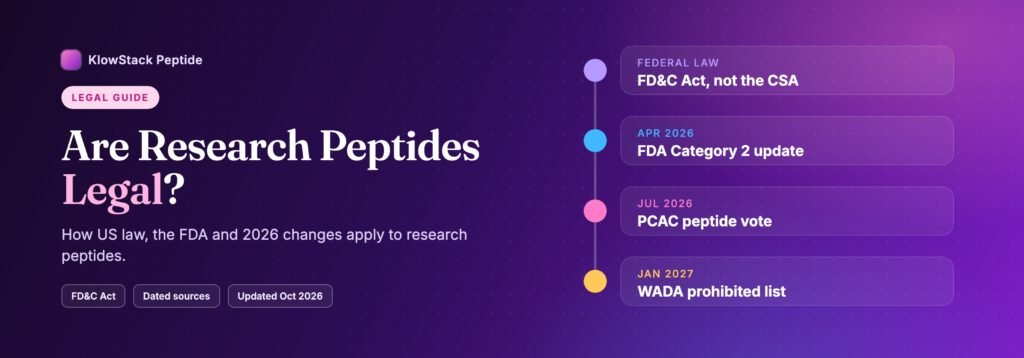
In 2026, the FDA removed twelve peptides from its Category 2 compounding list (April), an FDA advisory committee recommended six for the 503A Bulks List (July), Louisiana passed a state law on prescriber access to compounded peptides (August), and the Washington Post reported a planned temporary sale pathway (October). None of these makes research peptides FDA-approved.
| Date | What happened | What it means |
|---|---|---|
| 2023 | The FDA placed BPC-157 and other popular peptides in Category 2 of its interim compounding list | Pharmacies stopped compounding them, and online research sales grew |
| February 27, 2026 | HHS Secretary Robert F. Kennedy Jr. said most Category 2 peptides would move back toward Category 1 | A statement of intent with no formal change on its own. Legal analysis |
| April 15 to 22, 2026 | FDA removed 12 peptides, including BPC-157, TB-500, KPV and GHK-Cu, from Category 2 after the nominations were withdrawn | Off the risk list, but not moved to Category 1. Our recap |
| July 23 to 24, 2026 | The FDA’s Pharmacy Compounding Advisory Committee voted to recommend six peptides for the 503A Bulks List and voted against a seventh | Advice only. Compounding waits for FDA rulemaking. Our coverage of the vote |
| August 1, 2026 | Louisiana’s Act 374 took effect, limiting licensing boards from blocking prescribers and pharmacists who supply compounded peptides from compliant sources | A state rule for medical professionals, with no change to research-use-only products |
| October 7, 2026 | The Washington Post reported the administration is drafting a temporary pathway for some unapproved peptides while rules are written | Unannounced, scope and timing unclear |
| By end of February 2027 | A second advisory committee meeting is planned to review GHK-Cu, Melanotan II, LL-37 and two others | Another set of recommendations to come |
The October report drew wide coverage. According to Becker’s summary of the Post’s reporting, the plan hasn’t been announced, its timing is unclear, and it isn’t known which peptides it would cover. The original Washington Post article is paywalled.
Why haven’t the April and July steps changed much yet? Each one is a stage in a longer process. Leaving Category 2 removed a safety flag without adding the peptides to any approved list. The July vote was advice the FDA can accept or reject. A peptide becomes eligible for 503A compounding only after the FDA proposes a rule, takes public comments and publishes a final rule.
Are peptides becoming legal? Some may become legal to compound by prescription. That depends on FDA rulemaking, which usually takes 12 to 24 months from proposal to final rule. Which peptides are now legal? As of October 10, 2026, no research peptide has become an approved drug or a listed 503A bulk substance.
State Peptide Laws
States can add their own rules on top of federal law, mostly through pharmacy and medical licensing boards. Louisiana’s Act 374, effective August 1, 2026, is a dated example. It bars licensing boards from stopping prescribers and pharmacists who supply peptides made by compliant 503A or 503B facilities.
The enrolled text of Louisiana’s law is narrow. It protects licensed professionals working with compounded peptides from federally compliant sources. It doesn’t touch research-use-only products, and it doesn’t override federal law.
Most state power over peptides runs through licensing. States license pharmacies, discipline prescribers, set telehealth rules, and let their attorneys general pursue deceptive marketing under consumer protection laws. That means a state can tighten or loosen how clinics and pharmacies handle compounded peptides even while federal rules stay the same.
Other states have taken different approaches through board rules and guidance, and the picture changes as legislatures meet. If you need to know where your state stands, check your state board of pharmacy and state legislature’s website directly. We don’t give state-by-state legal advice.
Peptides in Sports, the Military and Drug Tests
Sports bodies and the military set rules that are stricter than federal law. WADA bans BPC-157, TB-500 and growth hormone-releasing peptides at all times, the NCAA follows a similar banned-substance approach, and the Department of Defense restricts unapproved substances for service members.
WADA and NCAA
The World Anti-Doping Agency’s Prohibited List names BPC-157 under S0 (non-approved substances) and covers TB-500 under S2 (peptide hormones and related substances). The 2027 list, approved September 10, 2026, carries those rules over. The NCAA’s banned classes include peptide hormones and growth factors, and its rules apply to college athletes year-round. See our WADA 2027 update.
Military service members
The Department of Defense keeps a Prohibited Dietary Supplement Ingredients List, published through its Operation Supplement Safety program, and BPC-157 is on it. Service members can face discipline for using listed substances.
Do peptides show up on drug tests?
Standard workplace drug panels look for controlled substances, such as opioids, amphetamines and THC, so they don’t test for research peptides. Anti-doping tests are a different story. Because BPC-157 and TB-500 are on WADA’s list, accredited anti-doping labs screen athletes’ samples for them, and military testing can include prohibited ingredients too. Anti-doping rules work on strict liability under the World Anti-Doping Code: an athlete is responsible for any prohibited substance found in their sample, whatever its source.
How to Tell a Compliant Research Peptide Supplier
A compliant research peptide supplier labels every product for research use only, makes no human-use or dosing claims, publishes batch-specific COAs, lists a real US business address and checks buyers’ ages. Missing any of these is a reason to be cautious.
- Research-use-only labeling on every product page and vial
- No dosing, injection or “benefits for you” language anywhere on the site
- Batch-specific COAs you can confirm with the lab. Our guide on how to verify a peptide COA shows how.
- A US business address and real contact details
- Age verification at checkout or site entry
- Clear policies for shipping, returns and data
- Payment and shipping that fit a lab supplier, with business-style invoices and plain, discreet packaging
What is the most legit peptide company? There’s no official ranking, and anyone selling one has a stake in it. Use the checklist instead, and see our guide to where to buy peptides for how to apply it.
Is the KLOW Stack Legal?
KLOW’s four peptides (GHK-Cu, BPC-157, TB-500 and KPV) follow the same rules as other research peptides. As a research-use-only product, KLOW is legal to buy and own for laboratory research, and it isn’t approved for human use.
All four ingredients were among the twelve peptides removed from Category 2 in April 2026, and three of them were recommended for compounding in July. A KLOW stack (four separate vials) and a KLOW blend vial (all four premixed) share the same status. Our guide to whether KLOW is legal covers the details.
Frequently Asked Questions
Can you get in trouble for owning peptides?
Owning research-use-only peptides isn’t a federal crime, because they aren’t controlled substances. Legal risk mainly falls on sellers who market them for human use. Athletes and service members face separate bans, enforced through testing, that apply regardless of federal law.
What peptides are legal in the US?
FDA-approved peptide drugs such as semaglutide and insulin are legal with a prescription. Research-use-only peptides are legal to buy for laboratory research. Compounded peptides are legal only when their ingredients qualify under the FDA’s 503A rules, which no research peptide does yet.
Can you buy peptides online legally?
Yes, for laboratory research, from suppliers that label products for research use only. Approved peptide drugs require a prescription and a licensed pharmacy. Imports can be held at the border if they appear to be unapproved drugs for human use, so packaging and paperwork count.
Are peptides legal for under-18s?
Reputable research suppliers sell only to adults, usually 18 or 21 and over, and use age checks. Approved peptide drugs for minors require a prescription and a doctor’s oversight. Research peptides aren’t intended for anyone’s personal use.
Are peptides legal for bodybuilding?
Research peptides aren’t approved for human use, so bodybuilding use falls outside their research label. Many, including BPC-157 and TB-500, are banned in tested sport under WADA rules. Competitive federations generally follow similar lists, and tested bodybuilding federations often adopt WADA’s list directly.
Are peptides legal outside the US?
Rules differ by country, so check the regulator where you live.
Conclusion
Research peptides are legal to buy and own for lab research in the US. They aren’t controlled substances, and selling them for human use is what crosses the line. The 2026 changes opened a review of compounding, and nothing about them makes research peptides approved for people. We update this page as the FDA, states and sports bodies act.
Sources
- Federal Food, Drug, and Cosmetic Act, US Food and Drug Administration
- Controlled Substance Schedules, Drug Enforcement Administration
- Bulk Drug Substances Nominated for Use in Compounding Under Section 503A, FDA interim categories list
- July 23 to 24, 2026 Meeting of the Pharmacy Compounding Advisory Committee, FDA
- Louisiana Act 374 (SB 253), enrolled text, Louisiana State Legislature
- Trump administration paving way for temporary sale of some unapproved peptides, The Washington Post, October 7, 2026
- HHS plans stopgap to allow sales of some unapproved peptides, Becker’s Hospital Review
- Operation Supplement Safety, US Department of Defense
- The Peptide Landscape Is Shifting: What Secretary Kennedy’s Joe Rogan Interview Could Mean for the Compounding Industry, Frier Levitt
- The Prohibited List, World Anti-Doping Agency